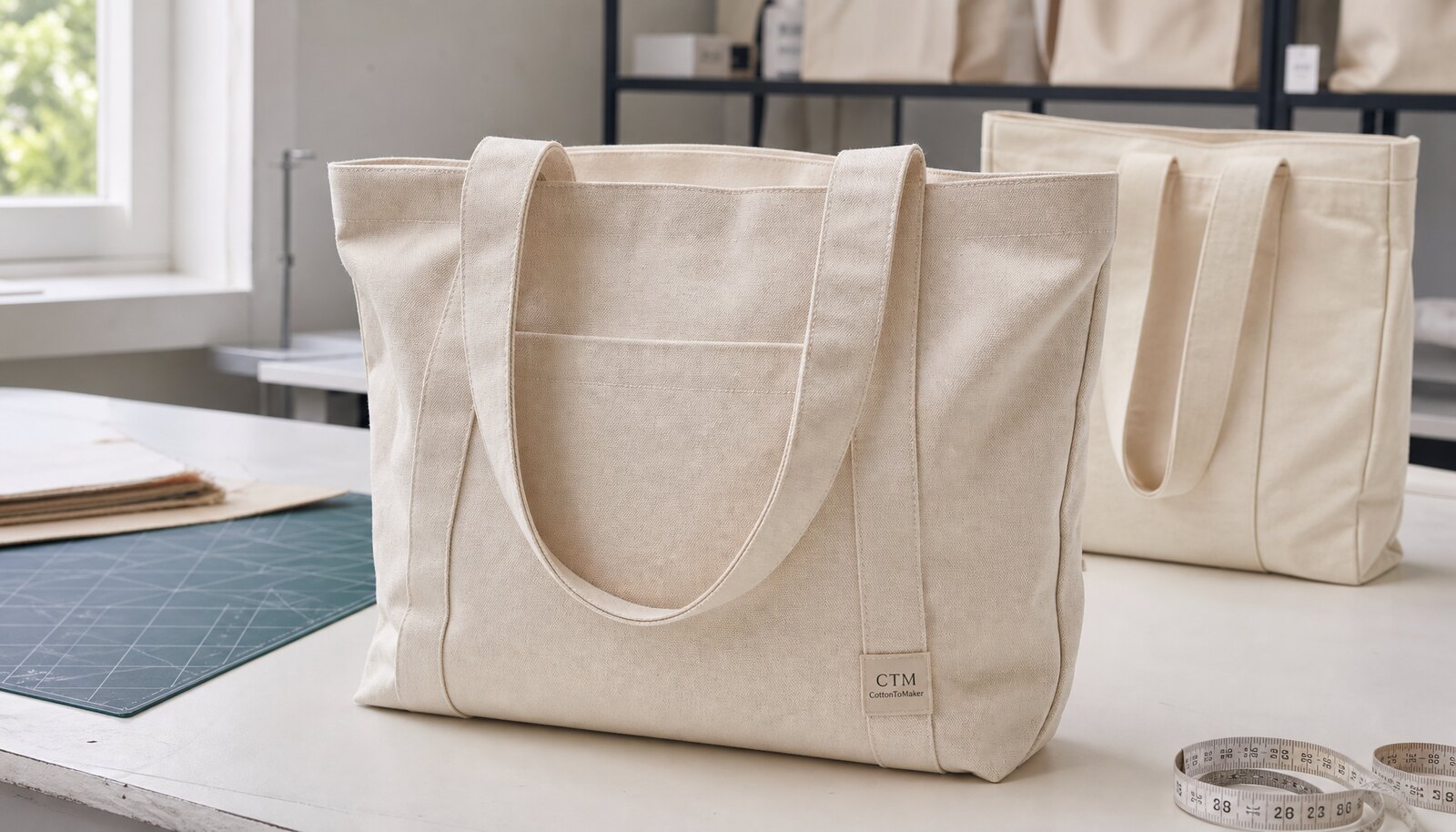
What buyers actually need from a teacher canvas bag
A teacher canvas bag is not just a tote with a school-themed print. In procurement terms, it is a daily carry item that has to hold folders, notebooks, a tablet, pens, classroom tools, and often a water bottle or lunch container without losing shape. The buying decision is therefore not only about artwork. It is about load performance, handle comfort, seam durability, and whether the bag remains presentable after repeated use. If the bag is intended for retail, it also has to feel intentional rather than promotional.
For school retail buyers, gift-program teams, and merchandisers, the bag usually has three jobs at once: it has to look clean enough to sell or gift, it has to survive practical use, and it has to stay inside a target landed cost. That means every loose spec becomes a cost risk later. If you leave size, fabric weight, handle construction, and closure type open, the supplier will fill those gaps with assumptions. The finished bag may still look acceptable in photos but fail under actual teacher use.
The most common use profile is heavier than many buyers expect. A teacher carrying folders, lesson plans, stationery, a laptop sleeve, and a personal bottle loads the bag differently than a casual shopper. That is why a procurement brief should read like a functional spec, not a marketing note. The better your brief, the fewer surprises in sample making, unit pricing, and final production.
- Common use case: books, papers, planner, tablet, and classroom tools
- Common failure modes: sagging bottom, weak handles, distorted print, and awkward carry height
- Common buyer mistake: treating a teacher tote like a giveaway item instead of a work bag
- Best buying frame: match the tote to actual carry weight, not just the visual design
Choose the right fabric weight before you price the bag
For most teacher canvas bag programs, 12 oz to 14 oz cotton canvas is the practical range. Lighter canvas can work for low-risk gift sets or event packs, but once the bag is expected to carry books and a tablet, thin fabric starts to look tired quickly. Heavier canvas gives a more premium hand feel and better shape retention, but it raises fabric cost, increases sewing difficulty, and adds freight weight. If you do not specify the fabric weight, you are not comparing the same product across suppliers.
Use both oz and gsm in the RFQ so you can compare suppliers who quote in different units. A useful shorthand is 12 oz ≈ 407 gsm, 14 oz ≈ 474 gsm, and 16 oz ≈ 542 gsm, though exact values can vary slightly by weave and finishing. Ask whether the cloth is pre-shrunk, enzyme-washed, piece-dyed, or left natural. Those details matter because shrinkage, hand feel, and print response all affect the final appearance and the likelihood of rework.
Also ask about weave density and cloth consistency. A dense, tight canvas supports cleaner print edges and more stable seams. A looser weave can save money but may show more panel distortion and may not hold a crisp logo edge as well. For buyers working with fine text or a multi-line slogan, a better surface can matter more than an extra half-ounce of weight.
- 12 oz: acceptable for light daily use, promotions, or lower-cost school gifting
- 14 oz: strong default for retail, staff packs, and heavier carry
- 16 oz and above: premium hand feel, but higher cost and more rigid handling
- Always request oz and gsm on the same quote to avoid unit confusion
Build the bag around actual carry requirements
The most common spec error is making the bag look large on paper while leaving the usable volume too shallow. For a teacher canvas bag, gusset depth matters because books and folders need room to sit flat. A tote that is too narrow collapses at the top and twists when loaded. A tote that is too deep may be stable, but it can become awkward to carry on one shoulder if the handle drop is wrong.
Specify finished width, height, and gusset in a way the factory can measure consistently. If the bag needs to fit A4 folders, a tablet sleeve, or a specific planner size, say so explicitly. The best RFQ includes the item the tote must carry, not only the tote size. That is a more reliable way to prevent a bag that measures correctly but fails in use.
Handle spec is equally important. Handle length should support the intended carry mode: hand carry, shoulder carry, or both. Handle width affects comfort and stress distribution. A narrow handle may cost less, but it can dig into the shoulder when the bag is loaded. If you want a bag that stands upright on a shelf or in a retail display, ask the supplier to confirm the bottom shape, seam construction, and panel balance under load.
- Width and height should be based on the largest item the bag must carry
- Gusset depth should be enough to keep books upright and protect the print from folding
- Handle drop should match the intended carry mode: hand carry, shoulder carry, or both
- Ask the supplier to confirm measurement method before sampling
Print method drives both appearance and cost
For most teacher canvas bag orders, screen print is the default for bold logos, school marks, slogans, and simple graphics. It is efficient at volume and gives a clean result when the artwork uses solid shapes and limited colors. If the design is more premium or you want a subtle brand cue, embroidery, woven labels, or a sewn-on patch can work better. Each option changes cost, lead time, and minimum order logic, so decoration should be treated as a sourcing decision rather than a late-stage design choice.
If the artwork includes fine text, gradients, thin outlines, or small decorative elements, screen print may need simplification. Ask for the actual number of screens, ink colors, and the placement tolerance. In many custom bag programs, a low quote hides assumptions such as one-color print only, relaxed placement tolerance, or no proofing of the Pantone target. The result may be acceptable from a distance but weakens the brand when the bag is used in store, at an event, or in a retail shelf display.
Embroidery can elevate the perceived quality, but it is not always the best fit for a light canvas tote. Dense stitches can pucker soft fabric, especially if the logo is large or the bag fabric is not firm enough. Woven labels and sewn patches often provide a more controlled premium cue for a teacher canvas bag, especially when the design needs a durable but low-risk branded touch.
- Screen print: best for simple logos and bulk economics
- Embroidery: best for premium positioning, but check for puckering on lighter canvas
- Woven or sewn label: useful when you want durable branding without heavy ink coverage
- Ask for decoration placement tolerance and color count before comparing quotes
Use a supplier comparison that reflects real sourcing routes
Not every supplier route fits the same teacher bag program. A direct factory quote gives you the best control over size, materials, and repeat production, but it demands a more precise tech pack and more disciplined sample approval. A trading company or sourcing agent can reduce communication friction when the order includes several variants, but you pay for that coordination. Stock bag importers are useful when speed matters, yet they usually offer less control over fabric weight, handle length, and exact shade matching, which is a problem if the bag is intended for resale rather than a one-time giveaway.
The right sourcing route depends on whether the bag is going into stores, staff packs, school events, or a recurring replenishment program. If the bag is part of a retail line, repeatability and carton presentation matter. If it is for a conference or teacher appreciation program, the buyer may prioritize speed and simplicity. Build the sourcing strategy around how the bag will be used and replenished, not around the first quote you receive. That prevents apples-to-oranges comparisons between a stock tote and a fully custom product.
Buyer teams should also ask who owns the risk on details. If a supplier quotes a decoration service but not the base bag spec, the final product may be assembled from inconsistent parts. A stronger supplier will tell you what is standard, what is optional, and what changes the lead time or MOQ. That is a more dependable partner than one who only promises a low unit price.
- Direct factory: strongest on spec control and repeat orders
- Trading company: stronger on mixed orders and simpler communication
- Stock importer: fastest for urgent launches, weaker on exact customization
- Ask who owns the fabric, decoration, and packing risks before award
Sample approval should test function, not only appearance
A sample is not approved just because the logo is centered. A teacher canvas bag sample should be loaded, carried, folded, and inspected after handling. Check the bag with books or equivalent weight to see whether the handles pull evenly, whether the bottom gusset sits flat, and whether the side seams keep their line. If the sample arrives folded badly, open it and let the fabric relax before judging shape. Some canvas recovers after unpacking, but weak stitching does not.
Set sample approval criteria in advance so there is no dispute later. Define acceptable color range, print sharpness, stitch uniformity, and any tolerance for panel size. If the bag must hold a laptop sleeve or a specific planner, measure that item, not just the tote dimension. The approval sample should mirror the final production build, not a simplified version with missing reinforcements or a lighter print film. If a supplier says the sample was made “for reference only,” that is a warning sign that the sample and bulk order may not match.
A useful sample review includes visual, dimensional, and functional checks. For visual review, compare the sample to the approved artwork and fabric reference. For dimensional review, measure width, height, gusset, handle length, and print placement. For functional review, load the bag and check whether the opening stays usable, whether the bottom collapses, and whether the handles feel balanced. This three-part review is faster than discovering a failure after cartons are packed.
- Test seam integrity with practical load, not just visual inspection
- Confirm logo placement against a paper or sewn template
- Keep one sealed approved sample as the production reference
- Treat “reference only” samples as a risk, not an approval basis
MOQ logic and quote structure determine your real unit cost
The quoted unit price on a teacher canvas bag only makes sense when you understand how the MOQ is built. Factories often separate fabric MOQ, print MOQ, and color MOQ. A one-color natural canvas bag may quote well at moderate volume, but adding a second ink color, a dyed handle, a lining, or an inside pocket can move the order into a different costing tier. When buyers compare quotes without matching the same assumptions, the lowest number is usually incomplete rather than truly cheaper.
Ask for a quote that breaks out the base bag, decoration, packaging, and extras. That makes it easier to see whether the supplier is hiding setup charges in the unit price or absorbing them only at a certain quantity. It also helps you model the cost difference between a direct factory route and a local decorator or stock supplier. A clear quote should show what changes at 500, 1,000, 3,000, and 5,000 units if those are your likely breakpoints. Those are the quantities where pricing steps, setup amortization, and packaging efficiency really matter.
For procurement teams, MOQ should be viewed in two ways: production MOQ and commercial MOQ. Production MOQ is the smallest quantity the factory can efficiently make with acceptable waste. Commercial MOQ is the smallest quantity that still makes sense after you add setup, freight, and expected defect allowance. A bag can be manufacturable at 200 pieces and still be commercially weak if the decoration and packing costs are too high.
- Separate setup charges from unit price
- Check whether print plates, screens, or embroidery digitizing are one-time costs
- Ask for pricing at realistic volume breakpoints, not only the target MOQ
- Distinguish production MOQ from commercial MOQ before award
Packing and carton rules can protect margin or destroy it
Packing is often treated as a warehouse detail, but it changes damage rate, freight efficiency, and the condition of the bag on arrival. A teacher canvas bag with a printed face should not be crushed into a carton with no protection. If the bag must retail cleanly, use a packing method that keeps the print surface flat and minimizes crease marks. Bulk packing may reduce cost, but it increases the chance that the first store opening looks rough. The best packing choice is the one that matches the bag’s sales channel.
Define whether the bags go in individual polybags, folded with tissue, packed by color, or stacked in mixed cartons. If you need barcodes, hangtags, or retail stickers, specify exactly where they go and who applies them. The factory should also give you carton dimensions and gross weight so you can estimate freight before production starts. That is one of the easiest places to lose money because the product may be right, but the packing makes it expensive to move. If carton dimensions are too large, you pay for wasted cubic volume; if cartons are too heavy, you create warehouse handling risk.
For mixed-color programs, ask whether each color is packed separately or mixed in a master carton. Separate packing simplifies receiving and store allocation, while mixed cartons can be better for small promotions or bundled campaigns. There is no single correct answer. The correct answer is the one that reduces handling cost without increasing distribution errors.
- Use polybags when print quality and presentation matter
- Keep carton weights manageable for warehouse handling
- Label cartons by color, size, and PO number to reduce receiving errors
- Ask for carton dimensions early so freight can be modeled before production
Lead time risks are usually hidden in sample and fabric decisions
A realistic schedule for a custom teacher canvas bag is not just production time. It includes artwork confirmation, sample making, sample feedback, fabric sourcing, print approval, cutting, sewing, finishing, packing, and final inspection. If the fabric is a special dye lot or the print requires multiple colors, the schedule lengthens quickly. Buyers often promise a retail date before the sample is frozen, which compresses every downstream step and increases error risk. That is why lead time should be reviewed as a chain, not as a single factory promise.
Protect the timeline by deciding early which details are fixed and which are flexible. If you can accept a standard natural canvas color, you remove one delay point. If the artwork is simple, you shorten approval cycles. If packaging needs custom printed inserts, barcode stickers, or individual hangtags, build that into the plan before the factory commits to a lead time. A good schedule is specific about what is being approved and when. It should also identify which tasks are sequential and which can run in parallel.
The best buyers ask the factory where delays typically happen. In many custom bag programs, the delay is not sewing; it is waiting for artwork sign-off, color confirmation, or a corrected sample. A supplier that gives you a milestone schedule is usually easier to manage than one that only gives a single delivery date. Ask for date ranges and contingency points, especially if the tote is tied to a school event or seasonal launch.
- Sample delay usually comes from artwork changes, not sewing time
- Special colors and custom trims should be treated as schedule risks
- Final inspection and carton labeling should be booked before the goods are packed
- Ask for a milestone schedule, not only a final delivery date
A QC plan should define measurable acceptance standards
Quality control is where a procurement brief becomes enforceable. For a teacher canvas bag, the inspection plan should specify not only that the bag looks good, but what counts as good. Start with measurements. Confirm finished dimensions against the approved spec and set a tolerance that the factory can actually hold. A typical working tolerance is ±5 mm on smaller measurements and ±8 mm on larger body dimensions unless your brand needs tighter control. If the gusset, handle length, or print position falls outside tolerance, the bag should be treated as nonconforming unless the deviation is pre-approved.
Next, define the stitch and seam standard. A practical acceptance criterion is consistent stitching with no skipped stitches, no loose seam sections longer than 3 mm, and no obvious seam distortion at stress points. If the bag uses bar-tacks or box-X reinforcement, the placement should be even and symmetrical. If the factory is not used to formal bag QC, give them a reference sample and a photo of the intended reinforcement position. That reduces disputes and makes the standard easier to inspect on the line.
Print QC also needs measurable language. Instead of saying “good print quality,” define acceptable registration, sharpness, color match, and rub resistance. For simple one-color logos, inspect edge clarity and coverage. For multi-color prints, define a registration tolerance before production, often around 1–2 mm for basic artwork. A basic dry abrasion check can catch weak adhesion before cartons are sealed. If the print cracks or transfers after moderate rubbing, that is a production issue, not a cosmetic preference.
AQL should be part of the plan, especially for larger orders. Use a clear defect classification: critical defects make the bag unsafe or unusable, major defects affect function or branding, and minor defects are cosmetic but do not affect use. Then agree in advance on the AQL level or final inspection standard. Without that structure, one side may think a loose thread is acceptable while the other side treats it as a reject. The more objective the inspection sheet, the faster the factory can correct issues and the easier it is to protect repeat orders.
- Measure finished size against the approved spec sheet and accept only within the agreed tolerance
- Inspect handle stitching for even reinforcement and no skipped stitches at stress points
- Rub-test the print for early shedding, cracking, or weak adhesion on fold lines
- Classify defects as critical, major, or minor and align the AQL standard before bulk production
- Use a simple load test with 5–8 kg of books or equivalent weight to simulate teacher use
Specification comparison for buyers
| Spec decision | Recommended option | When it fits | Buyer risk to check | Commercial signal |
|---|---|---|---|---|
| Sourcing route | Direct factory for custom specs and repeat replenishment | Best when you need controlled size, handle length, print placement, and stable reorders | Needs a detailed tech pack and more sample iteration | Best control of construction and consistency |
| Sourcing route | Trading company or sourcing agent for mixed programs | Useful when the order includes several sizes, colors, or artwork versions | More communication layers and possible detail drift | Faster coordination across small changes |
| Sourcing route | Stock bag importer with light decoration | Fits urgent promotions or short seasonal windows | Limited control over exact fabric weight and dimensions | Fastest route for simple branding |
| Fabric weight | 12 oz canvas for lighter teacher gifting or promo packs | Good for notebooks, documents, planner, and a few daily essentials | May sag if used for books or tablet plus water bottle | Lower material cost, easier sewing, lighter freight |
| Fabric weight | 14 oz canvas for everyday school carry | Strong default for retail, staff packs, and heavy daily use | If weave is loose, heavier fabric alone does not solve seam weakness | Balanced hand feel and durability |
| Fabric weight | 16 oz canvas for premium or highly loaded use | Fits retail gifting or structured tote positioning | Can feel stiff and increase freight and sewing difficulty | Premium look and better shape retention |
| Fabric conversion | 12 oz ≈ 407 gsm; 14 oz ≈ 474 gsm; 16 oz ≈ 542 gsm | Useful when suppliers quote in different units | Conversion errors can make specs incomparable | Clearer cross-supplier comparison |
| Print method | Screen print for bold, one-to-three color logos | Best for volume, simple artwork, and strong unit economics | Fine text and gradients may be lost | Lowest decoration cost at scale |
| Print method | Embroidery or woven label for premium branding | Useful for retail, faculty gifts, or reusable programs | Risk of puckering on lighter canvas and higher decoration cost | Better tactile brand value |
Buyer checklist before sampling
- Final bag size in millimeters, including finished width, height, gusset depth, and whether measurements are taken flat or expanded
- Canvas weight in oz and gsm, plus whether the cloth is natural, bleached, enzyme-washed, piece-dyed, or pre-shrunk
- Weave density if available, plus whether the fabric is tightly woven enough to hold print edges without excessive ink bleed
- Handle length, handle width, and handle drop, plus top-edge reinforcement and bar-tack or box-X stitch details
- Decoration method, artwork file format, Pantone targets, print placement, and tolerance for logo position drift
- Any add-ons such as inside pocket, zipper top, snap button, lining, woven label, hangtag, or care label
- Packing requirement, including polybag type, fold method, inner pack count, master carton count, and whether retail tags are applied at source
- Target MOQ by color and by artwork version, plus whether mixed-color cartons or mixed-assortment cartons are allowed
- Sample approval standard for color, seam strength, print sharpness, shape retention, and acceptable measurement tolerance
- Acceptance standard for carton labeling, barcode placement, carton count accuracy, and outer carton strength
Factory quote questions to send
- What canvas weight are you quoting in gsm and oz, and is the fabric pre-shrunk before cutting?
- What is the exact finished size, including gusset depth, handle length, and handle drop?
- What print method is included, how many colors are priced, and what are the setup charges per design or per color?
- What is your MOQ by color and by artwork version, and can you mix colors to meet the MOQ?
- What components are included in the unit price: pocket, zipper, snap, label, hangtag, or care tag?
- What packing is included: individual polybag, bulk pack, inner carton, master carton, or palletization?
- What is the production lead time after sample approval, and what changes trigger a new lead time?
- Which QC standard do you follow for seam allowance, stitch count, print placement, color tolerance, and carton count?
- Can you provide a pre-production sample, a photo approval set, and a final inspection report before shipment?
- What are the carton dimensions and gross weight, and how many pieces fit per carton without crushing the bag shape?
Quality-control points to confirm
- Measure finished size against the approved spec sheet and accept only within the agreed tolerance, typically ±5 mm on small dimensions and ±8 mm on larger body dimensions unless your product requires tighter control
- Inspect handle stitching for even bar-tack placement or box-X reinforcement, with no skipped stitches, loose threads, needle damage, or obvious stitch crowding at stress points
- Check stitch density on main seams and handle joins; a practical acceptance target is consistent stitching with no visible gaps and no loose seam sections longer than 3 mm
- Verify seam allowance consistency against the tech pack; a common procurement threshold is ±3 mm on seam allowance unless the factory has a tighter approved standard
- Rub-test the print for early shedding, cracking, ghosting, or weak adhesion on fold lines; reject prints that lose visible ink or show transfer after moderate dry abrasion
- If you use screen print, inspect for registration drift between colors; for multi-color artwork, define acceptable misalignment before production, often no more than 1–2 mm for simple logos
- Check gusset symmetry so the bag stands straight and does not twist when loaded, and reject obvious panel skew or diagonal seam pull
- Verify color consistency against the approved lab dip or sealed sample under daylight or D65-style viewing conditions, not under warm warehouse lighting alone
- Test zipper or snap function, if included, for smooth operation, proper alignment, and no snagging across repeated open-close cycles
- Use a simple load test with books or equivalent weight, such as 5–8 kg for daily teacher carry, to catch handle pullout, seam burst, or shape collapse before shipment