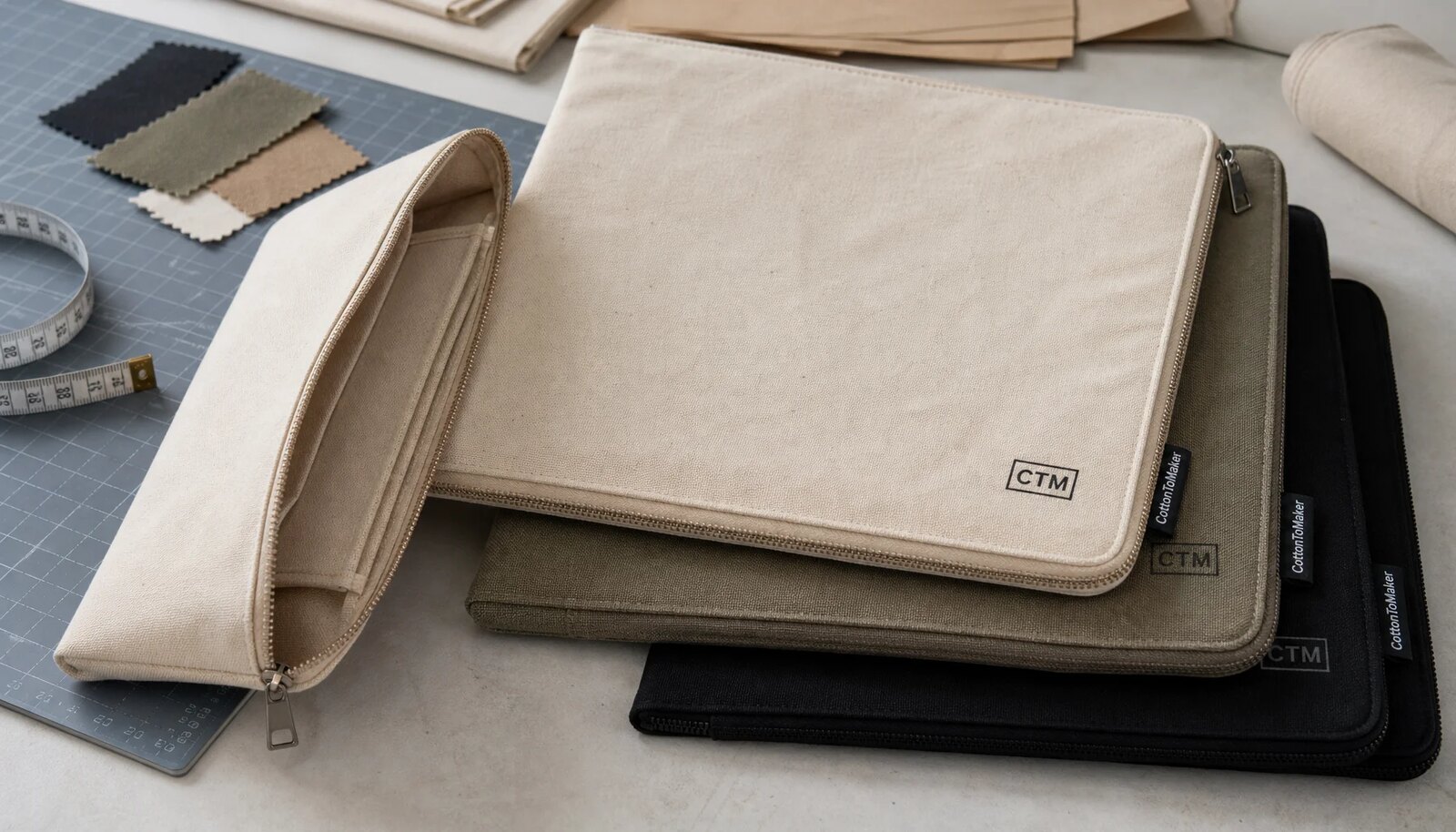
Start With the Craft Fair Use Case
Wholesale canvas zipper portfolios for craft fairs seem like a simple sewn item until they reach the booth. Then every shortcut becomes visible. A zipper that drags slows down order writing. A crooked logo weakens brand presentation. A front panel with oil marks looks unclean beside handmade goods. A tight opening bends line sheets and sample cards. For procurement buyers, the product is not only a pouch; it is a portable sales tool that must look tidy, load quickly, and survive repeated handling.
Supplier compliance should make that use case repeatable. The checklist is not paperwork for its own sake. It is a way to confirm that the supplier can repeat the approved sample, source the correct canvas and trims, control subcontracted printing or dyeing, inspect functional details, pack the goods cleanly, and provide documents tied to the actual purchase order. Good compliance language turns a vague request for canvas portfolios into a controlled sewn-product specification.
Most failures begin with small assumptions. A buyer asks for a 13 x 10 inch portfolio. The supplier quotes a lighter canvas to hit the price. Seam allowance shortens the usable space. The zipper opening becomes too narrow for catalogs. The logo is centered by eye. Cartons are packed too tightly, so corners arrive crushed. None of these problems is unusual, and none requires a complicated fix. They require early decisions, written tolerances, and evidence before bulk production runs too far.
- Treat the item as a functional sewn textile product with hardware, branding, packing, and receiving requirements.
- Link each compliance point to a real buying risk: document fit, zipper failure, print transfer, carton damage, or SKU error.
- Use the craft fair context to define fast loading, clean booth display, repeated opening, and seasonal replenishment needs.
- Approve one reference standard for fabric feel, zipper movement, seam finish, print color, dimensions, label placement, and packing.
- Require order-linked evidence because generic supplier claims do not prove that the bulk batch follows the approved specification.
Define Capacity Before Dimensions
Begin the RFQ with the contents, not the outside size. A portfolio can measure correctly on the outside and still be too tight for A4 sheets, US letter documents, laminated menus, sticker sheets, catalogs, or swatch cards. Usable capacity changes after zipper tape, seam allowance, binding, lining, and corner shaping are added. This is especially important for craft fair teams that load kits quickly while standing at a booth or restocking between events.
Ask the supplier to quote and later measure three separate dimensions: finished outside size, usable inside size, and zipper opening length. For a flat canvas document portfolio, plus or minus 5 mm on width and height is a practical starting point when the fabric and construction are stable. If the design includes a gusset, thick lining, padding, multiple pockets, or heavy canvas, wider tolerances may be realistic. Even then, the tolerance must protect document fit and keep the product visually consistent across cartons.
Do not leave load thickness to the factory's interpretation. A thin stack of order forms may need no gusset. Catalogs, swatch cards, sample cards, tablets, or full sales kits may need extra depth and a more generous zipper path. If the portfolio is expected to hold a tablet, state the model or exact dimensions, whether a sleeve is required, and whether padding is expected. Otherwise, suppliers may quote constructions that look similar in a photo but perform very differently in use.
- List the exact contents: A4, US letter, order forms, catalogs, swatch cards, tablets, sticker sheets, or complete craft fair sales kits.
- Specify finished outside size, usable inside capacity, zipper opening length, loading side, gusset depth, seam allowance, and tolerance.
- Require the sample to be tested with the actual document set instead of only measuring an empty portfolio.
- Confirm whether the zipper opens on the long side or short side because this changes loading speed and stress points.
- Include hangtag, barcode, belly band, display orientation, and retail-ready presentation requirements in the first RFQ.
Specify Canvas in Measurable Terms
Canvas affects handfeel, structure, print appearance, sewing efficiency, carton weight, and cost. Suppliers may describe it by ounces, GSM, yarn count, or loose sales terms such as heavy cotton. Procurement teams should ask for both oz and GSM because ounce descriptions are not always applied consistently. As working references, 10 oz cotton canvas is often near 340 GSM, 12 oz near 400 GSM, and 16 oz near 540 GSM. These numbers can vary with weave, finishing, moisture content, and supplier conversion, so they should guide the conversation rather than replace measured data.
For many wholesale canvas zipper portfolios for craft fairs, 12 oz cotton canvas is a balanced starting point. It has more body than 10 oz and is usually easier to sew, press, and pack than 16 oz. A 10 oz option may work for lightweight paper inserts or budget promotional runs, but it can wrinkle more easily and may show the outline of contents. A 14 oz or 16 oz option can feel more substantial, yet it increases cost, carton weight, needle wear, and the risk of wavy zipper seams if the sewing line is not used to heavier fabric.
Color and finish need the same discipline as weight. Natural canvas may include cotton seed flecks, shade variation, and small texture differences. That can support a handmade or craft-market look, but it must be approved as the standard. Bleached canvas gives a cleaner print background but shows dirt and handling marks quickly. Dyed canvas needs shade control, dye lot separation, and, where relevant to the sales market, an azo-free dye statement or restricted substance statement. If the item will be resold under a brand, ask whether the document can be linked to the fabric lot used for the order.
- Request canvas weight in oz and GSM, fiber content, color status, weave or finish, width, and handfeel target.
- Approve natural canvas only after reviewing seed flecks, shade range, surface texture, and acceptable slub level.
- Ask for a trim card that includes canvas, zipper tape, slider, puller, thread, binding, lining, label, and print material.
- Confirm whether lining, interlining, backing, or binding is needed for function instead of appearance only.
- Verify canvas GSM during inspection by measurement rather than relying on supplier descriptions.
Control Zipper and Sewing Construction
The zipper is the most handled component on the portfolio. For flat canvas document cases, a No. 5 nylon zipper is often a practical choice because it is flexible, light, and easier to sew around corners than many metal zippers. A No. 3 zipper may be acceptable for very light paper portfolios, but it can feel less robust. Metal zippers can look premium, yet they add weight, may scratch adjacent pieces during packing, and can feel stiff on flat constructions. The right choice depends on load weight, brand look, and cost target.
The RFQ should name the zipper type, gauge, tape width, tape color, slider finish, puller material, puller shape, opening length, and end stop method. Do not approve a zipper from a product photo alone. During sample review, open and close the zipper at least 20 times, including with the intended documents inside. During inspection, pay attention to the first and last 30 mm of the zipper path; catching often appears near corners, end stops, or bulky reinforcement.
Construction needs enough detail for every supplier to quote the same product. Specify whether edges are turned and topstitched, bound with cotton or polyester tape, overlocked internally, lined, or finished with facing. State seam allowance if it affects capacity. Define reinforcement at zipper ends and corners. Reinforcement should solve stress without distorting the panel. Too little reinforcement can lead to open seams; too much can create puckering that makes the portfolio look poorly made.
- Define zipper gauge, tape color, slider finish, puller material, puller shape, opening length, and end treatment in the RFQ.
- Require smooth movement across the full zipper path, especially at the first and last 30 mm.
- Specify seam type, seam allowance, stitch density range if needed, thread color, edge finish, and zipper-end reinforcement.
- Reject skipped stitches, open seams, loose end stops, detached pullers, rough sliders, and wavy zipper insertion as functional defects.
- Ask for first-piece photos when using a new zipper color, custom puller, heavier canvas, or revised corner construction.
Set Logo and Print Standards
Branding is usually the first thing a customer notices. Screen printing is often a strong option for one-color or two-color logos on cotton canvas because it is cost-effective and repeatable when ink compatibility and curing are controlled. Heat transfer can work for gradients, photographic artwork, or short multi-color runs, but the buyer should check handfeel, edge lift, bending behavior, and adhesion on the actual canvas. Embroidery can add perceived value, though dense stitching can pucker flat panels unless stitch count, backing, and placement are carefully managed.
The artwork package should include vector files, Pantone or brand color reference, print size, placement from two fixed edges, and allowed placement tolerance. For many flat portfolios, plus or minus 3 mm to 5 mm is a practical logo placement range, depending on panel size and print method. A casual phone photo should not be the approval standard. Canvas can shift during cutting, printing, pressing, and sewing. A print that looks centered on a loose panel may look off-center after the zipper and seams are added.
Print compliance should include simple, practical checks before bulk production. Rub the printed area with a clean dry white cloth to see whether obvious ink transfer occurs. Bend the printed panel gently to check transfer edge lift. Stack the printed sample against light canvas to see whether dark ink marks the opposite surface under pressure. These checks do not replace formal lab testing when a retailer or market requires it, but they catch avoidable failures before hundreds or thousands of panels are printed.
- Use screen printing for solid logos when cost, readability, and repeatability are priorities.
- Use heat transfer only after checking edge lift, handfeel, bending behavior, and color match on the approved canvas.
- Use embroidery carefully because dense stitching can pucker flat panels and reduce document presentation quality.
- Define logo size, color reference, placement from fixed edges, print tolerance, and approval sample standard in writing.
- Request order-linked ink, dye, or restricted substance statements when required by retail or brand compliance programs.
Break Down MOQ and Quote Assumptions
A headline MOQ rarely tells the whole story. Canvas zipper portfolios can carry separate minimums for greige fabric, dyed canvas, zipper tape color, slider finish, puller style, woven labels, screen setup, heat transfer setup, belly bands, barcode stickers, and carton labels. A supplier may offer a low MOQ for stock natural canvas with a stock black zipper and one-color screen print, then quote a much higher minimum for custom dyed canvas, custom zipper tape, branded pullers, or multiple logo versions.
Ask suppliers to separate MOQ by component and by SKU. A total order of 1,000 pieces may sound simple until it is divided across five logo designs, four canvas colors, two zipper colors, and different destination labels. Each split adds setup time, segregation risk, packing complexity, and inspection work. For craft fair distributors, assortment variety may be commercially important. It just needs to be priced and planned deliberately.
The quotation should also separate one-time costs from recurring unit price. Screen charges, sample fees, label tooling, custom puller tooling, barcode setup, special carton development, and pre-production sample costs may not apply to repeat orders. If these charges are buried inside the unit price, reorder economics become unclear. A clean quote allows procurement teams to compare first-order cost, reorder cost, landed cost, and supplier service scope.
- Ask for separate MOQs for canvas, dyeing, zipper tape, puller, print, label, retail packing, barcode materials, and carton labels.
- Compare stock-material pricing and custom-material pricing as different sourcing options.
- Request price tiers by total order quantity and by SKU split so mixed assortments are costed realistically.
- Separate unit price from sample charges, setup fees, tooling, packing costs, inland freight, inspection support, and export handling.
- Require written approval for substitutions in fabric, zipper, thread, label, print method, packing material, or carton count.
Use Samples to Lock the Standard
Sampling is where most bulk problems can still be prevented cheaply. A photo sample is not enough for this product because many key issues must be felt or tested: canvas stiffness, zipper smoothness, seam bulk, print texture, odor, corner shape, and actual document fit. The buyer should physically load the sample, open and close the zipper, inspect the logo, check the seam finish, review the puller, and look at the proposed packing presentation.
Different samples serve different purposes. A prototype may confirm size or construction using substitute materials. That can be useful, but it should not become the bulk standard. The pre-production sample should use the bulk-intended canvas, zipper, thread, logo method, label, inner pack, and carton orientation. If anything is temporary, write the exception into the approval record so the factory, buyer, and inspector know what is final and what still needs confirmation.
Sample approval should control the production gate. Bulk cutting and bulk printing should not start until the pre-production sample is approved. Once panels are cut or printed, correcting size, logo placement, zipper opening, or seam construction becomes expensive and slow. Keep one signed or sealed reference sample with the buyer and one at the factory. For repeat orders, record the sample date, version, or code so the supplier does not accidentally follow an older construction.
- Separate prototype approval from pre-production sample approval; only the final-material sample should release bulk production.
- Measure outside size, usable inside capacity, zipper opening, logo placement, and gusset depth if present.
- Test document fit, zipper movement, canvas handfeel, print quality, seam finish, odor, corner shape, and packed appearance.
- Keep sealed reference samples at buyer and factory locations for production training and dispute prevention.
- Require written approval before changing fabric lot, zipper source, thread color, print method, label, or packing after sample sign-off.
Define Bulk QC and Defect Rules
Bulk QC should cover measurement, function, appearance, labeling, packing, and document checks. AQL sampling can help on larger shipments, but it still needs product-specific defect definitions. A small cotton fleck on natural canvas may be acceptable if the buyer approved that texture. An oil mark near the logo, mildew odor, wrong barcode, detached puller, or zipper that catches at the corner should not pass because it affects sellable quality or user function.
Inspection standards should be measurable before production starts. Include finished-size tolerance, usable capacity test, zipper operation, stitch quality, logo placement, print defects, surface cleanliness, odor, label accuracy, carton marks, and packing condition. For retail-facing programs, the front panel, logo zone, zipper puller, and hangtag area deserve stricter appearance review. For distributor stock, SKU separation and carton labeling are just as important because mixed cartons create warehouse errors.
Needle control is a basic compliance item for sewn textile products. Small promotional orders may not need heavy documentation, but the supplier should still have a process for broken needle reporting, replacement, and line checks. For retail or brand programs, request a needle control record linked to the order. Inline QC also matters. First-piece review after cutting, printing, and initial sewing can catch wrong fabric, wrong zipper tape, mispositioned logos, or seam issues before the full order is affected.
- Measure pieces from multiple cartons and production bundles, not only samples selected from the top of a stack.
- Classify open seams, broken zippers, detached pullers, wrong logo, severe stains, mildew odor, and incorrect SKU labels as major or critical defects.
- Check print placement against fixed measurement points rather than judging by eye from a photo.
- Verify carton labels against PO number, SKU, canvas color, logo version, quantity, destination, and barcode requirements.
- Ask for inline photos or first-piece approval when the order uses new fabric, new zipper color, new print method, or multiple SKUs.
Plan Packing and Receiving Compliance
Packing is part of supplier compliance because canvas can pick up dirt, moisture, abrasion, pressure marks, and creases. Craft fair buyers often need portfolios ready for kit assembly, resale, or event distribution soon after delivery. Individual polybags provide strong dust and abrasion protection. Paper belly bands can improve presentation and reduce plastic use, but they provide less moisture protection. The right method depends on the distribution route, sustainability policy, storage time, and whether the product is sold individually.
Flat packing is usually best for document portfolios because folding across the zipper line can create permanent creases or stress the slider. If freight savings require folding, approve the fold method on a packed sample and include it in the inspection standard. Dark prints touching light canvas may transfer under pressure, so tissue, print-facing rules, or individual sleeves may be needed. Zipper pullers should be positioned so they do not scratch adjacent front panels.
Carton planning should balance protection, freight efficiency, and warehouse handling. Ask for units per inner pack, units per master carton, carton dimensions, estimated gross weight, carton board strength if relevant, stacking direction, and carton mark layout. Many buyers prefer cartons that stay below a practical manual handling limit rather than maximizing count and risking crushed corners or unsafe lifting. If retail DC receiving is involved, label location and barcode scanability should be confirmed before packing begins.
- Pack portfolios flat unless the buyer approves a folded sample and crease tolerance.
- Use sleeves, tissue, or print-facing rules when abrasion, pressure marks, or ink transfer are concerns.
- Confirm units per carton, carton dimensions, gross weight, inner pack count, stacking direction, and carton mark layout before price approval.
- Avoid carton pressure that bends corners, crushes zipper pullers, or creates permanent front-panel marks.
- Include barcode labels, inner pack labels, SKU separation, carton numbering, and destination marks in the quote when required.
Confirm Lead Time, Documents, and Terms
A useful supplier quote should show more than a unit price. It should identify material assumptions, MOQ, sample cost, sample lead time, bulk lead time, packing method, carton data, inspection support, payment term, Incoterm, quote validity, and one-time charges. Lead time for wholesale canvas zipper portfolios depends on canvas availability, dyeing, zipper color, print approval, label production, SKU complexity, and packing requirements. Stock natural canvas with a stock zipper is usually faster than custom dyed canvas with custom zipper tape and retail packaging.
Break the production calendar into real stages: artwork review, swatch approval, prototype if needed, pre-production sample, sample shipment, buyer comments, material booking, cutting, printing, sewing, inline QC, final inspection, packing, and export handover. This prevents the common mistake of counting only sewing days. Craft fair selling seasons often have fixed event dates, so sample approval delays can be as damaging as factory production delays.
Compliance documents should be relevant and linked to the order. Useful documents may include material declaration, azo-free dye confirmation for dyed fabric, restricted substance statement, production lot record, needle control record, final inspection report, carton packing list, and carton label proof. Avoid relying on vague claims such as compliant materials available. Ask which documents will be provided, what they will reference, and when they will be issued. Quote terms should also define change control because artwork, color, SKU split, packing, or destination changes can affect price, MOQ, and schedule.
- Request lead time by stage, not only a single production-day estimate.
- Separate unit price, setup charges, sample charges, packing costs, inland freight, inspection support, and export handling.
- State Incoterms clearly, such as EXW, FOB, CIF, or DDP, because supplier comparisons change when freight and duty are included.
- Ask which compliance documents will reference the actual material lot, production batch, purchase order, or shipment.
- Freeze specifications after pre-production sample approval; late changes should trigger written updates to price, MOQ, and lead time.
Specification comparison for buyers
| Supplier option | What to verify | Commercial advantage | Buyer risk to control |
|---|---|---|---|
| Direct sewing factory | zipper source record, production-line zipper test photos, approved trim card, cutting marker photos, and final open-carton count | Better sample-to-bulk control and faster production feedback | May be weaker on export paperwork or branded packing unless checked early |
| Trading company | Factory name, production photos, trim-source proof, and who owns QC decisions | Can coordinate small mixed orders and extra services | Markup can hide real factory capability and slow defect decisions |
| Specialized bag workshop | zipper gauge, zipper tape width, puller finish, binding tape, corner reinforcement, seam allowance, and document-size tolerance | More practical for detailed construction, trims, and repeat programs | Capacity may be limited during peak seasons |
| Low-price general supplier | 300D-600D polyester, 10-12 oz canvas, or recycled PET with backing stiffness matched to document weight | Useful for simple promotional runs with loose specs | Material downgrades, weak packing, and vague inspection scope can erase savings |
| Retail-ready supplier | flat packing, insert board if needed, SKU bundles, carton weight limit, moisture protection, and barcode visibility | Can handle labels, SKU separation, carton marks, and receiving rules | Higher unit cost must be compared against reduced warehouse work |
| Compliance-focused supplier | Fabric records, labeling review, test plan, and production traceability | Safer for retail programs and repeat brand orders | Documentation claims need evidence, not only sales language |
| Local sample room plus bulk factory | Signed sample, bulk factory handoff, first-piece photos, and deviation owner | Good for complex branding before large production | Sample room quality may not match bulk line unless handoff is controlled |
Buyer checklist before sampling
- Define the portfolio by what it must carry: A4 sheets, US letter sheets, catalogs, laminated menus, sticker sheets, swatch cards, order pads, tablets, buyer packets, or a full craft fair sales kit.
- State finished outside dimensions, usable inside dimensions, zipper opening length, loading direction, gusset depth if any, seam allowance, and the measurement tolerance after sewing, pressing, and packing.
- Specify canvas weight in both oz and GSM, fiber content, color status, weave or finish, expected handfeel, shrinkage limit if relevant, and whether lining, interlining, backing, or binding is required.
- Use practical canvas references in the RFQ: 10 oz is often near 340 GSM, 12 oz near 400 GSM, and 16 oz near 540 GSM, but require the supplier to confirm actual measured material data.
- Define zipper type, gauge, tape width, tape color, slider finish, puller material, puller shape, end stop method, opening length, and the minimum sample cycle test, such as 20 manual open-close cycles.
- Provide vector logo artwork with Pantone or brand color reference, print method preference, print size, placement from two fixed edges, and acceptable placement deviation, such as plus or minus 3 mm to 5 mm.
- Separate quantity by canvas color, logo version, zipper color, packing method, barcode requirement, SKU, and destination so the supplier can quote real MOQ, setup cost, and packing labor.
- Request a trim card showing canvas, zipper tape, slider, puller, thread, binding, lining, label, print ink or transfer, belly band, polybag, tissue, and carton board before approving the production sample.
- Require a pre-production sample using bulk-intended canvas, zipper, thread, logo method, label, packing method, and carton orientation before bulk cutting or bulk printing starts.
- Confirm inspection standards for document fit, finished dimensions, canvas GSM, zipper smoothness, seam strength, print adhesion, logo placement, odor, stains, corner shape, SKU labels, and packed presentation.
Factory quote questions to send
- Are you the factory sewing the canvas zipper portfolios? If not, which factory will sew them, and which processes will be subcontracted: dyeing, printing, embroidery, label production, zipper assembly, puller plating, barcode labeling, or packing?
- What exact canvas options can you quote in oz and GSM, and can you confirm measured GSM, fiber content, color status, width, shrinkage expectation, finish, and available stock quantity?
- Can you send a physical swatch or trim card with the actual canvas, zipper tape, slider, puller, thread, binding, lining, label, print sample, and proposed packaging material?
- What is the MOQ for stock natural canvas, dyed canvas, stock zipper color, custom zipper tape, branded puller, woven label, each logo version, belly band, barcode sticker, and retail inner pack?
- Which logo method do you recommend for this canvas: screen print, heat transfer, embroidery, woven patch, or label? What checks do you use for curing, rub resistance, edge lift, puckering, and color match?
- Can the pre-production sample use the same fabric lot or bulk-approved fabric, zipper, thread, print ink or transfer, label, packing material, inner pack count, and carton method planned for production?
- What finished-size tolerance can you hold for width, height, gusset, zipper opening, and logo placement, and will the tolerance be measured flat before or after final pressing and packing?
- How many zipper open-close cycles do you test during sample approval and bulk QC, and what is your rejection rule for rough sliders, skipped teeth, misaligned stops, detached pullers, or loose end stops?
- What seam construction do you propose at the zipper ends, corners, and panel edges, including seam allowance, binding width if used, stitch density range, thread type, and reinforcement method?
- Will you provide first-piece photos after cutting, printing, zipper insertion, and initial sewing before the line continues into full bulk production?
Quality-control points to confirm
- Verify fabric weight by cutting a measured fabric sample and calculating GSM; do not rely only on sales terms such as 10 oz, 12 oz, heavy canvas, premium cotton, or thick fabric.
- For flat document portfolios, finished width and height are commonly controlled within plus or minus 5 mm; tighter logo placement may need plus or minus 3 mm to 5 mm depending on print process and panel handling.
- Test usable inside capacity with the actual document set because zipper tape, seam allowance, binding, lining, and corner shape reduce usable space compared with outside dimensions.
- Measure zipper opening length separately from overall width or height; the opening should allow the intended documents to load without bending corners or forcing the slider.
- Zipper must open and close smoothly across the full length without catching at the first or last 30 mm, loose teeth, misaligned stops, missing stitching, scratched slider coating, or detached puller.
- Seams should have consistent stitch density, no skipped stitches, no open seam at zipper ends, no exposed raw edges beyond the approved construction, and loose thread ends trimmed to the agreed limit.
- Print should meet approved position tolerance and show no pinholes, smearing, severe ink build-up, transfer edge lift, obvious color mismatch, or visible ink transfer after a simple dry white-cloth rub check.
- Canvas surfaces should be free from oil stains, needle marks, mildew odor, strong chemical odor, water marks, dirty handling marks, and fold damage that affects retail or booth presentation.
- Portfolio corners should remain square enough for easy document loading; twisted corners, wavy zipper edges, and distorted panels indicate cutting, feeding, or zipper insertion problems.
- Labels, hangtags, belly bands, barcode stickers, carton marks, and packing lists should match the purchase order, SKU, logo version, color, destination, and buyer receiving instructions.