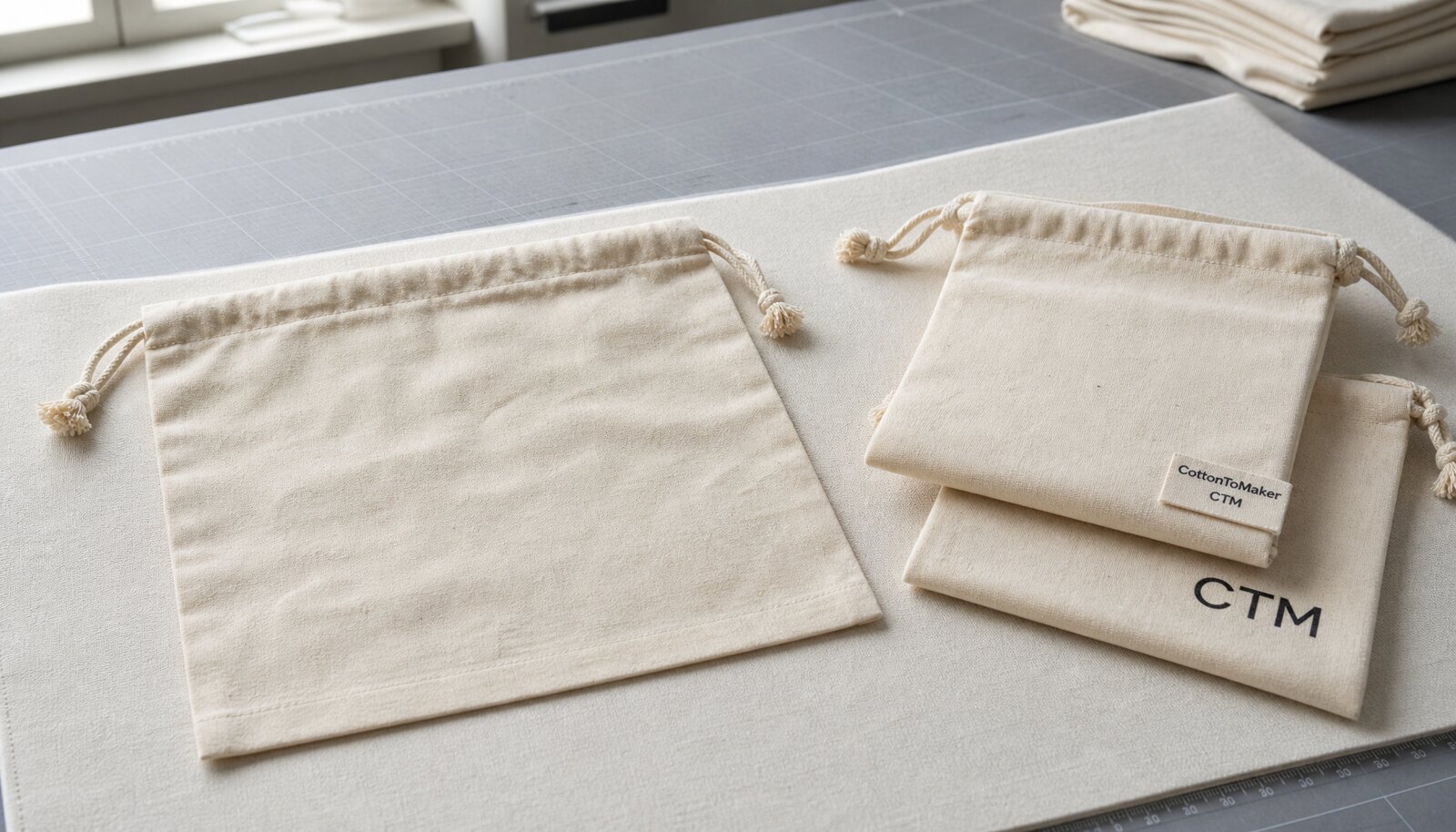
Why compliance matters even for a simple cotton pouch
Wholesale cotton drawstring pouches for gift shops look simple, but they sit at the intersection of merchandising, packaging, and import compliance. A pouch that is meant to hold jewelry, soap, candles, teas, or small seasonal gifts has to look clean on shelf, close properly, survive packing and transit, and arrive with the exact branding the store bought. If the pouch is only treated as a low-value accessory, the supplier may quietly change the fabric, use a different cord, or ship from a different line than the one that made the sample.
For procurement teams, compliance is not paperwork for its own sake. It is the operating system that keeps the order consistent from RFQ to carton receipt. The buyer needs proof that the fabric, trim, print, and packing all match the agreed spec, and that the supplier can document the chain of responsibility if something changes. In other words, the real question is not 'Can you make a pouch?' It is 'Can you prove that bulk production will match the approved sample, the target market rules, and the landed-cost assumptions in the quote?'
- Treat the pouch as retail packaging, not as a disposable textile item.
- Define compliance as product proof plus process proof, not just a signed declaration.
- Lock the approved sample, then require written approval for any material or artwork change.
Build the spec around use case, not a generic cotton label
The most common quoting mistake is to ask for 'cotton drawstring pouches' without saying what they will carry. A pouch for a single ring, a handmade soap bar, a candle jar, or a gift set behaves differently in packing, shelf appearance, and customer handling. The supplier can only price the right fabric and construction if the buyer gives a use case. For that reason, the RFQ should state the product purpose, the expected contents, the retail channel, and whether the pouch is a giveaway, a resale item, or part of a premium gift set.
Fabric weight is one part of that spec, but it should never be presented as a free-floating default. A natural cotton pouch might be quoted at 120 GSM, 140 GSM, or 160 GSM depending on opacity, hand feel, and budget. Those ranges are useful only if they are tied to a sample or a known mill sheet. Ask the supplier to confirm the actual measured GSM on the sample and to state whether the quoted fabric is stock cloth, dyed-to-order fabric, or a custom weave. That distinction affects cost, shrinkage risk, and lead time.
Size also needs more precision than a nominal width and height. A pouch that is 100 x 130 mm nominal may still be cut and sewn with tolerances that matter to the store team trying to insert a product quickly. Ask for finished size, tolerance, and whether the pouch is measured flat or after filling. Closure behavior is equally important: the drawstring should close fully without distorting the top seam, the channel should not twist, and the cord should not cut into the fabric after repeated use.
- State the item to be packed, not only the pouch dimensions.
- Request measured GSM and fabric source type: stock, dyed, or custom.
- Require both nominal size and allowed size tolerance in millimeters.
- Confirm that the pouch closes fully with no visible gap at the opening.
Decoration method changes price, MOQ, and approval risk
For gift shop programs, decoration is usually where the commercial decision is made. A one-color screen print is often the most predictable option for wholesale cotton drawstring pouches because it keeps the setup manageable and works well with simple logos, holiday messages, and minimal branding. But the buyer should still ask what exactly is included in the print quote: one screen, multiple screens, color matching, setup redo, and sample reprints can all change the real cost. If the logo includes thin strokes or small text, the buyer should ask for a print proof at actual size, not just a digital mockup.
Woven labels and sewn side labels are often better when the pouch is intended to feel more premium or be reused multiple times. They can reduce concerns about print wear, but they introduce other risks: label spelling, label placement, stitch security, and the visual effect of label thickness on a small pouch. If the pouch is used for gifting or retail resale, buyers should compare the decoration method against the expected customer handling. A low-cost print that rubs off quickly can cost more than a cleaner label solution once complaints and replacements are included.
The quote should separate unit decoration cost from setup cost. If the supplier offers a very low unit price but adds screen charges, plate charges, minimum color charges, or artwork revision fees, the final cost may be higher than a cleaner all-in quote. Ask the supplier to show the decoration method, the number of colors, whether Pantone matching is included, and whether the sample uses the same process as the bulk order. A photo proof is not enough if the bulk method is different.
- Request a line-item quote for unit decoration plus setup charges.
- For print, confirm color count, registration tolerance, and artwork scale.
- For labels, confirm stitch type, placement, and whether label material is stock or custom.
- Do not approve a digital proof as the final production standard.
Compare supplier routes by commercial scenario, not supplier type alone
The comparison table below is more useful when you read it as a buying scenario guide. A direct sewing factory is usually best when you have repeat business, stable artwork, and a need to control the fabric source. A trading company may be helpful if you are consolidating several small programs or need one contact to manage multiple factories, but the buyer must still demand the original production evidence. A specialized bag workshop can be strong on construction details, while a retail-ready supplier may be better at labeling and carton discipline. The right route depends on whether your main pain point is unit price, sample speed, export paperwork, or warehouse receiving.
The supplier route can also affect your approval workflow. If the sample comes from one place and the bulk order comes from another, the buyer should ask for a formal handoff record. That record should show who owns the approved sample, who signed the production spec, and what must happen if the bulk line cannot exactly match the sample. This matters because the most expensive problems in pouch sourcing are often not visible in the quote. They show up later as rework, relabeling, mixed cartons, or an unacceptable shelf look.
- Choose supplier route based on repeatability, paperwork, and packing needs.
- If sample and bulk sources differ, require a written handoff and deviation owner.
- Compare landed cost, not only unit cost, when a supplier offers better packing or labeling.
Supplier comparison table: actual buying scenarios and trade-offs
Use the table below to compare the practical consequences of each buying route. The goal is not to pick the cheapest supplier type. The goal is to match the route to the order profile so you do not pay twice: once for the product and again for mistakes, delays, or repacking.
If you want a useful commercial readout, ask the supplier to quote the same pouch under the same assumptions: same size, same fabric weight, same print method, same packing, and same compliance deliverables. Otherwise the comparison becomes a race between different products, not different suppliers.
- Write decisions in measurable language, not only descriptive wording.
- Ask for sample photos plus one physical approval sample for important orders.
- Keep quotation, sample approval, and inspection notes tied to the same spec version.
Compliance evidence: what to ask for, and what the documents should actually prove
A serious supplier should be able to explain exactly which documents are available for the quoted pouch and what each document covers. For simple decorative-use pouches, the compliance file may be limited to a material declaration, an invoice trace, and a basic product spec. For retail chain programs, imported branded goods, or any order with market-specific requirements, the file often needs more: test reports, batch traceability, and sometimes factory audit evidence. The key point is that documents must be linked to the actual article, not to a generic 'cotton bag' category.
For cotton drawstring pouches, buyers often ask for evidence around fiber composition, azo dye or restricted substance concerns where applicable, and general safety or textile conformity requirements depending on destination. The exact standard depends on the market and end use. For example, a decorative gift pouch sold as packaging may face different expectations than a pouch used with cosmetics, children’s merchandise, or food-adjacent retail bundles. A good supplier will tell you what they can support and where they need the buyer to define the target-market standard.
Useful documentary examples include a mill or fabric invoice trail, a material composition declaration, a test report with sample photo or article reference, and a packing list that shows the ordered styles and colors. If a supplier says they are 'compliant' but cannot identify the lab, the test date, the product reference, or the exact fabric and trim in the test sample, the claim is too weak to rely on. Ask for evidence depth, not compliance language.
- Ask which documents are product-specific and which are generic template files.
- Confirm the lab name, report date, sample reference, and exact article description on every test report.
- Request traceability from fabric lot to finished carton when the order is for a repeat program.
- Do not accept a compliance statement that cannot be matched to the quoted SKU and materials.
A procurement-grade checklist for samples and pre-production approval
The sample stage should do more than confirm that the logo is centered. For wholesale cotton drawstring pouches, the approved sample should become the controlling reference for bulk production. That means the buyer should review fabric hand feel, opacity, seam straightness, cord movement, print sharpness, label placement, and how the pouch folds inside the carton. A sample that looks fine on a desk can still fail when stacked in a gift shop display or when warehouse staff try to pack it quickly.
A practical approval pack usually includes a physical sample, a marked-up spec sheet, artwork approval, and a written note on any allowed variation. For example, if the supplier says the cord ends will be heat-finished or knotted in a specific way, that must be shown on the sample. If the print is one-color screen print, the buyer should retain the exact artwork version and screen count. If the buyer wants the pouch for seasonal retail, the approval should also include the expected color batch behavior, especially for natural cotton where shade variation can be visible.
- Keep one signed gold sample at the buyer side and one at the factory.
- Approve final fabric, final cord, final label, final artwork, and final pack method together.
- Note any acceptable variation in writing; do not leave it to memory or email threads.
- If the sample is hand-made and bulk will be machine-sewn, ask for a bulk-line pre-production check.
QC thresholds that make sense for retail gift presentation
A pouch can pass a simple visual review and still be unacceptable for a gift shop shelf. Buyers should set defect rules that reflect what customers will actually notice. The common retail problems are crooked print, uneven top edges, visible stains, twisted drawcords, missing bartacks, and loose threads that make the product look unfinished. Even if the pouch functions, those defects can damage the perceived value of the gift inside it.
This is where AQL and defect severity language help procurement. You do not need to turn every pouch order into a laboratory exercise, but you do need an inspection logic. For many programs, buyers use an AQL-based final inspection with major, minor, and critical defect categories. Critical defects are those that make the pouch unusable or unsafe for the order intent; major defects affect function or shelf appearance; minor defects are cosmetic issues that do not materially affect use. The buyer and supplier should agree on the definitions before production starts, not after the first problem is found.
QC should also include simple mechanical checks. Pull the cord repeatedly to see whether the channel deforms. Tug the seams gently to see whether the stitching opens. Check whether the print smears under light rubbing if the artwork is a key branding element. Measure a few units from each carton to confirm the fabric has not been substituted and that the finished size stays within tolerance. Small, cheap products often fail because nobody defines what 'good' means in a measurable way.
- Set AQL or equivalent inspection rules before the PO is issued.
- Define major, minor, and critical defects with actual examples.
- Check size, print, seam integrity, cord action, and carton count on sampled units.
- Record photo evidence for any defect so the factory can correct root cause, not just replace units.
Packing, carton math, palletization, and landed-cost traps
Packing is one of the easiest places to lose margin because the unit price looks fine while the shipping cost quietly rises. Cotton drawstring pouches are light, but they can still be volume-heavy if the supplier folds them inefficiently or overpacks inner bags. Ask for inner pack quantity, master carton count, carton dimensions, gross weight, and net weight. Those details are essential for freight planning, especially if the pouches are moving by air or being consolidated with other gift items.
A small change in carton size can materially change the landed cost. For example, if a supplier quotes a low unit price but uses a larger carton or poor folding method, the dimensional weight may rise enough to offset the savings. Buyers should ask the factory to show carton math, not just a carton photo. If the order is split across colors or artwork versions, request separate carton counts by style so the warehouse does not have to open cartons to sort mixed goods. For chain stores or distribution centers, clean carton marks and readable SKU labels reduce receiving errors and repacking time.
Palletization matters if the goods are going into a warehouse or a retailer’s distribution center. Ask whether cartons are stackable, whether a moisture barrier is used when needed, and whether the supplier can provide pallet height and pallet count assumptions. Even on a small pouch order, these details affect damage risk and receiving speed. The cheapest quote is not always the lowest-cost supply chain if it creates handling work on arrival.
- Request carton dimensions and calculate dimensional weight before confirming the PO.
- Use clear carton marks by style, color, and PO to avoid receiving mistakes.
- Ask whether inner packs are counted by hand, by weight, or by automated pack stations.
- If the channel is retail distribution, confirm whether pallet height or stack limits apply.
Lead time and MOQ: where the schedule really slips
MOQ and lead time are connected to material availability, decoration complexity, and factory queue position. A supplier may quote a low MOQ by using stock fabric and a simple one-color print, but if the buyer later asks for a different shade, a custom label, or a revised logo size, the production plan can move backward fast. That is why the RFQ should separate the minimum order for the base pouch from the minimum order for each artwork or color version.
Lead time should be broken into stages. Sample lead time covers fabric sourcing, cutting, sewing, and decoration. Bulk lead time covers line scheduling, material booking, printing, sewing, inspection, and packing. Transit is a separate assumption and should be written that way. If the supplier gives only one total number, the buyer cannot tell whether the risk is in sampling, production, or shipping. Also ask whether the quoted lead time assumes approval within a certain number of days. A delayed sample comment can become the buyer’s problem if it pushes the order into the factory’s peak season.
For commercial planning, it helps to ask what happens if the supplier misses the approved schedule. Not every delay is avoidable, but the buyer should know whether the supplier has backup lines, alternate fabric stock, or the ability to split shipments. If the pouch is tied to a gift shop promotion, the true cost of delay may be higher than a small price increase from a more reliable supplier.
- Split lead time into sample, bulk production, inspection, and transit.
- Ask whether MOQ is by color, artwork, size, or fabric lot.
- Confirm the supplier’s ability to split shipments or use stock material if the schedule is tight.
- Do not accept a single total lead-time number without milestone detail.
Specification comparison for buyers
| Supplier option | What to verify | Commercial advantage | Buyer risk to control |
|---|---|---|---|
| Direct sewing factory | cord material proof, reinforcement close-ups, load-test photos, approved sample tag, and bulk-line first-piece record | Better sample-to-bulk control and faster production feedback | May be weaker on export paperwork or branded packing unless checked early |
| Trading company | Factory name, production photos, trim-source proof, and who owns QC decisions | Can coordinate small mixed orders and extra services | Markup can hide real factory capability and slow defect decisions |
| Specialized bag workshop | cord diameter, eyelet or reinforced channel, bottom corner reinforcement, seam allowance, bar-tack position, and load target | More practical for detailed construction, trims, and repeat programs | Capacity may be limited during peak seasons |
| Low-price general supplier | 6-10 oz cotton canvas, 210D polyester, rPET, or blended cotton with shrinkage and colorfastness expectations set before sampling | Useful for simple promotional runs with loose specs | Material downgrades, weak packing, and vague inspection scope can erase savings |
| Retail-ready supplier | fold direction, cord protection, bundle count, carton compression, moisture bag, and retail label position | Can handle labels, SKU separation, carton marks, and receiving rules | Higher unit cost must be compared against reduced warehouse work |
| Compliance-focused supplier | Fabric records, labeling review, test plan, and production traceability | Safer for retail programs and repeat brand orders | Documentation claims need evidence, not only sales language |
| Local sample room plus bulk factory | Signed sample, bulk factory handoff, first-piece photos, and deviation owner | Good for complex branding before large production | Sample room quality may not match bulk line unless handoff is controlled |
Buyer checklist before sampling
- The quote names the exact fabric type, composition, and measured GSM, not just 'cotton'.
- The pouch size is written in millimeters, including finished width, height, and any tolerance band.
- The cord material, cord diameter, channel construction, and closure method are specified in writing.
- Artwork files, print size, print position, and color references are confirmed in the RFQ and final artwork approval.
- The supplier states whether MOQ is per color, per artwork, per size, or per fabric lot.
- The offer includes sample lead time, bulk production lead time, and transit assumptions as separate items.
- The supplier provides packing details: inner pack quantity, master carton count, carton dimensions, gross weight, and net weight.
- The buyer receives a pre-production sample or gold sample made with final fabric, final trim, and final decoration method.
- The compliance file is tied to the quoted style, fabric, and trims, not to a generic product family.
- The supplier identifies who owns final QC decisions and who approves any deviation before shipment.
Factory quote questions to send
- What is the exact fabric composition and measured GSM of the cloth you will use for this pouch size, and will you confirm it on the approved sample?
- Is the MOQ tied to one artwork, one color, one size, one fabric lot, or a combination of those?
- Which decoration method are you quoting, and what setup costs are included: screen charge, plate charge, embroidery setup, or label tooling?
- Can you share the actual carton pack plan, including inner pack quantity, master carton count, carton dimensions, and expected gross weight?
- What compliance documents can you provide for my destination market, and can you show how those documents link to this exact pouch construction?
- What seam construction do you use at the drawstring channel, and do you reinforce stress points with bartacks or extra stitching?
- Can you make a pre-production sample with final fabric, final cord, final print, and final label position before bulk approval?
- What are the production milestones after sample approval, and which parts of the timeline depend on outside vendors such as fabric dyeing, printing, or transport?
- What inspection standard do you use at the factory—AQL, 100% check for visible defects, or another method—and who signs the final release?
- If I request a change after sample signoff, how do you document the revision and prevent the bulk order from drifting away from the approved standard?
Quality-control points to confirm
- Use an agreed AQL plan for final inspection; many buyers use a normal inspection level such as AQL 2.5 for major defects and 4.0 for minor defects, but your channel may require tighter or looser limits.
- Major defect examples: torn seam, missing cord, broken drawstring channel, wrong size outside tolerance, unreadable print, wrong label, visible oil stain, or hole in fabric.
- Minor defect examples: slightly off-center print, loose thread within the agreed trim length, small fabric slub, or carton mark issue that does not affect retail appearance.
- Check size against the signed sample with a defined tolerance, such as ±5 mm to ±10 mm depending on pouch size and end use.
- Confirm GSM by measuring against the approved fabric spec or mill sheet; do not accept vague descriptions such as 'heavy cotton' or 'premium canvas' without a value.
- Perform seam strength checks on sample units and first bulk units by pulling the pouch at the channel and side seams to see whether stitching opens or distorts.
- Do a drawcord pull test: the pouch should open and close smoothly, the cord should not cut into the channel, and the cord ends should not fray excessively after repeated use.
- Check print adhesion with a simple rub test or tape test if your decoration method and market require it; watch for cracking, flaking, ghosting, or ink bleed.
- Verify that the pouch closes fully without gaping and that both cord ends are equal or within the approved asymmetry tolerance.
- Inspect front-facing presentation: logo position, label placement, fold consistency, stain-free fabric, and whether the pouch looks neat when stacked or displayed.