Start With the Buying Risk, Not the Unit Price
For a startup brand, the cheapest quote is often the one with the most hidden risk. A certified cotton shopping bag can look straightforward on paper, but the buyer is really purchasing four things at once: the fabric claim, the construction quality, the print outcome, and the packing discipline. If any one of those is vague, the order can still ship and still be wrong in ways that show up later at receiving, in retail, or during a compliance review.
That is why procurement teams should begin with the use case. Is the bag for light promotional distribution, premium retail, subscription inserts, or heavier everyday carry? The answer changes the right GSM, the handle construction, the print method, and the acceptable lead time. A useful supplier audit does not ask, 'Can you make a cotton bag?' It asks, 'Can you repeat this exact bag with the same materials, the same paperwork, and the same packed result every time?'
- Start by defining use case, carry weight, and channel before asking for pricing.
- Treat the quote as a manufacturing contract, not a marketing reply.
- Compare suppliers only after the spec, claim, and packing method are fixed.
Build a Spec Sheet That Forces Real Quotes
The fastest way to get comparable quotes is to give suppliers a production spec, not a mood board. A factory can interpret a sketch in many ways, and every interpretation creates a different price and a different risk profile. Specify the exact fabric weight, weave, color, bag dimensions, gusset depth, handle length, print size, and acceptable tolerance. If the bag needs a branded side label or a certification tag, state where it goes and whether it must be sewn before or after printing.
For cotton shopping bags, the fabric weight is usually the first cost lever, but not the only one. A 140-160 gsm bag can work well for lightweight retail or event use, while a 180-220 gsm bag usually suits heavier contents and a more premium hand feel. The buyer should also decide whether the cotton is natural, bleached, dyed, or organic-certified. Once those choices are fixed, the supplier can quote a real bag instead of a generic tote that only looks similar on screen.
- Include finished size in centimeters and inches if your market uses both.
- State handle type, handle drop, and reinforcement method.
- Lock the artwork size, color count, and placement before sampling.
Use Certification as a Document Trail
Certification is where many buyer-facing articles stay vague, and that vagueness is expensive. If you are buying a certified cotton shopping bag, ask which standard actually supports the claim. For many buyers, the relevant names are GOTS and OCS. GOTS is the stronger organic textile route because it covers processing requirements and chain-of-custody expectations more broadly. OCS verifies organic content in a more limited way. Which one you need depends on the claim you plan to make and the expectations of your channel or retailer.
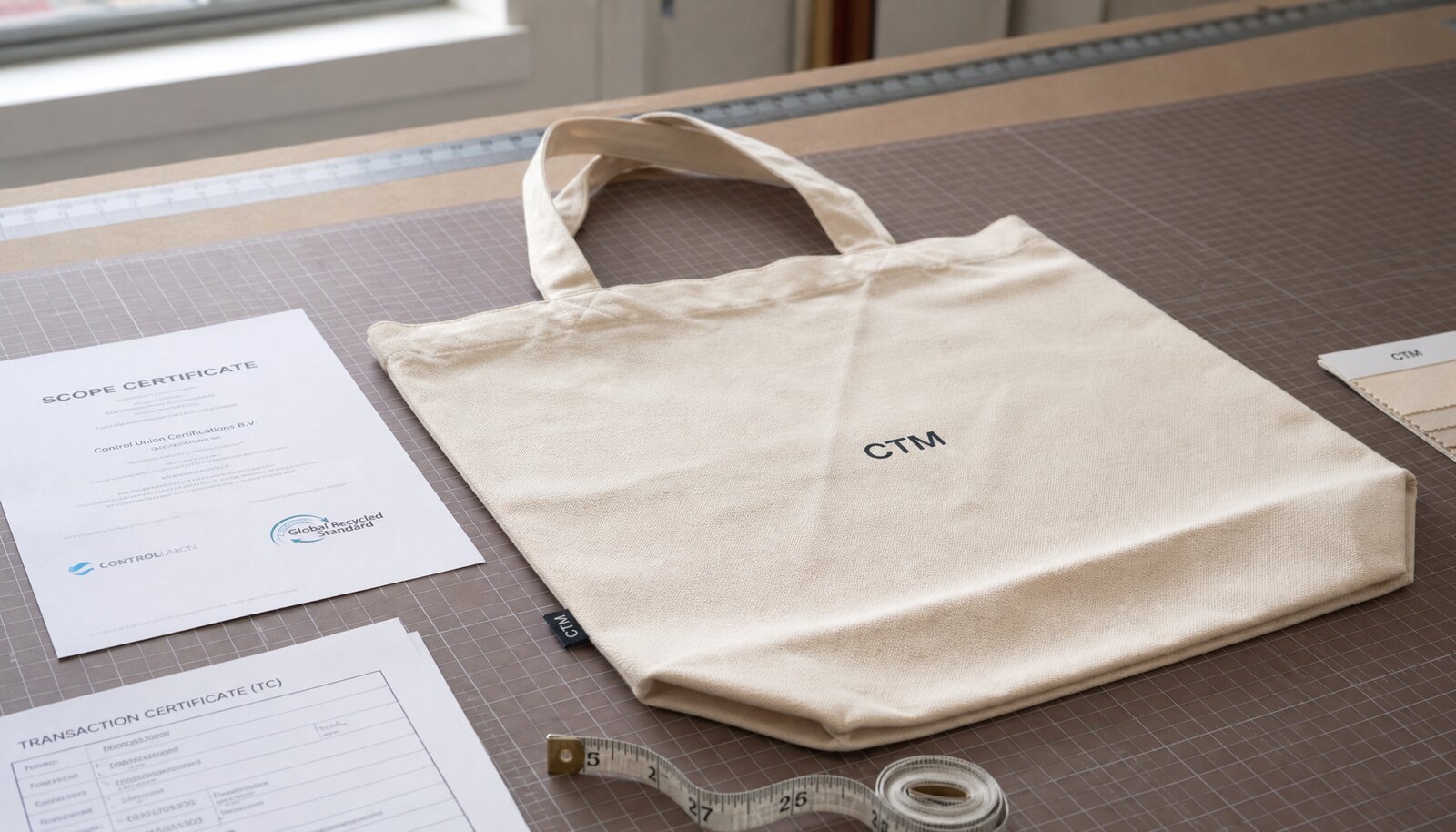
The audit should go beyond the certificate logo. Ask for the current scope certificate, the legal entity name on that certificate, and the exact processes covered. If the fabric is certified but the printing or sewing happens at a different site, find out whether that site is also within scope or whether approved subcontracting is documented. Ask whether the order needs transaction documents, batch references, or invoice-level traceability. Common failure points are boring but serious: an expired certificate, a different company name on the invoice, a scope that excludes sewing or packing, or an order that mixes certified material with uncertified trims without clear separation.
- Request the current scope certificate, not a screenshot from a website.
- Check that the order entity matches the certificate holder name exactly.
- Confirm whether your claim needs transaction paperwork or batch traceability.
- Ask whether any subcontractor touches the fabric, print, sewing, or packing.
Audit the Factory Like a Procurement Team
A useful supplier audit is not a polished questionnaire. It is a short search for the places where quality and traceability usually break. First, identify whether the factory actually controls the critical steps or whether it outsources sewing, printing, or packing. If the supplier is a trader, ask where the real production happens and whether that site can support the certification claim. If the supplier is a factory, ask how they manage incoming fabric, lot separation, production scheduling, and final carton control.
Then look for evidence of repeatability. You want to know whether the bag has a standard work instruction, a fixed golden sample, and a clear approval path when artwork or sizing changes. Ask who signs off on the first cut, who checks print alignment after sewing, and who releases cartons for shipment. A buyer does not need a perfect factory. The buyer needs a factory that can explain its process in a way that survives a second order, a late artwork change, and an inspection without improvisation.
The strongest audit questions are practical. What happens if the fabric lot shade shifts slightly? What happens if the print plates are wrong? What happens if the carton count is short by five pieces? Suppliers that answer in process terms are usually easier to manage than suppliers that answer only with price and lead time.
- Ask where each process happens: fabric, cutting, sewing, print, packing.
- Ask who owns first-article approval and final shipment release.
- Ask what happens when a lot is rejected or needs rework.
- Ask for a live sample room or production photo set if you cannot visit.
Read the Quote Like a Landed-Cost Document
A quote for a certified cotton shopping bag should tell you more than the unit price. It should separate the cost of the fabric, the sewing labor, the print or label application, the packaging, and any one-time setup fees. If the supplier bundles everything into one number, you lose the ability to compare suppliers on the same basis or to understand what changes when the order size changes. That matters especially for startups, where the first order is often small and the second order may need a different pack or artwork configuration.
You also need clarity on commercial terms. EXW and FOB can produce very different landed costs once domestic transport, export handling, and ocean or air freight are added. A supplier with a slightly higher unit price may still be the better option if their packing is tighter, their carton weights are lower, or their defect rate is lower. Cost is not just what the factory charges. Cost is what arrives cleanly, on time, and without rework.
Ask the supplier to show which costs are recurring and which are one-time. A screen setup fee, a lab dip, a print strike-off, a custom carton, or a certification handling fee may be reasonable. What matters is whether those costs are explained clearly enough that your finance team can forecast the second order without surprises.
- Separate recurring production cost from one-time setup cost.
- Check whether shrinkage, wastage, and trim are included.
- Compare quotes on the same Incoterm before judging the price.
- Ask for carton dimensions and gross weight because freight can move the total.
Choose Construction and Branding for Real Use
The right construction is the one that matches how the bag will actually be used. A simple self-fabric tote with reinforced handles is often the most efficient answer for launch programs because it keeps the supply chain short and the quote readable. If the bag is expected to carry heavier contents or to survive repeated daily use, cotton webbing handles or stronger reinforcement may be worth the extra cost. The buyer should not decide this on style alone. Decide it by load, wear, and the tolerance for returns or complaints.
Print method deserves the same discipline. Screen print is often the most stable choice for a simple one- or two-color logo on natural cotton because it is predictable and easy to repeat. Woven labels and sewn patches can work very well for minimal branding, but they add stitching steps and can distort the seam if placement is sloppy. Heat transfer can help with more detailed graphics, but buyers should check hand feel and edge durability before approving it. For a startup brand, the safest answer is usually the one the factory can reproduce with the least drama and the fewest hidden variables.
The mistake to avoid is over-designing the first production run. Heavy ink coverage, tiny text, special folds, and decorative stitching can all be attractive in a concept deck. In production, they often create avoidable failure points. The best first order is usually clear, durable, and simple enough to repeat.
- Match handle style to expected carry weight and frequency of use.
- Approve the print after sewing, not only on a flat pre-print panel.
- Avoid small text and dense artwork unless the chosen print method can hold it.
- Use woven labels or patches only when their placement has been tested on a full sample.
Make Sampling Expose the Real Problems
Sampling is the buyer's cheapest inspection point, and it should be treated that way. A photo sample tells you whether the factory understood the brief. A pre-production sample tells you whether the spec is buildable with the chosen materials and print method. A golden sample becomes the reference for the bulk run. If the factory skips one of these stages, the buyer gives up the best chance to catch problems before fabric is cut at scale.
When you review the sample, measure it. Do not rely on visual similarity. Check the finished width, height, gusset, and handle drop against the agreed spec. Look at the seam allowance and the stitch density. Pull the handles firmly to see whether the bar-tacks hold and whether the seam stretches in an odd way. Inspect the print for edge sharpness, color coverage, and shift after sewing or pressing. If the bag uses organic cotton, look at the fiber tone and hand feel too, because buyers often underestimate how much natural cotton variation is normal and how much variation is too much.
The sample review should also test the boring details. Is there loose thread? Does the label sit straight? Does the fold look good when packed? Does the bag smell clean? Those small checks are not cosmetic fuss. They are early signals of whether the bulk order will ship as a disciplined production run or as a series of corrections.
- Keep one signed golden sample for production reference.
- Measure the sample with a ruler, not just your eyes.
- Rub-test the print and tug-test the handles before approval.
- Check cleanliness, folding behavior, and label alignment as part of the sample sign-off.
Set Packing and Logistics Rules Before Production Starts
Packing is one of the easiest places to lose money quietly. A cotton shopping bag packed too tightly can crease the print or deform a sewn label. Packed too loosely, it wastes carton volume and inflates freight. Buyers should define the fold method, pack count, carton size, and shipping marks before the order is released. If the bag is going into retail, marketplaces, or direct-to-consumer fulfillment, individual polybags or paper bands may be needed. If the bags are going to wholesale or distribution, bulk folded packing may be better.
The buyer should also decide how much protection the bags need in transit. Moisture protection may matter on long sea lanes or humid routes. Carton strength matters if the shipment will be double-stacked or moved through multiple warehouses. If barcodes, destination labels, or carton lot numbers are required, they should appear in the quote and on the packing instruction. This is especially important for startup brands that need to receive, store, and move small launches quickly without opening and repacking cartons.
The simple rule is that packing is part of the product. If the factory does not know the packing standard, it will invent one. That invention can cost you time at receiving and money in rework.
- State the fold method and whether the logo must face outward.
- Confirm inner pack count, master carton count, and carton dimensions.
- Ask whether you need pallet limits, moisture barriers, or retail-ready labeling.
- Require carton marks and lot references that match the purchase order.
Release the PO Only After One Final Control Pass
Before the purchase order goes out, run a last internal check with procurement, brand, and operations. The point is not to create paperwork for its own sake. The point is to make sure the bag on paper is the same bag that will arrive in cartons. This is where many teams save themselves from a bad launch. If the certification language is loose, the print file is not signed off, or the carton format is still under discussion, the PO should wait.
A good PO for a certified cotton shopping bag should reference the approved spec, the approved sample, the commercial term, the packing standard, the inspection point, and the required document set. It should also name the acceptance criteria in plain language. If the supplier misses size tolerance, uses the wrong invoice entity, or changes the pack count, the buyer should know whether the shipment can be corrected, held, or rejected. A clear PO gives the factory a target and gives your team a basis for follow-up.
This is also the right time to confirm ownership. One person at the supplier should own sample follow-up, one should own production status, and one should own final shipping documents. Startup brands lose less time when responsibility is visible and specific.
- Tie the PO to the approved sample and spec sheet.
- State the required certification documents and invoice entity.
- Confirm inspection timing, defect limits, and rework rules.
- Name the supplier contact responsible for production follow-up and shipping paperwork.
Watch for the Failure Modes That Repeat
The same mistakes show up again and again in cotton bag sourcing. The first is buying from a quote that never really matched the spec. The second is treating organic certification as a marketing phrase instead of a document trail. The third is approving a sample that looks fine on a desk but has not been measured, rubbed, or pulled. The fourth is forgetting that packing and carton quality affect the order just as much as the bag itself.
Another common problem is overcomplicating the first launch. New brands sometimes add special stitching, dense artwork, extra labels, and custom packing all at once. That is a lot of variables for one order, especially when the supplier is also trying to meet a certification claim. The better path is usually to keep the first order clean and repeatable, then add detail on the second run once the factory has proved it can hold the standard. Procurement is not just about squeezing price. It is about making the next order easier to buy than the last one.
If you build the process around measurable details, the sourcing discussion gets calmer. You can compare quotes, defend the claim, and receive the product without the usual scramble.
- Do not compare suppliers until the spec, claim, and packing method are identical.
- Do not rely on a certificate logo without checking the actual scope and entity.
- Do not approve bulk production before measuring the sample and confirming the artwork.
- Do not let carton packing remain undefined after the PO is issued.
Specification comparison for buyers
| Decision point | Better fit | Commercial upside | Buyer tradeoff / audit risk |
|---|---|---|---|
| Fabric weight | 140-160 gsm cotton | Lower cost, lighter freight, good for giveaways and light retail carry | May feel thin or wear faster on heavier loads; confirm shrinkage and seam allowance |
| Fabric weight | 180-220 gsm cotton | Stronger hand feel, better reuse, better for premium retail programs | Higher unit cost, more sewing time, and higher carton weight; check landed cost |
| Certification route | GOTS-certified organic cotton | Best when the buyer needs a stronger organic processing claim and tighter chain-of-custody control | Requires current scope coverage and transaction paperwork; verify the legal entity and subcontracting status |
| Certification route | OCS-certified organic content | Useful when the buyer needs content verification with a simpler claim structure | Does not replace a deeper processing audit; confirm what claim your market and retailer will accept |
| Print method | 1-2 color screen print | Reliable for simple logos, strong opacity on natural cotton, easier to repeat at scale | Fine text can blur or crack if artwork is too detailed; approve the print after full sewing |
| Print method | Woven label or sewn patch | Cleaner look, lower ink dependency, strong for minimal branding | Adds stitching steps and can distort seams if placement is not controlled |
| Handle construction | Self-fabric handles with reinforcement | Simple, common, cost-effective, easy to source | Can fail if bar-tacks or seam allowance are weak; test pull strength on samples |
| Handle construction | Cotton webbing handles | Better comfort and better load distribution for heavier bags | Usually raises cost and changes the look; check width, color match, and attachment quality |
| Packing format | Bulk folded with carton marks | Efficient for wholesale and distribution channels | Can crease the bag or crush print if the fold standard is vague |
Buyer checklist before sampling
- Define finished size, gusset, handle drop, stitch allowance, and dimensional tolerance before requesting quotes.
- State whether the cotton must be GOTS-certified, OCS-certified, or simply organic-content verified for your market.
- Ask for the current scope certificate, the legal entity name, and the exact processes covered by that certificate.
- Request transaction documents or batch-level traceability if the claim or retailer requires them.
- Approve the artwork file, print method, ink type, and placement drawing in writing before sampling.
- Ask for a pre-production sample or golden sample before mass cutting begins.
- Require a line-item quote that separates fabric, cutting, sewing, print, labels, packing, setup charges, and export terms.
- Confirm whether the quote is EXW, FOB, or another term so you can compare landed cost correctly.
- Specify fold method, inner pack count, master carton count, carton dimensions, and shipping mark rules.
- Ask for expected lead time after sample approval, not just the earliest possible ship date.
Factory quote questions to send
- What fabric composition, GSM, weave, color, and shrinkage allowance are you quoting for this bag?
- Which certificate applies to this order, and can you share the current scope certificate and the invoice entity name?
- Does this order need transaction documents, and if so, who issues them and when?
- Which parts of the bag are made in-house, and which parts are subcontracted?
- What exactly is included in the unit price, and which items are separate setup or handling charges?
- What sample stage will I approve before bulk production, and how long does each sample step take?
- Which print method do you recommend for this artwork, and what failure risks should I expect?
- What is your standard packing method, carton quantity, and outer carton specification?
- What are your normal production and export lead times after sample approval and deposit?
- What are your defect limits for fabric weight, dimensions, stitching, print placement, and packing count?
Quality-control points to confirm
- Fabric weight matches the approved spec and is consistent across multiple pieces from the same lot.
- Finished dimensions stay within the agreed tolerance after cutting, sewing, and pressing.
- Seams, side seams, handle attachments, and bar-tacks are even, secure, and free from skipped stitches.
- Print color, placement, opacity, and edge sharpness match the approved sample on full-size bags.
- Woven labels, sewn patches, or certification tags are positioned correctly and do not distort the seam.
- No oil stains, needle holes, loose threads, broken fibers, or shade inconsistency are visible on the bag surface.
- If the order uses organic claims, the invoice, carton labels, and batch references match the certificate holder name.
- Packing count per inner pack and master carton matches the approved packing list and purchase order.
- Carton marks, product codes, batch numbers, and destination labels match the shipping instruction.
- Outer cartons are strong enough for the route and do not collapse, split, or crush the bags inside.