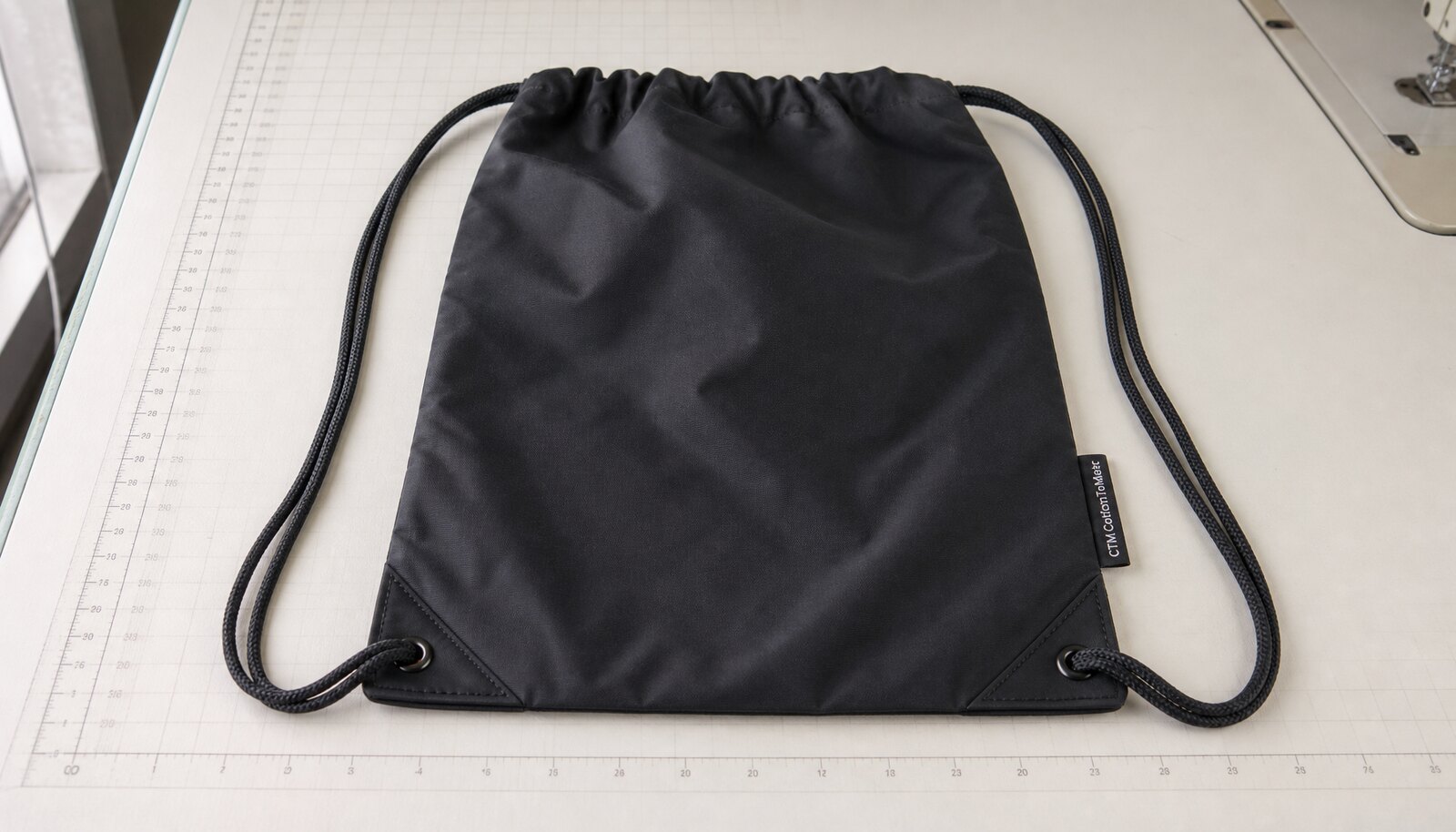
What this bag has to do at an event
Sports drawstring backpacks for events usually fail for one of three reasons: the bag is too thin, the logo process is wrong for the fabric, or the packing spec adds cost without adding value. Buyers often start with appearance, then discover that the bag needs to carry a shirt, a bottle, and a few hard items through a crowded venue. That changes the spec. The right brief is not just a bag with a logo. It is a bag that can be handed out quickly, survive rough handling, and still look acceptable after one day in use.
For procurement teams, the first decision is the actual use case. A fan giveaway for light apparel has a different requirement from a distributor pack that may sit in warehouse stock, travel in bulk freight, and be resold later. If you define the event flow early, the supplier can size the fabric, reinforcement, and packing to match it instead of quoting the cheapest possible construction. That is where most cost surprises start.
- Separate light giveaway use from heavier sports merchandising use.
- Define who will distribute the bag and how it will be handled on site.
- Treat the bag as a shipping item first, not only a print surface.
Choose the shell fabric by load, finish, and print method
For most event programs, 210D polyester is the practical starting point. Finished fabric weight usually lands around 95 to 110 GSM depending on coating and finishing, which is enough for folded apparel, a brochure pack, or light accessories. When the bag must feel more substantial or carry harder items, move to 300D or 420D polyester. Those fabrics usually land around 130 to 220 GSM finished weight and give you better hand feel, less collapse, and a better base for premium print or patch work.
Do not let a quote stop at denier. Two suppliers can both say 210D and still deliver very different bags if one uses a thin coating and the other uses a denser finish. Ask for the finished GSM, coating type, and whether the fabric is woven, calendered, or treated for water resistance. That tells you more about performance than the yarn count alone. If the buyer wants a more retail-ready look, a denser fabric with cleaner edge binding usually wins even if the unit price rises slightly.
- Use 210D for low-cost event handouts and lighter contents.
- Use 300D or 420D when the bag must feel stronger or be reused more often.
- Request finished GSM and coating details, not just denier.
Lock the construction before you talk price
The cheapest quote is often the one that removes the details that keep the bag alive. On a drawstring backpack, the stress points are the cord exits, the top hem, and the lower corners. If the supplier does not build in bar-tacks, double stitching, or edge reinforcement where the cords pull, the bag will look fine on paper and fail in the field. That is not a cosmetic issue. It creates returns, complaints, and a bad read on your event program.
Construction should be written into the RFQ as a hard requirement, not an optional finish. If the bag will carry shoes, bottles, or heavier merch, specify reinforcement at the corners and a cord type that does not cut into the fabric. If a zipper pocket or side pocket is included, note whether it changes the main panel dimensions or the print area. Small changes in construction often cause the biggest quote differences, so they need to be fixed before you compare unit prices.
- Specify bar-tacks at cord exits and stress points.
- State whether the bag needs a zipper pocket, mesh pocket, or no extra compartment.
- Confirm the cord diameter, cord tip finish, and top hem reinforcement.
Pick the supplier route that matches your order
A direct factory is the cleanest route when the bag is custom, the artwork is fixed, and you want the same team to cut, sew, and print. That gives you fewer handoffs and better control over lead time. A trading company can still be useful when the program mixes several products or when you need one manager to coordinate different factories. The tradeoff is clarity: you need to know who actually owns the manufacturing risk and who signs off on defects.
For sports drawstring backpacks for events, stock wholesalers and domestic converters look easy at first because they can move fast. They also tend to be less precise on the fabric and print details that matter once the order gets bigger. If you need a repeatable supply plan, use them only when the program is small, the timeline is short, or the bag can be accepted as a semi-custom item. Otherwise, compare the sourcing route on total landed cost, not just on quoted unit price.
- Direct factory works best for repeat custom programs.
- Trading companies help when you need mixed product categories in one PO.
- Stock routes are useful for urgent small programs, but they limit control.
Read the quote like a buyer, not a shopper
A useful quote should tell you what is included and what is not. At minimum, it should separate fabric spec, sewing construction, print method, packing, sample charge, setup charge, and shipping term. If a supplier gives only one unit price, you cannot compare it against another quote that includes polybags, carton marks, and a pre-production sample. That is how a cheaper quote becomes the more expensive order after the hidden extras are added.
The right quote also gives you price breaks that match your buying logic. If you know the event will repeat, ask for 1,000, 3,000, and 5,000 piece tiers. If the supplier uses screens or plates, ask whether the setup fee is tied to color count. If the quote includes a zipper pocket, woven label, or individual polybag, ask for a clean base price without those items so you can see which features actually drive cost. A good buyer should be able to read the quote and understand where the margin is hiding.
- Demand a line-by-line breakdown, not a single blended unit price.
- Request price tiers that match your forecast, not the supplier's convenience.
- Separate base bag cost from setup, sample, packing, and freight.
Use MOQ logic instead of guessing at volume
MOQ is not just a factory policy. It is the point where setup cost, fabric waste, and labor efficiency become reasonable. For a simple 1-color screen print on 210D polyester, a direct factory may work at 1,000 to 3,000 pieces if the rest of the bag is standard. If you add custom fabric color, a special cord, a zipper pocket, or multiple print positions, the MOQ normally moves up. That is because the supplier is not only sewing a bag, they are also locking material inventory and production time for your job.
The buyer mistake is trying to force one MOQ across every version of the bag. Instead, separate the quote into a base model and optional features. That lets you see which additions are reasonable and which ones are pushing the order into a different production class. In practice, the print method often changes MOQ more than the bag shape. Screen print is efficient at scale, heat transfer can support lower runs, and woven or embroidered details can add cost and sampling time even when the bag itself stays simple.
- Base MOQ is usually driven by setup, not by the bag pattern alone.
- Custom fabric colors and accessories usually raise the MOQ more than a simple logo change.
- Ask for separate pricing on base bag, print, and optional add-ons.
Set the sample standard before bulk cut
A digital proof is not enough for a product like this. You need a sewn sample made from the actual fabric, actual cord, and actual print method. That sample should be used to confirm hand feel, opening size, stitch quality, logo placement, and how the bag folds. A clean-looking mockup can hide weak seams, poor cord routing, or a print that becomes too stiff once it is applied to the real fabric.
Approval should be based on measured points, not general impressions. For example, confirm opening width, body height, cord length, and print placement against the approved sheet. Then do a practical pull test with a realistic load. If the buyer expects the bag to hold several kilograms of merchandise, say so in the sample phase and not after bulk production starts. Most avoidable quality disputes begin when the sample was approved too casually.
- Approve a physical sample built with production materials.
- Measure the critical dimensions against a written spec sheet.
- Use a simple load test that reflects how the bag will be used.
Packing choices change cost and damage rates
Packing is not a minor detail on an event order. Bulk packing reduces material and labor cost, but it can also create dust, scuffing, and carton compression if the bag has a soft print or a raised patch. Individual polybags make sense when the bags are going direct to retail, need barcode handling, or must stay clean through a long transit cycle. If the order will be opened and redistributed on site, there is usually no reason to pay for retail-style packing.
The practical approach is to write the pack spec around the destination workflow. If the buyer or distributor will repack the goods anyway, keep the factory pack simple and protect the carton. If the bags must arrive shelf-ready, specify the polybag size, barcode placement, and carton configuration. Ask the supplier to confirm carton dimensions and gross weight before shipment so you can compare freight cost and warehouse handling cost on equal terms.
- Bulk pack for event distribution when retail presentation is not needed.
- Use individual polybags only when hygiene, barcodes, or shelf display justify them.
- Confirm carton marks, carton count, and gross weight before booking freight.
Build lead time around approvals, not sewing
Event buyers often understate the time needed for approvals. Sewing a simple bag can be fast, but the job is held up by fabric confirmation, print sign-off, sample approval, and carton approval. For a standard custom run, a supplier may quote a relatively short bulk production window, but that only starts after the details are frozen. If the buyer changes artwork, color, or packing after the sample is underway, the schedule moves immediately.
The safest schedule is the one with buffers before the event date, not after it. Work backward from the handout date and leave room for sample review, freight transit, customs clearance, and warehouse receiving. If the event season is crowded, avoid locking the PO too late in the calendar because factories will prioritize orders that are already approved. A clean approval cycle is often more valuable than a small discount.
- Treat artwork approval, sample approval, and carton approval as separate milestones.
- Work backward from the event date and include freight and receiving time.
- Do not let late design changes sit inside the production window.
Use QC thresholds that catch the real defects
Inspection should focus on the defects that matter in use, not just on visual neatness. On sports drawstring backpacks for events, that means checking the reinforcement, the print, the cord routing, and the dimensions. A bag can look acceptable in a stack and still fail when a user loads it with a bottle and a pair of shoes. Build acceptance criteria around the actual risk, then apply a standard such as AQL 2.5 for critical defects and 4.0 for minor defects if the program needs a formal inspection structure.
The receiving team should compare random cartons against the approved sample, then open enough units to see if the lot is consistent. Look for loose threads, crooked labels, print smudging, uneven cord length, and carton packing errors. If one issue shows up repeatedly, it is usually a process problem, not an isolated defect. That is the point where a buyer needs photos, lot separation, and a supplier response before the goods move to final distribution.
- Inspect the stress points, not only the front panel.
- Use the approved sample as the control reference.
- Quarantine lots that show repeated defects across multiple cartons.
Specification comparison for buyers
| Spec decision | Recommended option | When it fits | Buyer risk to check |
|---|---|---|---|
| Sourcing route | Direct factory with in-house sewing and print | Custom event programs with one logo, one color story, and 1,000 to 10,000 pieces | Confirm the factory is not outsourcing printing or stitching without telling you |
| Sourcing route | Trading company that consolidates bag and accessory sourcing | Multi-item promotions or programs that combine backpacks, pouches, and lanyards | Verify who owns QC, who approves samples, and who absorbs rework |
| Fabric weight | 210D polyester at about 95 to 110 GSM finished weight | Budget event bags for shirts, flyers, and light merch | Ask for finished GSM and coating, not just the yarn count or denier |
| Fabric weight | 300D to 420D polyester at about 130 to 220 GSM finished weight | Premium events, heavier loads, or repeat-use giveaways | Check whether the heavier fabric still prints cleanly and folds well |
| Print method | 1 to 2 color screen print | Large runs with simple logos and strong price pressure | Watch for registration drift, ink cracking, and poor rub resistance |
| Print method | Heat transfer, DTF, or woven patch | Small runs, multi-color art, gradients, or sponsor logos | Test abrasion resistance and edge lift after folding and shipping |
| Construction | Bar-tacks at cord exits, reinforced corners, double top hem | Bags that will carry bottles, shoes, or move through crowded venues | Pull-test a sample and inspect every stress point before bulk approval |
| Packing route | Bulk packed by color with carton marks, individual polybag only when needed | Event distribution, distributor stock, and cost-sensitive programs | Wrong packing can add repacking labor, carton damage, and delay at destination |
Buyer checklist before sampling
- Lock final bag size, print size, cord length, and any front pocket or zipper detail before requesting a price.
- State the expected load and use case, such as shirts and flyers versus shoes and water bottles.
- Specify the fabric by denier and finished GSM or equivalent weight, plus any PU or water-resistant coating.
- Choose the print method, number of colors, and artwork placement with a real sample size or proof file.
- Define reinforcement requirements at the cord exits, seams, and top hem.
- Request quote breaks at 1,000, 3,000, and 5,000 pieces, plus the cost of samples and setup.
- Confirm packing style, carton count, master carton marks, and whether individual polybags are required.
- Ask for a pre-production sample, a bulk photo set, and the inspection standard before PO release.
Factory quote questions to send
- Is this quote based on direct factory production, or is any part of the order being subcontracted?
- What is the finished fabric weight or GSM, and what coating or backing is included?
- Which print method is included, how many colors are covered, and what is the maximum print area?
- What is the MOQ at each price break, and what changes the MOQ if we adjust color, print, or packing?
- What sample fee, screen charge, plate charge, or setup charge applies, and is any of it refundable at bulk order?
- What packing standard is included, including polybag use, carton size, carton count, and carton marks?
- What is the lead time from artwork approval and sample approval to bulk shipment?
- What overrun or underrun allowance applies, and how will you handle defects found during inspection?
Quality-control points to confirm
- Finished bag size stays within an agreed tolerance, usually no more than 1 cm deviation on key dimensions.
- Fabric matches the approved swatch in weight, hand feel, coating, and color tone.
- Cord exits, corners, and top hems have visible reinforcement with no skipped stitches or loose bar-tacks.
- Logo placement is centered and aligned within the approved tolerance, and print color matches the signed-off sample.
- No frayed edges, broken eyelets, exposed thread tails, or damaged cords appear on random inspection.
- Print passes dry rub and light wet rub testing without obvious smearing or peeling.
- Random sample bags survive a practical load test that reflects the event use case, not just a visual review.
- Carton counts, labels, and packing method match the PO exactly, with no moisture or transit damage on arrival.