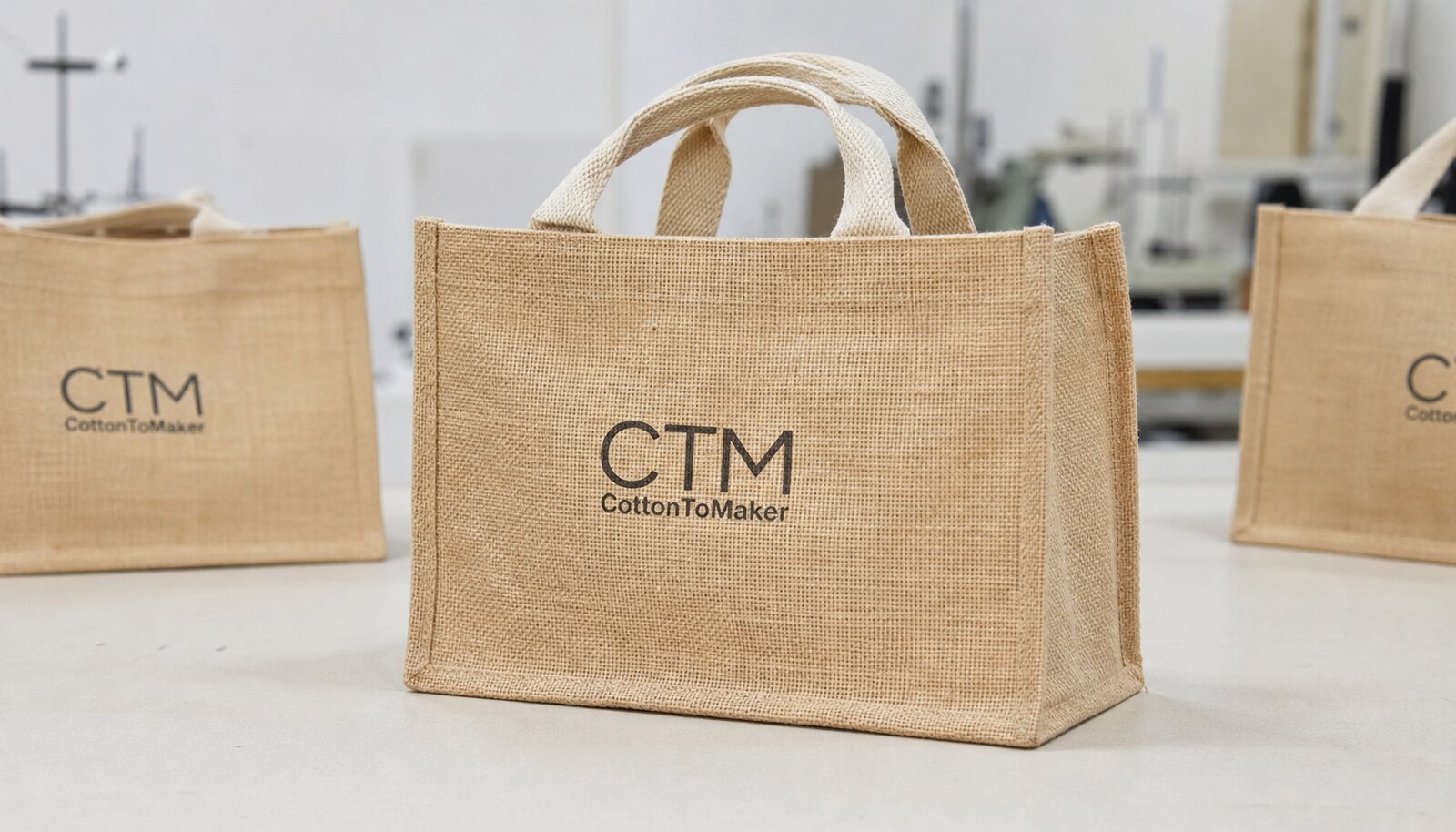
Why small personalised jute bags are a different buying problem
Small jute bags personalised are not just a reduced-size tote. The small format changes everything that matters to a buyer: print area becomes limited, the opening becomes harder to sew cleanly, and the bag can look distorted if the fabric weight is too light. For procurement teams, the main risk is assuming a generic mini tote quote will work for cosmetics, gift sets, tea packs, or promotional inserts without measuring the real product that goes inside.
The best way to source this item is to treat it as a packaging component, not a simple tote. A bag that looks fine in a factory photo may fail at retail if the logo sits too close to a seam, if the gusset collapses, or if the handles twist after packing. The right specification gives the factory enough room to control sewing and print placement while keeping the unit price stable across reorders.
- Measure the product or gift set first, then add clearance for insertion and closing.
- Decide whether the bag must stand upright on shelf or only carry a light insert.
- Keep the logo simple unless you are paying for a higher-risk print method.
Choose the right jute weight before you talk about print
For small jute bags, fabric weight is one of the biggest cost and quality drivers. A bag around 280–320 gsm can work well for lightweight gifts, samples, and lower-cost promotions. If the bag must feel premium, resist wrinkling, or carry a candle, jar, or multiple items, 350–400 gsm usually gives a more stable structure. That extra body helps the bag open neatly and gives the print a cleaner visual result.
The mistake many buyers make is specifying only the outside dimensions and logo, then leaving the factory to choose the jute weight. That creates quote noise. One supplier may assume a light base fabric and another may quote a heavier weave, so the prices are not comparable. Ask for the fabric weight in writing, along with whether the number refers to the raw weave or the finished sewn material. For the same bag size, that detail can change both hand feel and costing.
- 280–320 gsm: lower-cost, light gifting, seasonal campaigns, short carry loads.
- 350–400 gsm: better standing shape, premium retail presentation, heavier inserts.
- Above 400 gsm: usually only justified when structure or durability matters more than packability.
Print method, artwork limits, and what really drives unit cost
For small personalised jute bags, 1-color screen print is usually the most practical option. It holds cost down, works well for logos and simple retail branding, and is easier to repeat on reorders. If the design uses multiple colors, fine type, or photographic detail, print method choice changes quickly. Heat transfer can handle more detail, but it can also look less integrated on coarse jute and may raise long-term wear concerns.
A buyer should not compare quotes only by the printed sample image. Ask what print area is included, how many colors are priced, whether the art needs to be separated for the screen, and whether registration tolerance is acceptable on a rough weave. On jute, a design that looks sharp on screen can still appear fuzzy if the weave is too open or the ink sits too thick. The best quote is the one that names the print method, number of passes, setup charge, and rejection threshold before production starts.
- Simple logo, one color: usually the best cost-to-result ratio.
- Multi-color logo: expect higher setup cost and more registration risk.
- Very small text: avoid unless the buyer approves a proof on actual fabric.
MOQ logic: how small personalized jute bags become expensive too fast
MOQ is not only a factory policy; it is the sum of cutting, sewing, printing, and packing setup. Small jute bags personalised can have a reasonable MOQ for one size and one print, but the quantity climbs quickly when you add color variations, different handle types, or multiple sizes. A buyer launching three sizes may be better off consolidating the program into one or two formats first, then extending once reorder data is clear.
When comparing suppliers, separate true production MOQ from practical MOQ. A supplier may accept a low order quantity but add high setup charges, making the unit price uncompetitive. Another may quote a low per-piece price but require a higher quantity to offset print screens and carton work. For procurement, the right comparison is total spend by variant, not the headline MOQ alone.
- One size, one color print, one packing spec = lowest setup burden.
- Each extra size adds cutting control, sewing calibration, and carton complexity.
- Each extra print color adds registration risk and often a separate screen charge.
A practical supplier comparison for small personalised jute bags
If you are sourcing from multiple routes, the biggest difference is not just price. It is how much production detail the supplier controls. Direct factories usually give better visibility on jute weight, reinforcement, and print repeatability. Trading companies can be useful for mixed programs or urgent small quantities, but the quote may hide the actual factory specification or allow too much substitution.
For branded retail programs, the sourcing route should fit the repeat pattern. If the bag will reorder every season, a factory quote with a stable spec sheet is usually safer. If the program is a one-off event, a trading route may shorten the buying cycle, but the buyer should keep the sample approval stricter because responsibility can shift between the trader and the maker.
Supplier route comparison that buyers can use in an RFQ review
Use the comparison below to judge whether the quote matches the buying goal. The point is not to choose the cheapest source. It is to match the sourcing route to the level of control required over fabric, print, and packing. A low-cost quote that cannot be repeated cleanly is usually expensive by the second order.
When a supplier talks only about final price, bring the conversation back to the build: jute weight, handle reinforcement, print method, carton spec, and sample approval. That is what creates repeatability. A real quote should let you compare different suppliers on the same base assumptions.
- Write decisions in measurable language, not only descriptive wording.
- Ask for sample photos plus one physical approval sample for important orders.
- Keep quotation, sample approval, and inspection notes tied to the same spec version.
What to compare across sourcing routes
The table below is useful when a buyer is deciding between a direct factory, a trading company, or a local converter. Each route can work, but not for the same commercial reason. The important thing is to align order size, artwork complexity, and lead-time pressure with the route that can actually deliver the spec consistently.
For small jute bags personalised, the most common failure is buying through the easiest channel instead of the most controllable one. That often leads to mixed weave quality, inconsistent logo placement, or carton packing that does not match warehouse requirements.
- Write decisions in measurable language, not only descriptive wording.
- Ask for sample photos plus one physical approval sample for important orders.
- Keep quotation, sample approval, and inspection notes tied to the same spec version.
Production-specific comparison of sourcing options
A simple line-item quote is not enough. Ask every supplier to price the same build so you can compare like for like. The differences below are where margin gets lost: fabric substitution, print setup, and packing assumptions. Even when the quoted unit price is close, those details decide whether the bag is good enough for retail or only acceptable for a one-time promotion.
If your buyer team needs one rule, make it this: no quote is complete unless it states the base fabric weight, print method, and packing count. Without those three items, you are not comparing the same product.
- Write decisions in measurable language, not only descriptive wording.
- Ask for sample photos plus one physical approval sample for important orders.
- Keep quotation, sample approval, and inspection notes tied to the same spec version.
Comparison of supplier options and sourcing routes
Every open item in the buyer guide should have an owner: buyer to approve, supplier to confirm, or QC to verify. This keeps small personalised from becoming a vague note buried in an email thread.
Use short decision language: approved, rejected, revise sample, rework, sort, hold shipment, or accept with deviation. Clear action words help the factory respond without guessing.
- Write decisions in measurable language, not only descriptive wording.
- Ask for sample photos plus one physical approval sample for important orders.
- Keep quotation, sample approval, and inspection notes tied to the same spec version.
Sample approval: the stage where most avoidable mistakes show up
For small jute bags personalised, the sample is not only about appearance. It should prove the bag can be sewn cleanly, printed clearly, and packed without distortion. A good sample process usually starts with a pre-production sample or lab-style sample, then moves to a golden sample that both sides sign off. If the product is going into retail, the golden sample should represent the exact fabric weight, handle style, and packing format that will ship.
The most useful sample checks are simple and physical. Open and close the bag repeatedly, inspect the handle symmetry, and place the intended insert inside to test mouth width and gusset function. If the print sits too close to a seam or handle stitching, reject it before bulk starts. On coarse jute, a logo that looks centered in a photo may shift once the bag is folded and sewn.
- Compare sample against artwork with a ruler, not only visually.
- Check seam quality at corners and handle ends under tension.
- Approve one reference sample and keep it for inbound inspection during bulk.
Specification comparison for buyers
| Spec decision | Recommended option | When it fits | Buyer risk to check |
|---|---|---|---|
| Jute fabric weight | 280–320 gsm for light retail gifting; 350–400 gsm for a firmer premium feel | Use 280–320 gsm for seasonal promotions, events, and lower-cost retail packs; use 350 gsm+ when the bag must stand upright and carry heavier inserts | Too-light fabric can wrinkle, distort print alignment, and feel cheap; too-heavy fabric raises unit cost and may reduce foldability |
| Bag size | Small formats around 15×20 cm, 20×25 cm, or 20×30 cm | Best for cosmetics, small gifts, tea, candles, sample kits, jewelry, or bottle accessories | If the insert is not measured first, the final bag may be too tight at the mouth or too short in gusset depth |
| Handle type | Short cotton webbing handles or jute self-fabric handles with reinforced stitching | Short handles suit gift bags and shelf display; self-fabric handles suit a rustic look and lower-cost programs | Handle length, seam reinforcement, and load rating are often omitted from quotes and cause failures in use |
| Print method | 1-color screen print for best unit economics; heat transfer only for complex short-run graphics | Screen print fits simple logos, repeat orders, and price-sensitive retail runs; transfer fits photo-style artwork or limited editions | Detailed art can blur on coarse jute weave; transfers can crack if the heat or film quality is poor |
| Logo placement | Front center or lower front, with clear no-print margin from seams and handle stitching | Works for retail shelves, gift sets, and private label packs where the logo must be readable at a glance | Artwork too close to seams can distort after sewing; small logos may disappear in the jute texture |
| MOQ route | Standard production MOQ for one print is usually lower than multi-color or multiple-size programs | Best when launching one SKU or testing a design before expanding the line | Multiple sizes, colors, or print positions quickly multiply setup time and raise the real MOQ per variant |
| Inner finish | Unlined for low-cost rustic programs; PP laminated or cotton-lined only when product protection matters | Unlined bags suit low-cost gifts and dry products; lined bags suit premium inserts, cosmetics, or retail presentation | Lining adds sewing complexity, thickness, and lead time; lamination can affect recyclability expectations |
| Packing method | Bulk packed in export cartons with a defined polybag count and carton mark set | Best for distributors, wholesalers, and brands with their own warehouse labeling | Loose packing increases crease risk and handling damage; over-packed cartons can crush handles and print surfaces |
| Sourcing route | Direct factory for repeat volume; trading route only for very small mixed programs | Direct sourcing usually gives better control over GSM, print repeatability, and packing spec | Trading quotes can hide factory detail gaps, making QC and reorders harder to stabilize |
Buyer checklist before sampling
- Final bag size with internal usable opening, not just outer dimensions
- Target jute GSM or fabric feel band, plus whether the bag must stand upright
- Handle type, handle length, and stitch reinforcement requirement
- Logo artwork in vector format with exact print size and placement
- Required print method, number of colors, and whether Pantone matching is necessary
- Inner lining, lamination, or no-lining decision
- Packing spec: polybag count, carton count, barcode, and master carton mark
- A sample approval standard for weave, print clarity, seam strength, and odor
- Target lead time, reorder timing, and any launch date constraints
- Expected annual volume or forecast split by size and print version
Factory quote questions to send
- What exact jute fabric weight do you propose, and is that the finished fabric weight or the base weave weight before sewing?
- What is your MOQ per size, per print color, and per logo position?
- How many setup charges apply for screen, plate, or artwork preparation?
- Can you quote the bag unlined and lined separately so we can compare landed cost?
- What is the standard handle reinforcement method and stitch count at the attachment points?
- What packing counts per inner polybag and per export carton do you recommend for this size?
- What sample fee applies, and is it refundable against a confirmed order?
- What lead time do you need for pre-production sample, bulk production, and carton artwork approval?
- Can you share photos or measurements of a similar previous production with the same construction method?
- What QC tolerance do you accept for size, print registration, seam alignment, and handle symmetry?
Quality-control points to confirm
- Measure overall size, gusset, and opening width against the approved sample with a practical tolerance agreed before production
- Inspect jute weave consistency, loose fibers, odor, and stains on front and back panels
- Review print clarity under normal retail viewing distance, not only close-up; edges should remain readable on coarse texture
- Pull-test handle attachments and check bartacks or reinforcement stitches for symmetry and thread breakage
- Confirm seam straightness, corner shape, and bag stand-up behavior if the product is meant for display
- Verify carton packing count, polybag quantity, and shipping marks so mixed lots do not get separated at warehouse intake
- Check random samples for size variation within carton and between cartons, especially after bulk pressing or folding
- Approve one golden sample for color, logo position, and stitch detail before releasing bulk