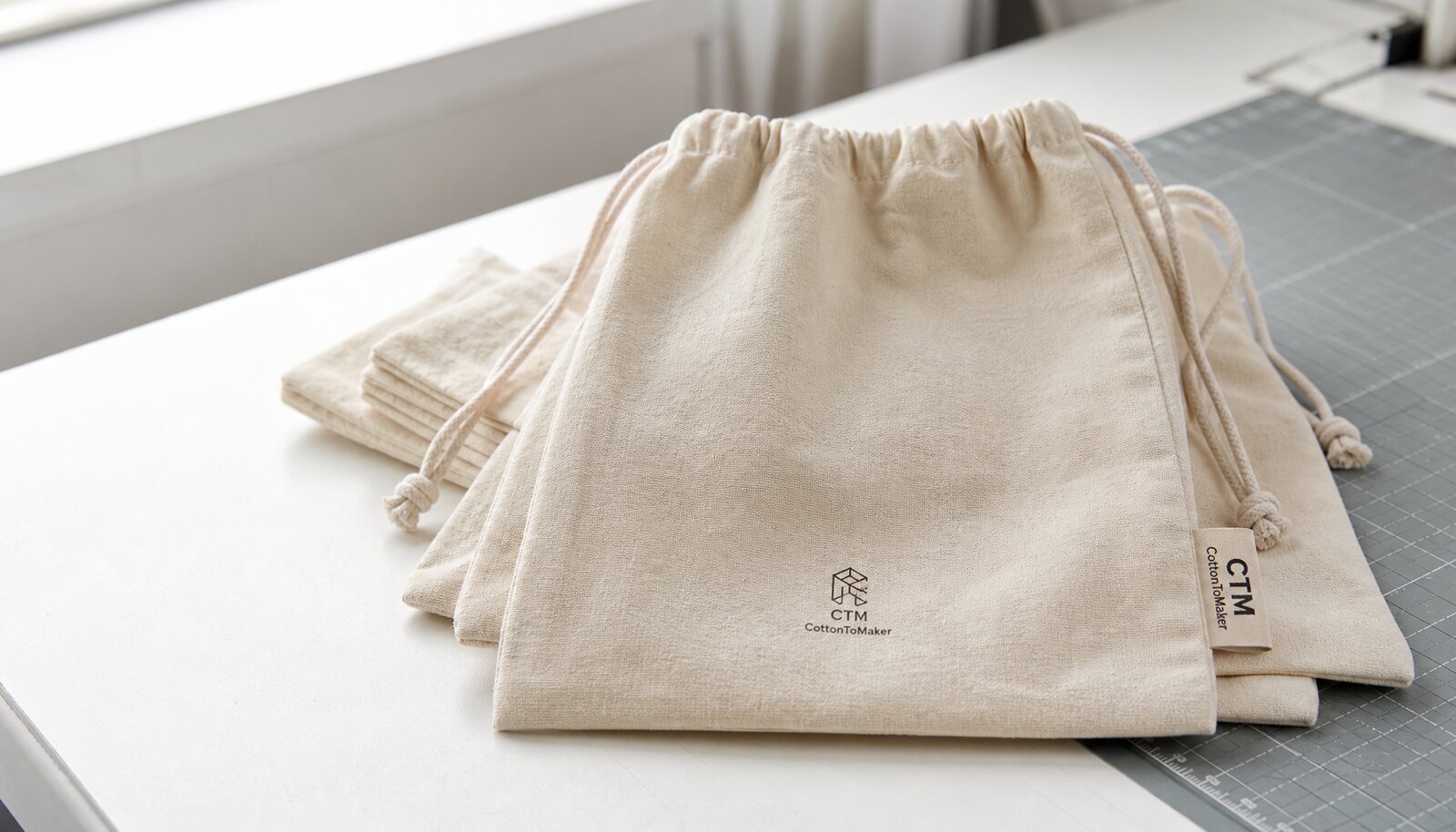
Start With the Job the Pouch Has to Do
For hotels, a small drawstring pouch is not just packaging. It can be part of the guest experience, a housekeeping handling item, a gift presentation layer, or a reusable item that carries the property brand home. That means the procurement brief should start with the operating job, not with a generic product name. A pouch for a soap bar and tea sachets is not the same as a pouch for slippers, jewelry, spa items, or a laundry return bundle, even if the bags look similar in a product grid.
The most common sourcing mistake is asking for "small drawstring pouches for hotels" without defining the contents, the presentation standard, or the handling environment. A supplier will fill in the blanks with their own assumptions. One factory may quote a thin muslin bag that looks fine in a photo but feels underbuilt when a housekeeper loads it. Another may price a heavy canvas bag that looks premium but adds cost to freight and carton space. If the brief is vague, the quote comparison becomes fiction rather than procurement data.
Translate Contents Into Size and Structure
Size should be driven by the largest item the pouch must carry, not by the smallest item that fits. For jewelry, folded cards, or a single soap sample, a compact pouch around 10 x 12 cm may be enough. For toiletries, small amenity kits, or welcome gifts, formats around 15 x 20 cm to 18 x 24 cm usually give staff enough mouth opening to pack quickly without pinching the seams. For slippers, spa accessories, or folded textiles, buyers often need a larger face and sometimes a gusset so the pouch does not become a flat sleeve that is hard to fill.
The right way to validate size is to test the physical contents against the sample, not to judge the pouch by flat dimensions alone. Ask the supplier to show the usable opening after seam allowance and drawcord channel are included. Ask whether the bag is being quoted as flat-cut or gusseted, and ask for a drawing with the finished measurement marked. A pouch that looks large on paper can become tight once the channel, top hem, and fold lines are added. For hotel programs, the receiving team and the housekeeping team should both be able to use it without forcing a fit.
Fabric and GSM Are Procurement Decisions, Not Style Choices
Cotton is a sensible default for many hotel pouch programs because it prints predictably, feels natural in the hand, and is familiar in hospitality buying. But "cotton" is not enough of a specification. Buyers should define the weave, construction, and GSM range they want the supplier to use. As a practical starting point, lighter muslin or poplin in the 90 to 120 gsm range is suited to simple presentation and low-weight contents. Poplin or twill in the 140 to 180 gsm range gives more body for general hotel use. Canvas or heavy twill in the 200 to 300 gsm range is better when the pouch needs structure, reuse, or a more premium hand feel.
The fabric choice affects more than appearance. Lighter cloth can reduce cost and pack smaller, but it also tends to show contents more easily, fray faster, and feel less substantial in the hand. Heavier cloth improves opacity and perceived quality, but it can increase sewing difficulty, slow production, and raise freight cost. Ask the supplier to name the exact fabric code or internal cloth reference so the order can be repeated. If the pouch will be reused or washed, request whatever colorfastness or wash data the factory can provide against the exact fabric and decoration method being quoted.
Construction Details Decide Whether the Pouch Survives Real Use
The difference between an acceptable pouch and a weak one is usually found in the construction details. A useful starting point is a seam allowance around 7 to 10 mm with a reinforced top hem and a well-formed cord channel. That gives the bag enough margin to survive normal handling without making it bulky or expensive. The finished bag should still be measured after sewing, because cut size and finished size are not the same thing. If the supplier only quotes cut dimensions, the buyer still needs a finished-dimension tolerance in writing.
The drawcord area is where many small pouches fail first. A thin cord combined with a weak channel can cut into the fabric, pucker the mouth, or create an uneven closure. Ask how the cord ends are finished, how the channel is stitched, and whether the top edge is reinforced with a second row of stitching or a bar-tack at the stress points. If the pouch will be reused, loaded with heavier items, or opened and closed repeatedly, insist on a sample test that checks the mouth, the corner seams, and the channel after several cycles of use.
A Quote Is Only Useful If It Is Comparable
A defensible supplier quote should separate the costs that matter. Buyers should be able to see the bag construction, decoration method, packing format, sample charge, and freight or shipping terms clearly enough to compare them across vendors. A flat unit price is often misleading because one supplier may include a stronger fabric, a woven side label, and proper carton marking while another leaves those items out. The objective is not only the lowest number; it is knowing exactly what the number buys.
Small pouches are sensitive to hidden setup charges. Screens, plates, label changes, individual bagging, and carton marking can all affect the landed price. For multi-property hotel programs, ask the supplier to show where price changes if the artwork, size, color, or packing format changes. That is often the difference between a repeatable supply program and one that needs a fresh RFQ for every slight property variation. Quote discipline is a commercial control, not administrative overhead.
Choose the Supplier Route That Matches the Risk
The best supplier route depends on how much control the hotel needs. A direct factory is usually the best fit when the order will repeat, branding must stay consistent, and the buyer wants visibility into fabric, sewing, printing, and packing. A trading company can be useful when the hotel is combining pouches with other items in one shipment or wants one commercial contact for a more complex order. A local stockist helps when the need is urgent, but stock availability usually comes with less control over size, material, and decoration.
The real question is not whether the supplier says they can make the pouch. It is whether they can prove who controls material sourcing, production, inspection, and packing. Ask for the actual production site, the responsible QC owner, and the person who signs off on defects. Ask what happens if the print shifts, the size drifts, or the fabric lot changes mid-run. If the supplier cannot answer those questions cleanly, the commercial convenience may not be worth the control risk.
Use the Sample as an Approval Gate
A pre-production sample should prove more than appearance. It should show that the bag, cord, print method, label, and packing style can all be produced together without surprises. The most useful sample reflects the final size, the final artwork placement, the final label, and the intended packing method. If the sample arrives with generic packaging or a different cord from the quote, it is not a reliable approval basis. It is only a partial reference.
Treat the sample as the point at which changes become expensive. Once the buyer approves a golden sample, the spec should be frozen unless there is a formal revision. Small pouch issues are often subtle but cumulative. A few millimeters of logo shift can make the branding look careless. A slightly tighter seam can reduce usable opening. A cord that is too short can make the bag feel flimsy even if the rest of the construction is acceptable. The sample must answer operational questions, not only aesthetic ones.
- Approve the sample with the real contents inside, not just as a flat bag.
- Record the approved finished size, fabric description, print placement, and cord length on one spec sheet.
- Freeze the sample in writing before bulk cutting starts.
- Reject substitutions unless they are pre-approved against the same sample standard.
Print, Color, and Brand Control Need Measurable Rules
For hotel programs, one-color screen print is often the most stable decoration method when the artwork is simple. It gives buyers a clearer comparison across suppliers because the result is less sensitive to substrate variation than many decorative methods. Woven side labels can work well when the logo is small, the artwork is detailed, or the brand wants a cleaner premium look without depending on ink coverage. The question is not which method sounds more elegant; it is which one stays readable and consistent across production lots.
Color control should be handled like a procurement issue, not a design preference. If the bag body, print, or label must match a Pantone reference, ask the supplier how they will control it and what tolerance they will accept. For reusable pouches, ask whether they have wash testing or colorfastness evidence if the fabric or print may be laundered. Hotels should also check that tiny text, thin outlines, and detailed crests will still reproduce cleanly at the actual pouch size. A logo that works on a screen often needs simplification before it will work on fabric. Set a placement window and a minimum line thickness so the factory is not guessing.
Packing and Labeling Affect Receiving Speed and Damage Risk
Packing should be treated as part of the product specification. Buyers should define inner pack quantity, master carton count, carton labeling format, and any property-specific marks before production starts. If the order is going to more than one site, ask for packing that makes receiving fast: one size per inner pack, clear outer labels, and a carton mark system that tells staff what they are opening before the box is cut. A shipment that is correct but hard to receive still creates labor cost.
Flat packing is usually the most efficient way to move small drawstring pouches through freight, but the buyer still has to think about presentation and protection. If the pouch is guest-facing, packing should prevent print rub, crushing, and permanent creasing. For premium programs, a simple belly band, tissue insert, or individual polybag may make sense, but only if it preserves the visual standard and does not create unnecessary receiving labor. The right packing choice balances protection, presentation, and speed at the property.
QC Should Focus on the Failures Hotels Actually Notice
Quality control on small drawstring pouches should be built around visible, operational failures: uneven size, weak stitching, distorted print, dirty packing, and mixed cartons. A hotel guest will not measure seam allowance, but they will notice a bag that looks off-center, sheds fibers, smells odd, or arrives with inconsistent size from carton to carton. The inspection plan should therefore include a measured check sheet, a reference sample, and clear acceptance criteria before production starts.
A practical QC plan should use an AQL framework, but the defect definitions must be written in advance. For example, a major defect could be a broken seam, a missing cord, a print that is visibly misregistered, or a pouch that fails the agreed size tolerance. A minor defect could be loose thread tails, slight cosmetic variation, or a carton mark error that does not affect the product itself. If the pouch may be reused or washed, ask for wash or colorfastness evidence before shipment. If the market requires it, request the material declaration and any applicable test reports before goods leave the factory. The goal is not paperwork for its own sake; it is preventing a cheap-looking shipment from becoming a guest-visible problem.
- Define major and minor defects before inspection starts.
- Use measured sampling for size, print position, and cord length.
- Check carton count and inner pack count against the PO.
- Request photo evidence if the schedule is tight and the shipment is blind-shipped to properties.
Specification comparison for buyers
| Spec decision | Recommended target | When it fits | Buyer risk to check |
|---|---|---|---|
| Finished size | 10 x 12 cm to 12 x 15 cm | Jewelry, soaps, tea samples, tiny amenity inserts, or presentation-only items | Check the usable opening after the top hem and drawcord channel are added; finished size alone can overstate capacity |
| Finished size | 15 x 20 cm to 18 x 24 cm | Most hotel amenity kits, welcome gifts, spa items, and mixed small accessories | Confirm the largest internal item clears the mouth without forcing the seams apart |
| Finished size | 20 x 25 cm and above | Slippers, folded textiles, robe accessories, and room-drop bundles | Decide early if a gusset is needed; flat pouches lose usable volume quickly |
| Fabric weight | 90 to 120 gsm cotton muslin or poplin | Light presentation pouches and low-weight contents | Watch opacity, fiber shedding, and whether the cloth feels too thin after printing |
| Fabric weight | 140 to 180 gsm cotton poplin or twill | General hotel programs that need more body and a cleaner hand feel | Heavier cloth can increase sewing difficulty and freight volume; ask for carton dimensions, not just unit price |
| Fabric weight | 200 to 300 gsm cotton canvas or heavier twill | Premium keepsake pouches, reuse-heavy programs, or contents with sharper edges | Verify the channel and side seams are reinforced; thicker cloth can fail at weak stitch points |
| Seam construction | 7 to 10 mm seam allowance with reinforced top hem | Standard hotel pouch programs | Ask for seam tolerance on the finished bag, not just cut size; target +/- 3 mm on seam consistency |
| Cord construction | 3 to 5 mm cotton cord with even ends and secured knots | Most amenity and gift pouches | Check that the cord is long enough for a clean closure and that the channel does not pucker under load |
| Decoration method | One-color screen print or woven side label | Simple logos, property names, and repeatable hospitality branding | Ask for print placement tolerance of +/- 2 mm and confirm fine text is still legible at actual bag size |
Buyer checklist before sampling
- Define the exact use case: welcome gift, bathroom amenity, spa set, turndown item, laundry pouch, or retail resale pack.
- Measure the largest inserted item first and then add clearance for the mouth opening, not just the flat pouch dimensions.
- Specify fiber content, weave, and GSM range, then ask the supplier to name the exact cloth or internal fabric code they will use.
- State whether the pouch is flat or gusseted, and require a sketch with finished dimensions and seam allowance marked.
- Set target tolerances up front: finished size +/- 5 mm, print placement +/- 2 mm, and cord length within +/- 10 mm unless your program needs tighter control.
- Approve artwork as vector files with Pantone references, logo height, print area, and placement measured from the top edge or side seam.
- Require a pre-production sample or golden sample before bulk cutting starts, and freeze that sample in writing.
- Ask for packing details in the quote: inner pack count, master carton count, carton dimensions, and carton labeling format.
- Confirm which documents ship with the order: commercial invoice, packing list, carton marks, material declaration, test reports if relevant, and photo evidence if the schedule is tight.
- Ask whether the fabric, print, and packaging need wash testing or colorfastness evidence if the pouch may be reused, laundered, or handled with moisture.
Factory quote questions to send
- What exact fabric are you quoting, including fiber content, weave type, GSM, and any finish such as brushed, pre-shrunk, or bio-washed?
- Is the price based on finished size or cut size, and what finished-dimension tolerance are you using?
- What seam allowance, top-hem depth, and channel width are included in the quote?
- Which print method is included, how many colors, and what setup charges, screens, plates, or transfers apply?
- What print placement tolerance can you hold, and how do you control color against Pantone or a physical standard?
- Does the quote include cord, label, inner packing, carton labels, and master cartons, or are any of those separate line items?
- What is your MOQ by size, color, and print version, and can multiple properties or sizes be combined in one production run?
- Can you provide a pre-production sample, what is the cost, what is the lead time, and what exactly will that sample represent?
- What are your production lead time and shipping lead time assumptions after sample approval, and what conditions could change them?
- Which Incoterms are you quoting, and what is excluded from the unit price?
Quality-control points to confirm
- Finished width and height should stay within the agreed tolerance, ideally +/- 5 mm on small pouches, and the opening should still accept the intended contents without forcing the seams.
- Fabric weight, hand feel, and opacity should match the approved sample; a visibly lighter cloth usually signals lower coverage, more fray risk, and a weaker premium impression.
- Seams should be straight, locked, and consistent, with no skipped stitches, loose thread tails, needle damage, or open corners; a practical target is no visible seam drift beyond about 3 mm across the bag.
- Top hem and cord channel should be even and reinforced, with no puckering or crushed edges; the cord should slide freely without snagging or tearing the channel.
- Drawcords should be symmetrical, securely knotted or heat-finished as specified, and long enough to close the bag without leaving one side visibly shorter than the other.
- Print should sit within the approved placement window, with no smearing, cracking, ghosting, color bleed, or obvious shift; a realistic factory target is +/- 2 mm on placement for simple artwork.
- Artwork should remain legible at actual size; thin lines, small type, and dense crests need to be checked on the physical sample, not only on screen.
- Cartons should match the packing list exactly, with no mixed sizes or mixed versions unless that mix was explicitly ordered and labeled.
- Bags should be checked for odor, dust, oil marks, stains, loose fibers, and uneven trimming before shipment, especially for guest-facing or cosmetic-contact uses.
- If the pouch is intended for reuse or laundering, request wash or colorfastness evidence before bulk production, not after a complaint.