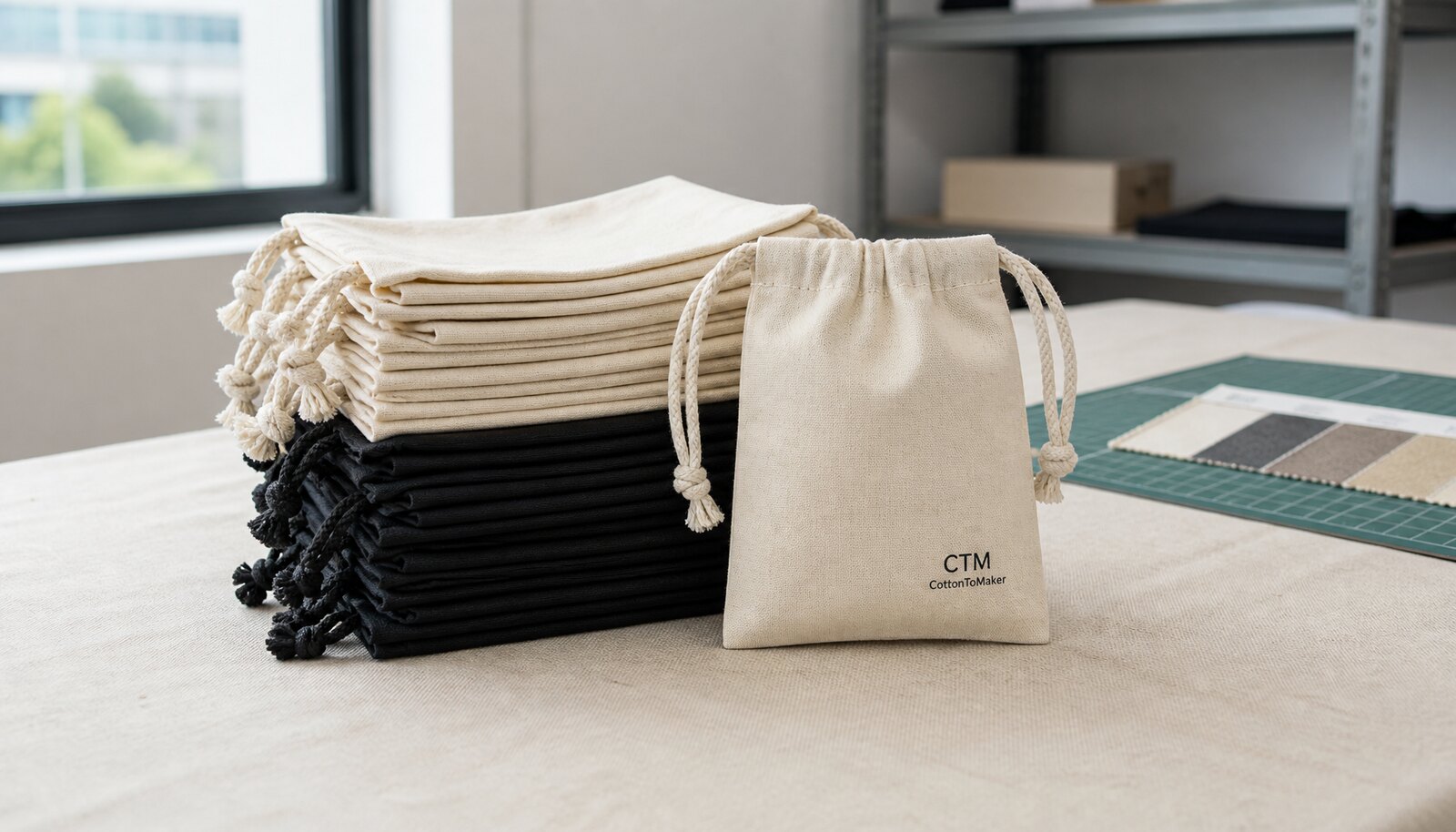
Why small drawstring pouches are a procurement item, not a simple giveaway
Small drawstring pouches for events are often treated as a low-risk accessory, but that is where buying teams get surprised. The pouch has to carry a logo cleanly, open and close quickly, survive handling at registration desks or on retail counters, and arrive packed in a way that fits the event schedule. If the pouch looks cheap, the brand looks cheap; if the closure fails, the gift inside becomes awkward to use.
The right RFQ should define the use case first. A pouch for jewelry samples, for example, needs a tighter weave and cleaner print than a pouch for conference swag cards. A pouch that will hold cosmetics or small bottles may need a stronger seam and a slightly larger opening. That is why suppliers should quote against the final use, not just a generic size.
- Typical event uses: product samples, VIP kits, jewelry inserts, cosmetics minis, conference swag, retail add-ons, and promotional handouts.
- Main failure points: weak cord, loose stitching, print smearing, fabric transparency, and poor carton counting.
Choose the right fabric weight before you compare prices
For most event programs, cotton muslin in the 120-180 GSM range is the practical starting point. At the lower end, the pouch feels light and economical, which works for short-life giveaways. Around 150 GSM, you get a better hand feel and better opacity without pushing cost too high. If the pouch carries heavier inserts or needs a more retail-ready look, a light canvas construction makes more sense, but buyers should expect higher fabric and sewing cost.
Do not compare quotes only by unit price if the fabric descriptions are vague. One supplier’s “cotton pouch” may be 120 GSM with thin cords, while another may be 180 GSM with a better weave and stronger hemming. The lower quote can disappear once you factor in complaints, rework, or a last-minute rush reorder.
- 120 GSM: best for light inserts, mailers, and simple giveaways where bulk freight cost matters.
- 150 GSM: balanced option for most events; usually the safest middle ground for feel and durability.
- 180 GSM: better for premium events, heavier items, and buyers who need reduced transparency.
Print method decisions affect both quote and product life
For small drawstring pouches for events, screen printing is usually the most cost-effective choice for one or two spot colors and mid-to-high volume. It gives strong logo opacity and predictable repeatability when the artwork is simple. If the art has more colors, gradients, or small type, heat transfer can look cleaner at lower quantities, but the buyer should inspect edge detail and wash/abrasion resistance if the pouch will be reused.
Embroidery is rarely the first choice for small pouches unless the brand wants a premium tactile effect and the logo size is large enough to sew cleanly. It adds cost, changes the hand feel, and can distort very light fabric. Buyers should also watch for print placement on the pouch face: a centered logo may look fine on a sample, but if the pouch is narrow, the art can sit too high once the drawcord channel is sewn.
- Screen print: best for simple logos, strong color blocks, and controlled unit cost.
- Heat transfer: useful for artwork with details, but validate crack resistance and edge finish.
- Embroidery: premium look, but only when the logo size and fabric weight support it.
How MOQ actually works on supplier quotes
MOQ on this product is usually driven by three things: fabric color, print setup, and sewing efficiency. A standard natural cotton pouch with one logo color may have a low MOQ because the factory can run one fabric, one print screen, and one sewing line setup. Add a custom dyed fabric, a second logo position, or mixed sizes, and the MOQ can jump quickly because the factory loses batching efficiency.
Buyers should ask whether MOQ is calculated per design, per size, or per color. That detail matters when an event program needs multiple regional versions. A supplier may quote a good unit price for 10,000 pieces, but if that is split into three artwork versions, the real MOQ per version may be too high for the project. It is better to simplify the program and use one core pouch with variable inserts or labels where possible.
- Best price path: one size, one fabric color, one print position, one or two spot colors.
- Highest cost path: custom fabric color, multiple logo placements, multiple sizes, and retail-style individual packing.
What a useful supplier comparison should show
A fair comparison between suppliers is not only about unit price. One factory may quote a lower number but leave out setup, labels, inner packing, or the correct carton count. Another may give a more complete quote with clearer production timing and a better sample process. Procurement teams should compare the route as well as the price: direct factory, trading company, or mixed sourcing with outside printing.
Direct factories are usually stronger on cost control and process visibility if they truly own the sewing and printing steps. Trading companies can be helpful when the buyer needs multiple accessory categories in one shipment, but the margin layer can obscure where quality risk sits. If the event schedule is fixed, the supplier with the clearest schedule and sample discipline may be worth more than the cheapest quote.
- Look for quote line items that separate fabric, print setup, sewing, packing, and cartons.
- Ask whether the supplier can show recent production photos of the same pouch construction.
- Treat unusually low pricing as a cue to inspect fabric GSM, cord quality, and pack-out detail.
Comparison table: sourcing routes for small drawstring pouches
The table below helps buyers compare sourcing routes rather than just isolated specs. For event pouches, the supplier model affects quote structure, sample speed, and how tightly the factory can control print and stitching. In practice, the best route depends on how repeatable the program is and how much risk the buyer can absorb.
For one-off event runs, a trading company may be acceptable if they can coordinate fast sampling. For repeat brand programs, a direct factory with in-house sewing and printing usually gives better control over cost and consistency.
- Write decisions in measurable language, not only descriptive wording.
- Ask for sample photos plus one physical approval sample for important orders.
- Keep quotation, sample approval, and inspection notes tied to the same spec version.
Sample approval should cover feel, fit, and closure behavior
A pre-production sample is not just a logo proof. It should show the actual fabric batch, drawcord, seam build, print finish, and finished size. Hold the sample with the intended insert inside it, not empty. If the pouch is for sample kits, use the real product dimensions and test whether the opening is wide enough and the cord closure sits evenly when pulled tight.
The approval note should be specific. For example: logo centered within a defined tolerance, no visible misregistration, drawcord ends heat-sealed or knotted as agreed, and seams free from loose thread. If the buyer needs a premium look, the sample should also confirm whether the pouch stands upright when filled or collapses too easily on the table.
- Sample check items: finished size, stitch count, fabric shade, logo placement, cord pull, and carton labeling.
- Reject the sample if the print shifts after folding or if the drawcord tunnels unevenly through the channel.
QC thresholds that prevent disputes at shipment
Quality control for small drawstring pouches for events should focus on the defects that matter in use, not on generic cosmetic language. A pouch with one or two tiny yarn specks may still be acceptable for a mass giveaway, but a misaligned logo or a weak side seam is not. Set acceptance criteria around function: the pouch must close evenly, the print must be legible at arm’s length, and the seam must hold the expected load without opening.
For import orders, define inspection intensity before production begins. If the order is large or the event date is fixed, buyers should request a mid-production check on stitching and an end-line inspection on packing counts. This is where many quote disputes are avoided: the supplier sees exactly which defect levels are acceptable before the cartons are sealed.
- Size tolerance should be stated in millimeters, not just “approximate.”
- Print defects should be tied to visibility and brand impact, not vague wording.
- Packing count should be verified by carton and inner bundle, especially for mixed SKUs.
Packing details that matter when the pouches are shipped for events
Event buyers often underestimate packing. If the pouches are being distributed at a venue, the shipment needs to arrive counted, labeled, and ready to allocate by team or location. Bulk packing is usually the best cost route, but the carton marking must be precise. If the same order includes multiple logo versions or colors, the supplier should separate by SKU and print a clear outer carton label so the event team does not waste time sorting on arrival.
Individual polybags can be useful for retail programs or premium kits, but they add labor, plastic, and cubic volume. If the buyer only needs protection during transit, a simple bulk inner bundle with export carton is usually the smarter route. Clarify whether the cords should be tied inside the pouch or left loose, because that changes packing speed and the final presentation.
- Typical efficient pack-out: bulk by 50 or 100 pieces per inner bundle, then outer export carton.
- Use carton labels with SKU, size, color, quantity, and artwork code.
- If retailers will receive the goods, specify whether hang tags or barcode stickers are required.
Lead time and landed cost: where the real schedule risk sits
A realistic lead time has more than one step: artwork confirmation, sample approval, fabric reservation, printing setup, sewing, inspection, and packing. Buyers who only hear a single factory number can miss the real bottleneck. The most common delay is not sewing; it is late artwork approval or a change in logo placement after sampling. Another common issue is fabric booking if the supplier is holding many event orders at the same time.
For landed cost, do not stop at EXW or FOB. Add carton volume, packing method, and freight mode. A cheaper pouch made from a heavier GSM or packed individually can increase the cubic cost enough to erase the apparent savings. Buyers comparing supplier quotes should calculate cost per delivered pouch and not just cost per factory unit.
- Schedule risk factors: artwork revisions, custom fabric color, peak season capacity, and delayed sample sign-off.
- Cost risk factors: higher GSM, second print location, polybagging, and oversized cartons.
- Best practice: lock the sample, then freeze the specification before mass production.
Specification comparison for buyers
| Spec decision | Recommended option | When it fits | Buyer risk to check |
|---|---|---|---|
| Source route | Direct factory with in-house printing and sewing | Repeat programs, tight control on fabric, print, and pack-out | Confirm whether printing and stitching are truly in-house or subcontracted |
| Fabric choice | Cotton muslin or light canvas at 120-180 GSM | Event giveaways, jewelry, cosmetics, small samples, conference kits | Too-light fabric can look transparent; too-heavy fabric raises cost and bulk |
| Closure style | Single or double drawcord with hemmed channel | Most event pouches where fast pack-out and easy opening matter | Thin cord may cut into the channel and fail after repeated use |
| Print method | Screen print for 1-2 spot colors; heat transfer for complex art | Logo-led event items with standard artwork and medium volumes | Fine lines, gradients, or small text can blur or crack if the method is mismatched |
| MOQ route | Standard colorway + one logo version | Buyers comparing multiple event dates or regional programs | Multiple sizes or colors can split MOQ and raise unit cost sharply |
| Packaging | Bulk packed by carton with count labels, optional individual polybag only if required | B2B event logistics where speed and freight efficiency matter | Retail-style individual packing adds labor, plastic, and carton volume |
| Quality standard | AQL-style inspection with emphasis on print placement, drawcord function, and stitching strength | Importers who need predictable acceptance criteria | General visual inspection without measurable thresholds leads to dispute |
| Lead-time route | Approved sample before mass production; reserve buffer for print setup and material booking | Event dates with fixed ship windows | Late artwork approval or fabric shortage can compress the schedule |
| Cost control | Keep size, fabric, and print count simple; change only one variable at a time | Budget-sensitive promotions and corporate events | Too many custom variables create hidden setup and waste costs |
Buyer checklist before sampling
- Confirm final bag size, gusset, handle drop, and usable loading weight.
- Specify fabric type, GSM/oz weight, color tolerance, and shrinkage expectations.
- Send vector artwork and define logo size, print position, and Pantone references.
- Ask for sample photos plus one physical pre-production sample before bulk approval.
- Agree carton packing, barcode or hangtag needs, and shipment marks before production.
- Record inspection checkpoints for stitching, print adhesion, stains, and quantity count.
Factory quote questions to send
- What exact fabric construction and GSM will you use, and is the GSM measured on greige fabric or after finishing?
- Is the printed logo screen printed, heat transferred, or embroidered, and what is the setup cost per color or per artwork version?
- What is the MOQ per size, per fabric color, and per print design, and how does the MOQ change if we add a second logo?
- What is included in the unit price: drawcord type, label, carton packing, inner bundles, and standard export carton test?
- Can you provide a pre-production sample with actual fabric, cord, stitching, and print, and how many days after artwork approval will it ship?
Quality-control points to confirm
- Finished size within agreed tolerance, especially width, height, and usable opening after the drawcord is closed.
- Fabric GSM and shade consistency across the lot, with no obvious thin spots, oil marks, or color variation beyond the approved sample.
- Stitching strength at side seams, bottom seam, and drawcord channel; no skipped stitches, loose threads, or seam pucker that distorts print placement.
- Print registration, color density, and edge sharpness; no cracking on fold lines if the pouch will be handled frequently at events.
- Drawcord operation: smooth pull, even closure on both sides, no fraying ends, and no cord slippage through the channel after repeated opening.
- Packing accuracy: correct count per inner pack and carton, correct SKU label, and no mixed sizes unless explicitly approved.