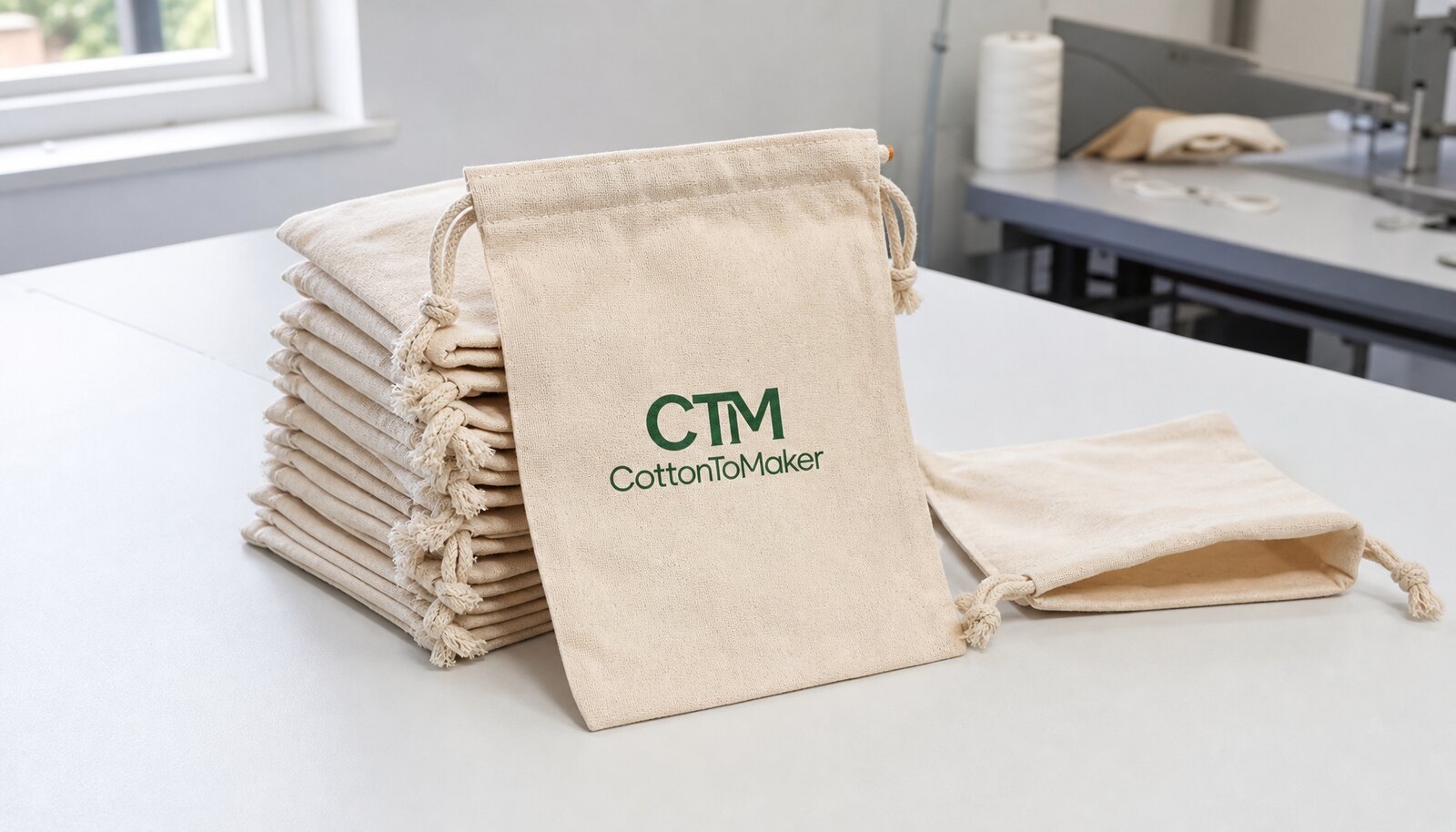
Why small drawstring pouches matter in ecommerce
Small drawstring pouches for ecommerce sit at the intersection of packaging, branding, and warehouse handling. They are often the first soft item a customer touches after opening the box, which makes the pouch part of the product experience rather than a disposable extra. That means the buyer cannot evaluate it the way a commodity bag is evaluated. The real questions are whether the pouch protects the contents, closes cleanly, prints consistently, and survives receiving, storage, picking, and customer handling without creating rework.
For procurement teams, the challenge is that pouch requirements vary by category. Jewelry, cosmetics, apparel accessories, sample kits, and promotional gifts all look similar in a catalog, but they fail for different reasons. A pouch for a necklace may need to prevent scratching and show a premium logo. A pouch for a skincare sample set may need faster pack-out and a cleaner bulk carton format. A pouch for bundled accessories may need stronger seam construction and a wider opening. The right source spec starts with that use case, not with a supplier’s standard size list.
- Treat the pouch as part of the customer experience and the fulfillment process.
- Define the function first: protection, presentation, speed of packing, or all three.
- Compare suppliers only after the use case is clear enough to write into the RFQ.
Translate the end use into a pouch specification
The most common sourcing error is choosing a pouch size before understanding the final packed item. Finished dimensions on a supplier page rarely tell you whether the product will fit comfortably once seam allowance, channel height, and closure slack are accounted for. If the pouch is too tight, the line slows down and the seam stress rises. If it is too large, the contents move around and the presentation looks careless. For ecommerce, that can matter as much as the print quality.
A useful spec starts with the item that will go inside. Record the actual length, width, thickness, and whether the surface scratches easily. If the pouch must hold a folded insert, a desiccant, or a barcode label, include that too. Then define the closing behavior: should the pouch sit snugly around the contents, or is a small visible top slack acceptable? When the buyer answers those questions before requesting quotes, the factories can price the correct construction instead of guessing from a generic sample image.
- Measure the packed product, not the loose product.
- Include inserts, labels, and protective layers in the fit calculation.
- State whether the pouch must close flush or can have visible slack at the top.
Fabric, weave, and GSM: what actually changes the result
For small drawstring pouches, cotton is still the default choice in many ecommerce programs because it prints well, feels natural, and supports a premium unboxing moment. Plain-weave cotton in the 120-140 GSM range is a practical starting point for most light retail and insert applications. It is usually strong enough for normal handling without becoming stiff or bulky in carton pack. If the contents are heavier, or if the pouch is expected to be reused frequently, moving to a heavier cloth can help structure and durability, but it also increases material cost and freight volume.
GSM alone does not tell the whole story. Weave tightness, slub level, finishing, and shrinkage behavior also affect appearance and performance. A loose weave may make small text less legible and can let darker contents show through. A tighter weave can improve opacity and print clarity but may cost more and may feel less soft in hand. If a brand is very sensitive to shade control, ask whether the fabric is stock dyed, piece dyed, or custom dyed, because the lead time and repeatability are different. The best comparison is not 'cotton versus polycotton' in the abstract; it is the exact cloth, finish, and tolerance the supplier can consistently hold.
- Use GSM as a starting point, not as the whole spec.
- Ask for weave type, shrinkage behavior, and shade control on dyed cloth.
- Check whether the pouch needs opacity, softness, or stronger structure before locking the fabric.
Construction details that affect durability more than the mockup does
Most pouch failures come from sewing details, not from the logo. The top channel is a stress point because it carries the drawcord load every time the pouch is opened or closed. If the stitching is uneven, if the channel is too narrow for the cord, or if the cord ends are poorly finished, the pouch becomes annoying to use and more likely to fail in transit. Buyers should ask where the channel is stitched, whether the side seams are locked, and how the drawcord is anchored at the ends. Those details should be written into the quote, not left to factory habit.
The closure style should match the contents. A single drawcord is usually enough for light ecommerce inserts and small gifts. A double drawcord can help with larger or heavier items, but it adds material and sewing steps. If the pouch is expected to be opened repeatedly by end customers, cord material also matters. Cotton cord supports the natural textile look, while polyester cord may be more consistent and resistant to fraying in some builds. If the brand is shipping premium goods, ask for a sample with the exact cord diameter and channel construction you plan to use, because the visual difference between a clean pouch and a sloppy one usually shows up at the opening edge.
- Put the channel construction and cord anchoring in the RFQ, not just the size and print.
- Match the closure style to the weight and handling frequency of the contents.
- Verify that the cord slides smoothly and does not pull out under normal use.
Print and branding choices: compare durability, cost, and shelf effect
Printing is where quote comparisons often become misleading. A supplier can offer the same logo on two prices that look close on paper but differ in setup fees, color count, and cure process. For a simple one-color logo, screen print is usually the most practical route because it is cost-effective and durable enough for most ecommerce pouch programs. It also keeps the surface textile-like, which matters for brands selling beauty, wellness, gifting, or artisan products. If the artwork is highly detailed or includes small type, the buyer should verify legibility at the actual print size instead of assuming the art will scale cleanly.
Heat transfer and digital methods can work for short runs or complex graphics, but they change the feel of the pouch and may not wear the same way as a direct print. For programs where the pouch will be reused as a storage item, a woven label or small woven brand tag can be a cleaner solution than a large print field. That reduces risk of cracking and may look more premium over time. The procurement point is simple: choose the branding method based on use case, not on what happens to be easiest for one quote cycle.
When a factory quotes print, ask what is included in the placement, size, and color count. A logo on the front center is not equivalent to a logo on the lower corner, and a one-color mark is not equivalent to a two-color layered print. The quote should also state whether any registration tolerance is acceptable, especially for multi-color art. Without that detail, different suppliers are not really bidding on the same product.
- Screen print is usually the best starting point for simple, repeatable branding.
- Use woven labels when the pouch should look premium and remain usable after repeated handling.
- Require the quote to spell out print area, color count, and placement tolerance.
How to build an RFQ that suppliers can actually quote against
A good RFQ for small drawstring pouches for ecommerce should be specific enough that two factories can quote the same product without guessing. Start with the finished size and the intended contents. Add fabric composition, target GSM, weave type, cord material, and the print method. Then specify packing, carton format, and the inspection standard. The more the buyer leaves implicit, the more the quote will hide differences in fabric source, sewing steps, or packing labor. That is how low prices look comparable when they are not.
The same discipline should apply to commercial terms. Ask the supplier to separate fabric, sewing, print, packing, and carton charges where possible. If setup fees exist, ask for them in writing. If the supplier offers a tiered price, request the next break point so the team can judge whether volume consolidation is worth the inventory risk. For a first order, keep variables low: one size, one color family, one print version, and one packing standard. That is the cleanest way to isolate whether the pouch itself is viable before the order becomes a multi-SKU program.
A useful RFQ also names the reference documents. Attach the artwork file, the target product dimensions, and the signed sample photo or measurement sheet. If the pouch must fit a fulfillment center's process, say that upfront. If the factory is expected to barcode the cartons or individual units, include the label format. Buyers who leave those details out often end up paying more later in revisions than they saved in the initial quote.
- Keep the first order simple enough to compare suppliers on equal terms.
- Ask for separate line items so hidden setup costs are visible.
- Attach artwork, target dimensions, and packing rules to the RFQ.
How to judge supplier quality beyond the brochure
For branded pouch programs, supplier evaluation should go beyond price and a few product photos. The buyer needs enough evidence to understand where the fabric comes from, how the dye is controlled, and how the factory inspects finished goods before shipment. A direct factory is often the better fit when repeatability matters, because the buyer can ask about the sewing line, the fabric source, the dye lot, and the inspection process directly. A trading company can still be useful when the order needs category consolidation, but the buyer should expect less direct visibility into the actual production floor.
The useful evidence is practical, not theatrical. Ask whether the factory can identify the fabric source or mill, whether it keeps shade control records for dyed cloth, and whether it can share inspection photos or a pre-shipment report. If the order uses custom-dyed fabric, request the shade band or approved sample reference. If the supplier claims a quality standard, ask for the actual inspection method rather than the label. A good factory will not only say 'we inspect'; it will explain the defect categories it checks, how many cartons it opens, and what it does when the lot fails. That is the difference between a vendor who sells pouches and a supplier who can support a procurement program.
Landlocked cost matters here too. A unit price that looks attractive can be offset by oversized cartons, extra polybag steps, or an unclear sample process that creates multiple rounds of revision. The cheapest quote is often the one that leaves the fewest unanswered questions, not the one with the lowest line item on day one.
- Ask who actually makes the pouch and where the fabric comes from.
- Request dye-lot or shade control evidence when color consistency matters.
- Compare suppliers on landed cost, not only on unit price.
Sampling and approval: lock the reference before mass production
Sampling should reduce uncertainty, not create a parallel debate. The most useful sample is a pre-production sample built from the same fabric, cord, print method, and sewing approach that will be used in bulk. If the factory sends several versions, the buyer needs to identify one sealed gold sample and store it against the same spec version as the purchase order. That prevents later arguments about which version was 'approved.' The sample becomes the control point for size, print placement, shade, and construction.
Before approving a sample, test it with the real contents or with a dummy load that matches the size and weight of the final item. Check how the pouch opens and closes, whether the cord feels too short or too long, and whether the product causes the fabric to bulge or distort. If the pouch is part of a gift set, pack it the same way the warehouse will pack it. A sample that looks fine on a desk can fail once it is handled at speed, folded into a kit, or packed in a tight carton. That is why approval should cover both appearance and packability.
For custom-dyed or branded programs, the buyer should also ask for close-up sample photos that show seam finish, print edge clarity, and the inside of the channel. Remote approval is workable when the images are detailed and the measurement sheet is complete, but it should not replace a physical sample for important launch orders.
- Use one gold sample tied to the final spec version.
- Test the sample with the actual contents or a matching dummy load.
- Approve both appearance and packability, not just logo placement.
QC thresholds that prevent avoidable returns and repacks
Quality control for small drawstring pouches should be written in terms the inspector can measure. A useful starting point is zero tolerance for critical defects, AQL 2.5 for major defects, and AQL 4.0 for minor defects, with tighter limits for premium retail-facing programs. The defect list should distinguish function from appearance. A broken cord channel, missing cord, or open seam is a major functional failure. A small loose thread or slight shade variation may be minor if it does not affect the customer experience. Without this taxonomy, factories and buyers often argue about the same defect using different language.
Measurement should be tied to the approved sample. Finished size should be checked flat, after the fabric has been conditioned to room temperature and humidity if possible. The buyer should define which dimensions are critical: length, width, opening width, or all three. If the pouch is printed, set placement tolerance for the logo so the mark does not drift from one lot to the next. For small formats, even a few millimeters of movement can make a centered design look off. A good QC plan also checks stitch density, seam alignment, and the integrity of the top channel, because those are the most common stress points in use.
Packaging needs its own checks. Ask the supplier to confirm carton count, bundle count, and barcode placement. If cartons will be stacked or shipped long distance, run a simple validation on a sample carton: a face-and-corner drop from handling height, followed by a visual check for crushed corners, displaced pouches, or print scuffing. If the pack-out is fragile, add a compression or top-load check on the packed carton before release. These tests are not complicated, but they are more useful than a generic 'looks fine' sign-off.
- Use an AQL-based inspection plan with named critical, major, and minor defects.
- Measure the finished pouch flat and compare it to the signed sample and tolerance sheet.
- Validate packed cartons with a basic drop and compression check before shipment.
Packing, freight, and warehouse handling details that change the real cost
Packing is one of the easiest places to lose money on small drawstring pouches because the product itself is light, but the carton design, inner bundles, and retail presentation can add cost fast. Bulk packing is usually the best option for fulfillment-driven ecommerce programs because it reduces labor and plastic use. If the pouch will go directly into a warehouse picking flow, clear bundle counts and carton marks can matter more than retail packaging. The receiving team needs to know how many units are in each carton, how many inner bundles exist, and whether any units are protected from print rub or moisture during transit.
If the pouch needs to be sold as a retail accessory or presented as part of a premium kit, individual polybags or insert cards may be justified. That decision should be intentional, because it changes not just unit cost but also carton volume and receiving speed. Buyers often underestimate the freight impact of loose packing or over-pack the product to protect the print. The better approach is to define the pack standard based on the route to the customer: warehouse shelf, kitting line, retail shelf, or direct shipment. Each path has a different tolerance for labor, damage, and presentation.
Carton dimensions should always be part of the quote package. A pouch with a low factory price can still be expensive to move if the carton is oversized or the stackability is poor. For larger orders, ask for carton dimensions, net weight, gross weight, and the count per carton so the logistics team can estimate pallet efficiency and cube utilization without assumptions.
- Use bulk packing for warehouse-first programs unless retail presentation requires more.
- Include carton dimensions and gross weight in the quote set.
- Treat inner bundles, labels, and moisture protection as costed decisions, not defaults.
Specification comparison for buyers
| Spec decision | Recommended option | When it fits | Buyer risk to check |
|---|---|---|---|
| Fabric weight | 120-140 GSM cotton as the default starting point | Best balance for jewelry, cosmetics, sample kits, and gift inserts where the pouch must look neat, print clearly, and stay light in fulfillment | Too light can show contents and wear quickly; too heavy raises unit cost and adds bulk to carton volume |
| Fabric type | Plain-weave cotton for the most common ecommerce use cases | Works well when the brand wants a natural retail look and the pouch will be handled mostly as packaging, not as a heavy-duty carry bag | Shade variation, shrinkage, and weave slub level need to be controlled batch to batch |
| Alternative fiber route | Polycotton when you want a smoother handfeel or slightly better dimensional consistency | Useful for mixed-channel programs where unit cost and wrinkle control matter more than a fully natural textile look | Can feel less premium in beauty, gifting, and artisan categories if the buyer expects a natural cotton finish |
| Closure construction | Single drawcord with reinforced channel for light loads; double drawcord only when contents are heavier or the opening is wide | Fits most ecommerce inserts, bundled products, and small retail gifts | Weak channel stitching and poor cord anchoring are the main transit-failure points |
| Print method | Screen print for simple logos; woven label for premium re-use; heat transfer only for small, complex, or short-run art | Best for one- to two-color branding and repeat replenishment orders | Fine text can fill in on screen print, and transfer graphics can crack or lift under abrasion |
| Size strategy | Standardize one or two pouch sizes that map to actual product dimensions | Good for brands with repeat SKUs, subscription kits, or a stable fulfillment line | Too many sizes create MOQ pressure and make quote comparison messy |
| Supplier route | Direct factory for repeat volumes and specification control; trading company only when you need mixed-category consolidation | Best when the buyer wants traceability on fabric, dye, and sewing details | Trading layers can hide the true fabric source and add margin without improving execution |
| Color route | Stock natural or stock-dyed fabric for speed; custom dye only when the brand standard requires it | Use stock fabric for pilot programs and time-sensitive launches | Custom dye can add sampling rounds, shade-band approval, and lead-time risk |
| Packing method | Bulk packed by carton with clear size and count labels; retail polybag only when shelf presentation is required | Ideal for warehouse fulfillment and B2B resale | Retail-ready packing adds labor and plastic cost; loose bulk packing can crease prints if separation is poor |
Buyer checklist before sampling
- Measure the actual packed product, including any card, insert, desiccant, or protective wrap, before choosing pouch size.
- Write the finished size, not the cut size, and state whether tolerances apply to width, length, opening, or all three.
- Define fabric by composition, weave, target GSM, and whether the cloth must be pre-shrunk or piece-dyed.
- Lock the print method, print area, color count, and acceptable registration or placement tolerance in the RFQ.
- Specify cord material, cord diameter, cord end finish, and whether the channel needs bar-tacks or extra reinforcement.
- State the packing method clearly: bulk carton, inner bundle count, retail polybag, barcode label, insert card, or mixed assortment.
- Request a pre-production sample and keep one sealed gold sample tied to the same spec version as the PO.
- Ask the supplier to break out fabric, sewing, print, packing, and carton charges so landed cost can be compared line by line.
- Request mill or fabric source information, dye lot traceability where relevant, and the pre-shipment inspection method.
- Confirm carton dimensions, carton count, and gross weight if the pouches will move through a fulfillment center or palletized warehouse.
Factory quote questions to send
- What is the exact finished size after sewing, and what tolerance do you accept on length, width, and opening width?
- What fabric composition, weave, and GSM are included in the quote, and is the cloth pre-shrunk, piece-dyed, or stock dyed?
- What is the cord material and diameter, and is the channel stitching reinforced at the top edge?
- How many print colors are included, what is the print area, and are setup fees or plate fees separate from the unit price?
- What packing is included in the base price: bulk pack, inner bundle count, polybag, barcode sticker, or retail insert card?
- What is the MOQ by size, color, and print version, and how does the unit price change at the next volume tier?
- Can you identify the fabric source or mill, and if the fabric is custom dyed, what shade control documents do you provide?
- What sample stages are included, how are sample charges handled, and will sample cost be credited against the bulk order if approved?
- What inspection standard do you use before shipment, and will you share carton photos, count checks, and defect photos if issues are found?
- What is the lead time from artwork approval and sample approval, and which steps can extend it if the buyer changes details late?
Quality-control points to confirm
- Use a starting acceptance plan of zero tolerance for critical defects, AQL 2.5 for major defects, and AQL 4.0 for minor defects, then tighten it if the brand is premium or the pouch is highly visible at retail.
- Measure finished pouch size flat on a conditioned sample, excluding the cord, and compare against the signed gold sample and the written tolerance; do not rely on cut-size claims.
- Classify defects in the PO: critical includes broken cord channel, unsafe metal contamination, or missing product protection; major includes open seams, severe misprint, or wrong size; minor includes loose threads, small shade shifts, or light crease marks.
- Check stitch quality along the side seams, bottom seam, and top channel; look for skipped stitches, uneven stitch density, seam puckering, and stitch-back at stress points.
- Test the cord by opening and closing the pouch repeatedly and by applying a reasonable pull that reflects your use case; the cord should move smoothly, stay anchored, and not cut into the channel.
- Verify print quality against the approved sample for placement, ink density, curing, and rub resistance; no cracking, smearing, bleeding, or obvious misregistration should be present.
- Inspect color against the approved shade or sample lot under consistent lighting, especially if the order uses dyed fabric or is split across more than one production batch.
- Review carton pack counts and labels against the packing list, and confirm inner bundles or polybags match the stated count per carton.
- Run a packaging check on one or two sample cartons: corner/face drop from handling height, then inspect for crushed corners, count loss, or print scuffing after transit simulation.
- If the cartons will be stacked in warehouse storage, ask for a simple compression or top-load check on the packed carton so the pouch shape and print are not damaged by storage pressure.