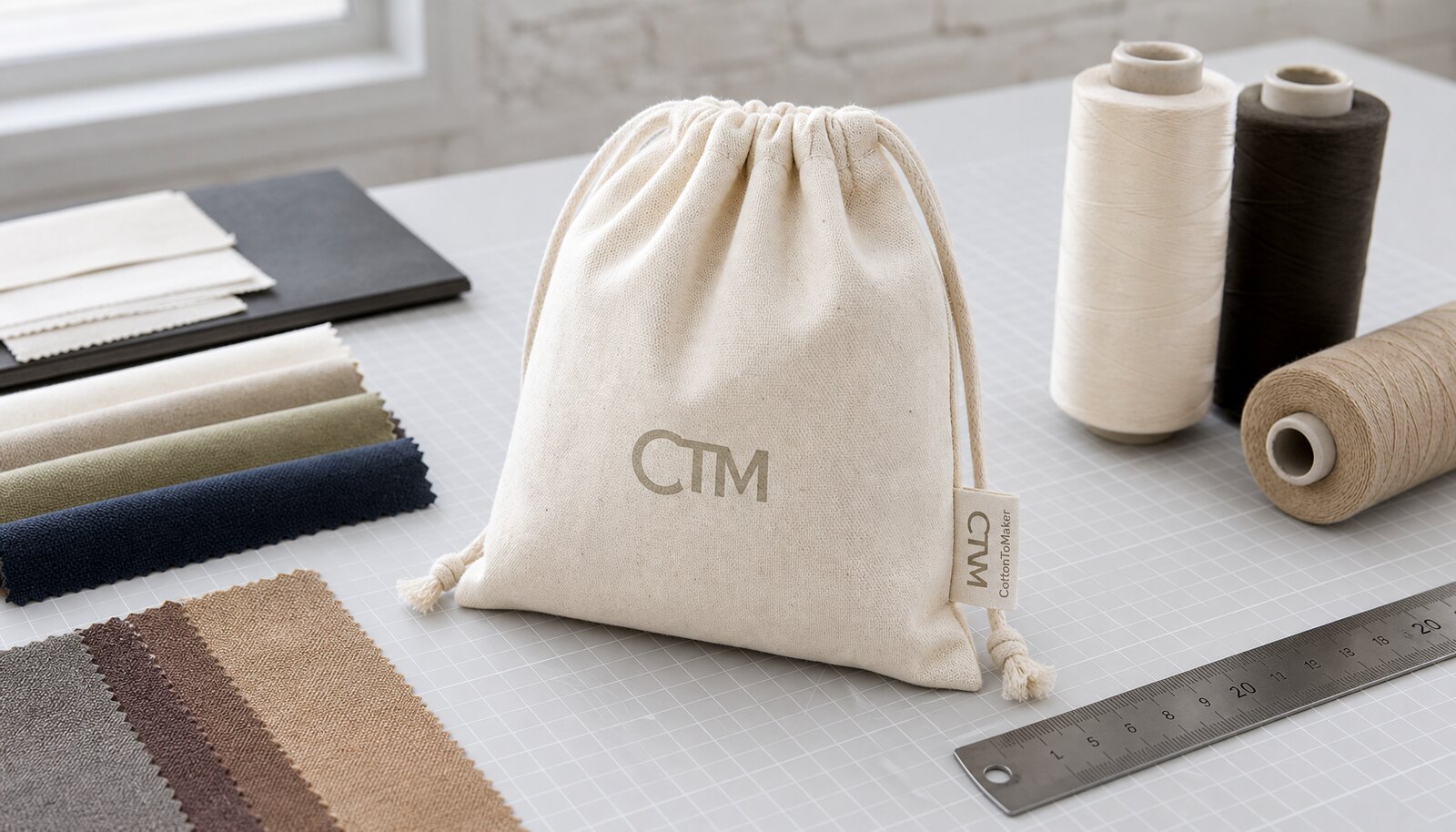
Why small pouches are a launch item, not just packaging
For a brand launch, small drawstring pouches do more than hold the product. They shape the first physical impression, protect delicate items in transit, and help buyers decide whether the pouch belongs in a retail set, a PR kit, or a gift bundle. If the pouch feels thin, opens unevenly, or carries a weak logo print, the whole launch can look underdeveloped. Procurement teams should treat the pouch as a branded component with its own spec, not as an afterthought added at the end of the timeline.
The buying problem is usually not the pouch itself. It is the mismatch between the brand intent and the factory interpretation. A marketing team may say "simple natural pouch," while the factory quotes a loose cotton bag with no size tolerance, no print standard, and no packing plan. That gap creates surprise at approval stage. The right RFQ turns the pouch into a measurable item: finished size, GSM, cord, print method, carton count, sample path, and the launch date it has to support.
- A launch pouch must protect the product, support the brand image, and survive warehouse handling.
- The RFQ should define the pouch as a packaged component, not as generic packaging stock.
- The most common failure is not price, but unclear expectations on fabric, print, and finishing.
Start with size, fabric, and closure before you talk artwork
The fastest way to overpay for small drawstring pouches for brand launches is to start with the logo before the structure. The factory needs the finished size, the product dimensions that will sit inside the pouch, and the kind of hand feel the brand wants. For light items such as jewelry, samples, or cosmetics, 100-120 gsm cotton is usually enough if the pouch is not meant to look premium on its own. For retail gifts or high-touch launches, 140-180 gsm cotton canvas gives better body and less transparency.
Closure details matter more than many buyers expect. A narrow cord looks clean but can cut into the fabric channel if the fill weight is too high. A slightly wider cotton cord is often more durable and gives a more balanced look. If the pouch is used as a reuse item, consider whether the opening should be easy to pull, whether the top hem needs reinforcement, and whether the bag should stand upright when filled. Those details change sewing cost, appearance, and failure rate.
- Define finished dimensions after sewing, not cut size on the pattern.
- Match fabric weight to the contents and the launch positioning.
- Specify cord material, cord diameter, and whether the top should have a clean channel or a folded hem.
- If the pouch holds sharp or heavy items, ask for reinforced corners and stronger stitch density.
Choose the print method based on launch volume, not taste
Logo choice should follow the order profile. For one-color brand marks, screen print remains the most practical method for pouches because it is stable, repeatable, and easy to quote. It also keeps the artwork readable on cotton weave. If the launch uses a multicolor brand image or very small text, heat transfer can work for short runs, but the buyer should test the hand feel and wash resistance. Embroidery can look premium, but on small pouches it can distort fine details and raise cost quickly. Woven labels are useful when the pouch itself should feel like a branded accessory rather than a disposable pack-out item.
For procurement, the main issue is not whether the print looks good in a sample photo. It is whether the print survives the way the pouch will actually be used. If the bag is tossed into shipping cartons, handled by retail staff, or rubbed against other items, the logo needs enough opacity and curing strength to avoid cracking or offsetting. The approved sample should state the print method, the ink type or thread type where relevant, the artwork size, and the exact placement tolerance. Without that, bulk production can wander by several millimeters and still look "close enough" to the factory.
- Use screen print for simple, repeatable logo work on cotton or canvas.
- Use heat transfer only when the artwork demands detail that screen print cannot hold.
- Use embroidery or woven labels when the pouch must feel premium and durable.
- Lock the artwork size and placement tolerance before bulk approval.
What drives quote differences between suppliers
When buyers compare quotes for small drawstring pouches, the unit price alone is not a reliable signal. Two suppliers can quote the same pouch size and still build the cost from different assumptions. One may include heavier fabric, tighter stitching, and carton packing. Another may be quoting a thinner cloth with a simpler print and looser tolerance. That is why quote comparison should separate fabric cost, sewing cost, print setup, packing, and export carton cost. If the supplier refuses to break out the structure, the buyer has less leverage when something shifts later.
MOQ logic also affects the real commercial decision. A factory may give a lower unit price once the order reaches a certain threshold, but the launch may not need that many pieces in one artwork version. In that case, the supplier with a slightly higher unit price but lower color MOQ may be the better choice. If the launch has multiple SKUs, ask whether the MOQ applies per size, per color, or per print file. Mixed-SKU launches often fail at the quote stage because the buyer assumes one total quantity will unlock the best price across every version.
- Ask for a quote split by fabric, sewing, print, packing, and cartonization.
- Compare MOQ by size, color, and artwork version, not only by total order quantity.
- Make sure the supplier states whether the unit price includes inner polybags, inserts, or barcodes.
- Look for hidden costs such as sample charges, screen setup, embroidery digitizing, or label application.
Direct factory, trading company, or local decorator: choose the route that fits the launch
Direct factory sourcing gives the best control when the launch needs repeatability, a clean approval path, and a realistic bulk schedule. It works well when the buyer already knows the target fabric, print method, and packing standard. The tradeoff is that the buyer has to manage a clearer technical brief. A factory will usually give a sharper price when the spec is stable, but it will also expect the buyer to accept normal production constraints such as stitch tolerance and color variation within an agreed band.
Trading companies and local decorators can be useful when the launch is small, time-sensitive, or spread across multiple product categories. A trading company can coordinate mixed orders and consolidate communication. A local decorator can print or label imported blank pouches quickly. The risk is control. If the buying team cannot see where the pouch is sewn, printed, and packed, it becomes harder to hold one party responsible when samples and bulk diverge. For brand launches, the lower friction route is not always the lower-risk route.
- Direct factory: best for repeat launches and technical control.
- Trading company: best when you need one commercial contact for a mixed program.
- Local decorator: best for short domestic timelines, but inspect blank quality and print durability carefully.
- The right route depends on how much technical control the launch needs, not just on unit cost.
Use a sample ladder, not a single approval moment
A launch pouch should not move from email mockup to mass production without at least one physical sample review. The useful sequence is usually artwork proof, pre-sample, and preproduction sample if the order is large or the branding is strict. The first sample confirms size, fabric feel, cord behavior, and logo placement. The preproduction sample should reflect the exact bulk method, including the final fabric lot, print setup, label, and packing style. If the supplier can only provide a visual approval picture, the buyer is taking a quality risk that usually shows up in carton opening, not in the quote itself.
Sample approval should be specific enough that a production supervisor can use it. Write down the accepted measurements, the approved Pantone reference or print reference, acceptable needle marks, and any packaging details that must not change. If the launch uses more than one pouch size, approve each size separately. It is common for a factory to get one size right and treat the second size as a variation. That shortcut creates mismatched brand presentation when the pouches are packed together in one set.
- Approve size, fabric, logo placement, closure, and packing separately.
- Require the bulk reference sample to match the production method, not just the artwork.
- For multi-size launches, approve each size and artwork version as its own item.
- Keep a written approved sample standard with measurements and visual notes.
QC thresholds that prevent launch-week surprises
The best QC plan for small drawstring pouches focuses on a few failure points that actually matter in use. The opening should draw smoothly and close evenly. Side seams should not twist. The logo should sit centered enough that the pouch looks intentional when displayed or photographed. Fabric should match the approved hand feel and weight, especially if the launch depends on a premium unboxing moment. Buyers do not need a huge inspection checklist; they need the few checks that reveal whether the factory understood the product.
Acceptance criteria should be practical. For example, a minor thread tail can be trimmed, but a crooked logo, uneven cord length, or a visibly off-size pouch should be rejected or reworked. If the pouch is part of retail packaging, count accuracy matters as much as appearance. A carton short by a few pieces creates downstream problems for warehouse intake and store allocation. A buyer-friendly QC plan sets tolerances that are strict where the customer sees the issue and flexible where the factory can correct it without rework.
- Inspect finished size, seam alignment, cord action, print position, and count accuracy.
- Reject visible artwork drift, twisted seams, and uneven cord exits.
- Treat carton count and SKU separation as core quality issues, not packing details.
- Use the approved sample as the only reference for subjective issues like hand feel and print tone.
Packing, labeling, and distribution setup matter more than buyers expect
Launch programs often fail at the distribution stage, not the sewing stage. A pouch that looks fine in bulk can become a warehouse problem if cartons are packed too tightly, labels are inconsistent, or the bag count per carton is not fixed. If the pouches are destined for retail shelves or e-commerce bundles, the packing format should be planned before production starts. That includes whether each pouch needs a polybag, a barcode label, a size sticker, a master carton mark, or a carton drop test standard. These details affect labor, time, and the final landed cost.
If the pouch is a reusable brand item, bulk packing may be the right choice. If it has to enter a retail DC, individual packing may be mandatory. The buyer should define whether the logo must remain visible through any inner bag, whether the label goes on the back seam or carton only, and how the cartons are stacked. The factory should also state how many pieces fit into each carton and whether the carton size changes by color or size. These are small points until the goods arrive and the receiving team cannot reconcile the shipment.
- State whether the pouch needs bulk packing, individual polybagging, or retail-ready labeling.
- Set carton count, carton dimensions, and carton mark requirements before bulk starts.
- Protect barcode or SKU stickers from covering the logo or leaving adhesive residue.
- Align packing with the warehouse or DC receiving rules, not only with factory convenience.
How to compare landed cost without losing sight of launch risk
A true landed-cost comparison should include more than the factory unit price. For small drawstring pouches, the meaningful line items are fabric, sewing, print setup, sample cost, packing labor, cartons, inland transport, and any additional decoration or label application. If the buyer only compares FOB unit prices, the cheapest quote may become the most expensive option once cartonization, rework, or rush shipping is added. The cleaner approach is to compare each quote on the same assumptions and then ask what changes if the launch quantity increases or if the artwork changes from one color to two.
The final decision should balance cost against launch risk. A slightly higher quote from a supplier that can hold size tolerance, give a clean sample, and meet the timeline is often the better buy. The savings from a lower quote disappear quickly if the team has to reapprove artwork, replace damaged cartons, or split shipments because the production date slipped. For procurement teams, the goal is not the lowest number on paper. It is the lowest-risk landed cost for the launch deadline, with a pouch that still looks like part of the brand.
- Compare quotes on the same fabric, print, packing, and carton assumptions.
- Include sample charges, setup fees, and packing labor in the decision.
- Measure supplier risk by approval speed, sample accuracy, and schedule reliability.
- Choose the quote that protects the launch date and the brand look, not just the headline unit price.
Specification comparison for buyers
| Spec decision | Recommended option | When it fits | Buyer risk to check |
|---|---|---|---|
| Source route | Direct factory with pouch sewing and printing in-house | Best for repeat launches, tighter spec control, and orders that need stable lead time | Confirm the factory actually cuts, sews, prints, and packs the pouch instead of outsourcing the critical steps |
| Source route | Trading company with verified factory backing | Useful when the launch includes multiple SKUs or when the buyer needs one commercial contact | Watch margin stacking, unclear responsibility for defects, and sample-to-bulk drift |
| Source route | Local decorator using imported blank pouches | Fits very short domestic timelines or small launch events | Check shrinkage, seam strength, and whether decoration damages the pouch after washing or handling |
| Fabric choice | 100-120 gsm cotton | Good for light cosmetics, jewelry, small accessories, and launch inserts | Thin fabric can look cheap, show contents, and distort logo placement |
| Fabric choice | 140-180 gsm cotton canvas | Better for premium gifting, retail launches, and reuse-driven branding | Heavier cloth raises unit cost and can need wider cord channels or stronger stitching |
| Print method | 1-color screen print or a restrained 2-color print | Most efficient for logo-first launches with clear brand marks | Confirm print opacity, hand feel, and cure quality so the ink does not crack or offset |
| Print method | Woven label or embroidered mark for premium positioning | Works when the pouch itself must feel like a keep item, not only a pack-out bag | Check minimum line width, stitch density, and whether the logo loses detail at small size |
| Packing route | Bulk packed in export cartons with inner polybag protection only if needed | Best for lower cost and high-volume distribution | Require carton count, carton size, and stack limits so the goods survive warehouse handling |
| Packing route | Individual polybag plus barcode or SKU sticker | Needed for retail-ready launches, DC intake, or e-commerce bundling | Make sure the sticker position does not cover the logo or create adhesive residue |
Buyer checklist before sampling
- Final pouch size with finished dimensions, not flat cutting size
- Fabric weight, weave type, color, and whether the cloth is pre-shrunk
- Cord material, cord diameter, closure style, and knot or stopper details
- Logo file, print method, imprint size, Pantone target, and placement tolerance
- Target MOQ by color and by artwork version
- Packing spec, carton count, and whether polybags or barcode labels are required
- Sample approval standard covering fabric hand feel, stitching, and print accuracy
- Required lead time for sample, preproduction sample, and bulk shipment
Factory quote questions to send
- What are the finished dimensions, fabric GSM, cord type, and closure construction in your quotation?
- Is the quoted price based on direct production in your own factory or on an outsourced process stage?
- What is the MOQ per color, per size, and per print version, and does a one-color logo change the MOQ?
- Which print method is included, what is the setup fee, and how many colors are covered in the unit price?
- What sample types can you provide before bulk production, and what is the sample lead time?
- How are the pouches packed for export, how many pieces per carton, and what carton size do you use?
Quality-control points to confirm
- Finished size within the agreed tolerance, especially opening width and pouch depth
- Seam strength at side seams, base corners, and cord channel with no skipped stitches or loose thread tails
- Print position centered within the allowed offset and color matched against the approved artwork reference
- Fabric weight and hand feel consistent across the lot, with no obvious shade variation between cartons
- Cord action smooth enough for repeated open-close use, with no fraying, kinks, or uneven lengths
- Packing count accurate by carton, with no mix-up between sizes, SKUs, or artwork versions