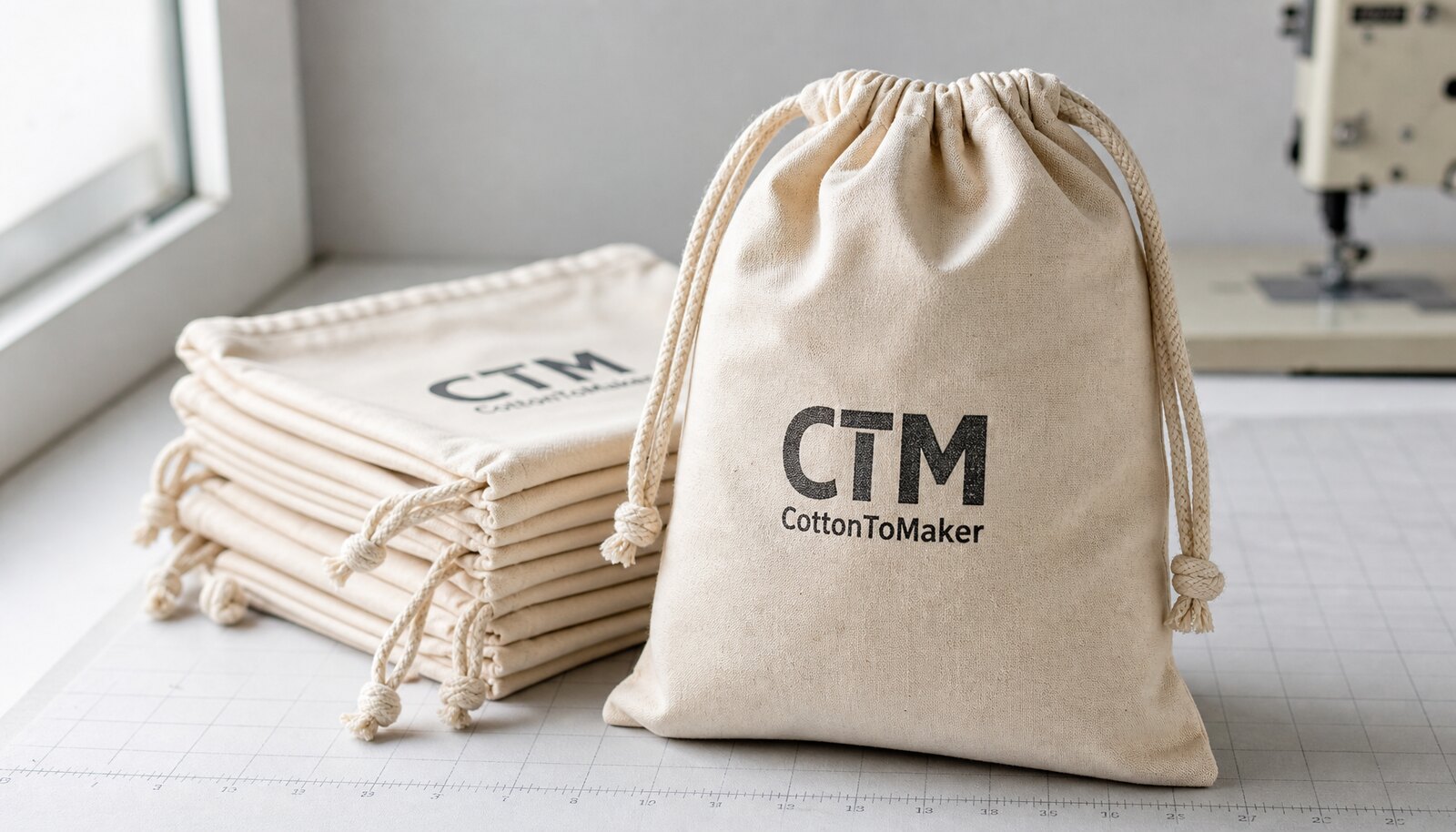
What Buyers Really Mean By Small Drawstring Bags With Logo
For procurement teams, "small drawstring bags with logo" usually means a pouch that is used for packaging, giveaway sets, or retail presentation rather than a general gym bag. The size is the first decision, because small pouches are often sold in several close dimensions that look similar on paper but behave differently in use. A 9 x 12 cm pouch can work for jewelry or samples, while a 12 x 16 cm or 15 x 20 cm bag is more practical for cosmetics, candles, or accessory kits.
The logo is the second decision, and it is where many quotes become misleading. A supplier may quote the same bag body for a one-color screen print, a woven label, and an embroidered mark, but the production effort and rejection risk are not the same. If the bag is meant to sit on a retail shelf, buyers usually care about crisp logo edges, consistent cord length, and carton presentation; if it is for events, the priority shifts toward unit cost and stable bulk output.
- Use a small pouch spec only when the product inside is light enough that the cord and seams will not deform.
- Define the exact use case in the RFQ: packaging insert, retail accessory, event giveaway, or sample pouch.
- Do not rely on the supplier's stock photo size; ask for a measured sample or a flat-lay dimension sheet.
Choose The Right Fabric Weight Before You Talk About Print
Fabric choice drives cost, print quality, and how the bag feels in the hand. For small cotton pouches, common ranges are 55-90 GSM for lightweight muslin, 100-140 GSM for basic cotton, and 180-280 GSM for heavier canvas-style pouches. A lightweight muslin bag folds neatly and suits jewelry or sample kits, but it will show contents and may not hold a dense printed logo as cleanly as a tighter weave. Heavier canvas gives a cleaner print surface and a more premium feel, but it also increases cost and carton weight.
Do not assume that a heavier bag is always better. For small drawstring bags, a high GSM fabric can make the pouch bulky, which matters if the bag must fit inside a product box or ship in large quantities. If the bag is for cosmetics or premium accessories, a tighter weave around 120-160 GSM often gives the best balance between print clarity, shape retention, and landed cost. If the bag is for lightweight samples, the buyer may save money by accepting a thinner fabric as long as seam strength and opacity are still acceptable.
- Ask for fabric weight in GSM, not only by marketing name like muslin or canvas.
- Confirm whether the supplier is quoting pre-wash or finished GSM, because that can change the real result.
- If the contents are sharp or abrasive, include a seam and abrasion check in the sample approval.
Logo Method Matters More Than Most RFQs Admit
The best logo method depends on the fabric, the number of colors, and how the bag will be handled. For small drawstring bags with logo, screen printing is usually the simplest and most controllable option for one to three colors. It gives clear edges on cotton and canvas, but it needs proper curing and alignment control. If the artwork is detailed or contains gradients, a woven label or stitched patch may be a safer manufacturing choice than trying to force a difficult print onto a small fabric panel.
Embroidery can work on thicker canvas or heavier cotton, but it is not always ideal on very small pouch faces because dense stitching can distort lightweight fabric. Heat transfer can help with fine detail, yet it should be treated carefully if the bag will see repeated folding or friction. A direct embroidered logo, woven side label, or sewn patch is often more durable for premium pouch programs, while a simple screen print remains the lowest-friction route for promotional volume.
- One-color screen print is usually the cleanest price-to-quality option for mass promotions.
- Woven labels and stitched patches are better when the logo needs a premium tactile look or a durable brand mark.
- Do not approve artwork from a flat digital mockup alone; insist on a strike-off or physical sample for color and placement.
How To Compare Supplier Routes Without Comparing Bad Quotes
The biggest sourcing mistake is putting a factory quote next to a trading company quote and assuming the cheaper line is the better deal. A direct factory may quote a lower unit cost but require more precise artwork control and a higher MOQ. A trading company may charge more, yet package multiple product types, manage export documents, or handle mixed assortments that a single factory cannot. If you only compare the headline unit price, you miss the setup fees, packing costs, and the chance of rework when the supplier does not actually control the full process.
A meaningful quote comparison starts with route selection. If the pouch spec is stable and the buyer expects repeat orders, a direct factory often gives better control over fabric, print, and lead time. If the project is a one-off promotional bundle or has several packaging components, a trading company or integrated packaging vendor may reduce coordination risk. When speed matters more than customization, a regional stock importer or domestic decorator can be the better route even if the unit price is higher.
- Compare like with like: the same size, same GSM, same logo method, same packing, and the same incoterm.
- Ask each supplier to quote the same quantity breaks, such as 1k, 3k, 5k, and 10k pieces.
- Require the quote to separate bag cost, logo setup, sample fee, packing cost, and freight assumptions.
MOQ Logic: Why Small Drawstring Bags Often Cost More Than Buyers Expect
MOQ is not just a supplier policy; it is a function of setup work. Small drawstring bags with logo may need fabric cutting, cord threading, print plate preparation, and carton packing changes even when the body is simple. If the logo has multiple colors or the bag uses a custom fabric shade, the MOQ will usually rise because the factory needs to recover setup time and material minimums. A lower MOQ is possible, but the buyer should expect a higher unit cost or a limited choice of fabric and print method.
The most useful question is not "What is your MOQ?" but "What changes the MOQ?" In many factories, stock fabric and one-color print allow smaller runs, while custom dyed fabric or complex embroidery forces a larger minimum. Buyers who need a trial order should decide in advance which lever matters most: lower quantity, lower cost, or higher customization. Trying to optimize all three at once usually results in confusing quotes and delayed approvals.
- Expect the MOQ to change if you move from stock cotton to custom color fabric.
- Expect a larger MOQ for embroidery than for a single-color print on the same pouch.
- Ask whether different logo sizes count as separate artwork versions for MOQ purposes.
Build A Sample Process That Catches Errors Before Bulk
A physical sample is not just a formality. For small pouches, the sample should prove size, seam behavior, cord movement, and logo placement all at once. If the supplier sends a flat artwork proof only, the buyer still does not know whether the drawcord channel is too tight, whether the pouch stands unevenly, or whether the print looks washed out on the actual fabric. The goal of sampling is to eliminate uncertainty before the order enters cutting and decoration.
A clean approval process usually has two stages. First, the supplier sends a digital proof or artwork placement mockup for signoff. Second, the factory produces a physical pre-production sample or strike-off in the actual fabric and logo method. At that stage, the buyer should measure finished size, inspect the logo under normal light, and test the drawstring pull several times. If the bag is meant for retail, also place a sample inside the final master carton to confirm fit and presentation.
- Approve the physical sample against the exact fabric, color, and logo method intended for bulk.
- Mark any approved deviation in writing, especially if the sample is not production standard.
- If the sample is revised, keep version control so the factory does not produce against an older file.
QC Thresholds That Protect You From Avoidable Rework
Quality control for small drawstring bags should be straightforward and measurable. Size tolerance matters because a few millimeters can affect whether the bag fits the intended product. Print placement matters because a small pouch has limited surface area and off-center logos are immediately visible. Stitching and cord performance matter because buyers often handle these bags repeatedly, and any weak channel seam or frayed cord end becomes a complaint even when the bag itself looks acceptable in the carton.
Set acceptance criteria that a factory can actually inspect on the line. For example, allow a reasonable tolerance on finished dimensions, but specify no open seams, no major print smears, no visible stains, and no broken cords. If the pouch is retail-facing, add a simple visual standard for logo sharpness and panel symmetry. If the pouch is a promotional item, you may accept slightly broader cosmetic variation, but you should still reject any bag that cannot close properly or that shows obvious contamination.
- Measure at least a small AQL-style sample lot from each batch, not only the top cartons.
- Inspect the first output for print registration, seam tension, and cord insertion before the entire order is packed.
- Treat loose thread trimming, odor, and carton damage as real defects, not cosmetic noise.
Packing Decisions That Change Cost More Than The Unit Price Does
Packing can quietly move the landed cost more than a buyer expects. A simple bulk pack in cartons is cheaper than individual polybags, tissue inserts, barcode stickers, and retail hanging tags, but the retail channel may require those extras. If the pouches are being supplied as part of a gift set, the order may need nested packing, inner bundles, or a strict carton count that matches the assembly line. If the bag arrives wrinkled or dusty, the buyer may save on unit price and lose the margin later through rework at the destination.
The right packing spec depends on where the bag will be unpacked. For trade show giveaways, bulk packed cartons are often enough. For retail or ecommerce fulfillment, buyers usually need clean inner packing, clear carton marks, and a carton size that avoids crushing the pouch body. Ask for the carton cube and gross weight in the quote, because the difference between dense packing and oversized cartons affects freight, warehouse handling, and storage.
- State whether each bag should be bulk packed, folded, polybagged, or tagged.
- Confirm the carton count per size and per artwork version so picking errors do not mix SKUs.
- If the bag is a retail item, ask for a packing photo before shipment leaves the factory.
Lead Time, Freight, And The Landed-Cost View
Lead time for small drawstring bags with logo depends on three separate clocks: sample approval, production, and freight. A simple stock-fabric, one-color print order can move quickly, while custom fabric, embroidery, or carton redesign will extend the schedule. Buyers should separate promised production time from the real calendar time that includes artwork signoff, lab dip or sample approval, and booking space for ocean or air freight. A supplier saying "25 days" may mean 25 days after sample approval, not 25 days from PO date.
Landed cost is the only number that matters for comparison. A lower unit price can disappear once setup fees, inner packing, carton cost, and freight are added. For small bags, shipping inefficiency matters because the product is light but bulky relative to its value. When the bag is going into retail inventory, the buyer should compare the full landed cost by channel: factory price, export packing, inland transport, international freight, duty, and destination handling. That is the only way to see whether a cheaper sourcing route is actually cheaper.
- Ask suppliers to separate sample lead time, bulk lead time, and transit time.
- Request a landed-cost comparison at at least two shipping methods if the order is time-sensitive.
- If your program will repeat, model the cost difference between a trial order and a full reorder quantity.
How To Write A Better RFQ For Small Drawstring Bags
A strong RFQ removes ambiguity before quotes arrive. List the bag size, fabric type and GSM, logo method, logo size, print colors, cord style, packing method, and requested quantity breaks. Include a reference sample or a clear photo if you want the supplier to match a prior pouch. If you already know the end use, say so in the RFQ. A supplier that understands the bag will be used for jewelry, cosmetics, or event kits can recommend a different fabric weight or closure style before production starts.
The best RFQs also force quote discipline. Ask the supplier to show what is included and excluded, then compare only those quotes that use the same assumptions. If a factory leaves out carton marks, sample cost, or artwork setup, the quote is not actually lower; it is incomplete. Buyers who define the spec clearly usually get faster answers, fewer revision loops, and a much cleaner approval path.
- Write the RFQ in one page with a separate spec block and quotation block.
- Attach the logo artwork in vector format and state the required Pantone references if color match matters.
- Require the supplier to note any assumption changes instead of silently substituting materials or pack formats.
Specification comparison for buyers
| Spec decision | Recommended option | When it fits | Buyer risk to check |
|---|---|---|---|
| Direct factory | Best when you need custom fabric, print, and pack specs under one buyer-controlled RFQ | Mid-to-large repeat programs where you can wait for sampling and want tighter cost control | Confirm who owns the print files, who approves the lab dip or logo strike-off, and whether the factory is quoting true FOB or hiding local handling charges |
| Trading company | Useful when you need bundled sourcing or multiple bag styles in one shipment | Mixed orders with different SKUs, accessories, or destination consolidation needs | Check whether the trading company is adding margin on each sub-item and whether the real maker can keep your artwork and fabric spec consistent |
| Domestic decorator | Good for urgent small runs and very short replenishment cycles | Launch events, local promotions, and last-minute retail needs | Make sure the decoration method is compatible with the pouch fabric and that the bag itself is not a lower-grade stock blank than you expected |
| Marketplace seller | Acceptable for market testing or non-critical giveaways | Very low-volume trials where price and speed matter more than custom control | Verify actual dimensions, GSM, cord strength, and print durability because listings often describe a generic bag rather than the exact product you will receive |
| Regional stock importer | Strong option for faster delivery and smaller MOQs | Seasonal campaigns or retail programs that need replenishment without long ocean transit | Check whether logo application is done on a blank stock item and whether shade variation will appear between batches |
| Integrated packaging vendor | Best when the bag must ship with another packaged item or kit | Gift sets, cosmetics, jewelry, tea, or apparel inserts | Confirm carton configuration, pack-out sequence, and whether the vendor can maintain the same logo placement across all components |
| Specialty print shop | Works when logo quality matters more than raw bag cost | Simple bag body with high-visibility branding, especially one- or two-color logos | Ask for print alignment tolerances and wash/rub test results if the pouch may be handled repeatedly |
| Local converter from imported fabric | Good when you want domestic assembly with controlled material sourcing | Programs needing regional compliance, short lead times, or tariff flexibility | Check whether the fabric lot and closure cord are traceable to the same order, or whether the converter is mixing stock inputs across jobs |
Buyer checklist before sampling
- Final bag size in centimeters, including usable opening width and finished height
- Fabric type and GSM, with a tolerance range if the supplier cannot hold exact GSM
- Cord material, cord diameter, and whether the bag uses single or double drawcord channels
- Logo method, number of colors, print size, and exact print position on the bag
- Artwork file format, Pantone references, and whether a strike-off or digital proof will be approved before bulk
- MOQ by color, logo version, and carton assortment
- Packing method, carton count, inner polybag use, and retail labeling requirements
- Target lead time for samples and bulk production, plus shipping mode assumptions
- QC limits for size, print placement, stitching, and odor or contamination
- Incoterms, payment terms, and whether the quote includes sample freight, setup fees, and carton costs
Factory quote questions to send
- What exact fabric weight, weave, and finish are you quoting for the bag body?
- Is the logo price based on one-color print, multi-color print, embroidery, woven label, or stitched patch?
- What is your MOQ by color and by artwork version, and does MOQ change if we use a standard fabric instead of custom fabric?
- What are the sample cost, sampling lead time, and approval steps before bulk production starts?
- Which measurements are guaranteed on the finished bag, and what tolerance do you accept for size and print placement?
- What is included in the unit price: bag, cord, print, inner packing, master carton, and export carton marking?
- Can you share photos or videos of recent production, in-process QC, and finished packing for a similar pouch?
- What is your lead time by quantity, and what risks can extend it, such as fabric dyeing, print plate making, or carton delays?
Quality-control points to confirm
- Finished size matches the approved spec within an agreed tolerance, especially width, height, and opening depth
- Fabric GSM and hand feel match the approved sample or approved tolerance range, with no obvious thin spots or slubs unless the fabric is intentionally rustic
- Logo placement, size, and color stay within the approval sample limits, with no visible skew or broken edges
- Stitching at side seams, top hem, and cord channels is even, secure, and free from skipped stitches or loose thread ends
- Drawcord runs smoothly without snagging, and cord ends are properly sealed or knotted as specified
- No oil stains, dye transfer, odor issues, or cutting dust remain on finished bags before packing
- Packed quantity per carton matches the packing list, with carton marks and label data aligned to the PO
- Sample approval notes are reflected in bulk production, especially any changes to print sheen, logo contrast, or cord length