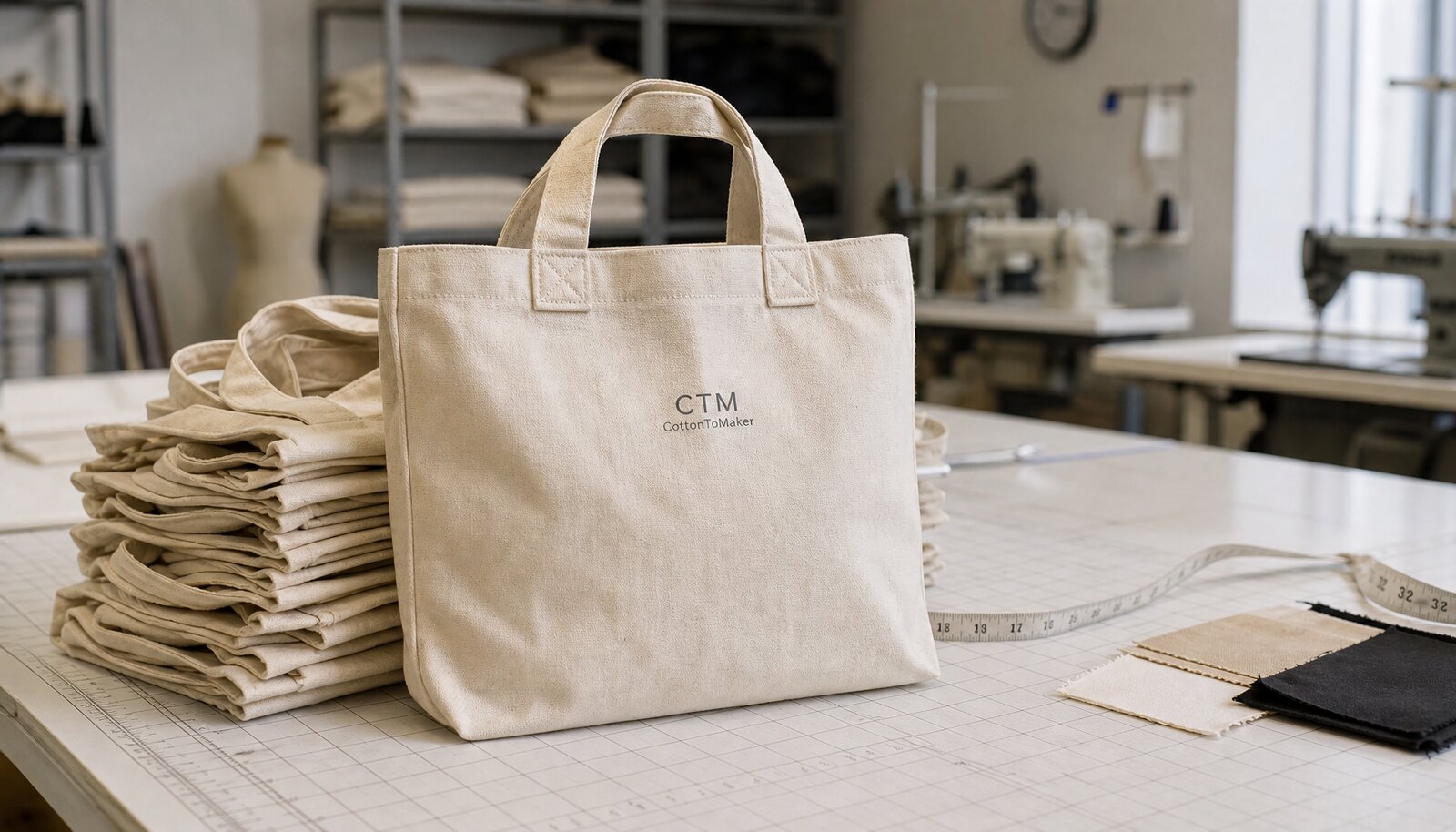
Why small canvas tote bags need their own buying spec
Small canvas tote bags are often used for retail gift sets, event kits, cosmetics, hotel amenities, and compact product packaging. They are not simply smaller shopping totes. The reduced format changes the sourcing risk because there is less room for print error, fewer centimeters to absorb seam variation, and more pressure on the bag to look finished even when it carries only a small load.
That is why the first procurement question should be the use case, not the logo. A tote for a fragrance sampler needs a different body structure from one that will hold a boxed accessory or a stitched gift set. The intended contents affect fabric weight, gusset depth, handle reinforcement, and carton density. Without that context, suppliers may quote bags that look similar on paper but perform very differently in use.
A short functional brief usually works better than a long style description. Tell the factory what the bag must carry, how it will be packed, and how the branded face should appear at the point of sale. That gives the supplier enough information to choose the right fabric, stitch pattern, and packing method before sampling starts. It also reduces the back-and-forth that happens when the sample looks fine on the table but fails in the real channel.
- Retail gift use: prioritize appearance, print sharpness, and shelf presentation.
- Functional carry use: prioritize seam strength, handle reinforcement, and bottom support.
- Ecommerce pack use: prioritize flat packing efficiency, carton density, and consistent count.
- Event or promo use: prioritize cost control, simple branding, and repeatable production speed.
Fabric weight, weave, and finish: what actually changes the quote
For most small canvas tote bags, a practical fabric band is about 10–12 oz, or roughly 340–410 GSM. That range usually gives enough body for the bag to hold shape without pushing sewing cost and freight weight too high. Below that range, the bag can feel soft or limp. Above it, the bag becomes sturdier, but cutting, sewing, and packing labor usually rise with it. Buyers sourcing for retail presentation rather than heavy-duty carry often find that 12 oz gives the best balance because it sits neatly and prints cleanly.
Finish matters just as much as weight. Natural canvas is usually the easiest starting point because it accepts a wide range of logos and is less sensitive to shade variation. Bleached canvas creates a brighter background but needs tighter shade control. Dyed canvas can lift the brand presentation, but lot-to-lot color variation becomes more important if the order is split or repeated. If repeat business is likely, ask the supplier how they track dye lots and whether they can keep rolls from the same lot together through cutting.
Weight alone also does not tell the full story. Two fabrics can both be 12 oz and still behave differently if the weave density or yarn structure is not the same. That shows up in hand feel, print smoothness, and seam behavior. If the supplier cannot explain the fabric source clearly, ask for a swatch, a lot photo, or a simple fabric record before approving the spec.
- 10 oz: lower cost, lighter hand, and suitable for giveaways or low-load insert packs.
- 12 oz: better body, better shelf presence, and a safer default for retail presentation.
- Natural finish: broadest use and lowest shade risk.
- Bleached or dyed finish: stronger visual impact, but tighter lot control needed.
- For repeat orders, ask for fabric lot identification or roll segregation if shade stability matters.
Size, gusset, seam allowance, and handle geometry
Small tote quotes often look precise until you compare outside dimensions with usable volume. A bag quoted as 25 x 20 cm can feel much smaller if seam consumption is not clear or if there is no gusset. For compact retail formats, a 5–10 cm gusset is common, but the buyer should state whether that gusset is side, bottom, or both. A side gusset changes how the tote opens. A bottom gusset changes stability. Both change cutting yield and carton fit.
Handle geometry is another point where quotes diverge. Short self-fabric handles keep the bag visually clean and usually cost less, while cotton webbing handles can improve grip, durability, and perceived value. The handle drop should match the use case. A short drop may be right for a gift bag or counter display pack. A slightly longer drop may suit a tote that will be carried during transit or reused after purchase. Ask the supplier to state handle length, width, fold method, and whether the handle is sewn into the seam or applied on top of the body.
Procurement teams should also write down seam allowance rather than assuming the factory will use a consistent house standard. For a small bag, a written target such as 7–10 mm is more useful than a vague instruction. Uneven seam allowance can create size drift and shift print placement. A simple product drawing is more valuable than a product name because it turns a generic tote into a measurable item that can be inspected.
- Request both outside dimensions and internal usable dimensions.
- State the intended fill weight or sample contents in the RFQ.
- Specify whether the tote must stand upright when empty or only when filled.
- Clarify if the handle is folded into the seam, top-stitched, or bar-tacked at the end.
- Ask for a sewing sketch if the bottom or gusset shape is non-standard.
Construction details that change durability, not just appearance
On small canvas tote bags, construction is often the difference between a tidy promotional item and a bag that feels commercially weak. Buyers should look at the top edge finish, corner reinforcement, gusset attachment, and handle anchoring. A simple tote with clean seams can work well, but if the bag is expected to carry heavier inserts or survive repeated handling, the factory should reinforce the handle ends and stress points. Compact geometry makes alignment more sensitive than many buyers expect.
Ask the supplier to define handle attachment in plain language. A handle sewn through once at the top edge is not the same as one fixed with dense backstitching or bar tacks. That difference may not matter for a display pack, but it matters more if the bag will be reused. Handle failure is one of the easiest issues to prevent and one of the most visible after delivery, so the PO should name the reinforcement method or stitch-density target instead of relying on the phrase 'make it strong.'
The bottom structure matters too. A flat bag uses less material and is cheaper to produce, but it may collapse when filled with rigid items. A bag with a separate bottom panel can stand better, but it creates extra seams and more opportunity for twisting if alignment is poor. Ask each supplier to show the construction method in a sketch or annotated sample photo. That makes comparison easier than using product names that sound similar but are built differently.
- Confirm reinforcement at handle ends, not only at the top seam.
- If the bag must stand on shelf, ask whether the bottom panel is reinforced or single-layer.
- Request stitch-density guidance for stress points if the tote will carry weight.
- Ask for seam photos on the pre-production sample, not only a front-view image.
Print methods for small canvas tote bags: what to choose and why
Screen printing is still the default branding method for many small canvas tote bags because it is predictable, economical, and repeatable when the artwork is simple. It works well for bold logos, solid text, and one- or two-color decoration. On textured canvas, though, fine lines, tiny reversed text, and tight registration can become visible problems. Buyers who only compare unit price can miss the key question: will the artwork still look clean at the bag size they actually need?
Transfer printing can work for smaller runs or more detailed artwork that is harder to set up as a screen job. The buyer should still test rub resistance, edge softness, and whether the finish matches brand expectations. Embroidery can create a premium look, but on a compact tote it can distort lighter fabric or cause puckering if backing is not managed properly. Digital printing offers flexibility for complex graphics, but it is not always the most economical path for large quantities or simple logos.
For procurement, the right print question is not only the method; it is the placement tolerance and the approval standard. On a small tote, a few millimeters of shift can be obvious. Ask for placement tolerance in millimeters, request a strike-off or pre-production proof, and define a centerline or reference point. If the artwork sits close to a seam or border, ask how the factory will control registration during production. That detail often decides whether the job passes without dispute.
- Use screen print for simple logos, bold text, and repeatable volume.
- Use transfer print for smaller runs with more detailed artwork, but test rub resistance.
- Avoid artwork that crosses seams or fold lines unless the supplier has a proven method.
- Write print placement tolerance in millimeters, not only 'centered.'
MOQ, pricing logic, and why the lowest quote can mislead
MOQ on small canvas tote bags is not a single universal number. A factory may set one minimum for the body, another for printing, and another for packing changes. That is why two quotes can look similar and still produce very different landed costs. A low unit price may depend on higher volume, a simpler fabric, or the omission of individual polybags and labels. A more transparent quote is often more useful than the lowest line item because it shows where the real cost sits.
A common procurement mistake is comparing a blank-bag price with a fully decorated retail unit. Another is comparing one supplier’s standard carton count with another supplier’s tighter pack that adds labor but saves freight. If the project has mixed sizes or multiple artwork variants, ask the supplier to price each variant separately and then show the combined effect on total order value. That makes it easier to see whether a lower ex-factory price actually leads to a lower landed cost.
For smaller buyers, it helps to think in terms of sourcing route as much as unit price. Buying stock blanks and adding decoration locally gives speed but less control over color and presentation. Buying direct from a factory gives more consistency but may require a higher order threshold. Using a trader can simplify communication but reduce visibility into subcontracted steps. The right route is the one that fits forecast confidence, target quality, and the amount of internal sourcing time available.
- Ask suppliers to quote the same assumptions: fabric weight, handle material, print method, pack format, and carton count.
- If the quote excludes packing, treat that as a separate cost line.
- If artwork changes often, ask whether screens, plates, or files can be reused.
- If several SKUs share one body, compare total fabric demand and setup cost, not only per-SKU MOQ.
Comparison of sourcing routes for small canvas tote bags
The decision is not only which bag to buy, but which sourcing model gives the best balance of control, speed, and risk. A retail brand may need factory-direct custom production because it needs stable fabric shade, repeatable print registration, and predictable packing. A distributor or event buyer may prefer stock blanks because lead time and flexibility matter more than exact material control. The comparison below is meant to help normalize the quote before commercial review starts.
When comparing sourcing routes, buyers should first normalize the spec. Every supplier should price the same bag size, the same canvas weight, the same handle construction, the same print method, and the same packing format. If one quote includes a polybag and carton label and another does not, the lower number is misleading. The same applies to inspection. If one supplier only does visual screening while another provides AQL-based inspection, the risk profile is different even if the unit cost is close.
- Normalize all quotes to one spec before comparing price.
- Ask who controls fabric, sewing, print, and packing if a trader is involved.
- Treat packing and inspection as commercial costs, not optional extras.
- Use the sourcing route that matches forecast certainty, not only first-order savings.
Sample approval and pre-production control
A sample for small canvas tote bags should be treated as a control document, not just a visual reference. The sample needs to reflect the actual fabric weight, actual handle material, actual print method, and actual seam structure. If the sample uses a different material or a shortcut decoration process, it can hide the risks that appear in production. For repeat orders, this matters even more because a small change in fabric lot can change hand feel and print appearance.
The buyer should review the sample against the intended contents or packing, not just on a desk. Insert the products or filler items the tote is meant to carry. Then check whether the bag opens cleanly, whether it twists under load, and whether the handle spacing still looks balanced. On a compact tote, even a slight imbalance is easy to see. If the bag is for retail display, hang the sample and inspect the front panel from normal customer viewing distance. That catches problems that can be missed in a close-up photo.
Approval should be tied to a written standard. The standard should state what is acceptable on size, seam straightness, print placement, stitch cleanliness, and packing format. If the supplier offers a pre-production sample, insist that the mass run match it in material and construction. A sample that is only 'similar' is not a reliable basis for procurement.
- Measure finished dimensions against the spec sheet, not against a seller photo.
- Check print registration at corners and near seam interruptions.
- Pull-test the handle attachment by hand to spot weak stitch points.
- Confirm the sample matches the final packing format, not a loose prototype.
- If the bag will be reordered later, keep a retained sample and a sealed reference photo set.
QC thresholds, AQL language, and destination checks that reduce disputes
QC for small canvas tote bags should be written around measurable defects, not general impressions. A buyer should define acceptance criteria for fabric weight, dimensions, stitch quality, print placement, and packing count. For simple bags, appearance defects are often the main issue. For bags intended to carry product weight, strength defects matter more. In both cases, the important part is separating major defects from minor ones so inspection results can be interpreted consistently.
A practical QC plan usually combines in-line checks, final random inspection, and packing verification. Buyers often ask whether a supplier 'inspects carefully,' but that phrase is too vague to be useful. A better approach is to agree on an inspection method such as AQL sampling, then define the defect classes. For example, a major defect might be a broken handle attachment, a missing print, or a bag outside tolerance. A minor defect might be a loose thread or a small cosmetic fiber mark. If a third-party inspector is used, ask for the sample size and the pass/fail criterion before production ends.
Specific tolerances reduce disputes after delivery. For compact bags, stitch count targets at stress points, seam allowance control, and print registration are worth writing into the PO or spec sheet. If the bag is plain natural canvas, dust, oil marks, and shade streaks become more visible. If it is bleached or lightly dyed, carton scuffing and handling marks may become a rejection reason even when the bag is functionally sound. The inspection standard should reflect how the product will actually be sold, not only how it performs structurally.
- State whether inspection will follow AQL 2.5, 4.0, or another agreed level.
- Define major vs minor defects before production starts.
- Include stitch cleanliness, print placement, and packing count in the final check.
- Ask for photo evidence of carton labels, carton seals, and packed count if you cannot inspect in person.
- If a third-party inspector is used, make sure they check both product and packing, not only visual appearance.
Packing, carton density, and freight planning
Packing can change the economics of small canvas tote bags more than buyers expect. A flat-packed tote is more freight-efficient than a folded tote with inserts or bulky retail packaging, but the presentation may be too simple for some channels. If the bag needs to arrive retail-ready, the buyer may require polybags, size stickers, hang tags, or barcode labels. Each choice adds labor and material cost, and each one affects carton density and handling quality.
Carton planning should be part of the quote stage, not an afterthought. Ask for carton dimensions, gross weight, and unit count per carton so the logistics team can estimate air or sea freight correctly. If the supplier cannot provide a realistic packed size before production, the landed cost model is incomplete. That is especially true for small tote programs because the bags are lightweight, which means freight and packing can represent a larger share of total cost than many buyers expect.
Carton strength also matters. For long-distance shipping, ask whether the outer cartons are designed to withstand stacking and normal transit handling. If the bags are densely packed, the carton should be strong enough to avoid crushing product edges. If the order passes through warehouse handling, ask for a layout that protects print surfaces from rubbing. A realistic carton handling expectation can be agreed in advance, but it should match the channel and shipping method.
- Flat pack reduces freight but can increase fold marks on heavier canvas.
- Individual polybagging improves cleanliness and retail presentation.
- Barcode labels and size stickers should be included in the packing spec if needed.
- Confirm whether master cartons are single-SKU or mixed-SKU.
- Ask for carton gross weight and dimensions before approving freight bookings.
Specification comparison for buyers
| Sourcing route | Best commercial fit | Typical cost drivers | Primary buyer tradeoffs | Best use case |
|---|---|---|---|---|
| Factory-direct custom production | When body spec, fabric, print, and packing all need to be controlled on repeat orders | Fabric booking, cutting loss, sewing labor, print setup, packing labor, inspection | Best consistency and cleaner accountability, but usually higher MOQ and less flexibility if the factory is full | Retail launches, private label programs, and replenishment orders with stable demand |
| Stock blank bags + local decoration | When speed matters more than exact fabric or construction control | Blank inventory price, local decoration setup, split freight, rework risk | Fast to start, but fabric shade and final presentation can vary between vendors | Events, test markets, and short-run promotions |
| Trader or sourcing agent | When the buyer needs one point of contact across multiple processes | Service margin, subcontracted sewing/print, extra coordination, packaging markup | Simplifies communication, but root-cause tracking can be harder if defects appear | SMBs, distributors, and buyers with limited sourcing bandwidth |
| Hybrid sourcing: blank body from one source, decoration/packing from another | When the bag body is standard but branding needs local control | Inter-vendor transport, duplicate QC, shade mismatch, handoff losses | Can shorten first-run lead time, but the buyer absorbs more coordination risk | Urgent launches where the body is simple and branding is light |
| Integrated OEM factory | When one supplier should own sewing, printing, and packing end to end | Setup, tooling, capacity allocation, minimums, packaging labor | Fewer handoffs and clearer responsibility, but less flexibility on tight schedules | Repeat programs and branded retail packs |
| Material | 8-12 oz cotton canvas, 120-220 gsm cotton, recycled cotton, or blended fabric selected by use case and target price | Before price comparison | Different cloth weights, backing, or certification claims make quotes hard to compare | |
| Construction | bag size, gusset, handle drop, seam allowance, stitch density, reinforcement patch, and loading expectation | Before sampling | Weak stress points create returns and failed inspections | |
| Decoration | screen print, heat transfer, embroidery, woven label, or hangtag matched to fabric texture and brand durability needs | Before artwork approval | The wrong method can crack, bleed, pucker, or fail on the chosen fabric |
Buyer checklist before sampling
- Final bag size stated as internal usable dimensions, not only outside dimensions
- Canvas weight in GSM or oz, plus whether the fabric is natural, bleached, dyed, washed, or pre-shrunk
- Yarn count, weave density, and whether the factory can keep fabric lots segregated for repeats
- Handle length, width, fold style, and the exact reinforcement method at the top edge
- Seam allowance target, gusset structure, and whether the bag uses side gusset, bottom gusset, or both
- Print method, number of colors, artwork file type, and placement tolerance in millimeters
- MOQ by size, color, artwork, and packing format if mixed SKUs are planned
- Sample approval standard for shade, seam quality, stitch density, print registration, and odor/dust
- Packing spec, inner polybag requirement, carton count, carton markings, and any carton strength expectation
- Lead time split for fabric booking, cutting, sewing, printing, packing, and final inspection
Factory quote questions to send
- What is the exact fabric spec in GSM or oz, yarn count, and weave construction, and can you show the fabric source record?
- Is the price based on blank bags, printed bags, or fully packed retail units, and what is excluded?
- What is the MOQ per size, per color, per artwork, and per packing format?
- Can you provide a pre-production sample made from the same fabric weight, same handle material, and same print method as mass production?
- What is your print tolerance for placement, color variation, edge sharpness, and registration on a small tote format?
- What seam allowance do you use, and what stitch density do you use at the top edge and handle attachment?
- Which packing method is included, and what carton dimensions, carton weight, and carton count should I use for freight planning?
- What QC points are checked before shipment, and do you work to AQL 2.5/4.0 or another agreed sampling standard?
- Can you share a fabric lot record or a photo log showing lot consistency before cutting?
- If we reorder, which elements can be held stable and which may change because of fabric lot, dye lot, or screen reuse?
Quality-control points to confirm
- Fabric weight matches the agreed GSM or ounce target, with no thin spots, slubs, oil marks, or shade breaks
- Fabric lot stability is checked before cutting; ask for lot numbers, shade references, or roll segregation if repeat consistency matters
- Finished dimensions are within tolerance, especially opening width, body depth, gusset depth, and handle drop
- Seam allowance is consistent; for small totes, a written target such as 7–10 mm is more useful than a loose instruction like 'sew neatly'
- Stitching is even and tight, with no skipped stitches, loose thread ends, or tension gaps at corners and handle joins
- Handle attachment uses reinforcement such as bar tacks or dense backstitching when the bag is expected to carry weight
- Print is centered within tolerance, with no color drift, pinholes, bleeding, or misregistration at seam lines
- Artwork does not cross fold or seam lines unless that risk has been approved in writing
- Seams are straight and the bottom panel, if present, is square and not twisted
- No odor, visible dust, stain, adhesive marks, or loose fibers on blank or printed surfaces