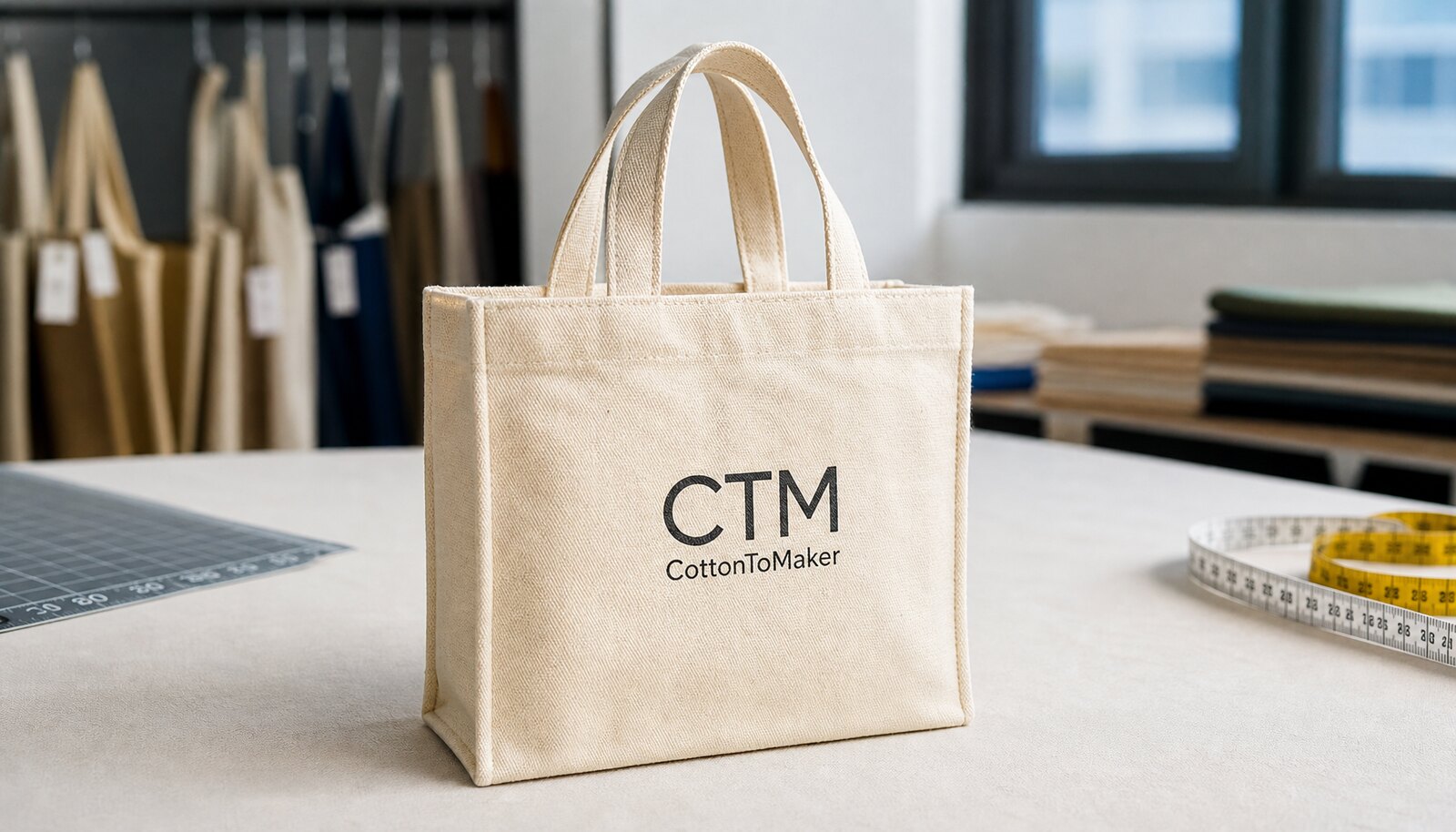
Why small canvas tote bags sell well in ecommerce, and why they fail in sourcing
Small canvas tote bags work in ecommerce because they are inexpensive to ship, easy to brand, and flexible enough for many uses: gift-with-purchase, cosmetics, stationery, accessories, subscription inserts, and low-price retail add-ons. They also photograph well, which matters when the bag itself is part of the product listing. But the same simplicity creates sourcing mistakes. Buyers often treat the item as a commodity and compare only unit price, then discover the bag feels too thin, the print looks weak, or the handles tear under normal customer use.
The commercial problem is not finding a factory that can sew a small tote. It is getting a bag that fits the intended margin, customer expectation, and fulfillment method. For ecommerce, the bag has to survive warehouse handling, parcel compression, and customer review photos. That means procurement should define the use case first: is the tote a paid SKU, a branded insert, or a promotional item bundled into another order? The answer changes the right fabric weight, decoration method, and packaging spec.
- Paid SKU: prioritize print quality, hand feel, and carton presentation.
- Promotional insert: prioritize low unit cost, stable print, and fast pack-out.
- Subscription or kit component: prioritize compact size, clean edges, and consistent folding.
- Retail add-on: prioritize structural strength and shelf-ready appearance.
Choose the right size and fabric weight before you quote anything
For small canvas tote bags for ecommerce, the most common mistake is starting with artwork before fixing bag structure. A small tote around 20 x 20 cm, 22 x 25 cm, or 25 x 30 cm can all be valid, but each changes fabric usage, print area, and perceived value. A flat size is not enough. You need the finished bag size, seam allowance, and whether the bag uses a gusset. Even a 2 cm difference can alter what fits inside and how the tote sits in a shipping box or gift set.
Fabric weight is the second critical decision. A practical range for small ecommerce totes is 10–12 oz canvas, roughly 340–410 GSM. At the lower end, the tote is lighter and cheaper, but it can look soft and collapse when displayed. At the higher end, it feels sturdier and prints cleanly, but the fabric cost and sewing load rise. For buyers comparing quotes, the important question is not whether a factory says “canvas,” but whether the quote specifies actual GSM, weave type, and finish.
- 10 oz / about 340 GSM: good for light promotional use and tight price targets.
- 12 oz / about 410 GSM: better for retail resale and premium perceived value.
- Duck canvas or denser weave: better body and print clarity, usually at a higher cost.
- Washed or softened finish: improves hand feel but can change size and shade slightly.
How to compare supplier quotes without getting trapped by a low unit price
A clean quote for small canvas tote bags should show more than a single price per piece. It should separate fabric, sewing, print setup, sample fee, packing, and freight-ready carton specs. Many suppliers can hit a target price by reducing canvas weight, simplifying the handle finish, or leaving print and packaging details vague. That is why a quote comparison must start with a shared spec sheet. If two factories are quoting different fabric weights or different artwork methods, the lower price is not real savings.
Procurement teams should also separate factory-direct sourcing from trading-company sourcing. Direct factories usually give better control over fabric, stitching, and repeat orders, especially if the style will become a recurring ecommerce item. Trading companies can be useful when you need multi-category consolidation, smaller trial volumes, or faster communication across multiple suppliers. The risk is that the actual production site and QC control may be less transparent. For a buyer, the right route depends on how much internal sourcing time you can spend and how repeatable the item must be.
- Compare quotes on the same bag size, same canvas weight, same print method, and same pack format.
- Separate one-time setup costs from recurring unit price.
- Use the same Incoterm basis when comparing landed cost, not just ex-factory price.
- Treat unusually low MOQ offers carefully if they come with narrow artwork limits or loose quality tolerance.
Comparison table: sourcing routes for small canvas tote bags
Make suppliers separate base unit price, setup fee, sample fee, label or packing cost, and freight handover term. MOQ should be tied to real drivers such as fabric dye lot, print setup, trim sourcing, carton rules, or inspection depth.
This structure protects buyers from false savings. If one quote excludes sample approval or carton labeling, it is not cheaper in a practical purchasing sense; it is just incomplete.
- Write decisions in measurable language, not only descriptive wording.
- Ask for sample photos plus one physical approval sample for important orders.
- Keep quotation, sample approval, and inspection notes tied to the same spec version.
Print method choices that affect appearance, durability, and MOQ
Small canvas totes usually use one of three branding routes: screen print, heat transfer, or woven/embroidered branding. Screen print is the most common for ecommerce because it balances cost and durability, especially for one-color logos or simple art. It also works well on natural canvas, where a slightly rustic print is acceptable. Heat transfer can support finer detail and more colors, but it is more sensitive to press settings and long-term abrasion. Woven labels and embroidery feel premium, though they usually suit smaller logo placements or side labels rather than large artwork.
The important buying point is not method preference alone, but artwork fit. A small logo with thin strokes may disappear on coarse canvas if the mesh and ink deposit are wrong. A detailed illustration can look good on a mockup and fail in production once the fabric texture absorbs ink. Buyers should provide final vector artwork and specify the smallest legible text size. For ecommerce listings, keep the design simple enough that it still reads well after folding, shipping, and customer handling.
- Screen print: best for volume, one to two colors, and repeat orders.
- Heat transfer: useful for short runs, gradients, and small text, but test abrasion.
- Embroidery: premium feel, but heavier thread density can distort light fabric panels.
- Woven label: good for side branding or exterior identity without large print coverage.
MOQ logic: how to keep the first run economical without weakening the spec
MOQ for small canvas tote bags depends on three things: fabric availability, decoration setup, and packing method. If the factory has standard canvas in stock and your art uses one print color, the MOQ can be relatively low. Once you add custom dyeing, special handles, or multiple print locations, the MOQ rises because the factory must buy or reserve material more efficiently. Buyers should not treat MOQ as a fixed number; it is a consequence of the production route.
The common sourcing mistake is lowering MOQ by loosening the specification. For example, a factory may offer a lower minimum if you accept a lighter fabric, no internal clean finish, or a looser print tolerance. That can work for a test order, but only if the customer use case can tolerate it. A better approach is to keep the bag spec stable and reduce risk elsewhere: fewer artwork versions, one color, standard packaging, and a single carton pack count. That protects the product while preserving a workable order size.
- Lower MOQ is easier with stock natural canvas than with custom-dyed fabric.
- One print color and one logo location reduce setup and make reorders cleaner.
- Multiple sizes or colorways should be consolidated only if the artwork and pack spec stay identical.
- MOQ should be written separately for fabric, print, and carton labeling if the supplier uses different thresholds.
Sample approval: what a useful pre-production sample must prove
A pre-production sample is not just for visual approval. It should prove that the actual fabric, thread, print method, and folding pack can all work together. For small canvas tote bags, the approved sample should use the same canvas weight, the same handle width, and the same seam finish as mass production. If the sample is made from a different lot or uses a more careful sewing process than production, it is not a reliable reference. Buyers should insist that the sample reflects the real factory method, not an idealized version of it.
The best sample review is practical. Fill the bag with the intended product weight, fold it as it will be shipped, and inspect the print after handling. Measure finished dimensions, logo position, and handle symmetry. Check whether the bag stands or collapses the way you expected. If the tote is part of a retail pack, test how it looks inside the final carton or polybag. The goal is to discover issues before mass cutting begins, when a correction is still cheap.
- Measure finished size against the signed-off spec, not the artwork file.
- Inspect seam straightness, stitch count consistency, and reinforcement points.
- Rub test the print lightly to see whether ink transfers or cracks early.
- Confirm the fold direction and carton count before approving production.
QC thresholds that matter for ecommerce returns and warehouse complaints
Ecommerce buyers should set QC thresholds that reflect customer handling, not only factory sewing standards. A tote that passes a visual inspection but arrives with crooked printing or weak handles can still trigger returns, negative reviews, or warehouse rejects. For small canvas tote bags, the most valuable QC points are seam integrity, print placement, handle strength, and packing cleanliness. Because the product is simple, customers notice imperfections quickly. A 5 mm print shift or one loose thread can become visible in listing photos or unboxing videos.
Define what is acceptable before production starts. For example, decide whether slight natural canvas shade variation is acceptable, how much print position drift is allowed, and what level of thread trimming is required. If the order is for retail resale, ask the supplier to separate A-grade from any discounted secondary grade. If the order is for promotional use, you may allow a broader tolerance, but only if the brand team understands the visual result. Clear acceptance criteria reduce disputes more effectively than a long inspection email after shipment.
- No open seams, skipped stitches, or broken bartacks on sample or bulk goods.
- Print should be centered within the agreed tolerance and readable at arm’s length.
- No visible oil stains, dye marks, or cutting dust inside packed cartons.
- Handles should match in length and sit evenly when the bag is placed upright.
- Carton count should match the packing list exactly before release to freight.
Packing, carton loading, and warehouse handling for ecommerce channels
Packing is often overlooked because small totes seem easy to pack. In practice, packing determines whether the product arrives clean and ready for warehouse intake. Bulk packing is usually the most cost-efficient option, but the bags must be folded consistently and protected from dust, moisture, and scuffing. Individual polybags add cost, yet they may be necessary if the bag has a dark print, delicate finish, or direct-to-consumer presentation. If the bag will be inserted into another kit, flat bulk packing with a controlled fold direction can be the better answer.
For ecommerce, carton optimization matters. Small canvas totes compress well, but over-compression can crease the print or distort the handle fold. Ask for a master carton size and gross weight that suits your receiving process and carrier limits. If your warehouse uses barcodes, make sure the carton labels and inner pack counts are specified clearly. A low price is not useful if the receiving team cannot reconcile carton counts quickly or if the bags arrive with inconsistent folds that slow pack-out.
- Specify fold direction and whether handles should be tucked inside or left outside.
- Use moisture protection if cartons will move through humid transit lanes.
- Match carton pack count to warehouse receiving rules and pallet patterns.
- Include barcode labels or carton marks if the tote is going through retail distribution.
Lead time planning and landed-cost comparison
Lead time for small canvas tote bags is usually driven by fabric availability, print setup, and packing complexity. A simple order on standard fabric with one-color print may move faster than a custom-colored tote with multiple pack instructions, but only if artwork approval is clean. Buyers should separate sample time, material purchase, production, and shipping. If you are planning a retail launch, the hidden delay is often approval time, not sewing time. One revision on artwork placement can cost several days because the factory may need to remake the sample or re-cut the print screen.
Landed cost should be evaluated with more than unit price. Include setup fees, sample charges, packaging upgrades, carton volume, and freight class implications. Small canvas totes are light, so air freight can appear manageable at first glance, but carton volume can still make the landed cost unattractive. Sea freight is usually more efficient for reorder programs, while air may make sense only for urgent launches or short promotional windows. Buyers should calculate landed cost on the same basis across suppliers so the apparent low quote does not disappear after pack and freight are added.
- Separate sample lead time from mass-production lead time in the project schedule.
- Factor in artwork revisions and approval loops before promising a launch date.
- Compare landed cost per sellable unit, not only factory ex-works price.
- Watch carton volume because small totes can still become freight-heavy in bulk.
Specification comparison for buyers
| Spec decision | Recommended option | When it fits | Buyer risk to check |
|---|---|---|---|
| Fabric weight | 10–12 oz canvas (about 340–410 GSM) | Best balance for ecommerce gifts, cosmetics, small accessories, and repeat use | Too light feels flimsy; too heavy raises unit cost and slows printing on large runs |
| Bag size | Small format around 20 x 20 cm to 25 x 30 cm with short handles | Fits compact retail SKUs, subscription kits, event inserts, and add-on items | Verify product fit with real packed samples, not flat dimensions alone |
| Print method | 1-color screen print or heat transfer for small artwork; woven label or embroidery for premium look | Use screen print for volume and simple logos; use woven/embroidered branding when durability matters | Fine lines, gradients, and small text can blur or crack if the method is mismatched |
| Handle build | Self-fabric or folded canvas handles with bar-tack reinforcement | Works for ecommerce parcels and light retail carry use | Weak handle stitching is a common failure point in small bags because buyers overstuff them |
| MOQ route | Standard stock fabric with custom print is usually lowest-risk; full custom size/spec needs higher MOQ | Good for brands testing a new SKU or splitting runs by design | Low MOQ quotes may hide higher setup fees, limited print colors, or higher defect tolerance |
| Sample stage | Pre-production sample matched to final fabric, print, stitch, and packing | Needed for any branded retail or DTC launch | Approved artwork alone is not enough; production fabric shrinkage and print placement can shift |
| Packing method | Bulk packed in OPP or master cartons with clear carton marks and piece counts | Fits ecommerce fulfillment and warehouse receiving | Individual polybags can add cost and plastic volume; loose packing can cause scuffs and dust marks |
| Supplier route | Direct factory for repeatable volume; trading company for mixed sourcing or smaller programs | Choose by internal sourcing bandwidth and order complexity | Trading quotes can look easier to buy but may hide the true factory spec or QC control point |
Buyer checklist before sampling
- Final bag size with tolerance, not just a nominal dimension
- Fabric weight in GSM or oz, plus whether it is plain weave or duck canvas
- Handle length, width, and reinforcement method
- Logo size, print placement, and acceptable color variation
- Target use case: gift insert, resale SKU, ecommerce shipping insert, or premium merch
- Packing instruction: bulk, individual polybag, barcode label, and carton count
- Acceptance standard for seams, stains, print defects, and dimensional variance
- Target MOQ, sample fee, production lead time, and carton pack quantity
Factory quote questions to send
- What is the exact canvas fabric weight in GSM or oz, and is the price based on greige, dyed, or finished fabric?
- Does the quoted unit price include one-color print, one location, and what is the setup charge per color?
- What is the MOQ by fabric color, print color, and artwork version?
- Can you provide a pre-production sample that matches final fabric weight, handle construction, and packing method?
- What tolerance do you accept for size, print position, and stitch quality?
- How are bags packed for export carton loading, and what is the master carton size and gross weight?
- What lead time applies to sample, material purchase, and mass production, and what changes if the order includes multiple SKUs?
- What inspection standard do you use for needle holes, loose threads, off-center print, and seam failure?
Quality-control points to confirm
- Fabric weight should match the agreed spec within a practical production range; for a small retail tote, weight drift should not create a visibly limp body or overly stiff hand feel.
- Top edge and side seams must be straight, with no broken stitches, skipped stitches, or open seam allowance.
- Handle reinforcement should include bartacks or equivalent reinforcement at stress points; the bag should not deform when lightly loaded during sample review.
- Print registration should stay centered on the approved panel and remain legible on the actual production fabric, not just on artwork proof.
- Color consistency should be evaluated under daylight-like lighting against the approved sample, especially for natural canvas and pigment prints.
- Cutting accuracy should keep the bag square and balanced; twisted handles or uneven side gussets reduce retail value immediately.
- Packing count must be verified by carton, with clear evidence that the pack method will not crush the print or stain the fabric in transit.