What a retail wine bag has to do
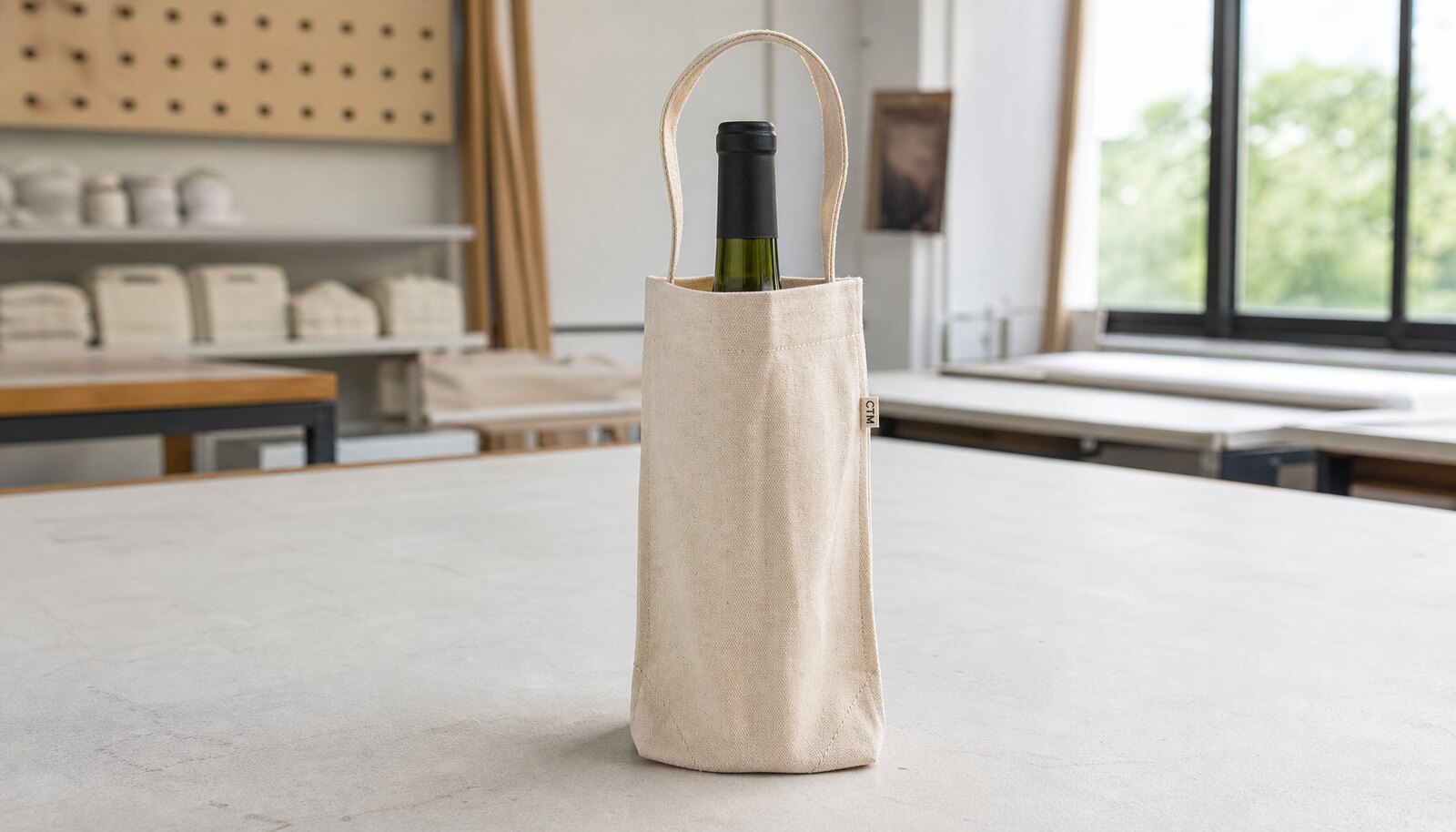
Single bottle wine bags for retail are a packaging item, a display item, and a margin item at the same time. The bag has to fit a 750 ml bottle securely, communicate brand value on the shelf or at checkout, and survive repeated handling without looking tired before it reaches the customer. That sounds simple until you split the use case into the real retail channels: a gift add-on at point of sale, a seasonal holiday bundle, a tasting-room upsell, or a standalone retail accessory. Each one puts pressure on the bag differently. A gift-wrap style only needs to look polished long enough to leave the store. A reusable retail bag has to keep its shape after handling, stacking, and transit, which means fabric weight, seam construction, and print durability become commercial issues, not just design choices.
The fit question is the first place buyers protect margin. If the bag is too loose, the bottle rattles, the shape collapses, and the premium feel disappears. If the bag is too narrow, the bottle catches at the shoulder, labels rub against seams, and returns or complaints become more likely. For a standard 750 ml bottle, buyers should define not only the bottle body diameter but also the shoulder height, neck length, and whether the bottle includes a capsule or decorative finish. Those details matter because the usable bag height is not the same as the flat cut height. Retail buyers who send only the bottle name and a logo usually get a generic pouch quote back. Procurement teams that send the bottle dimensions and the intended channel get a bag that is actually usable.
The same bag can be right for one store program and wrong for another. A premium wine shop may want a heavier cotton canvas bag with a woven side label and neat top hem because the bag can be resold or reused. A supermarket checkout add-on may need a lighter structure, a simpler one-color screen print, and a lower-cost pack format to keep the add-on margin intact. For gift programs, visual consistency matters more than heavy load testing; for reusable programs, abrasion resistance and seam durability matter more than a perfect showroom image. Before asking suppliers for a price, define the commercial job of the bag in one sentence. That sentence will determine almost every spec that follows.
- Define the channel first: checkout add-on, gift bundle, tasting-room retail, or standalone accessory.
- Send the bottle dimensions, not just the bottle name, especially if the neck or shoulder shape is unusual.
- Decide whether the bag should feel reusable or single-use, because that changes GSM, seam, and print decisions.
Choose the right supplier route
The supplier route shapes the quote, the risk, and the level of control you get over the finished bag. A direct factory is usually the strongest option for custom retail wine bags because it allows a cleaner breakdown of fabric, cutting, sewing, printing, and packing. That makes it easier to normalize quotes and to correct fit issues without passing instructions through a middle layer. The main advantage is not only price. It is accountability. If the factory owns the sewing line and print process, the sample is more likely to reflect the bulk order. If the factory only subcontracts those steps, the quotation may be competitive while the real production control is weak.
Trading companies can still be useful in procurement, especially when one buyer is coordinating several bag formats, multiple colors, or a broader retail accessories program. They can simplify communication and consolidate shipments, but the buyer needs to know exactly what is being quoted. Ask for factory identity, production address, sample origin, and who actually signs the final QC release. Some trading companies are highly competent and fully transparent. Others provide a quote that is structurally impossible to compare because the sample came from one source and the bulk order will come from another. When the source route differs, the commercial risk differs too.
Stock wholesalers and local decorators are the fastest path when the bag does not need much custom work. That route can make sense for seasonal rush orders or small tests, but it is a weaker fit for retail buyers who need consistent shelf presentation. Standard stock bags often force compromise on size, handle placement, decoration area, or carton packing. A lower unit price can hide higher downstream costs if the bag does not fit the bottle cleanly, requires manual repacking, or creates a presentation problem at the store level. The right route is the one that protects the whole program, not just the factory gate price.
In practice, procurement teams should compare supplier types only after they normalize the quote structure. A direct factory price that includes sewing, print, and packing cannot be fairly compared with a stock reseller quote that only covers the blank shell. If one supplier quotes EXW and another quotes FOB, or one includes cartons and another does not, the apparent savings may vanish once the order is landed. The buyer’s job is to make the comparison real before the PO is issued.
- Use a direct factory when repeatability, custom size control, and line accountability matter.
- Use a trading company only if it provides factory traceability and a sample trail you can verify.
- Use stock sourcing only if standard dimensions and limited branding are truly acceptable.
Finished size, fit, and bottle geometry
Finished size is more useful than nominal material language when you are buying single bottle wine bags for retail. A bag can be called “premium cotton” or “jute” and still fail because the cut dimensions do not match the bottle profile. Retail buyers should request the finished width, gusset depth, and usable height in millimeters, then confirm the tolerance band. For many retail programs, a practical tolerance of about ±3 mm on width and ±5 mm on height is easier to work with than a vague “close enough” statement, especially when the bag is packed flat and stacked by the thousands. The buyer should also ask where the dimensions are measured: at the body, across the gusset, or from the bottom seam to the top hem. Those are not interchangeable values.
Bottle geometry matters because not all 750 ml bottles are the same. A classic Bordeaux bottle is easier to sleeve than a wider Burgundy bottle. Some bottles have a longer shoulder, some have a thicker punt, and some are sold with foil capsules or decorative neck finishes that add bulk. If the bag has a drawcord closure or a stitched top hem, the neck clearance has to be measured with the closure closed, not only with the bottle dropped in loosely. One common sourcing mistake is approving a bag that fits an empty bottle but strains once the actual retail bottle, capsule, and label are included. That mistake shows up late, usually after the cartons are already packed.
For procurement, the cleanest approach is to define the bag around the bottle family you sell most often. If you sell several bottle shapes, ask the supplier to quote separate SKUs or a controlled fit range rather than forcing one vague size to do everything. A bag that looks slightly roomy on paper can become the better commercial option if it reduces scrap, rework, or shelf complaints. The goal is not absolute minimal clearance. The goal is stable presentation and predictable pack-out. In retail sourcing, a few extra millimeters can protect both conversion and margin.
A useful spec sheet should also mention shape behavior after packing. If the bag is gusseted, define how much the gusset should open at the base and whether the bottom panel must stay flat when empty. If the bag is cylindrical or panel-cut, define how the printed panel should face when the product is displayed. These details matter because the bag is a visible retail object, not a hidden shipping sleeve.
- Request width, gusset depth, and usable height in millimeters, with tolerance bands.
- Fit the bag to the exact bottle family you sell, including capsule or neck decoration.
- Ask how the dimensions are measured so the factory cannot quote a misleading cut size.
Fabric, GSM, and structure
For retail, fabric choice is both a quality signal and a cost lever. Cotton canvas in the 10-12 oz range is a common premium option because it holds shape well, carries print cleanly, and feels substantial in hand. For buyers who need a natural look with more texture, jute in the 240-280 gsm range can work well, but it requires better control over loose fibers, odor, and edge finishing. Nonwoven around 80-100 gsm is the economical route for promotional-style retail packs or event programs; it can be functional, but it usually reads as lower value and less reusable. When comparing quotes, buyers should ask for true fabric weight and finishing method rather than accepting a material name alone. “Canvas” can mean very different hand feel and performance depending on weave density and finish.
Structure can matter more than raw fabric weight. A gusseted sleeve with a reinforced base generally presents better than a flat pouch cut too tightly. A proper bottom panel lets the bottle stand more securely, reduces seam stress, and gives the bag a cleaner retail silhouette. Buyers should ask whether the bag is panel-cut, tubular, or side-gusseted, because that changes both the fit and the printing area. A lined bag can improve the hand feel and hide inner seam work, but only if the lining is cut and sewn correctly. A weak or twisted lining creates more problems than it solves, especially if the bag is packed flat and then opened at retail.
Finished edge quality should be discussed early. On cotton, buyers can ask for folded top hems, reinforced seam allowances, and clean thread trimming. On jute, buyers should ask how fraying is controlled, whether the cut edges are bound or turned, and how the factory handles odor removal or ventilation before packing. On nonwoven, buyers should check how the fabric is cut and sealed so the edge does not split or shed excessively. The best fabric choice is not the one with the most impressive name; it is the one that fits the sales channel, budget, and presentation standard without creating hidden defects later.
A useful material comparison for procurement looks like this: cotton canvas gives the best premium feel and print clarity, jute gives the strongest natural texture and gift look, and nonwoven gives the lowest entry price. The commercial tradeoff is shelf value versus unit cost. If the bag is sold alongside a mid- to high-priced bottle, the bag should not look cheaper than the wine. If the bag is only a checkout add-on, it should still carry enough structure that the customer does not see it as throwaway packaging. The right fabric is the one that supports your margin strategy and your brand story at the same time.
- Ask for true GSM or ounce weight and confirm whether it reflects the finished cloth, not only the mill spec.
- Confirm whether the bag is gusseted, panel-cut, tubular, or lined because the construction changes fit and cost.
- For natural fabrics, ask how the factory controls fray, odor, and shade variation before packing.
Decoration, branding, and shelf readability
Decoration is where retail wine bags move from utility to commercial display. Screen printing is usually the best value for one or two solid colors because the setup cost can be absorbed well over volume and the result is easy to read on the shelf. Woven labels and sewn side labels are stronger options when the brand wants a more durable finish or a premium cue that survives handling and folding. Heat transfer can be appropriate for certain fabrics and graphic styles, but it should be evaluated on the actual material, not assumed from a t-shirt program. The decision is not only visual. It is also about abrasion resistance, registration stability, and how the print behaves when the bag is folded into cartons.
For procurement, the artwork spec should be measured, not just described. Buyers should request print size in millimeters, logo position relative to the hem and side seam, and whether the print crosses a fold line. A design that looks fine on a flat mockup can fail when the bag is packed or when the closure tunnel compresses the art. One-color logos are easier to standardize, but if the brand requires a two-color mark, the buyer should ask how the print is aligned across production runs and what the acceptable registration tolerance is. If the supplier cannot explain how they control print placement, the buyer may be buying a sample, not a repeatable product.
Retail presentation also includes administrative branding. If the bag is sold across different stores, regions, or seasonal campaigns, it is often better to keep SKU or barcode data off the bag and place it on a removable hangtag or label. That protects the design and prevents obsolescence when product data changes. It also makes it easier to reuse the same bag for several retail programs. Buyers trying to protect margin should consider not only the cost of printing but the cost of making the bag flexible enough to serve more than one channel.
Durability should be tested where the customer touches the bag: near the opening, along the seam edges, and on the printed face. If the logo cracks after folding, or if the sewn label scratches the bottle label, the bag loses retail value even if the unit price looked attractive. A premium appearance that survives the first handling is usually worth more than a slightly lower buy cost that looks tired on the shelf.
- Approve a measured artwork placement sheet, not only a design file.
- Use one primary decoration method on the first run to keep cost and QC easier to control.
- Consider a woven or sewn label when the brand mark must survive handling better than a printed surface.
How to read and normalize the quote
A retail buyer should never compare supplier quotes without first normalizing the spec. The quote should identify the same finished size, fabric weight, decoration method, packing format, and commercial term on every line. If one supplier includes cutting, sewing, printing, labels, inner packs, and carton marks, while another only quotes the sewn shell, the lower number is not meaningful. This is especially important for single bottle wine bags for retail because the final unit cost is affected by more than the fabric. Thread, labels, setup charges, carton count, and even fold method can move the landed cost in a real way.
A useful quote separates the major cost drivers. Buyers should ask for line items or at least clearly stated inclusions for fabric, sewing, decoration, labels, packing, tooling, and cartons. They should also ask for the pricing ladder at realistic volume points, such as 3,000, 5,000, and 10,000 pieces. That makes it easier to judge whether a lower quoted price is driven by scale or by hidden spec changes. For example, a lighter fabric or a simpler print could make the quote look attractive while quietly reducing perceived value at retail. The goal is not to buy the cheapest bag. It is to buy the bag that supports gross margin after freight, duty, and warehouse handling are included.
Landed cost logic matters because retail buyers often focus on unit price too early. Freight per carton, customs duty, local drayage, warehouse receiving, and any relabeling or repacking cost should be considered before the final PO is issued. A low EXW price can become a poor deal if the carton count is inefficient or if the bag needs manual correction when it reaches the warehouse. Ask the supplier to quote in the same Incoterm across all bids, and make sure the packing format is consistent. If one quote is FOB and another is EXW, normalize them before the comparison. Otherwise, the buyer is comparing cost structures, not price.
If the program is large enough, ask the supplier to explain what can move the price down without harming the retail appearance. Sometimes the right savings come from standardizing the fabric color, using a single-color print, or optimizing pack count rather than thinning the cloth to an unsafe level. Those choices are easier to defend in a margin review because they reduce hidden cost without weakening the bag’s shelf performance.
- Normalize every quote to the same size, same fabric, same decoration, same packing, and same Incoterm.
- Request pricing at 3,000, 5,000, and 10,000 pieces so you can see where the real break point is.
- Ask what is included in setup and tooling so recurring charges do not surprise the replenishment order.
MOQ, sampling stages, and approval control
MOQ depends on how custom the bag is, not only on the final quantity you need. A standard-size bag in a stock fabric with a simple print can often be ordered at a lower minimum than a custom-dyed cotton bag with a lined interior, woven label, and retailer-specific packaging. For many fully custom sewn retail bags, 3,000 to 5,000 pieces per style or color is a practical working range, but the exact threshold depends on fabric sourcing, print setup, and whether the factory can combine multiple orders in one run. Buyers should not ask only for the headline MOQ. They should ask how MOQ changes when the color changes, when the logo changes, or when a label is added. Those are different cost events.
Sampling should move through stages. A proto sample checks the general structure, bottle fit, and visual concept. A pre-production sample should match the actual bulk fabric, stitching, closure, decoration, and packing method. Only after that should the buyer sign off a golden sample that becomes the reference for bulk inspection. If the supplier sends a sample made from different cloth, different cord, or different finishing than the bulk order, the sample is not an approval basis. It may still be useful for direction, but it should not be treated as the final standard. Retail buyers protect margin by preventing “sample drift,” where the approved look is not the look that is actually manufactured.
There is also a practical timing issue. Sample review should be tied to a documented approval checklist with dates and comments, not to a loose email thread. The buyer should note what changed between versions, who approved the change, and whether the revised sample still uses the same materials. This matters because large bag programs often fail at the transition from sample to bulk. The supplier may substitute a thread color, a label backing, or a packing method unless the approval trail is clear. A clean sample record makes later dispute resolution much easier.
The best procurement teams treat the sample as a control item, not as a souvenir. Keep one signed golden sample for the buyer file and one for the factory file. If the order is critical, photograph key details: seam finish, label position, hem width, bottle fit, and packed fold direction. That makes bulk checks much faster and gives both sides a concrete reference.
- Ask how MOQ changes by fabric color, artwork, label type, and packing method.
- Use a proto sample for shape and a pre-production sample for final approval.
- Keep a signed golden sample on both the buyer and factory side before bulk starts.
Compliance, supplier verification, and document set
Retail sourcing needs more than a promise that the bag is “safe” or “compliant.” Buyers should ask for a document pack that matches the target market and the material stack. For textile or textile-like bags, that can include fiber composition identification, REACH-related declarations for the EU, CPSIA-related information if the bag is for children’s use or sold into a child-facing program, and colorfastness or azo-related test reports where relevant to the market. If the bag is decorated, ask for ink or print chemical declarations, and if labels or trims are used, request the same level of traceability for those components. Compliance is not a generic label. It is a document trail tied to the exact components in the order.
Supplier verification should also be concrete. Ask who owns the cutting, sewing, printing, and packing. Request the factory business license or registration details if your procurement process requires it, and ask for a recent third-party audit report if the supplier is claiming a social or quality system. Depending on the market and buyer policy, that can include BSCI, Sedex SMETA, ISO 9001, or an internal retailer audit. If the buyer requires a specific test standard, name it in the RFQ. Do not ask only for “test reports.” Ask for the actual standard, issue date, and lab name, and confirm whether the report covers the same fabric and decoration used in bulk production.
Traceability matters because bags are made from multiple components: shell fabric, thread, label, cord, print ink, and packaging. If one component changes, the document set may no longer apply. A good supplier should be able to tell you which lot numbers were used and which documents cover them. At minimum, ask for a component list, origin of key materials, and a statement of whether any substitution will trigger reapproval. If the supplier cannot explain this clearly, the buyer has no reliable basis for compliance review. In retail procurement, the cheapest compliance problem is the one caught before production starts.
Audit steps can be simple but effective. Review one production record, one incoming material record, and one final inspection record from a recent order. Ask the supplier to walk you through how a nonconforming bag is isolated, who signs the disposition, and how rejected goods are prevented from mixing back into good stock. That kind of process review is far more useful than a generic capability brochure.
- Ask for the exact compliance standard, lab name, and issue date—not just “test reports.”
- Request a component list covering shell fabric, thread, label, cord, ink, and packaging.
- Verify who actually manufactures the bag and whether any subcontracting changes the document trail.
QC thresholds, inspection methods, and lot sampling
QC is where a retail program either protects margin or leaks it. Buyers need clear acceptance criteria before the first bulk carton ships. Start with dimensions. Measure length, width, and gusset depth against the approved sample using a defined tolerance. Then move to stitch quality: inspect for skipped stitches, loose threads, crooked seam runs, seam slippage, and uneven top hems. On retail wine bags, these defects are visible enough to affect shelf perception, even if the bag still functions mechanically. The inspection method should be simple enough for the factory to follow and strict enough to catch presentation failures before shipment.
For lot checks, the buyer should not rely on a single bag pulled from the top carton. Pull samples from top, middle, and bottom cartons, and if the order is large, sample more than one pallet or production lot. A common way to structure this is a first article check at line start, an in-process check during production, and a final carton pull before packing release. If the buyer uses an AQL system, state the inspection level and defect classification before production. Even if the buyer does not publish a formal AQL number in the RFQ, the factory should know whether a critical defect is a zero-tolerance item and what counts as major or minor.
Useful retail defect thresholds should be specific. For example: print misregistration that makes the logo visibly off-center is a major defect; loose thread ends that are easy to trim may be minor if they do not affect appearance; open seams, broken closures, holes, oil stains, odor, or wrong packing count should be treated as critical or major depending on the order. The important point is not the exact label assigned to each defect. It is that the supplier and buyer agree on the threshold before bulk production. A bag that looks acceptable in isolation can still fail a retail program if the logo is crooked, the bottle rubs against the seam, or the closure distorts the top hem.
Quality control should also include use testing. Insert the actual retail bottle, close the bag as it will be sold, and handle it the way a customer or store associate would. Check whether the bottle sits upright, whether the logo remains readable after folding, and whether the bag recovers its shape after compression. If the bag includes a label, test whether the label edge catches on the bottle or irritates the hand. This is the practical QC that protects the sell-through experience.
- Set defect thresholds before production: critical, major, and minor.
- Sample from top, middle, and bottom cartons, not only from the first carton.
- Use the actual retail bottle and packing method during inspection, not a dummy shape.
Packing, pallet logic, and store presentation
Packing is part of the retail product experience, not a shipping afterthought. A flat-packed wine bag that arrives neatly folded will sell better and move faster through the warehouse than one that comes crushed or inconsistently packed. Buyers should define the fold direction, the visibility of the logo in the fold, the polybag requirement, and the master carton count. If the bag is sold as an add-on at checkout, consistency of fold and count makes shelf replenishment easier. If the bag is warehoused and distributed to stores, carton dimensions and pallet efficiency become important landed-cost factors because they affect freight, receiving, and storage costs.
Material choice also affects packing strategy. Cotton and jute can pick up odor and moisture if they are packed in a humid environment or held in transit too long without protection. For longer routes or humid destinations, an inner polybag can be worth the small added cost because it protects appearance and keeps the stock fresher on arrival. The buyer should weigh that cost against the value of shelf presentation. A bag that smells musty or arrives creased creates a hidden cost in repacking or write-off, which can be more expensive than a small packaging upgrade.
Warehouse logic matters for retail buyers who manage multiple SKUs. Ask the supplier to mark cartons by SKU, color, quantity, and pack count in a way that matches your receiving system. If your warehouse uses barcodes, confirm the barcode format before printing. If the retailer requires carton labeling standards or pallet marks, include those instructions in the PO rather than by email later. This avoids delays when the goods arrive and keeps the product from being repacked at local cost. The best packing spec reduces handling as much as it protects the bag itself.
A final detail is display readiness. If the product is sold individually, ask whether the bag can be folded so the brand side is visible on opening. If the bag is sold in a set or as a premium add-on, consider how the pack presents when the customer touches it first. Those details are small, but they shape the retail impression and can justify a higher shelf price when the bag is merchandised well.
- Fix fold direction and logo orientation before production starts.
- Use inner polybags when humidity, long transit, or odor control is a real risk.
- Match carton marks and barcodes to the warehouse system to avoid relabeling costs.
Specification comparison for buyers
| Supplier or spec choice | Best-fit option | What it changes commercially | Buyer risk to check |
|---|---|---|---|
| Direct factory with in-house cutting, sewing, and printing | Best for custom retail programs that need repeatable fit, controlled stitching, and stable lead times | Usually improves quote transparency because sewing, print, and packing can be normalized in one place | Verify that the factory owns each process step and is not outsourcing the critical work |
| Trading company with named factory disclosure | Best when you need one buying contact for mixed bag types or multi-market sourcing | Can simplify coordination, but the landed cost may include an extra margin layer | Request factory name, production address, and sample provenance before you compare pricing |
| Stock bag with light decoration | Best for fast seasonal sell-in, store opening packs, or low-complexity add-ons | Lowers setup cost and shortens lead time, but limits size control and brand differentiation | Check whether stock dimensions truly fit your bottle family and shelf display needs |
| 10-12 oz cotton canvas | Best for premium giftable retail bags with reusability and stronger shelf presence | Higher unit cost than promotional fabrics, but stronger perceived value and lower return risk | Check shrinkage control, seam finish, and print durability on the actual cloth |
| 240-280 gsm jute | Best for natural-look packaging with strong visual texture and gift appeal | Can support premium positioning, but rough hand feel and loose fiber control affect presentation | Verify odor, lint, and edge-finish quality because jute quality varies widely |
| 80-100 gsm nonwoven | Best for low-cost seasonal promotions or event-driven retail packs | Supports aggressive price points, but usually reads as promotional rather than reusable | Confirm whether the hand feel, opacity, and print quality are acceptable for the sales channel |
| Screen print with one or two colors | Best for simple logos and high-volume repeat orders | Usually the lowest total decoration cost once setup is spread over volume | Review registration, curing, abrasion, and crack resistance on folded fabric |
| Woven label or sewn side label | Best for premium branding where the logo needs to survive handling | Often raises unit cost slightly but improves perceived quality and durability | Check label placement, edge softness, and whether the label interferes with bottle insertion |
| Flat-packed with barcode and carton marks | Best for warehouse and retail replenishment efficiency | Improves receiving speed and shelf-ready consistency, but requires packing discipline | Confirm fold direction, inner bag count, carton dimensions, and barcode placement |
Buyer checklist before sampling
- Finished size in millimeters, including width, gusset depth, and usable height from base to top hem
- Bottle-fit target: standard 750 ml bottle, Burgundy bottle, or another specific profile, with or without capsule
- Fabric spec in GSM or ounces, plus weave type, lining, reinforcement, and shrinkage expectation
- Seam construction details: side seam type, bottom seam, top hem depth, and reinforcement points
- Decoration spec: print method, number of colors, print placement in millimeters, and whether labels are sewn or inserted
- MOQ by style, color, decoration, and packing configuration, not one blended number
- Sample path: proto sample, pre-production sample, and golden sample sign-off
- Packing spec: fold method, polybag usage, inner pack count, master carton count, barcode format, and carton marks
- Commercial terms: Incoterm, freight responsibility, payment milestones, tooling charges, and whether screens or plates are one-time or recurring
- Compliance pack: fabric, ink, trim, and packaging documents required for the destination market
Factory quote questions to send
- What exact finished size are you quoting in millimeters, and what bottle profile did you use to set it?
- Does the bag fit a standard 750 ml wine bottle with capsule, or only the glass body? Please show the bottle-fit reference.
- What is the fabric spec: GSM or ounce weight, weave, lining, and any shrinkage allowance after finishing?
- What seam construction are you using at the side seam, bottom, and top hem, and what reinforcement is built in?
- Which decoration method is included, how many colors are covered, and what are the setup charges for screens, plates, or labels?
- What is the MOQ by color and by artwork, and does adding a woven label, hangtag, or special packing change it?
- Will the pre-production sample use the same fabric lot, cord or closure, trim, and packing method as bulk production?
- What are the unit price breaks at 3,000, 5,000, and 10,000 pieces, and what changes at each tier?
- What packing is included per inner bag and per master carton, and are barcode labels, carton marks, or pallet marks included?
- What lead time applies after sample approval, and what risks could extend it on your side?
Quality-control points to confirm
- Finished dimensions should match the approved sample within the agreed tolerance, with special attention to width at the bottle body and height above the shoulder.
- Check bottle fit using the actual retail bottle, including capsule, foil, embossing, or neck decoration if those are sold with the bottle.
- Inspect side seams, bottom seams, and top hem for straightness, consistent stitch density, skipped stitches, loose threads, and puckering.
- Measure top hem depth and bottom alignment on a sample set from different cartons to confirm the line did not drift during production.
- Evaluate print for registration, color density, coverage at folds, cure completeness, and abrasion after folding and handling.
- Check label placement, label edge softness, and whether sewn labels create pressure points that rub the bottle or distort the bag.
- Inspect fabric for holes, oil spots, odor, broken yarns, loose fibers, shade variation, and contamination inside folds.
- Verify closure function, including drawcord pull, knot security, stopper placement, and whether the top opens and closes without distortion.
- Review carton counts, SKU labels, barcode labels, and pack configuration against the PO before release from the factory.
- Use a defined sample size plan: for example, first article plus in-process checks, then carton pulls from top, middle, and bottom cartons before shipment.