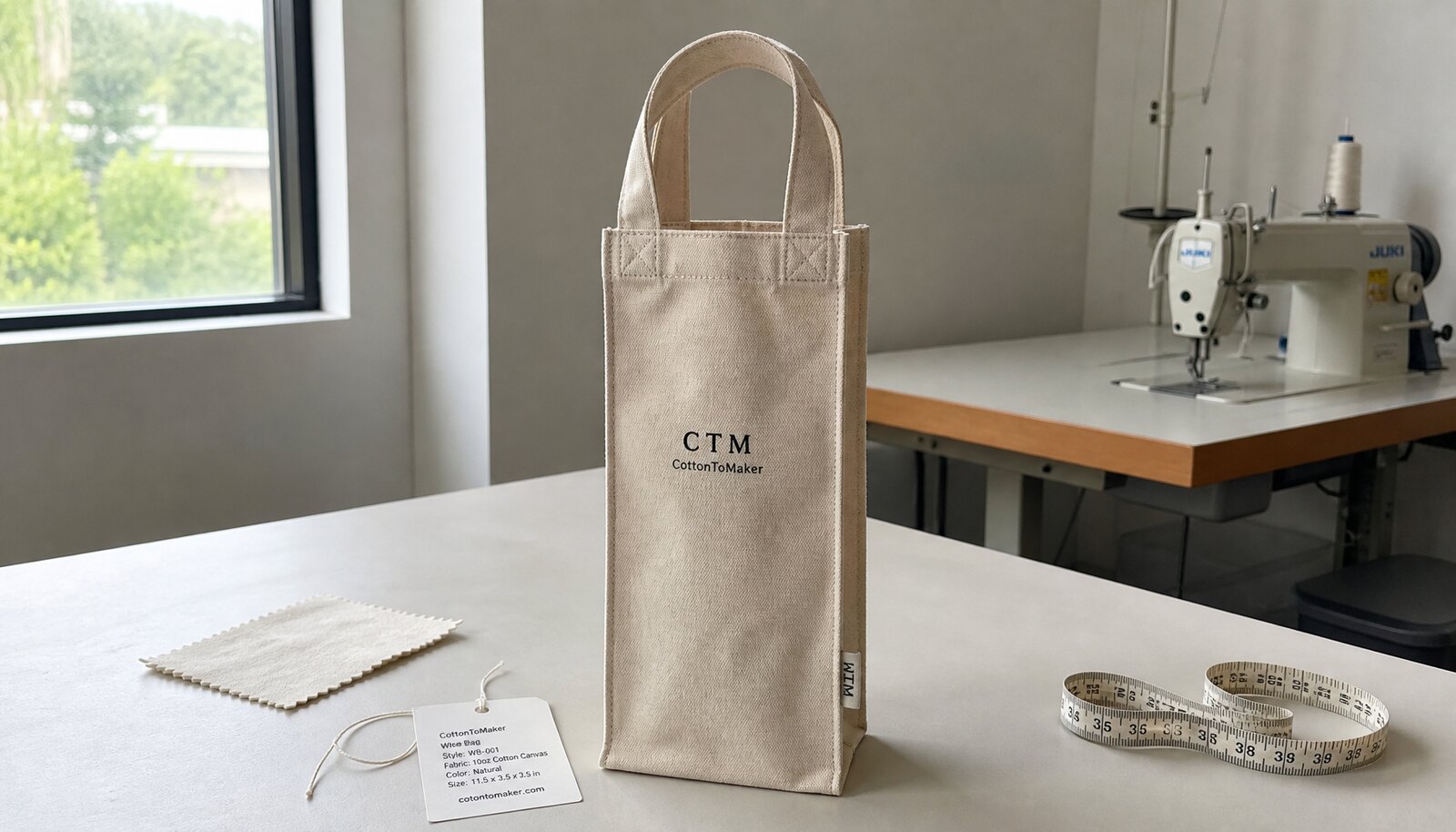
Why hotels buy single bottle wine bags in the first place
Single bottle wine bags for hotels are not just a packaging item. They sit at the intersection of guest presentation, minibar merchandising, in-room gifting, and retail upsell. A good bag makes the bottle feel intentional; a poor one looks like an afterthought and can undermine the perceived value of the wine inside.
For procurement teams, the buying problem is simple: the bag must look clean, carry a full bottle safely, and arrive in a spec that is repeatable. Hotels often need a style that can work across welcome amenities, concierge sales, holiday gifting, and F&B promotions, so the bag has to be built around usage, not decoration.
- Use case defines the spec: guest gift, minibar, retail shop, or event takeaway.
- A bag for one-off gifting can tolerate slower packing; a room-service bag cannot.
- The wrong fabric weight or handle design becomes obvious the first time a full bottle is carried across a lobby.
Start with the bottle, not the logo
The most common mistake is designing the artwork first and the fit second. A standard 750 ml bottle may sound universal, but shoulder shape, neck height, and bottle diameter vary enough to affect bag height and opening width. If the bag is too short, the top edge fights the cork or capsule. If it is too narrow, the side seam bulges and the print distorts.
For a normal hotel wine bag, a practical starting point is a body width around 10-12 cm and a body height around 33-38 cm for a standard bottle, with handle length chosen for hand carry rather than shoulder carry. If you are packing chilled bottles, add extra allowance for condensation and easier insertion.
- Standard 750 ml bottle: confirm diameter and overall height before finalizing the pattern.
- Magnum or tall Bordeaux-style bottle: often needs a wider gusset or taller body.
- If the bottle goes into a decorated carton before the bag, measure both together.
Fabric choice changes the whole quote
For single bottle wine bags for hotels, cotton canvas is usually the cleanest sourcing route. A 180-220 gsm canvas gives a more structured appearance, holds a screen print well, and feels appropriate for boutique hotels and premium properties. A lighter 140-170 gsm cotton works if the program is cost-sensitive or the bag will be used mainly as an internal presentation item.
Jute can create a rustic hospitality look, but it needs careful handling. The fiber texture can make fine logos look uneven, and the bag may shed more during packing. If the hotel brand is polished and modern, cotton canvas is usually easier to control across batches.
- 180-220 gsm: best for premium appearance and better shape retention.
- 140-170 gsm: suitable for lower-cost utility use or high-volume internal giveaways.
- Jute: visually strong, but harder on print detail and edge finishing.
Printing and branding: keep the artwork within factory limits
The print method should match the logo, not the other way around. A simple one-color screen print is usually the most reliable for hotel programs because it holds up well on canvas and keeps the quote predictable. If the design uses fine lines, gradients, or multiple colors, the factory may suggest heat transfer or multi-pass screen printing, but each added layer raises the risk of placement drift and longer lead time.
Logo placement matters more than buyers expect. On a narrow bottle bag, a logo that is too low may be hidden by the bottle label. A logo that sits too high may be interrupted by the handle base or top fold. For best results, request the factory to mark the print area on the blank sample and approve the exact centerline before bulk printing starts.
- One-color screen print is the safest commercial choice for most hotel orders.
- Two-color printing can work, but line thickness must be tested on fabric, not on a PDF.
- Ask for a placement proof on the physical sample, not only a digital mockup.
Compare the sourcing routes before you compare the prices
Hotel buyers often receive quotes from direct factories, trading companies, and mixed-item gift suppliers. These routes can all provide a single bottle wine bag, but the real comparison is control versus convenience. A direct factory is usually stronger when you need repeatable size, custom packing, and stable print placement. A trading company may be useful if the hotel is bundling wine bags with napkins, gift boxes, or other F&B accessories from one PO.
When quotes look close, the difference is often hidden in what is not included. One supplier may quote the bag only, another may include custom labels, inner polybags, and carton marks. Another may promise a lower MOQ but use stock fabric colors with no shade guarantee. For hotel procurement, the cheapest quote is rarely the one with the lowest landed cost.
- Direct factory: stronger on pattern control, QC, and repeat orders.
- Trading company: useful for mixed sourcing, but verify the actual maker.
- Stock-item reseller: good for fast trials, weak for brand consistency.
Use a real comparison table, not just a unit price
A quote for single bottle wine bags for hotels should be read as a bundle of decisions: fabric, print, sewing labor, packing, and shipment density. The same bag can vary sharply in price depending on whether the supplier uses 140 gsm cotton or 220 gsm canvas, a single-color screen print or a heat transfer, and flat-pack bulk cartons or individual retail folding. Buyers who compare only unit price often miss a heavier carton, higher print waste, or a change in handle construction.
For procurement, a practical rule is to compare quotes on the same assumptions: same fabric weight, same logo size, same packing count, same sample approval stage, and same delivery term. If the supplier refuses to quote the options separately, that is a signal that the offer may not be transparent enough for a hotel program.
- Ask for separate pricing by fabric weight and print method.
- Compare carton pack-out and outer carton dimensions alongside unit price.
- Use the same sample reference when judging each supplier's quote.
MOQ logic: what a realistic first order looks like
Most custom cotton wine bags need a sensible minimum order because setup labor is real: pattern cutting, print screen preparation, sampling, and sewing line changeover all consume time. For single bottle wine bags for hotels, a common commercial range is 1,000 to 3,000 pieces per color/style for custom orders. If you need multiple hotel properties with different logos, the factory may accept artwork changes under one base fabric spec, but every extra version can create added screen or setup cost.
Lower MOQ is possible, but the tradeoff is usually one of three things: a narrower fabric choice, higher unit price, or less control over custom packing. If you are launching a pilot program, it is often smarter to order a smaller quantity of the final spec than to order a larger quantity of a shortcut spec that the hotel will later reject.
- One base style with multiple logos is often cheaper than multiple bag constructions.
- Short runs are feasible if the supplier uses stock fabric and simple print.
- MOQ should be tied to a repeat forecast, not just the first shipment.
Sample approval should test fit, finish, and handling
A printed sample is not enough. For hotel wine bags, the approval flow should begin with a blank sample or pre-production pattern sample, then move to a printed sample with the actual artwork. The buyer should test it with a real bottle, not a dummy that is close enough. Check whether the bottle slides in smoothly, whether the handle feels balanced, and whether the top opening stays clean when the bottle is removed and reinserted several times.
The sample also needs a basic durability review. Rub the print lightly with dry fabric, inspect seam corners, and look at the top hem after the bottle has been inserted and removed a few times. If the bag twists, gaps, or feels too soft, the issue usually comes from fabric weight, stitch tension, or cut accuracy, and it is cheaper to solve at sample stage than after mass production.
- Approve fit with a real bottle from the hotel's actual wine list.
- Inspect print placement against the physical opening and handle lines.
- Keep the signed sample with the PO as the production reference.
Packing and carton strategy affect both appearance and freight
Packing for hotel bags is often underestimated. A flat-packed cotton wine bag can save freight and store neatly in-house, but it must be folded consistently so the print does not crease in the wrong place. If the bag is intended for retail or minibar display, a simple polybag and insert card may improve shelf appeal, but it also adds labor and carton volume. In a large hospitality rollout, those small additions can add up quickly across several thousand units.
Ask the factory to propose carton pack counts that protect shape without wasting air. For example, a higher pack count per carton may lower carton count and improve freight efficiency, but if it compresses the fabric too much, the bags arrive with hard fold lines. The goal is to protect presentation while keeping cubic volume under control.
- Flat pack is usually best for internal hotel distribution.
- Retail-facing programs may need individual polybags or an insert card.
- Carton labels should show style, quantity, color, and PO number clearly.
Lead time risk lives in print, packing, and approvals
Lead time is not just sewing time. For single bottle wine bags for hotels, the schedule usually includes artwork confirmation, sample approval, raw material sourcing, printing, sewing, packing, and final inspection. If the supplier is waiting on your logo sign-off, the line may be ready but idle. If you change the print after sample approval, the clock resets faster than most buyers expect.
The safest way to control the timeline is to freeze three things early: bag size, print method, and packing format. Once those are fixed, the supplier can plan material buying and line scheduling. If your hotel opening date is immovable, build buffer time for re-sampling, carton relabeling, and transit delays, especially when the order crosses peak season.
- Freeze size, print method, and packing before mass production release.
- Expect sample correction to add days even when sewing is simple.
- Allow extra time if using custom woven labels or special retail inserts.
Specification comparison for buyers
| Spec decision | Recommended option | When it fits | Buyer risk to check |
|---|---|---|---|
| Fabric route | 180-220 gsm cotton canvas or 10-12 oz canvas for a more structured retail look; 140-170 gsm for lower-cost room delivery use | Hotels that want a premium feel, good print sharpness, and a bag that keeps shape around a 750 ml bottle | Too-light fabric can collapse and wrinkle in guest presentation; too-heavy fabric raises unit cost and freight weight |
| Alternative material | Jute with inner lamination or lined jute look | Resort shops, wine gifting, or eco-positioned properties that want a rustic presentation | Scratchy handle feel, fiber shedding, and print distortion if the panel is too rough or uneven |
| Handle style | Self-fabric handles or cotton webbing handles with reinforced top stitching | When the bag must carry a full bottle safely and feel comfortable in hand | Short handles make the bag hard to carry; weak stitch counts lead to seam stress at the shoulder |
| Closure style | Open top for fast room-service use; drawstring or button closure for gift sets | Open top for minibar or welcome-room use; closure for VIP gifting or retail sell-through | Closures add labor and may complicate insertion speed, especially if bottles vary slightly in height |
| Print method | 1-color screen print for cost control; 2-color screen print or heat transfer for more detailed branding | Hotels ordering medium to high volume with a clean logo and consistent placement | Fine text can fill in on textured fabric; poor logo placement gets cropped by seams or handle tops |
| Supplier route | Direct factory with packaging control and sample approval; trading company only if you need mixed items or very small trials | Repeat hotel programs, uniform branding, and custom packing requirements | Trading layers can hide factory capabilities and increase quote spread without improving QC |
| MOQ logic | Base MOQ 1,000-3,000 pcs per color/style for custom canvas; lower only with stock fabric or simplified print | Properties rolling out one design across multiple outlets or rooms | Very low MOQ often means limited fabric choice, weaker packaging control, or higher per-unit cost |
| Packing format | Flat pack with bulk polybags and carton labeling, or folded with insert card for retail presentation | Bulk hotel procurement uses flat pack; boutique retail or minibar sales need presentation packing | Overpacking drives carton size and freight cost; underpacking causes wrinkles and print rub during transit |
| Sourcing route | Direct manufacturer with sample room and in-house sewing/printing | Best for custom dimensions, logo control, and stable repeat orders | If the factory outsources printing or sewing, lead time and defect responsibility can get blurred |
Buyer checklist before sampling
- Bottle size confirmed: 750 ml standard, magnum, or a non-standard wine bottle width and shoulder height
- Bag size drawn with bottle insertion clearance, not guessed from a photo
- Fabric GSM or oz specified, plus whether the buyer wants a structured or soft drape
- Print method, logo size, and exact placement marked on artwork and sample photo
- Handle length, seam reinforcement, and stitch count defined
- Closure style selected or intentionally left open top for speed
- Carton pack count, inner polybag rule, and hangtag or insert card requirement defined
- Target MOQ, trial quantity, and repeat-order forecast stated together
- QC acceptance limits written for print alignment, stitch defects, stains, and dimension tolerance
Factory quote questions to send
- What fabric weight, weave density, and shrinkage control do you recommend for a 750 ml hotel wine bag, and what is the price difference between 140-170 gsm and 180-220 gsm options?
- Is the logo printed in-house, outsourced, or applied by heat transfer, and what is your standard placement tolerance from the bag centerline and top edge?
- What is your MOQ by color and by artwork version, and can you combine hotel properties under one fabric spec if only the logo changes?
- Please quote separate pricing for open-top, drawstring, and cotton webbing handle versions so we can compare guest-use versus gift-use applications.
- What samples do you provide first: blank sample, pre-production sample, or printed sample, and how long does each stage take?
- What are your standard packing details per polybag and carton, and what carton size do you use for sea freight efficiency?
- What lead time changes if we approve one color print versus two colors, and what happens if we need custom woven labels or insert cards?
- Which QC checks are done before shipment for stitch strength, print rub resistance, measurement tolerance, and carton drop resistance?
Quality-control points to confirm
- Bag opening width must allow smooth insertion of the target bottle without forcing the seam; use the approved bottle dummy during inspection
- Stitching at handle base and side seams must be dense and even, with no skipped stitches, loose threads, or seam puckering
- Print placement must stay within the agreed tolerance and remain readable after light rubbing; no broken logo edges or ink bleed
- Fabric must be free from oil stains, dye marks, needle holes, and visible weave flaws in the logo area
- Handle length must match the approved sample so the bottle hangs upright and does not tip excessively
- Closure components, if used, must operate smoothly and not snag the fabric or distort the top opening
- Cartons must hold the agreed pack count without crushing the bags; exterior labels must match style, color, and PO details
- Random carton checks should include one fold-open inspection for creasing, odor, and print transfer between bags