Shopping Bag OEM Sustainability Sourcing Criteria for United States Buyers
Byline: Vincent Xi, Editorial Author.
Author scope: The linked profile identifies Vincent Xi as Editorial Author. It does not document factory work, product testing, certification, or customer results, so no first-hand operational claim is made here.
For United States B2B buyers, shopping bag OEM sustainability sourcing criteria should function as manufacturing award gates. A quote is not ready for approval until it includes a controlled SKU specification, the exact wording and scope of each environmental claim, evidence linked to the proposed material and manufacturing site, buyer-approved marking and conditional labeling instructions, normalized landed-cost inputs, and dated production and delivery milestones.
This article addresses one purchasing decision: whether an OEM shopping bag quote is complete enough to award. It does not rank materials by presumed environmental benefit or treat a supplier webpage, certificate reference, or marketing term as proof for the finished SKU.
United States Shopping Bag Sustainability Sourcing Criteria
The following controls are buyer-defined procurement practices. They are not presented as requirements of a cited standard.
| Award gate | Supplier return | Buyer release evidence | Stop condition |
|---|---|---|---|
| Product specification | Dimensions, tolerances, bill of materials, construction, print, performance method, and packing data | Approved technical specification and pre-production sample with the same revision | A material, tolerance, test, artwork, or packing field remains open |
| Sustainability claim | Exact wording, claimed component, defined percentage or basis, site and lot scope, method, and supporting file | Approved claim-to-evidence record | Evidence is generic, expired, site-mismatched, or unrelated to the quoted bulk material |
| Manufacturing site | Quoting entity, production-site address, process locations, and disclosed subcontractors | Approved site and process record | Production may move to an undisclosed or unapproved site |
| United States release | Origin-marking instruction, conditional textile-label determination, environmental-claim review, and artwork | Approved artwork plus finished-sample and pack-out images | Wording, placement, material, or site differs from the approved record |
| Landed cost | Unit price, quote basis, named place, packing data, logistics assumptions, import inputs, and separate extras | Normalized comparison for the same SKU, quantity, destination, and comparison date | A cost is omitted, unscoped, or based on unconfirmed classification or duty treatment |
| Delivery | Material, sample, production, inspection, shipment, and destination milestones | Dated calendar with dependencies, owners, and recovery actions | Lead time is an undefined range or omits approval, material, documentation, or booking time |
Freeze the Shopping Bag Manufacturing Specification
The supplied commercial sources can inform RFQ questions, but they do not define the buyer's finished product. The Hansun shopping bag sourcing reference names nonwoven fabric, canvas, and recycled PET. The Lucky Star Creation factory article discusses dimensions, fabric weight, load, handles, samples, printing, quality control, timelines, and communication. The Exploretex commercial page names cotton, recycled-material, hemp, jute, and rPET options and discusses traceability and lifecycle topics. Those pages do not establish the composition, performance, or environmental impact of a buyer-specific SKU.
| Specification field | Required supplier response | Award evidence |
|---|---|---|
| Intended use | Contents, handling conditions, requested public claim, and buyer-defined performance objective | Written design basis with supplier exceptions recorded |
| Finished geometry | Width, height, gusset, handle drop, measurement points, tolerances, and units | Dimensioned drawing and sample measurement report |
| Body material | Generic fiber or polymer identity, composition basis, nominal fabric mass, tolerance, finish, color reference, source, and material lot | Bill of materials plus material-specific records |
| Handles and construction | Handle material, width, drop, attachment geometry, seam or weld method, reinforcement, and workmanship limits | Construction sheet and close-up sample images |
| Decoration | Print method, ink system, artwork revision, color reference, placement, registration tolerance, and rub or adhesion method | Approved strike-off or print sample |
| Performance | Named method, specimen scope, units, acceptance rule, failure definition, and bulk test plan | Traceable result for the identified sample or production lot |
| Packing | Fold method, individual packing, units per carton, carton dimensions, weights, and carton marks | Approved packing specification and pack-out image |
Undated example assumptions to verify in the supplier quote: These values apply only to a hypothetical future RFQ. They are not market norms, sourced product facts, or test results. The buyer must add the actual RFQ issue date and verify every value in the supplier quote, drawing, bulk-intent sample, and approved test method.
- Finished geometry assumption for the hypothetical SKU: 400 mm width x 350 mm height x 120 mm gusset.
- Body-material assumption for the same hypothetical SKU: nominal 280 g/m2 cotton canvas, with composition, measured mass, and tolerance still to be documented.
- Handle assumption for the same hypothetical SKU: 25 mm webbing width, with material, drop, and attachment geometry defined on the drawing.
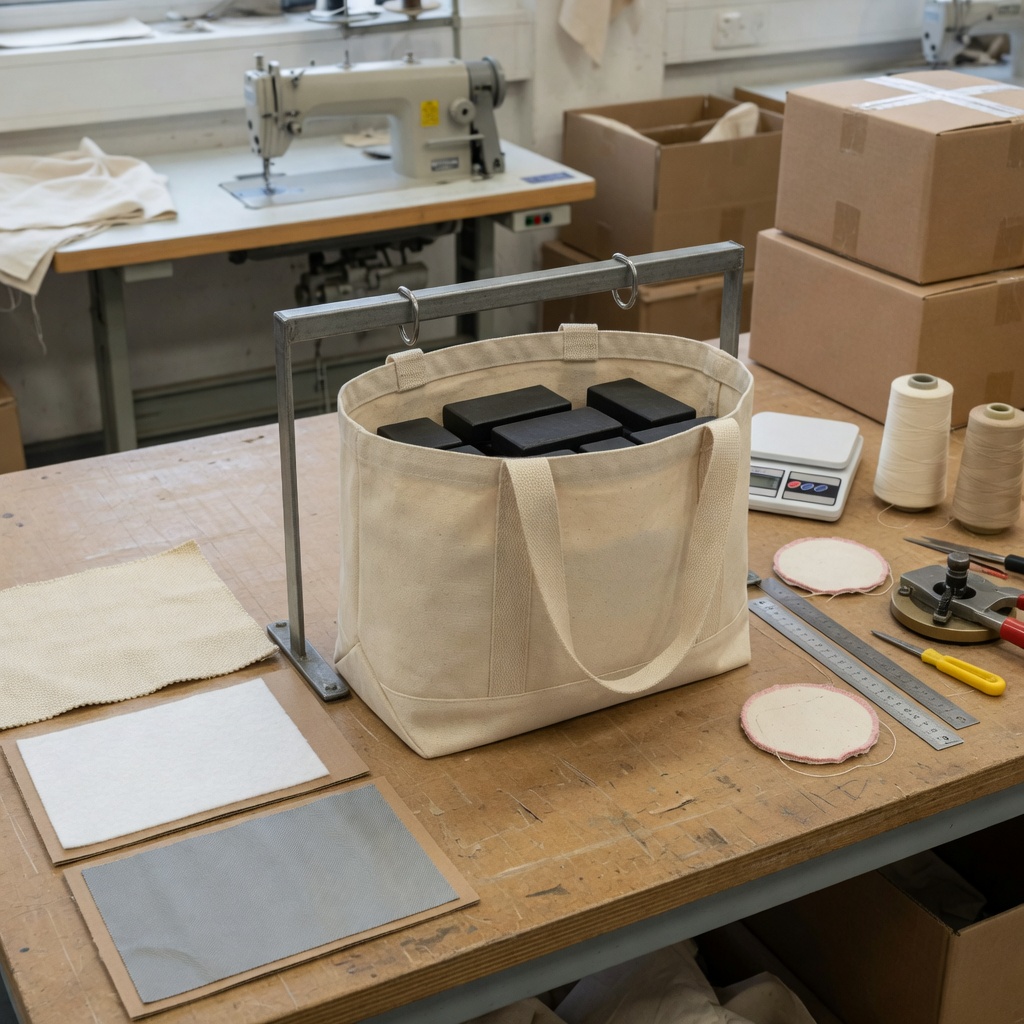
- Performance assumption for the same hypothetical SKU: 10 kg distributed design load under a buyer-approved method that defines the fixture, load distribution, duration, specimen scope, failure condition, and acceptance rule.
- Quote-volume assumption for the hypothetical RFQ: 10,000 bags per order, with quantity-break prices returned separately.
These assumptions must not become purchase-order facts without verification. The drawing, bill of materials, claim record, artwork, packing specification, and approved sample should carry the same revision identifier.
Apply Sustainability Sourcing Criteria to Claims
A proposed sustainability claim has procurement value only when its wording is tied to the relevant component, calculation basis, manufacturing site, material or production lot, supporting document, validity context, and release owner.
| Proposed claim | Supplier must define | Evidence and release rule |
|---|---|---|
| Recycled content | Component, claimed percentage, calculation basis, and any intended pre-consumer or post-consumer distinction | Obtain evidence appropriate to the named scheme and linked to the quoted site, material, and lot; approve only supported wording |
| Organic fiber | Fiber, component, claimed percentage, processing scope, and proposed public wording | Verify current scheme rules and site- and lot-specific documents before release |
| Reusable or durable | Intended use, construction, buyer-defined load, method, specimen scope, and proposed statement | Require a traceable result for a bulk-intent sample or production lot; omit unsupported trip-count or service-life claims |
| Carbon, water, or lifecycle impact | Exact SKU, functional unit, boundary, geography, data period, method, datasets, and review status | Omit numerical claims unless a complete SKU-level study supports the same wording and scope |
| Recyclable or compostable | Included and excluded components, required conditions, collection or processing qualification, and exact wording | Remove or qualify the claim when required conditions cannot be substantiated for the intended United States use |
| No environmental claim | Supplier returns no environmental claim | Continue to require material identity, quality, labeling, and traceability evidence without assigning an unsupported claim benefit |
Standards and Buyer Practice
The official ISO 9001:2015 page describes the 2015 edition of ISO 9001 as specifying requirements for a quality management system. That is the supported scope of the cited standard. Requesting a full certificate and checking its site address, scope, issuer, and validity is the buyer practice proposed here; it is not presented as an additional requirement of ISO 9001. No supplied source establishes that a quoted supplier currently holds this certification.
The Exploretex commercial page names GOTS and GRS in connection with material options. Because no scheme-owner source is supplied, this article does not state their detailed requirements. A supplier-page reference is not evidence of current certification, site coverage, or lot eligibility. Verify the current scheme rules and obtain the applicable site and transaction records before approving claim language.
The Hansun commercial page names BSCI and Sedex four-pillar checks. Treat any returned audit file as site-specific due-diligence material requiring buyer review, not as product certification, proof of material content, or evidence of finished-product performance.
United States Labeling, Marking, and Claim Release
The part numbers below are regulatory identifiers rather than product data. Their linked eCFR pages provide dynamic current text. Record the access date and obtain a product-specific determination when approving artwork and import instructions.
| Official source context | RFQ output | Release control |
|---|---|---|
| 19 CFR Part 134, the supplied current-text context for marking imported articles and containers | Importer-approved origin-marking wording, location, application method, artwork revision, and pre-production image for the exact SKU | The importer or designated customs adviser confirms the instruction before bulk packing; hold release if wording or placement changes |
| 16 CFR Part 303, the supplied current-text context for textile fiber product rules | Written SKU-specific applicability determination and, when applicable, approved content and identification artwork | The designated compliance owner determines applicability; do not infer inclusion or exclusion from a catalog name |
| 16 CFR Part 260, the supplied current-text context for United States environmental marketing guidance | Exact claim, qualifications, substantiation file, SKU and lot scope, artwork revision, owner, and approval date | Do not release print, packaging, or product-page wording until the evidence supports the exact claim |
| Harmonized Tariff Schedule, the supplied official classification-research context | Composition, construction, intended use, origin, invoice, and packing facts needed for classification review | The United States importer or customs broker confirms classification and entry treatment; do not award based only on a factory-supplied code |
Require the supplier to reproduce buyer-approved artwork without modification. Final release evidence should include the approved proof, a finished-article image showing placement, and a production pack-out image. No state-specific source was supplied, so this article makes no state-specific labeling or environmental-claim conclusion.
Normalize Landed Cost Before Comparing Quotes
Compare bidders against the same specification revision, order quantity, currency treatment, United States destination, and comparison date. Require separate lines for:
- Merchandise price per bag, quantity break, currency, quote validity, quote basis, named place, and included manufacturing operations.
- Development samples, print strike-offs, pre-production samples, tooling, testing, inspection, and requested evidence files.
- Packing method, units per carton, carton dimensions, gross and net weights, and production pack-out assumptions.
- Origin handling, international freight, insurance, brokerage, applicable import charges, and destination transport, with responsibility assigned for each line.
- Reinspection, rework, replacement, credit, or disposal terms for nonconforming goods.
Ask the supplier for the composition and construction facts needed for classification research. The United States importer or customs broker should confirm treatment against the Harmonized Tariff Schedule on the recorded bid-comparison or entry-review date.
Undated example calculation to verify in current quotes: The following values apply only to a hypothetical future order delivered to one buyer-named United States destination. They are not supplier prices, freight rates, duties, fees, or market benchmarks. Add the actual quote date and replace every input with dated supplier, logistics, broker, testing, and inspection quotes before award.
- Hypothetical order scope: 10,000 bags per order.
- Assumed merchandise input: USD 1.20 per bag for that hypothetical order, producing USD 12,000 per order.
- Assumed combined remaining landed-cost input: USD 6,000 per shipment for that same hypothetical order.
- Example total: USD 12,000 per order + USD 6,000 per shipment = USD 18,000 per order, assuming one shipment for the order.
- Example normalized cost: USD 18,000 per order / 10,000 bags per order = USD 1.80 per bag.
This arithmetic demonstrates normalization only. The actual worksheet should preserve every cost line, quote owner, currency, validity date, inclusion, exclusion, and supporting file.
Convert Lead Time into Dated Milestones
In the commercial source's 2026-labeled sourcing context, the Hansun page reports supplier-specific capacity of 1.5 million pieces per month and a supplier-specific lead time of 30-45 days. These are attributed commercial-page statements, not independently verified capacity, an industry average, or a reservation for the buyer's order. The source does not establish whether the reported days are calendar or business days, and the title label is not treated as a verified publication or retrieval date. Reconfirm both values as of the dated RFQ response.
Before award, require each bidder to state the quote date, available capacity for the specified construction, the period covered by that capacity response, existing booking assumptions, the lead-time start event, and whether quoted days are calendar or business days.
The delivery calendar should assign dates, dependencies, owners, and recovery actions to document approval, material availability, pre-production sample approval, bulk start, in-line inspection, final inspection, ex-factory readiness, booking, departure, estimated arrival, customs availability, and warehouse delivery. Production completion, carrier booking, arrival, customs release, and warehouse receipt are separate milestones and should not share one undefined delivery date.
Practical RFQ Checklist for United States Shopping Bag Awards
Use this checklist for each bidder and SKU. Record pass, hold, or not applicable beside every item, name the reviewer, and link the supporting evidence. A checked item means the evidence was reviewed against the current RFQ revision, not merely received.
- [ ] Enter the RFQ identifier, issue date, response deadline, SKU, order quantity, United States destination, currency, and specification revision.
- [ ] Record the quoting legal entity, payment entity, manufacturing-site address, process locations, disclosed subcontractors, response owner, and response date.
- [ ] Attach the dimensioned drawing, bill of materials, construction sheet, artwork revision, performance methods, acceptance rules, and packing specification.
- [ ] Confirm that every material entry states identity, composition basis, nominal value, tolerance, source, site scope, and applicable material lot.
- [ ] Require the exact sustainability claim or
no environmental claim, including the component, calculation basis, site and lot scope, evidence identifier, issuer, validity, and proposed wording. - [ ] Check any certificate or audit document for the named site, covered scope, issuer, issue date, validity, and relationship to the quoted material or process.
- [ ] Define the sample sequence, bulk-intent material confirmation, inspection stages, defect definitions, test-result format, traceability path, and disposition authority.
- [ ] Obtain importer-approved origin-marking instructions and a written determination of whether the conditional textile-label context applies to the SKU.
- [ ] Link each environmental claim to its substantiation file, approved wording, artwork revision, approval owner, and approval date before printing or publication.
- [ ] Capture merchandise price, quantity break, currency, validity, quote basis, named place, inclusions, exclusions, samples, tooling, testing, inspection, and remedy terms.
- [ ] Normalize freight, insurance, brokerage, import inputs, destination transport, and packing data against the same quantity, destination, and comparison date.
- [ ] Obtain classification inputs from the supplier and record confirmation by the United States importer or customs broker rather than relying only on a supplier code.
- [ ] Convert lead time into dated material, sample, production, inspection, booking, departure, arrival, customs, and warehouse milestones with owners and dependencies.
- [ ] Require prior written approval for any change to the site, subcontractor, material, construction, claim, artwork, test method, packing, price basis, or delivery plan.
- [ ] Resolve every exception and blank required field before award; attach the final evidence index and record the authorized award decision.
Place the quote on hold when evidence is expired or outside the relevant scope, a required cost line is omitted, a delivery dependency has no owner, or a substitution can occur without prior written approval. The purchase order should reference the approved specification revision, claim evidence record, artwork, sample, inspection plan, packing specification, delivery calendar, change-notification process, no-substitution rule, and remedy for nonconforming goods.
Methodology, Source Contexts, and Limitations
Methodology: Explicit statements in the supplied commercial pages were separated from official standard and regulatory contexts. Commercial statements were retained only as attributed statements and converted into RFQ questions, evidence requests, or award controls. Official sources were used only for the stated scope; no product-specific legal or certification conclusion was inferred. Exact values without a factual source were labeled as undated hypothetical assumptions or calculations that must be verified in current quotes. The landed-cost result was derived directly from the displayed example inputs.
Author source context: The Vincent Xi author profile supports the displayed author name and Editorial Author role only.
Commercial source context: The Hansun sourcing reference, Lucky Star Creation article, and Exploretex page can identify sourcing questions and attributed supplier statements. They do not independently validate the buyer's SKU, supplier, material, claim, or test result.
Official source context: The ISO page, 19 CFR Part 134, 16 CFR Part 303, 16 CFR Part 260, and Harmonized Tariff Schedule provide the standard, federal-rule, and classification contexts used here. Their current text and product-specific applicability must be checked at release.
Limitations and what to verify: This article does not independently validate a factory, certificate, audit, material identity, production lot, test result, capacity statement, lead time, environmental footprint, tariff classification, duty treatment, freight rate, landed cost, or delivery date. Where a publication or retrieval date is not established by the supplied package, none is inferred. Before award, verify current site and lot documents under the issuer's rules, test the approved construction under a written method, reconcile the production lot to the approved sample, obtain dated commercial and logistics quotes, have the importer or broker confirm classification and entry treatment, and obtain approval of final marking, conditional labels, and environmental claims from the designated United States compliance owner.
Discuss Your Requirements
Review our manufacturing capabilities, then share your specifications for a supplier-fit review.