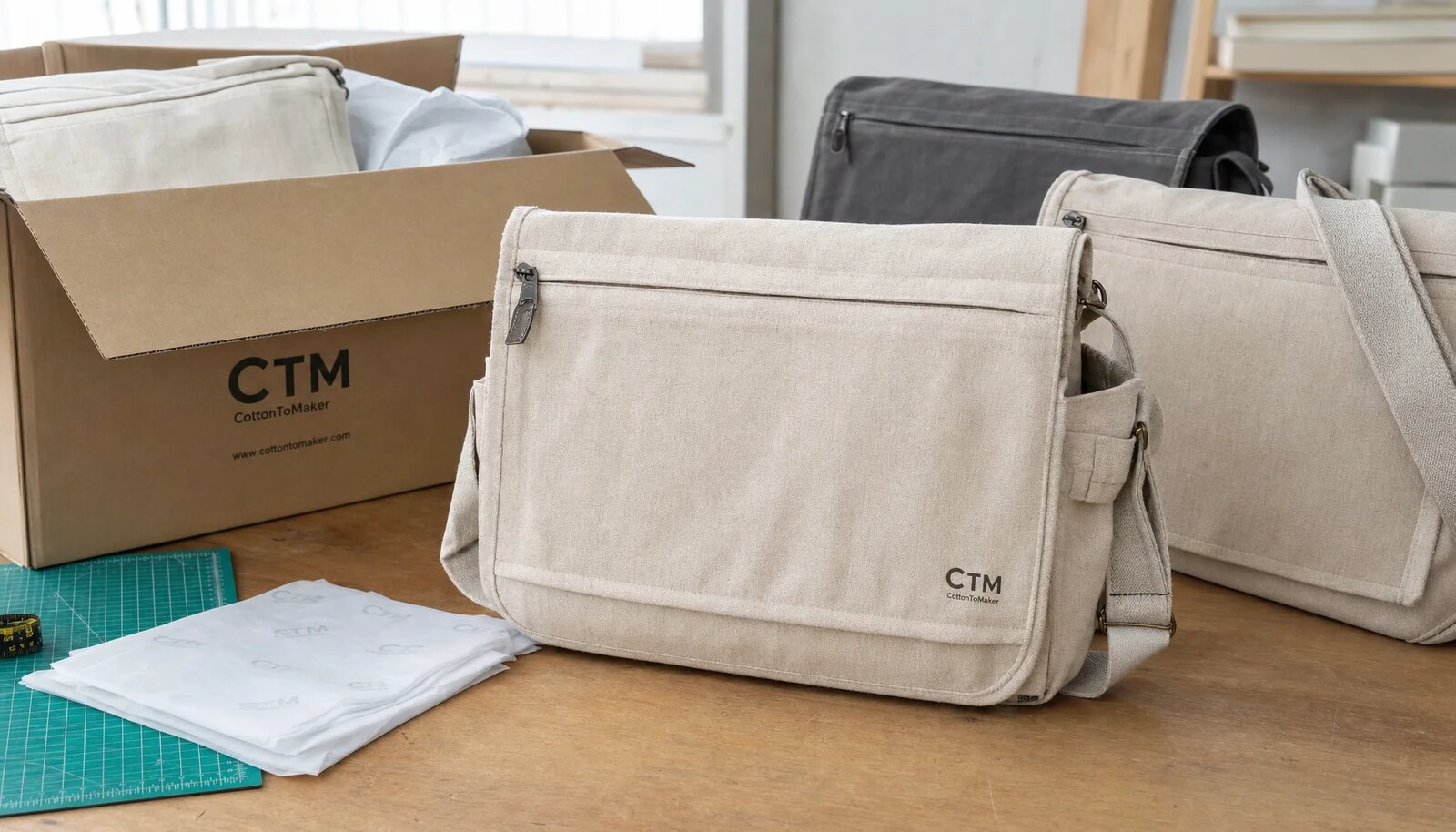
Why carton planning belongs in the RFQ
Carton planning should start while the custom canvas messenger bag is being quoted, not after bulk sewing is finished. The same bag can ship as 30, 40, or 50 pieces per carton, and each choice changes freight cube, gross weight, carton strength, warehouse handling, and the condition of the logo panel when the bag is unpacked.
For procurement teams, the carton is part of landed cost. A low unit price can become less attractive if the supplier uses oversized cartons, weak corrugated board, poor folding, or packaging that forces rework at receiving. A slightly higher unit price may be easier to justify when the quote includes folded dimensions, total CBM, carton count, gross weight, label details, and a packed sample standard.
Eco apparel brands have one more constraint: packaging choices are visible to customers, warehouse teams, and sustainability reviewers. Removing polybags can reduce plastic, but it can also expose cotton canvas to moisture, lint, dye transfer, and print rub. The practical goal is not the least packaging; it is the least packaging that still protects the product through the real route.
- Put carton data in the first RFQ, alongside bag dimensions, fabric, logo method, MOQ, and lead time.
- Compare suppliers by unit price, carton count, total CBM, gross weight, packaging method, and inspection evidence.
- Ask for at least two carton pack options when weight or cube is uncertain.
- Approve a packed sample carton before mass packing on first orders or changed specifications.
Define the bag before defining the carton
A useful carton plan begins with the finished messenger bag specification. Body width, height, gusset depth, flap length, closure, lining, pocket structure, strap width, adjuster hardware, and carry handle all affect folded size. A soft unlined canvas bag may stack flat; a lined messenger bag with buckles and zipper pulls may need separation between layers.
Canvas weight should be written in a way both sides can verify. Buyers often refer to 12 oz, 14 oz, or 16 oz canvas, but mills and factories may quote greige fabric, finished fabric, or a converted GSM estimate. Ask the supplier to state the measurement basis and tolerance. If the bag includes heavy webbing, lining, metal hardware, or reinforcement, separate those elements from shell fabric weight so carton gross weight is realistic.
Do not build the carton plan only from finished bag dimensions. A 38 x 30 x 10 cm messenger bag may fold to a compact rectangle if the strap tucks inside the body, or it may become bulky if the strap, flap, and hardware stack in one corner. Folded dimensions should come from a sample or a similar production style.
- Define finished size and folded size as separate fields.
- Specify shell canvas, lining, webbing, hardware, and reinforcement materials clearly.
- State the intended product use: retail resale, employee kit, event merchandise, or daily-use accessory.
- Require logo placement from measurable reference points, not only from a visual mockup.
Compare carton pack options with numbers
Piece count per carton should be a decision, not a habit. Round numbers such as 25, 30, 40, or 50 pieces are convenient, but the right choice depends on unit weight, folded size, carton strength, pallet pattern, and receiving rules. Ask the factory to quote at least two packing configurations when the order is new or when freight cost is material.
A simple example shows the tradeoff. If one packed messenger bag weighs 0.58 kg, 40 pieces create 23.2 kg net weight before the carton and inner materials. Gross weight may land around 24 to 26 kg. That may work for palletized handling but exceed a hand-lift policy. At 30 pieces, net weight is 17.4 kg and gross weight may be closer to 18.5 to 20.5 kg, but carton count rises.
CBM also needs a route-specific check. A 60 x 42 x 48 cm carton is 0.121 CBM. Thirty cartons equal about 3.63 CBM before pallets. A 56 x 40 x 42 cm carton is 0.094 CBM; forty cartons equal about 3.76 CBM before pallets. The lower carton count is not automatically better if it creates heavy handling, weak stacking, or pressure marks on the bags.
- CBM per carton equals length x width x height in meters.
- Total CBM equals CBM per carton x carton count.
- Net carton weight equals unit bag weight x pieces per carton.
- Gross carton weight adds corrugated board, inner packaging, labels, and moisture-control materials.
Check freight mode and dimensional weight
Ocean freight, air freight, courier, and domestic trucking treat cartons differently. For ocean freight, total CBM, pallet count, carton strength, and moisture protection usually matter most. For air or courier, dimensional weight can make a large but light carton expensive even when actual gross weight is moderate.
Dimensional weight is commonly calculated as length x width x height divided by a carrier divisor, using the units required by that carrier. With centimeters and a 5,000 divisor as a common example, a 60 x 42 x 48 cm carton equals 24.2 kg dimensional weight. If actual gross weight is 20 kg, chargeable weight may be based on dimensional weight. If actual gross weight is 26 kg, actual weight may control.
Ask the forwarder to confirm the divisor and unit rules before approving cartons for air or parcel routes. A carton optimized for sea freight may not be optimal for courier replenishment. If the program will use both ocean for launch orders and air for urgent replenishment, it may need two approved carton configurations.
- Ask whether freight cost is based on actual weight, dimensional weight, CBM, pallet space, or container utilization.
- Get the dimensional weight divisor from the carrier or forwarder before approving air cartons.
- Avoid oversized cartons that look easy to pack but create unnecessary chargeable weight.
- Keep separate carton standards when launch orders and replenishment orders move by different routes.
Plan pallets and warehouse handling early
If goods will move through export consolidation, distribution centers, or retail replenishment networks, master cartons should be planned with pallets in mind. A carton that is efficient by itself may stack poorly on a standard pallet, causing overhang, wasted surface area, unstable layers, or hidden labels.
Ask for cartons per layer, layers per pallet, pallet height, pallet gross weight, and label visibility. If the buyer has a maximum pallet height or a preferred label face, send that rule before cartons are printed and packed. Late pallet instructions can create relabeling, repacking, or extra forwarding charges.
Handling limits are equally important. Some warehouses can manage 24 kg cartons when palletized; others prefer lighter cartons because workers handle them repeatedly. A practical RFQ gives the supplier a target maximum gross weight. If no policy exists, request alternatives such as 30 pieces versus 40 pieces per carton and let the receiving team choose.
- Confirm carton gross weight limits with the destination warehouse.
- Request pallet pattern, pallet dimensions, pallet count, and pallet height where relevant.
- Avoid carton overhang because it increases corner crushing and instability.
- State who pays for pallets, corner boards, stretch wrap, pallet labels, and any relabeling required by the forwarder.
Specify carton board and sealing
Descriptions such as strong export carton or 5-ply carton are too vague for controlled procurement. A 5-ply carton can perform differently depending on paper grade, flute combination, humidity, carton dimensions, gross weight, and stacking time. Ask for measurable data where the supplier can provide it.
Useful carton fields include wall construction, flute type, paper grade, edge crush test value, burst strength, and sealing method. ECT relates to edge crush performance and stacking strength. Burst strength relates to resistance against rupture or puncture. Not every bag factory has full lab testing for every carton, but it should know the carton specification it is buying and why it fits the planned gross weight.
Sealing deserves attention because canvas bags can be dense. Heavy cartons with weak tape may open during handling even if the board is acceptable. Confirm tape width, tape pattern, strap banding if used, and whether staples are prohibited by the receiving warehouse. For eco packaging programs, also check whether tape, labels, and carton coatings align with recyclability requirements.
- Ask for wall type, flute, board grade, ECT or burst strength where available.
- Tie carton strength to gross weight, pallet stacking, transit route, and storage time.
- Inspect sealing method on the packed sample carton, not only in a written quote.
- Avoid staples when destination handling or customer safety rules prohibit them.
Choose eco packaging by performance, not slogan
Eco packaging for canvas messenger bags often means reduced plastic, recycled paper, FSC board, paper bands, or bulk packing. These choices can support brand goals, but they must still protect light-colored cotton canvas, printed logos, hardware, and clean retail presentation.
Individual polybags protect against moisture, dust, and scuffing, but they create plastic waste and may require warning labels or disposal guidance in some markets. Tissue and paper bands reduce plastic and can look better to customers, but they may tear, absorb humidity, shed fibers, or rub against ink. Bulk packing with a carton liner reduces individual wrapping but increases the consequence if one carton gets damp.
FSC and recycled-content claims should be documented. Ask what claim can appear on purchase documents, carton records, or packaging labels, and confirm whether the supplier has the correct chain-of-custody support. Destination rules may also affect recycling icons, plastic statements, and extended producer responsibility reporting. Procurement should keep claim documents with the PO file.
- Rank priorities: plastic reduction, recyclability, recycled content, FSC sourcing, moisture protection, or customer presentation.
- Test reduced-plastic packing for logo rub, fiber transfer, tissue tearing, staining, and mildew risk.
- Confirm claim wording before printing recycling marks or sustainability statements.
- Use the packed sample carton as the evidence that the eco packaging choice works in practice.
Approve a packed sample carton
A sewn pre-production sample proves the bag. A packed sample carton proves the shipment. For first orders, changed dimensions, new artwork, new inner packaging, or new carton counts, buyers should approve both before bulk packing starts.
The packed sample should use final folding, final inner packaging, final carton board, final carton marks, SKU label, barcode if needed, quantity label, net weight, gross weight, and measured carton dimensions. Keep the carton compressed for at least 24 hours before reviewing the bags. This reveals crease memory, strap ridges, print rub, hardware marks, tissue lint, and carton bulging that may not appear immediately.
Packed sample approval also protects the supplier from vague disputes. Once the buyer signs off on the folding photo set, label layout, and carton data, the production team has a clear packing standard. Any later change to carton count, pallet height, packaging material, or label rules can be treated as a controlled commercial change.
- Photograph each folding step and include it in the production file.
- Check logo panels after compression, not only before packing.
- Verify carton marks, PO number, SKU, color, quantity, country of origin, and barcode readability.
- Record approved carton dimensions, net weight, gross weight, and pieces per carton for repeat orders.
Control MOQ, lead time, and change points
MOQ is usually driven by fabric availability, dye color, logo setup, lining, hardware, or packaging configuration. A natural canvas messenger bag with one printed logo may have a different MOQ from a dyed canvas bag with custom lining, embroidery, metal buckles, and paper-only retail packing. Ask which element drives the MOQ so you know where flexibility exists.
Lead time should be broken into stages: artwork proof, fabric sourcing, color approval if needed, pre-production sample, packed sample, bulk cutting, printing or embroidery, sewing, finishing, carton packing, inspection, and shipment handover. A single statement such as 30 days after deposit is not enough for a first order with custom packaging.
Carton changes can affect cost and schedule. Changing from 40 to 30 pieces per carton may require new cartons, new labels, a new pallet plan, and revised freight booking data. Changing from polybag to tissue after production starts may slow packing and increase scuff risk. Freeze the carton plan before the supplier orders cartons for bulk packing.
- Ask what drives MOQ and what changes if colors, logos, or packing methods are split.
- Require a stage-by-stage lead time that includes packed sample approval.
- Lock carton count, carton size, labels, and inner packaging before mass packing.
- Treat late packaging changes as price and schedule changes, not simple preferences.
Use inspection evidence for landed-cost decisions
Final supplier selection should compare landed cost and operational risk, not only unit price. For custom canvas messenger bags, carton planning affects total CBM, chargeable weight, pallet count, receiving labor, storage space, packaging waste, and damage allowance. Quotes are only comparable when they use the same bag specification, same packing method, same Incoterms, and similar inspection evidence.
Inspection should focus on defects that become expensive after arrival. At minimum, request photos or reports showing finished bags, logo placement, stitching, hardware, folding, inner packaging, carton sealing, carton labels, carton count, gross weight, and carton dimensions. For larger orders, add in-line checks for fabric weight, print curing, strap reinforcement, and first packed cartons.
Before shipment, reconcile PO quantity, carton count, packing list, commercial invoice, warehouse booking, and pallet data if applicable. If eco packaging claims are part of the purchase, store supporting documents with the order file. A proven carton plan becomes a reusable specification for reorders, which reduces quote ambiguity and makes future procurement faster.
- Compare suppliers on unit price, total CBM, gross weight, carton count, pallet plan, Incoterms, and packaging method.
- Require first-packed-carton evidence before the full order is sealed.
- Reconcile PO quantity, carton count, packing list, invoice, and booking data before handover.
- Save the approved carton plan with the product specification for repeat orders.
Specification comparison for buyers
| Carton pack configuration | Best fit | Procurement advantage | Risk to validate before approval |
|---|---|---|---|
| 30 pieces per master carton | Medium-weight canvas bags, manual warehouse handling, first orders where product recovery matters | Keeps gross weight easier to handle and reduces pressure on logo panels, flap seams, and hardware | Higher carton count may slightly increase CBM, corrugated use, label work, and receiving touches |
| 40 pieces per master carton | Stable repeat orders with proven folding, moderate unit weight, and palletized handling | Can reduce carton count and improve cube efficiency when folded units stack cleanly | Gross weight may exceed some hand-lift policies; bottom bags need compression and print-rub checks |
| 50 pieces per master carton | Lightweight promotional messenger bags with simple construction and limited hardware | Lowest carton count when the bag is thin and not sensitive to compression | Often too heavy or too compressed for heavier canvas; inspect carton bulging, flap creases, and strap marks |
| Flat pack with straps tucked inside | Bags with front logo panels, flaps, and soft cotton webbing | Protects the main face and creates a predictable rectangular packed unit | If straps stack in one area, cartons can bulge and leave ridge marks after transit |
| Rolled or soft-fold pack | Unstructured cotton canvas bags where creasing is less critical | Can reduce sharp fold lines and fit irregular shapes into cartons | Usually weaker for retail presentation and harder to count quickly during inspection |
| Individual polybag plus master carton | Humid routes, long storage, light-colored canvas, or strict cleanliness requirements | Good moisture and dust protection with simple receiving and barcode control | May conflict with plastic-reduction goals; bag warnings, recyclability, and EPR rules may apply |
| Tissue or paper-band inner pack | Eco apparel programs reducing plastic while keeping some surface protection | Better brand presentation and lower plastic use than standard individual polybags | Test for moisture absorption, fiber transfer, tissue tearing, print scuffing, and hardware rub |
| Carton liner with bulk-packed units | Reduced individual wrapping with some moisture barrier at carton level | Can cut inner packaging labor and reduce single-use plastic pieces | If one carton gets damp, multiple units may be affected; logo and light fabric need inspection |
| Palletized export cartons | LCL, FCL, consolidation warehouses, and DC deliveries with pallet receiving | Improves handling control, label visibility, and carton corner protection when planned well | Requires pallet height, overhang, stretch wrap, corner board, and pallet cost ownership to be defined |
Buyer checklist before sampling
- Confirm finished bag width, height, gusset depth, flap length, strap width, strap drop, lining, pocket structure, closure type, and intended carry weight.
- State canvas weight using a measurable basis, such as finished GSM or ounces per square yard, and require the supplier to declare the basis and tolerance.
- Send vector artwork, logo dimensions, placement reference points, color references, and allowed placement tolerance before sampling.
- Request folded bag dimensions from a real sample or close existing style; do not rely only on flat finished bag size.
- Ask for pieces per carton, master carton dimensions, net weight, gross weight, carton count, total CBM, and estimated pallet plan where relevant.
- Set a carton gross weight limit from your warehouse or forwarder. For hand lifting, many teams use an internal ceiling such as 18 to 22 kg, but the correct limit is your receiving policy.
- Define inner packaging: individual polybag, recycled tissue, paper band, bulk pack, carton liner, silica gel if allowed, or no individual wrap.
- Request carton board details such as wall construction, flute type, ECT or burst strength if available, sealing method, and stacking assumptions.
- Confirm packaging claim requirements, including FSC claim type, recycled content basis, plastic labeling, recyclability wording, and documents needed for your market.
- Approve one sewn pre-production sample and one packed sample carton before bulk packing, especially for new dimensions, new artwork, reduced-plastic packaging, or first orders.
Factory quote questions to send
- What are the finished bag dimensions, folded dimensions, unit weight, pieces per master carton, carton dimensions, net weight, gross weight, carton count, and total CBM?
- Is the canvas weight quoted as finished GSM, ounces per square yard, greige fabric basis, or another standard, and what tolerance will production follow?
- What folding method do you propose, and can you provide photos showing strap placement, flap position, hardware separation, and logo protection?
- Can you quote two carton pack options, such as 30 pieces and 40 pieces per carton, showing the change in gross weight, carton count, total CBM, and unit packing cost?
- What master carton board grade will you use, including wall type, flute, ECT or burst strength if available, and sealing method?
- Can you provide one packed sample carton with final inner packaging, carton marks, quantity label, net weight, gross weight, and photos before bulk packing approval?
- What is the MOQ for one canvas color, one logo method, one lining option, and one packing configuration? What changes if we split colors or packing types?
- How many working days are needed for artwork proof, material sourcing, pre-production sample, packed sample, bulk sewing, packing, inspection, and shipment handover after deposit?
- Which Incoterms can you quote, and under EXW, FOB, CIF, or DDP who pays for inland trucking, palletization, export cartons, carton labels, and customs document preparation?
- What eco packaging options can you support, and what documentation is available for FSC board, recycled paper, reduced plastic, or destination packaging compliance?
Quality-control points to confirm
- Fabric weight tolerance should be agreed in writing against a declared measurement basis. The supplier should not substitute greige roll weight when the buyer has specified finished GSM or ounces per square yard.
- Finished dimensions should be checked after normal finishing. Measure body width, height, gusset, flap alignment, strap length, and strap drop against the approved sample.
- Stitch density and reinforcement should be consistent at strap anchors, pocket corners, zipper tape, flap seams, and other stress points. For load-bearing styles, request a simple hanging-load or strap-pull check matched to intended use.
- Print placement should be controlled from measurable reference points such as centerline, flap edge, pocket seam, or top edge. The approved sample should define the allowable shift before bulk production.
- Print adhesion and rub resistance should be checked after curing and after compression in the proposed packing format. A clean logo on the table can still scuff if it faces hardware or rough seams inside the carton.
- Hardware should be inspected for rust, sharp edges, coating consistency, zipper function, buckle movement, and pressure marks on neighboring bags after packing.
- Carton count must match the packing list. For single-SKU cartons, mixed SKUs should have zero tolerance unless the buyer has approved an assortment carton plan with clear markings.
- Carton board should be specified with measurable data where possible, such as wall construction, flute, ECT or burst strength, and supplier stacking assumptions. Terms like export carton or 5-ply are not enough by themselves.
- Packed carton checks should include gross weight, net weight, carton dimensions, sealing method, corner condition, label position, barcode readability, and whether carton bulging appears after 24 hours.
- For sea freight, long storage, or humid seasons, inspect the moisture-protection plan. Reduced-plastic packaging should be tested against staining, mildew risk, paper dye transfer, tissue tearing, and logo rub marks.