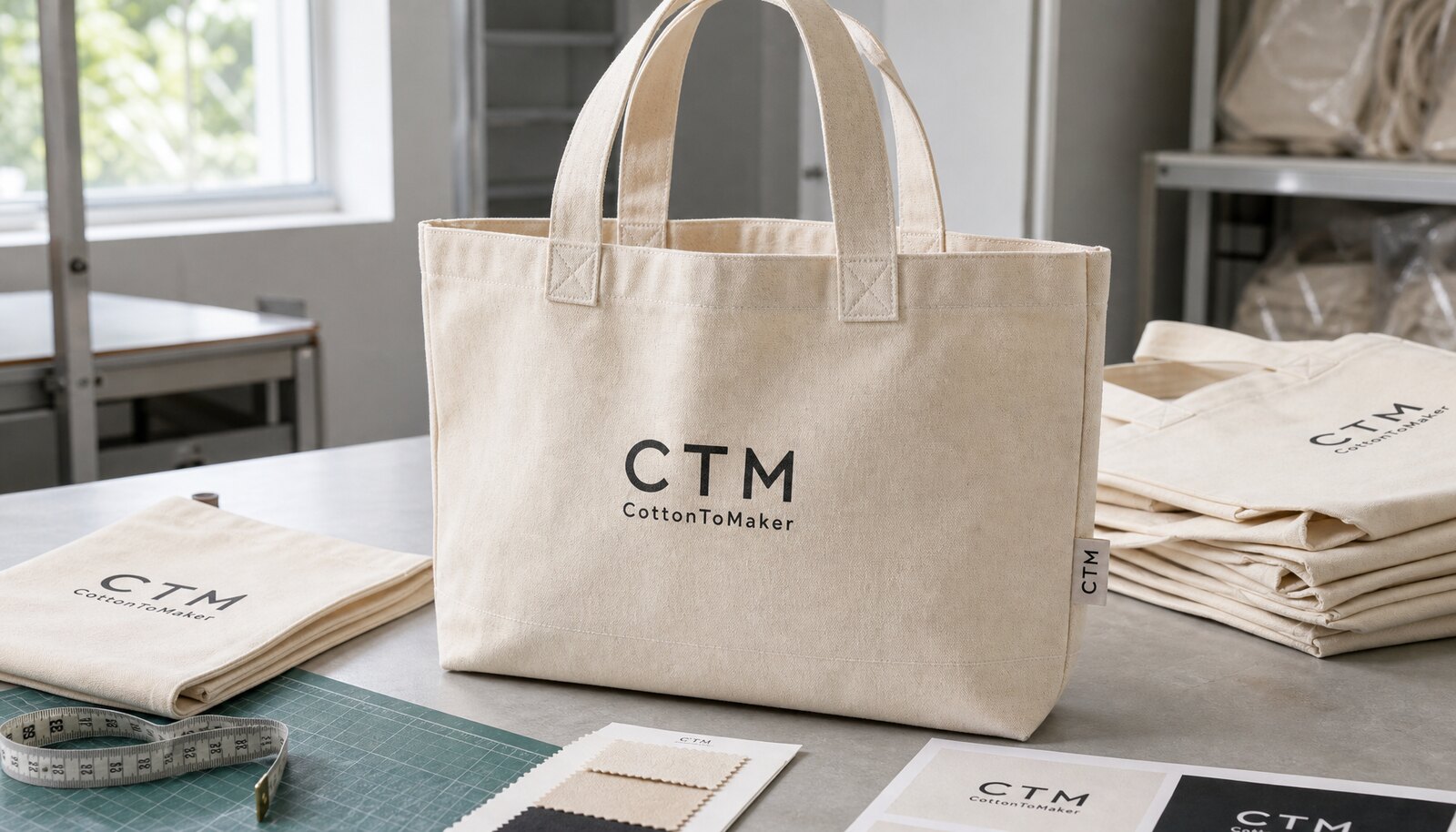
The buying problem: quotes look similar, but the bags are not
Screen printed canvas tote bags are often quoted as if only three details matter: size, quantity, and logo. That is not enough for procurement. Two suppliers can quote the same 38 x 42 cm tote with a one-color logo, but one may use 8 oz loose-weave canvas, short handles, light ink coverage, and thin export cartons, while another uses 12 oz tighter canvas, reinforced stitching, proper curing, and better packing.
The result is a quote comparison that looks clean on a spreadsheet but does not control the actual product. The main buying problem is specification leakage. If the RFQ does not lock fabric weight, construction, print method, artwork details, sampling, packing, and lead time assumptions, the lowest quote may simply be quoting a different bag.
- Do not compare unit prices until every supplier quotes the same canvas weight and finished size.
- Do not approve screen printed artwork from a digital mockup only; request a strike-off or pre-production sample.
- Do not leave packing open if the goods will ship long distance by sea or sit in a humid warehouse.
- Do not assume one-color printing means the same cost if the print area, fabric color, and ink opacity differ.
Fabric weight and canvas feel: specify oz and GSM together
For canvas tote bags, fabric weight drives handfeel, durability, print surface, sewing difficulty, and freight cost. Many buyers ask for 10 oz or 12 oz canvas, but suppliers in different markets may work in GSM. To avoid confusion, state both where possible. As a practical reference, 10 oz canvas is often around 280 to 300 GSM, while 12 oz canvas is often around 340 to 360 GSM, depending on weave and finishing.
The right fabric weight depends on the end use. A light event giveaway can use lower GSM if the buyer accepts a softer, less structured bag. A retail tote or bookstore bag usually needs a firmer canvas. For premium brand merchandise, the buyer may choose 12 oz, 14 oz, or washed canvas, but should also expect higher carton weight, higher sewing cost, and more attention to print curing.
- 8 oz canvas: suitable for budget promotions, but check transparency and handle strength.
- 10 oz canvas: common balance for promotional and retail-ready totes with decent body.
- 12 oz canvas: better perceived value and print base, but higher fabric and freight cost.
- 14 oz and above: premium feel, but confirm needle choice, seam thickness, and folding marks.
- Natural canvas: color shade varies by batch; approve a fabric swatch before bulk cutting.
Screen print method: match ink to fabric color and artwork
Screen printing is efficient for solid logos, brand marks, slogans, and simple artwork on canvas tote bags. The cost is affected by the number of colors, the number of print positions, screen setup, print area, ink type, and whether an underbase is needed. A white logo on black canvas may need an underbase or multiple passes to get acceptable opacity, while black ink on natural canvas is usually simpler.
Buyers should send vector artwork and specify final print size, not only a logo file. Fine text, thin lines, halftones, and large solid blocks all require different production control. A large solid print may feel heavier and can crack if curing is poor. Very small text may fill in on rough canvas. The factory should advise minimum line thickness and whether the artwork should be adjusted for the fabric texture.
- Water-based ink gives a softer hand, but opacity on dark fabric must be checked.
- Plastisol-style ink can give stronger coverage, but the handfeel may be heavier.
- Large solid print areas need curing control to reduce tackiness, cracking, or blocking.
- Multi-color artwork needs registration checks, especially near seams or gussets.
- Printing over thick seams should be avoided unless the design tolerates uneven pressure.
Construction details that affect real use
The tote bag construction should match the carrying load. For light brochures, a simple stitched handle may pass. For retail, groceries, bottles, or catalogs, the buyer should specify reinforced handles, seam type, and bottom construction. Handle drop is also important. A 25 to 28 cm handle drop is common for shoulder carry, while shorter handles may only work for hand carry.
Small construction details can create large complaint risks. If the handle is stitched too close to the top edge, it may tear under load. If the inside seam is poorly overlocked, loose threads can appear after use. If the gusset is not controlled, the bag may not stand or pack as expected. These are not cosmetic details; they affect usability and return risk.
- State handle width, handle length, and handle drop separately.
- Request cross-stitch, box-stitch, or bartack reinforcement for heavier use.
- Define inside seam finishing: overlock, bound seam, or French seam if required.
- Confirm whether the bottom is flat, gusseted, boxed, or simple side-gusset construction.
- Set finished size tolerance, commonly plus or minus 1 cm for sewn canvas products.
MOQ logic: why the minimum is not only about quantity
MOQ for screen printed canvas tote bags is usually shaped by fabric sourcing, dyeing, cutting efficiency, screen setup, and packing labor. A supplier may accept a lower MOQ for natural canvas with one print color because the material is common and setup is simple. The same supplier may require a higher MOQ for dyed canvas, special GSM, custom handle color, multiple print designs, or individual retail packing.
Procurement teams should avoid asking only, 'What is your MOQ?' A better RFQ asks for MOQ by scenario. For example: natural canvas with one-color front print, dyed black canvas with white front and back print, and two artwork versions split across the same order. This helps the buyer understand where cost changes come from instead of treating MOQ as an arbitrary sales rule.
- Lower MOQ is more realistic when using stock natural canvas and standard sizes.
- Dyed canvas may require higher MOQ because of fabric dye lot and shade control.
- Each additional artwork version may add screen setup and production changeover cost.
- Split shipments, individual polybags, and barcode labels can raise handling cost.
- Very small orders may be better handled as sample or trial production, not mass production.
Sample approval: check the print, not just the bag shape
A proper sample process for screen printed canvas tote bags should include a fabric swatch, a print strike-off, and a pre-production sample when the order value or brand risk justifies it. A blank sample checks size and sewing only. It does not prove print color, ink opacity, curing, registration, or print placement. A digital mockup is useful for layout discussion, but it is not a production approval.
For repeat programs, keep the approved sample and bulk fabric swatch as the control reference. The sample should show final print size, final logo position, final handle length, and final seam construction. If the buyer approves a sample with one fabric and the factory later changes the fabric weight or finish, the print result may also change.
- Check print size with a ruler, not only by visual approval.
- Compare Pantone target against cured print under consistent light.
- Rub the print surface after curing to check smearing, dusting, or poor adhesion.
- Fold the bag once and check whether the print cracks or sticks to itself.
- Photograph the approved sample front, back, inside seam, handle stitching, and packing.
Packing and export handling: prevent dirty edges and print marks
Canvas is absorbent and can pick up dust, moisture, odor, and carton marks. Packing should be specified early because it affects cost, carton size, labor time, and the condition of the print when goods arrive. Flat packing usually protects the print better than tight folding, especially for large printed areas. Individual polybags can keep bags clean but add material cost and may not fit every brand's packaging policy.
For sea freight, buyers should ask for carton dimensions, gross weight, net weight, and CBM before confirming the order. This helps estimate freight and warehouse handling. Moisture control is also important. Canvas bags packed too soon after printing or stored in damp conditions can develop odor, mildew risk, or print blocking.
- Use flat packing where possible for large front prints.
- Avoid tight folds directly across thick ink areas.
- Confirm pieces per carton and maximum carton weight for warehouse handling.
- Request inner liner or carton protection if natural canvas must stay very clean.
- Ask whether desiccants are recommended based on season, route, and storage time.
Lead time and quote data: what a usable supplier quote includes
A serious quote for screen printed canvas tote bags should show more than a unit price. It should clarify fabric weight, bag dimensions, print method, number of print colors, print positions, sample cost if applicable, setup charges, packing method, carton data, production lead time, and trade term. Without these details, a buyer cannot compare quotes fairly or forecast the landed cost.
Lead time should be broken into stages. Fabric preparation, sample approval, bulk cutting, sewing, printing, curing, inspection, and packing all take time. If the buyer needs a fixed delivery window, approval delay must also be controlled. Many late orders are not caused only by factory speed; they happen because artwork, Pantone references, sample approval, or packing instructions were not confirmed on time.
- Ask for lead time after sample approval, not only after deposit.
- Confirm whether fabric is in stock or needs weaving, dyeing, or washing.
- Request carton data before booking freight or quoting distributors.
- Separate screen setup cost from running cost if multiple designs are involved.
- Ask whether the supplier quote is EXW, FOB, CIF, DDP, or another trade term.
Specification comparison for buyers
| Spec decision | Recommended option | When it fits | Buyer risk to check |
|---|---|---|---|
| Canvas weight | 10 oz to 12 oz cotton canvas for most retail and promotional totes | Brand campaigns, bookstores, trade shows, lifestyle retail, and reusable shopping bags | Too light may feel cheap; too heavy increases carton weight, freight cost, and sewing difficulty |
| Print method | Flatbed screen print with plastisol, water-based, or discharge-style ink depending on fabric and artwork | Best for solid logos, simple artwork, and medium to large repeat orders | Fine gradients, tiny text, and many colors can raise setup cost or lose edge sharpness |
| Bag construction | Box-stitch or cross-stitch handle reinforcement with inside seams overlocked or bound | Orders where bags carry catalogs, apparel, gifts, groceries, or event materials | Weak handle bartacks and loose seam allowance can fail during load testing |
| Color fabric | Natural, black, or dyed canvas approved by lab dip before print sampling | Retail programs needing brand consistency across repeat orders | Dark fabric may need underbase printing; dyed canvas can shrink or bleed if not controlled |
| MOQ planning | MOQ based on fabric color, bag size, and print color count, not only total pieces | Importers consolidating several SKUs or distributors quoting multiple buyers | Small split quantities can trigger higher unit cost, more screens, and longer setup time |
| Packing method | Flat packed in export cartons with moisture control; individual polybag only when required | Most wholesale, retail, and promotional bulk orders | Over-packing raises labor and plastic cost; poor carton sizing causes creasing and dirty edges |
| Sample approval | Pre-production sample with actual fabric, actual ink, actual logo size, and final handle length | Any branded order where print placement and handfeel matter | Approving a digital mockup only can hide scale, ink hand, seam distortion, and color mismatch |
Buyer checklist before sampling
- Confirm finished bag size, gusset depth, handle length, seam type, and tolerance in centimeters or inches.
- Specify canvas weight by oz or GSM, and state whether it is natural, bleached, dyed, recycled cotton, or blended fabric.
- Send vector artwork with Pantone references, final print size, print position, number of colors, and whether both sides are printed.
- Ask whether the quote uses water-based, plastisol, pigment, or other screen printing ink, and whether dark fabric requires an underbase.
- Request a pre-production sample using the real bulk fabric and real print method, not only a blank bag or paper proof.
- Define packing requirements: flat packed or folded, pieces per polybag, pieces per carton, carton marks, and moisture protection.
- Ask for estimated lead time split by material preparation, sampling, bulk production, inspection, and export packing.
- Compare quotes only after all suppliers confirm the same fabric weight, bag dimensions, print colors, packing, and inspection standard.
Factory quote questions to send
- What is the exact canvas weight in oz and GSM, and is the fabric pre-shrunk, washed, dyed, or natural greige canvas?
- What is your recommended screen printing ink for this fabric color and artwork, and will the print need an underbase?
- How many screens are required for the artwork, including front, back, underbase, or separate logo positions?
- What is the MOQ for this bag size and fabric color, and what changes if we split the order across two print designs?
- Can you make a pre-production sample with actual bulk fabric, actual ink, and final packing method before mass production?
- What print curing or drying process do you use, and what rub, wash, or tape test can be performed before shipment?
- What are the carton dimensions, gross weight, net weight, and estimated CBM for the quoted packing plan?
- What quote data is included: fabric, sewing, printing setup, printing run charge, packing, inspection, export carton, and FOB port?
Quality-control points to confirm
- Measure finished bag size, gusset, handle drop, seam allowance, and print placement against the approved sample.
- Check canvas weight by GSM cutting test or supplier fabric report, especially when comparing several factory quotes.
- Inspect print color, opacity, registration, edge sharpness, pinholes, ink cracking, and handfeel after curing.
- Run dry rub and wet rub checks on the printed area, especially for dark ink on natural canvas or light ink on dyed canvas.
- Load test handles and bottom seams using a practical weight based on intended use, not only visual inspection.
- Check packing for moisture, odor, carton strength, dirty edges, folded print marks, and correct carton labels.
- Keep an approved golden sample, print strike-off, bulk fabric swatch, and packing photo for final inspection reference.