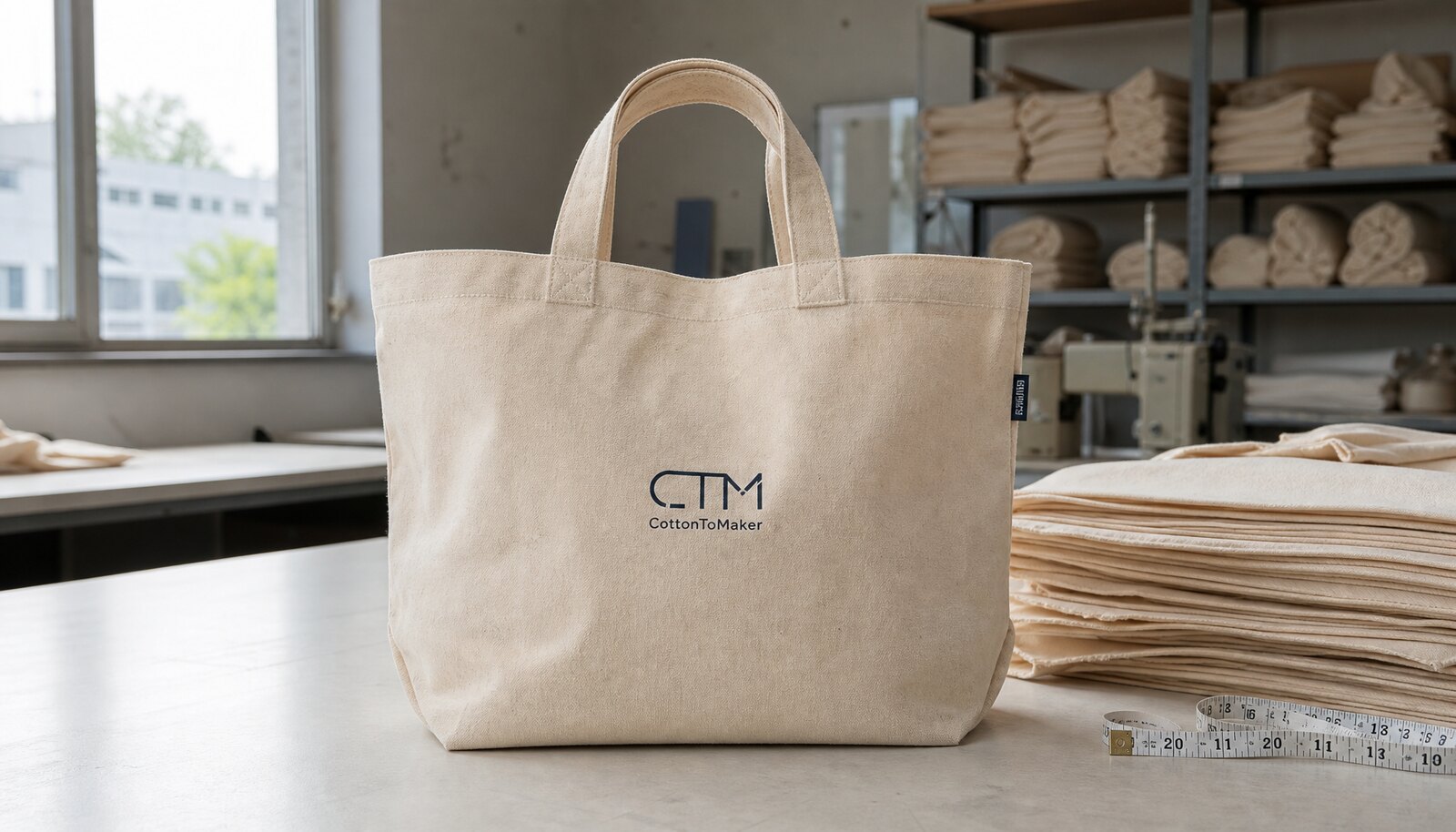
What buyers mean by screen printed canvas bags
In procurement terms, screen printed canvas bags are not one fixed product. The bag may be a flat tote, gusseted tote, zipper tote, or a drawstring canvas style, and the print may be a one-color logo, a two-color brand mark, or a larger graphic that covers most of the front panel. The buying mistake is to treat the bag and the decoration as separate problems. In production, they interact. A loose weave canvas will print differently from a dense 12 oz body, and a large artwork that looks fine on a flat art board may distort once it crosses seams and folds.
The right RFQ starts with the use case. A giveaway bag for a trade show can be built around a low-cost 10 oz body and a single front print, while a retail tote needs better fabric consistency, tighter stitching, and cleaner print edges. If the supplier has to guess whether the bag is promotional or retail-grade, the quote will be vague and the sample will likely miss the target. The buyer should define not only how the bag should look, but also how it will be handled, packed, and resold.
- Promo use usually favors a simpler bag, fewer print colors, and faster production.
- Retail use usually needs tighter quality control on fabric, stitching, and packaging.
- The more the artwork depends on fine detail, the more the print spec must be controlled.
Choose the canvas before you talk about print
Canvas weight is one of the first price and quality drivers. For many buyer programs, 10 oz canvas is the entry point, 12 oz is the common middle ground, and 14 oz or 16 oz is used when the bag needs a heavier hand feel, stronger structure, or a more premium retail presentation. GSM and ounce weight are not interchangeable in a casual way, so the buyer should name one standard and ask the supplier to confirm the conversion, tolerance, and actual measured weight on the approved sample. If the fabric is too light, the print may show strike-through or warp after sewing. If it is too heavy, the bag can look stiff and drive up sewing cost.
Beyond weight, buyers should control weave density, shrinkage behavior, and whether the fabric is bleached, natural, or dyed. Natural ecru canvas prints differently from bleached white canvas, especially on light ink colors. A pre-shrunk or sanforized fabric gives more stable finished dimensions, which matters when your retail pack expects the same fold and carton count every time. Handle construction also belongs in the fabric decision because a soft body with weak handles will fail in use even if the logo print is perfect.
- Use one fabric standard across the order unless there is a strong cost reason to split it.
- Specify finished size, not only cut size, so the supplier cannot hide shrinkage behind loose measurements.
- Ask for a measured sample weight, not just a catalog description.
Print method and artwork controls that change the quote
Screen print is attractive because it scales well for repeat orders and produces a bold, opaque mark on canvas. It also creates avoidable problems when the artwork is not prepared for the process. A buyer sending a low-resolution logo, a full-color gradient, or tiny legal text is asking the factory to guess. For a clean order, the artwork should be separated into spot colors, the print area should be sized in centimeters, and the placement should be measured from the top edge and side seam. If the logo sits too close to a seam or handle, the print can distort during sewing or trimming.
Ink choice matters as much as the art file. Standard plastisol-style inks, water-based systems, and discharge-style systems do not behave the same way on canvas. A dark body with a light logo often needs an underbase or a more controlled ink system, which adds setup time and can change the hand feel. Buyers should not accept a generic statement like screen printed without asking how the supplier will cure the ink, control opacity, and prevent smear during packing. The approved sample should be evaluated both for visual appearance and for how the ink feels after curing.
- Keep artwork in vector format whenever possible.
- Set the print location in centimeters from fixed bag reference points.
- Reduce tiny text if the final print size is small or the canvas is coarse.
- If the design needs gradients or photo detail, screen print may not be the right process.
Where the cost really comes from
A useful quote for screen printed canvas bags should break the price into fabric, cutting, sewing, print setup, print labor, packing, cartonization, and inland handling. Many buyers only compare the unit price and miss the structural differences between quotes. A supplier offering a low unit price may be excluding screens, sample charges, inner polybags, or carton labels. Another may include everything but use a heavier fabric, which makes the bag look better but changes the landed cost materially. The right comparison is not lowest ex-works price. It is the price for the same bag specification, same print setup, and same packing method.
MOQ logic follows the same pattern. The minimum is usually driven by fabric roll usage, screen setup, ink wastage, sewing line efficiency, and packing labor. One color on one side is the easiest case. Two-sided printing, multiple ink colors, mixed sizes, or mixed packing requirements can all move the MOQ upward. A buyer who wants to test the market should ask for a pilot run price and a repeat order price separately. That avoids confusion when the first small order looks expensive and the second quote appears to jump for no reason.
- Ask whether the quote includes screen charges and how long the screens are retained for reorders.
- Separate sample cost from bulk cost so the first PO does not distort the program economics.
- Request a landed-cost view if the order will move through import duty, inland freight, or DC handling.
Compare the right supplier route, not just the quote
Not every supplier route fits every buyer. A direct factory with in-house screen printing is usually the best choice for repeatable volume, because the factory can control fabric, sewing, print, and packing under one workflow. A trading company can be useful when the buyer needs multiple product types in one shipment or wants one contact to manage several factories, but the tradeoff is less visibility into the real process. A local printer using imported blanks can work for low MOQ tests or urgent regional drops, yet it often creates reorder risk because the blank bag spec may change or disappear.
The most important issue is control. If the supplier cannot prove that the same blank, same screen, same ink formula, and same packing method will be available on the next reorder, the buyer is not buying a program. They are buying a one-off. For procurement teams, that distinction matters because reorder consistency is part of the real cost. A stable factory route may look less flexible at the start but usually reduces variance, stock disputes, and delayed approvals later.
- Direct factory suits repeat programs and cleaner specification control.
- Trading companies suit multi-item orders when the buyer accepts a little less process visibility.
- Local blank printers suit short tests but create higher reorder risk.
Sample approval should prove more than the logo
A sample is not approved because it looks acceptable in a photo. It is approved when the buyer can measure the bag, compare the print, and see that the construction matches the order. The best process is to request a pre-production sample after artwork approval and before mass sewing. That sample should confirm the canvas weight, handle length, stitch quality, print size, and carton fit. If the supplier is serious about repeatability, they will keep a reference sample for the order and mark it clearly in the file. Buyers should do the same. When a production issue appears later, the approved sample becomes the only practical tie-breaker.
The sample review should be specific. Measure the body size, gusset, handle drop, and print placement. Check whether the ink sits on top of the fabric cleanly or sinks into the weave and loses density. Look for weak corners, loose threads, and any distortion at the seam where the print passes too close to folded material. If the bag will be sold retail, open and refold it to see whether the pack is consistent. A sample that only looks good on a table can still fail in a carton or on a shelf.
- Approve one physical reference sample, not just a PDF.
- Record the exact fabric, ink, and packing version used for approval.
- Keep a signed or dated sample record with the purchase order file.
Packing and labeling can break an otherwise good order
Packing sounds secondary until a retailer rejects the shipment for count errors or damaged presentation. Screen printed canvas bags are often folded, stacked, and packed in bulk, but the pack method should match the channel. A wholesale account may want bulk inner packs with no individual polybag, while a retail program may require each bag to be folded to a fixed size, inserted with a card, and labeled with a barcode or SKU sticker. Every extra packing step adds labor, and every ambiguous instruction increases the chance of a mixed carton. The buyer should specify the final pack count per inner and outer carton, plus whether a master carton label is required for each SKU.
Carton data matters for freight planning and warehouse acceptance. Ask for carton dimensions, gross weight, and packing configuration early, not after production is done. If the bags are bulky, the packed carton can become inefficient long before the unit count looks expensive. For importers, that changes landed cost and sometimes even container utilization. The same is true for fold size. A bag that is only slightly too large when folded can waste carton volume and create poor shelf presentation. Packing should be treated as a production spec, not a shipping afterthought.
- Define fold size, inner pack count, outer carton count, and label format in the RFQ.
- Confirm whether the supplier can barcode scan the pack before carton sealing.
- For retail programs, specify how the bag should be folded, inserted, and sealed.
Lead time risk is usually hidden in approvals and materials
A quoted lead time is only useful if it separates the real steps. For screen printed canvas bags, the timeline often includes artwork confirmation, sample making, fabric booking, screen preparation, production, packing, and final inspection. A supplier that gives one total number without those stages is usually hiding the schedule risk. If the bag uses a custom dyed canvas, special ink, or imported trim, material booking can become the bottleneck. If the artwork changes after the sample, the print screen must be remade and the clock resets. The buyer should treat changes after approval as schedule events, not minor edits.
The easiest way to protect the program is to freeze the specification before the pre-production sample. That means the canvas weight, print size, ink color, packing method, and carton count should all be fixed. If the buyer still expects last-minute art edits, the supplier will either pad the lead time or rush the job. Rushing a print order is where off-shade ink, missed packing counts, and weak quality control usually appear. For seasonal orders, build in time for a second sample round if the first one is not right.
- Ask for a stage-by-stage schedule, not one flat delivery date.
- Freeze artwork and pack details before materials are booked.
- Add buffer for approvals, holidays, and peak factory loading.
Write the RFQ so quote comparisons are actually usable
A strong RFQ gives the factory enough detail to quote the same bag from the same assumptions. That means the RFQ should include the bag style, finished size, fabric weight, color, print method, print size, number of print locations, packing method, target quantity, and required documents. When a buyer leaves out one of those items, the supplier fills the gap with its own default. The result is a quote that looks comparable but is not. Procurement then spends time untangling why one supplier is cheaper even though the bags are not built the same way.
The practical way to compare quotes is to create one internal line for the bag and one for every variable. Separate the base bag from print setup, sample cost, special packing, freight assumptions, and any export document charges. If the supplier gives a cheaper number because it omitted screen fees or used a lower fabric weight, you should catch that in the quote review. For repeat programs, ask for both first-order and reorder pricing, since the second run often removes screen setup and may change the unit economics materially.
- Use one written specification sheet for all suppliers.
- Compare first-order price and reorder price separately.
- Call out any assumption that would change the quote, including fabric source, print colors, and pack format.
When screen print is the wrong decoration choice
Screen printing is a good fit when the design is bold, the order is repeatable, and the buyer can live with a fixed artwork setup. It is the wrong choice when the art depends on gradients, tiny details, many color transitions, or frequent design changes. It is also a poor fit when the buyer wants a very low MOQ with frequent style swaps, because the screen setup cost starts to dominate the landed cost. In those cases, another decoration method or a different bag construction may be more commercially rational, even if the first sample looks less impressive on paper.
The best buyers are not attached to the decoration method. They are attached to the commercial result. If the bag is meant for a short event cycle, the buyer may accept a simpler print or a smaller graphic to keep the order efficient. If the bag is meant for retail, the buyer may decide that the fabric needs to move up a weight class or the artwork should be simplified so the print survives handling. The point is to avoid forcing screen print onto a program that needs a different production logic.
- Use a simpler art file if small text or photo detail would fail in print.
- Consider another decoration method if the order changes every few weeks.
- Upgrade the canvas weight if the bag needs a more retail-ready feel.
Specification comparison for buyers
| Spec decision | Recommended option | When it fits | Buyer risk to check |
|---|---|---|---|
| One-color front logo on 10 oz canvas | Direct factory with in-house screen printing | Promo giveaways, events, and entry retail programs where the print is bold and the order is volume-driven | Ink strike-through on loose weave canvas, poor edge sharpness, and quotes that exclude setup charges |
| Two-color logo on 12 oz canvas | Factory with controlled registration and a dedicated print line | Brand programs that need a cleaner hand feel and a more durable retail look | Misregistration between colors and higher waste if the supplier runs the job like a souvenir print order |
| Large logo across the body panel | Factory with a larger print bed and pre-approved artwork proof | When the graphic is the main visual and must read from a distance | Distortion from bag seams, print placement drifting too close to the side seam, and weak opacity on dark fabric |
| Fine text or thin line art | Simplified spot-color artwork or a different decoration method | When the buyer needs tiny legal text, web addresses, or detailed artwork | Screen print may fill in or break up small details, especially on textured canvas |
| Dark canvas with light ink | Underbase screen print or discharge-style system if the fabric supports it | When the brand needs a strong contrast on navy, black, or dark olive bodies | Ink cracking, heavy hand feel, and wash performance that does not match the approved sample |
| Retail-ready folding and bag-insert packing | Integrated factory packing line with carton labeling controls | When the bags move through distribution centers or need shelf-ready presentation | Counting errors, mixed SKUs in one carton, and labeling that does not match the purchase order |
| Low MOQ pilot run | Local printer on imported blanks or a small factory with flexible setup | When the buyer is testing art, a seasonal drop, or a limited channel launch | Unit cost is higher, and repeat orders may not match the first run if the blank bag changes |
| High-volume repeat program | Direct factory with retained screens and locked color standards | When the buyer expects reorders over multiple seasons and needs shade consistency | Screen wear, fabric lot changes, and shade drift if the supplier does not keep the same ink formula and reference sample |
Buyer checklist before sampling
- Confirm the exact bag type: flat tote, gusseted tote, zipper tote, or drawstring canvas style.
- Lock the fabric weight in GSM or oz, plus the acceptable tolerance and any wash or pre-shrink requirement.
- State the finished size, handle length, handle drop, gusset depth, and seam allowance in the RFQ.
- Provide one-color artwork and a second file with spot colors separated if more than one ink is needed.
- Specify print area in centimeters, print placement from top edge and side seam, and whether both sides are printed.
- Define packing details: bulk pack or individual polybag, insert card, barcode label, and carton pack count.
- Request sample photos, a pre-production sample, and one production reference sample kept by both sides.
- Ask for lead time split by sample, material booking, production, and final packing rather than one vague delivery date.
Factory quote questions to send
- What exact canvas weight, weave, and finish will you use for this bag, and what tolerance do you allow on the finished fabric weight?
- Is the print price based on one color, one location, or one screen set, and what is the setup charge for each additional color or location?
- Does your quote include cutting, sewing, screen making, print labor, packing, and cartons, or are any of those separate line items?
- What is the minimum order quantity by artwork, by color, and by size, and do mixed sizes or mixed print designs change the MOQ?
- Can you confirm the print method, ink type, and curing method you will use for this fabric and color combination?
- What sample stages do you offer before bulk production, and which sample charge is refundable against the order?
- How do you control print placement, handle length, and seam tolerance during production, and what is the acceptance range for each?
- What carton dimensions, gross weight, and pack count will you use, and can you provide a packing list format before shipment?
- How long does each stage take: artwork approval, sample, material booking, production, and packing?
- What documents can you provide for the shipment, including commercial invoice, packing list, and country-of-origin statement if needed?
Quality-control points to confirm
- Fabric weight matches the approved target and stays within the agreed tolerance across random production checks.
- Canvas weave is even, without thin spots, slubs, broken yarns, or weak edges in the body panel.
- Print placement stays within the agreed tolerance, with the logo centered and not drifting into the side seam or handle stitch line.
- Ink coverage is solid, with no pinholes, streaks, double images, bleeding, or visible ghosting after curing.
- Color match is consistent against the approved reference under daylight and standard indoor light.
- Small text, rules, and fine lines remain readable at the approved distance and do not fill in.
- Stitching is even, seam allowance is consistent, and handle anchors are reinforced with no skipped stitches or loose threads.
- Finished dimensions, handle length, and handle drop match the approved sample closely enough for retail presentation and end-use fit.
- Packing count is exact by inner pack and carton, and the carton label matches SKU, color, and quantity.
- Dry rub and, if required, wet rub testing do not show visible transfer beyond the agreed limit, and the print does not crack or peel at first handling.