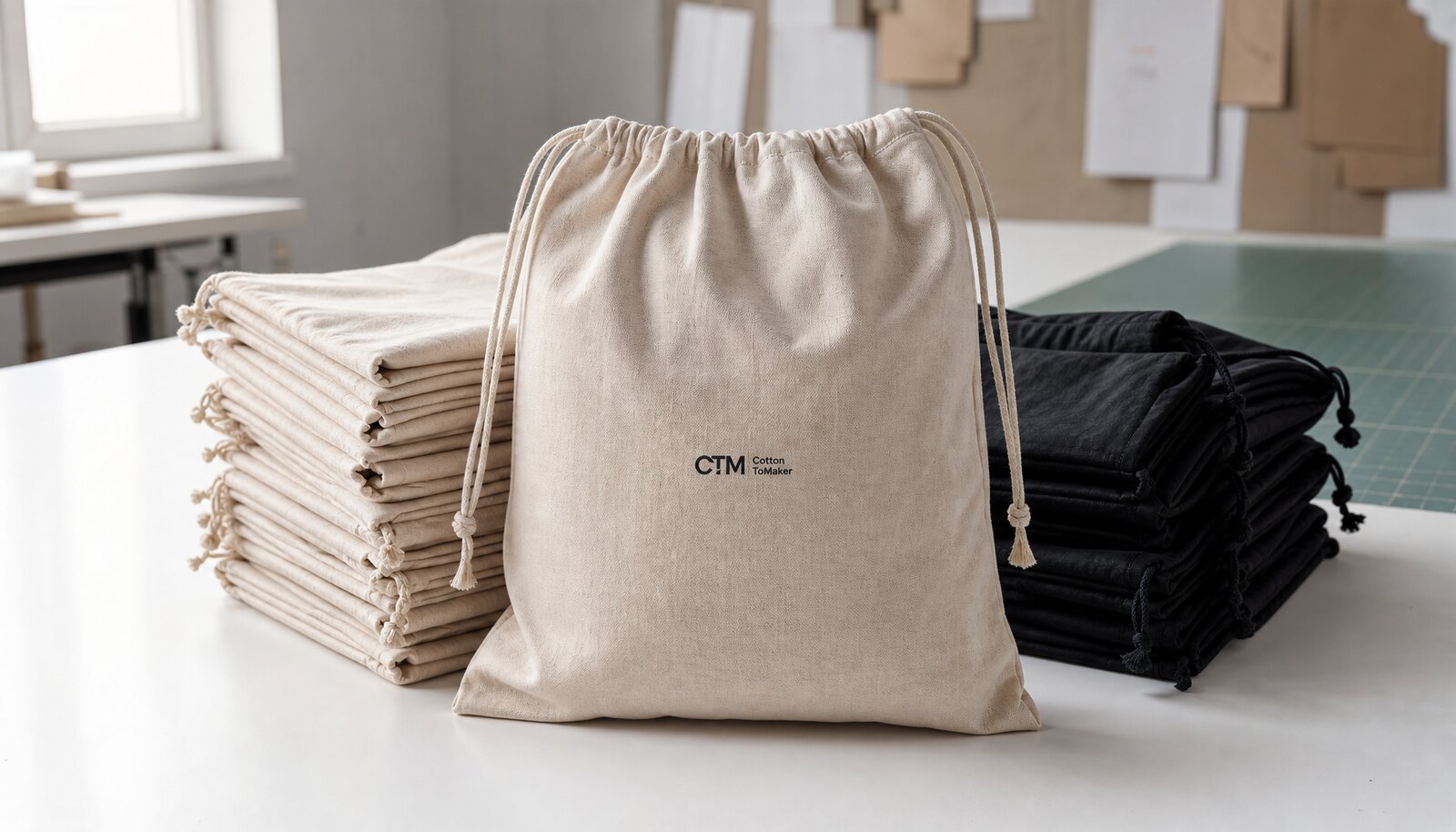
Why this product needs a real spec, not a loose quote
Screen print drawstring bags look simple until the first quote comes back with assumptions attached. Two suppliers can both say they can make the same bag, but one may be pricing a lighter cloth, a smaller logo, a different cord, and cheaper packing. The unit price only helps when the buyer has already fixed the product definition. Without that, the quote is a moving target, and procurement ends up comparing different items as if they were equal.
The clean way to source this category is to treat the bag as a small technical package. The spec should tell the factory how the bag will be used, how it will be decorated, how it will be packed, and what quality level is acceptable. A giveaway bag and a retail accessory are not the same product. A sample kit bag that carries heavier items needs different seam support than a flat promo pouch. If those differences are left out of the RFQ, the supplier will fill them in with their own default standard.
That is where the risk usually starts. The printed mockup may look good, but the actual bag can still fail on fabric behavior, seam alignment, cord pull, or packaging. For procurement, the goal is not to create a perfect design brief. The goal is to create a buying document that makes supplier quotes comparable and keeps the production team from guessing.
- Quote the finished product, not just the logo decoration.
- Treat fabric, print, cord, reinforcement, and packing as part of one spec.
- If the use case is unclear, the supplier will choose the cheapest acceptable version by default.
Start with the use case and the load requirement
Before asking for price, define what the bag needs to do. A trade-show giveaway is usually judged by visual impact and low unit cost, so a lighter build and simpler construction may be acceptable. A retail item has a different standard: the bag must look consistent in hand, stay presentable after repeated use, and feel robust enough that the buyer does not question the quality immediately. A sample-kit or packaging-insert bag sits in between, but it often carries more weight than a promo bag and needs cleaner folding because it travels inside a larger branded pack.
Write the job into the RFQ. Say whether the bag is intended for event handout, e-commerce packaging, retail resale, internal sample distribution, or a bundled kit. If the bag needs to carry weight, state the expected contents rather than leaving the factory to infer it. That matters because the load affects the cord choice, the seam reinforcement, and the confidence level of the supplier’s recommendation. If the bag is only ever going to hold paper or lightweight items, you do not need to overbuild it. If it will hold heavier goods, the closure and top channel become a real quality risk.
The best procurement teams do not ask for a generic product. They ask for a bag that is fit for a specific job. That one sentence improves pricing accuracy, reduces revision cycles, and makes QC easier later because the buyer can judge whether the delivered bag actually fits the use case.
- State the expected contents or load so the supplier can size the build correctly.
- Use different standards for giveaway, retail, and kit packaging.
- If presentation matters, ask the supplier to show the folded bag format before bulk approval.
Fabric and construction: where the bag is actually made durable
Material choice does more than change the price. It changes how the bag prints, folds, carries weight, and holds its shape. Cotton is often the easiest base for screen printing because the surface is familiar to most decorators and the hand-feel suits the category. Polyester and rPET can work too, but the printing and handling behavior need to be checked more carefully. The buyer should not assume that a fabric that looks similar in a photo will behave the same in production or in use.
The spec should describe the fabric in production terms. That means the fabric type, finish, color, and approved weight should all be written down, along with any wash or shrink expectations if those matter to the end use. Avoid loose phrases like "heavy duty" or "premium" because they do not tell the factory what to make. Ask for a swatch or a physical reference if the fabric hand-feel is important to the brand. Once the wrong cloth is woven or cut, it is expensive to correct later.
Construction details matter just as much. The top channel has to guide the cord without distorting the opening. The side seams must stay even so the bag hangs correctly. Corners and stress points need enough reinforcement to survive filling and pulling. If a supplier cannot explain how the bag is built at those points, the quote is not strong enough to support a purchase decision.
- Specify the fabric type, finish, and approved weight on the RFQ.
- Ask for a physical swatch or approved fabric reference when appearance matters.
- Check top-channel reinforcement, side seams, and corner stress points before comparing price.
Screen print and artwork control: keep the decoration realistic
Screen printing is usually the right decoration method when the artwork is simple, bold, and limited in color count. It is cost-efficient, reliable on the right fabric, and easy to reproduce on repeat orders if the setup is documented properly. It becomes less forgiving as the design gets more detailed. Small text, thin strokes, tight outlines, gradients, and closely registered colors all raise the risk of a disappointing result on fabric that is folded, stitched, and handled before the customer ever sees it.
Put the artwork into production language. State the exact print area, the number of colors, the ink color references, and whether the design needs a white underbase on dark fabric. If the logo must be crisp at a distance, a simpler version often performs better than a decorative one that pushes the limits of the print process. Buyers should also ask the supplier what minimum line width and text size they can hold on the chosen fabric, because that is where many promising mockups break down in production.
The print spec should also cover placement. Centered is not enough. A buyer should define the placement relative to the seam, the top channel, and the visible front panel so the artwork lands in the same place on every piece. If the logo changes size or the fabric color changes later, treat that as a new approval step rather than a minor update.
- Use the simplest print layout that still serves the brand.
- State the print area in millimeters and anchor it to seams or panel edges.
- For dark fabric or fine artwork, ask the supplier to prove print feasibility before final approval.
Comparing quotes without getting fooled by the unit price
The unit price on screen print drawstring bags is only useful if the quotes are built on the same assumptions. A lower number can mean less fabric, a smaller print area, fewer setup steps, lighter packing, or weaker finishing. Procurement should normalize the RFQ before looking at price. If the same supplier would quote a different bag once the weight, print count, or packing method changes, then the first quote is not comparable with the others.
A better comparison is to ask for line items. Separate the base bag, the decoration setup, the recurring print labor, packing, labels, and any special handling charges. That structure makes it easier to see where the cost is really coming from and whether a low quote is genuinely efficient or just missing a costly step. It also helps on reorders because the buyer can see which charges disappear after the first run and which ones stay embedded in the production cost.
Do not stop at the factory gate. Landed cost should include packing format, carton volume, freight mode, and any inspection or rework that the program requires. A slightly higher ex-factory price can still be the better commercial choice if it reduces receiving issues or saves time in warehouse handling. For procurement, the real comparison is not only the invoice. It is the total cost to receive, count, store, and distribute the bag without exceptions.
- Normalize the same bag size, fabric, print count, and packing method before comparing price.
- Ask for one-time setup charges and recurring production charges separately.
- Compare landed cost, not just ex-factory cost, if the bag is shipping in volume.
Choosing the sourcing route: what each supplier model does well
The sourcing route changes the result as much as the product spec does, which is why the comparison table belongs in the buying conversation. A direct factory is the cleanest choice when the artwork is stable and the order will repeat. The buyer gets the most direct view into sewing, printing, and corrective action, which matters when consistency is more important than convenience. The main thing to verify is that the company quoting the order is the actual production site, not just a sales office relaying information.
A trading company can be useful when the order sits inside a broader program or the buyer wants one contact point for several products. That can reduce coordination work, but only if the sample trail is traceable and the factory behind the order is disclosed. Local converters are useful when speed matters and the team needs to see a physical sample quickly. The tradeoff is that some converters are better at decoration than at full cut-and-sew control, so the buyer needs to know whether sewing and printing are actually managed in-house or outsourced.
A hybrid model can be the most practical path when the buyer wants to test artwork, fold behavior, and print appearance locally before committing to volume production. That works only if the sample spec and the production spec are the same document. If the sample is made with one material and the bulk order uses another, the exercise loses most of its value and the quote comparison becomes misleading.
- Direct factory: best for repeat programs and tighter control over production decisions.
- Trading company: best when coordination matters more than direct factory access.
- Local converter: best for rapid sample iteration, but verify who owns sewing and printing.
- Hybrid: best when you need to de-risk the design before committing volume.
Sampling and approval: lock the details that are hard to fix later
A good sample proves more than logo placement. It should confirm the actual fabric, the real cord, the seam behavior, the print opacity, and the finished fold. A digital mockup cannot do that. The pre-production sample should be judged as a complete object, because the problems that create the most friction are usually the ones that only show up once the bag is built and handled.
The approval workflow should be simple and documented. First, approve the artwork and print area. Second, approve the physical sample or strike-off made on the intended material. Third, confirm the folded and packed format, because a bag that looks fine open can crease badly in the carton. Fourth, record the approval with photos and notes so the production team can match the right version later. If the factory later changes a cord supplier or trims the print area to improve yield, the written record becomes the basis for change control.
Treat any material substitution as a new approval event. If the fabric color, cord material, print system, or packing method changes, the old sample no longer proves the current order. That sounds strict, but it prevents the most common sourcing argument: the factory says the sample was approved, and the buyer says the delivered bag is not the same thing. The way to avoid that argument is to keep the sample traceable and versioned.
- Approve the physical sample, not only the artwork file.
- Keep the approved sample tied to a dated spec sheet and versioned art file.
- Treat fabric, cord, print, and packing changes as new approval points.
QC checks that catch the failures buyers actually see
Quality control should focus on the failure modes that cause complaints: misplaced print, weak seams, uneven cord lengths, poor curing, shade drift, and carton mix-ups. The inspection standard does not need to be complicated, but it does need measurable thresholds. Use millimeters for print placement, define the approved size tolerance, and state what counts as a defect on the seams or print surface. If the team only says the bag should be "centered" or "clean," the inspection result will depend on opinion instead of a standard.
A practical QC routine checks both appearance and function. The bag should open and close smoothly, the cords should not snag, and the top channel should not deform when the bag is loaded and pulled. The print should stay legible after handling and a simple rub check on the approved area should not produce visible transfer. This is not laboratory testing. It is a buyer-level control that keeps a weak lot from clearing shipment just because the bags looked fine in a still photo.
Do not ignore carton-level control. Mixed sizes, mixed print versions, missing PO numbers, and weak carton marking create receiving delays even when the individual bags are acceptable. If the bag is being delivered to a distributor, a retailer, or a warehouse team, clean carton data is part of the product. A tight QC plan checks the bag and the carton together.
- Define print placement in millimeters, not vague language.
- Check top-channel strength, cord movement, and seam integrity under normal use.
- Verify carton counts, PO numbers, size labels, and destination marks before release.
Packing, labeling, lead time, and landed cost: the hidden commercial layer
Packing often looks like a small line item, but it changes the real economics of the order. Bulk packing is usually efficient, but only if the fold method protects the print face and keeps the cords from tangling. Bundle packing can make counting easier and improve presentation. Individual polybags may be necessary if the bag needs extra protection or must arrive retail-ready, but that decision should be costed up front rather than discovered after the quote has been approved.
Labeling should be part of the sourcing conversation, not an afterthought. If the warehouse needs barcodes, retailer labels, or specific carton marks, the factory should price and plan for that work before production starts. The same applies to carton size and weight. A quote can look competitive on paper and still create handling pain later if the cartons are packed too heavy or too awkward for the receiving team. For procurement, these are not minor details. They are part of the total landed cost.
Lead time should be broken into sample approval, production, packing, and transit. A supplier who says the order will take a certain number of days without separating those steps is compressing risk into one vague promise. The better question is what has to happen before the clock starts, what can delay production, and what documentation will be sent with the shipment. That gives the buyer enough structure to compare suppliers on delivery certainty instead of just quoted speed.
- Choose bulk, bundle, or individual polybag packing before you finalize the RFQ.
- Include barcode, retailer label, and carton-mark requirements from the start.
- Separate sample time, production time, and shipping time when you plan the schedule.
MOQ, reorders, and landed-cost tradeoffs buyers should plan around
For screen print drawstring bags, the useful question is not just the minimum order quantity. It is where the price becomes efficient for the exact spec you want. Setup work, print screens, packing labor, and special labeling can make a small order disproportionately expensive even when it technically meets the factory minimum. If the program is expected to repeat, ask the supplier to quote at your target volume and at one smaller test volume so you can see the break point instead of guessing it.
Reorders need special attention because the first order and the second order are often priced differently. A factory may include artwork setup, screens, or sampling work in the first run and leave those costs out of the reorder. That is normal, but it should be explicit. If the buyer wants predictable replenishment pricing, the quote needs to separate one-time setup from recurring production cost. Otherwise the initial order can look attractive while the follow-on cost is a surprise.
Use landed cost as the decision metric. That means ex-factory price plus packing, labeling, carton volume, freight, and any inspection or rework required for the program. For many procurement teams, that full view is the difference between a bag that looks cheap and a bag that actually fits the budget. It also makes supplier conversations more honest because everyone can see which part of the order is driving the cost.
- Ask for pricing at your target volume and at one smaller test volume to find the break point.
- Separate first-order setup charges from reorder pricing.
- Compare landed cost, not only unit price, when the order ships in volume.
Specification comparison for buyers
| Sourcing route | Best fit | Strength for procurement | Risk to control |
|---|---|---|---|
| Direct factory | Repeat programs with stable artwork, defined specs, and planned replenishment | Best visibility into sewing, print curing, and corrective action; easier to lock one standard and buy it again | Confirm who actually owns the line, who approves the pre-production sample, and whether the quote comes from the real production site |
| Trading company | Mixed-item programs, buyers who need one contact point, or teams that want broader coordination | Simplifies communication and can reduce admin when the order sits inside a larger promotional shipment | Identify the real factory, the sample path, and who makes final quality decisions if something changes |
| Local converter | Urgent samples, short domestic runs, or quick artwork iteration | Fast sampling and easier revision cycles when the buyer needs to see print and fold behavior quickly | Verify whether they sew in-house, print in-house, or outsource both parts |
| Hybrid model | Buyers who want to test locally before scaling production | Lets procurement validate the bag, print, and packing format before committing volume | Keep the sample spec and production spec identical or the comparison becomes misleading |
| Material | 6-10 oz cotton canvas, 210D polyester, rPET, or blended cotton with shrinkage and colorfastness expectations set before sampling | Before price comparison | Different cloth weights, backing, or certification claims make quotes hard to compare |
| Construction | cord diameter, eyelet or reinforced channel, bottom corner reinforcement, seam allowance, bar-tack position, and load target | Before sampling | Weak stress points create returns and failed inspections |
| Decoration | screen print, transfer, embroidery, woven label, or drawstring tag tested against folding and abrasion | Before artwork approval | The wrong method can crack, bleed, pucker, or fail on the chosen fabric |
| MOQ | Base MOQ plus change drivers | During quote review | Custom colors, trims, and packing can change minimums |
Buyer checklist before sampling
- State the intended use case first: giveaway, retail accessory, sample kit, or packaging insert.
- Specify the finished bag size, not just the nominal size, and define the allowed tolerance for width and height.
- Name the fabric construction, finish, color, and approved weight on the spec sheet instead of describing it loosely.
- Lock the print method, print side, number of colors, ink references, and the exact print area in millimeters.
- Set the cord material, cord diameter, cord length, stopper requirement, and anti-fray expectation if the ends are visible.
- Define seam and reinforcement expectations for the top channel, corners, and any other stress points.
- Request a pre-production sample made from the same material family and print process intended for bulk production.
- Specify the packing method, carton quantity, master carton limit, carton marks, barcode needs, and retailer label rules.
- Ask for a quote that separates fabric, sewing, decoration, packing, sampling, and labeling charges.
- Write down the change-control rule so any later change to fabric, cord, print, or packing triggers a fresh approval.
Factory quote questions to send
- Which exact bag construction are you quoting, and what finished weight, size, and material description will appear on the spec sheet?
- What is included in the unit price, and which items are extra for setup, print colors, packing, labels, or carton marking?
- How does the price change if we adjust the print side count, the number of colors, or the print area?
- Are the sample and the bulk order made with the same fabric family, cord material, and printing process? If not, what differs?
- Can you show a physical strike-off or pre-production sample on the same fabric color we intend to buy?
- How do you control print placement, registration, and ink curing on the chosen fabric?
- What inspection standard do you use before shipment, and what defects trigger rework or rejection?
- How do you verify bag counts, carton counts, and finished packing before cartons are sealed?
- What happens if fabric shade, cord lot, or print density changes after sample approval? Who signs off on that change?
- What is the real lead time after sample approval, and which steps most often extend it?
Quality-control points to confirm
- Finished bag dimensions match the approved spec and stay within the agreed tolerance band.
- Top channel stitching is straight, secure, and free of skipped stitches, loose thread tails, or open seams.
- Cord length is consistent from bag to bag and the drawstring pulls evenly without snagging.
- Reinforced areas at the channel, corners, and stress points hold shape when the bag is filled and pulled.
- Print placement stays inside the approved area and does not shift enough to look off-center or cropped.
- Ink coverage is even, with no pinholes, ghosting, obvious banding, or unintended transparency on darker fabric.
- If the design uses a white underbase, it fully supports the top color without visible edge bleed or weak opacity.
- A simple dry-rub check does not leave visible transfer or early cracking on the approved print area.
- The bag surface is free of oil marks, stains, loose fibers, and shade variation beyond the approved limit.
- Carton counts, bag counts, PO numbers, size labels, and destination marks all match the packing list before release.