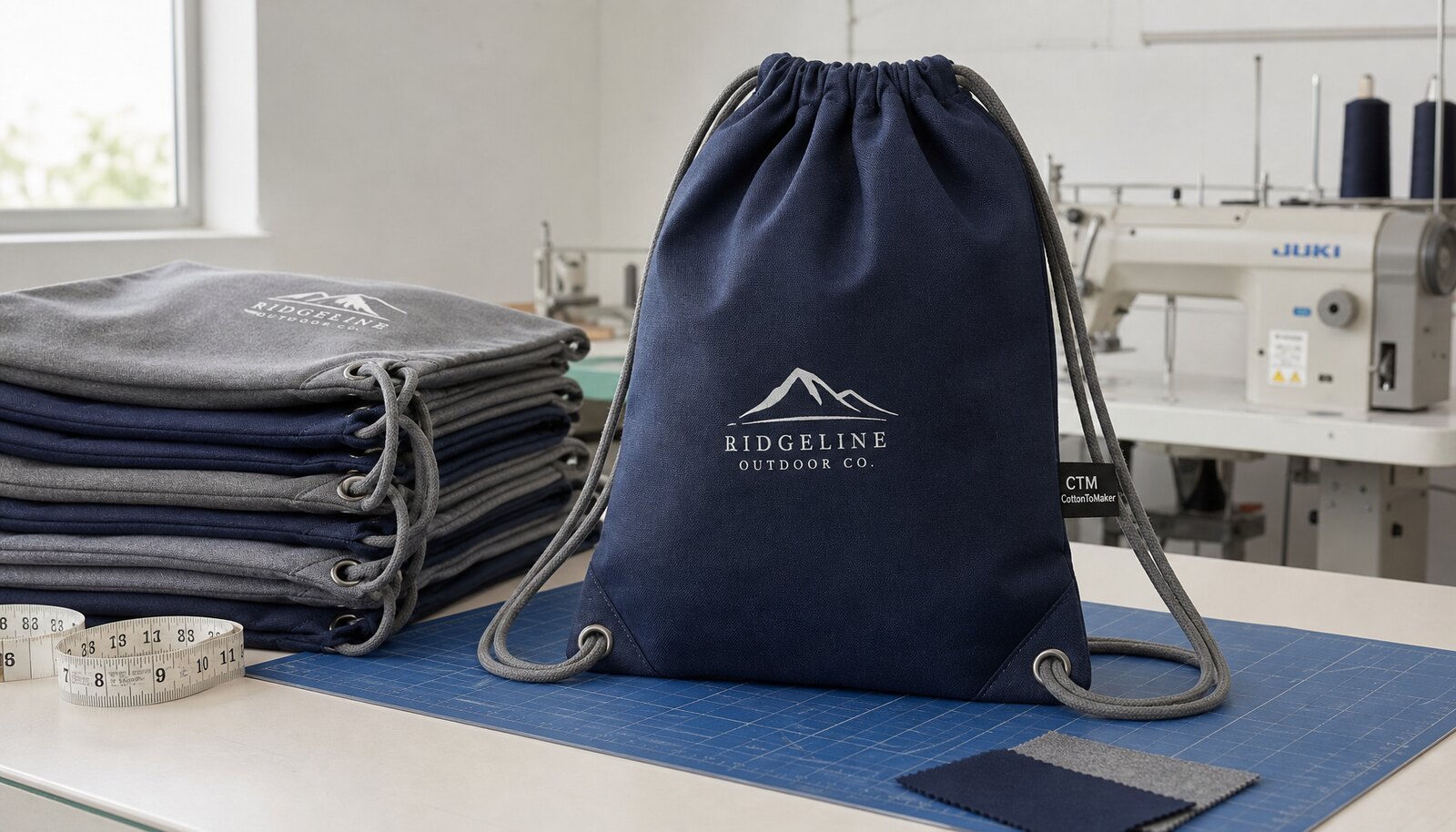
Why This Bag Works For Corporate Gifts
School drawstring backpacks sit in a useful middle ground for corporate gifting. They are more practical than a flat pouch, cheaper and lighter to ship than a structured backpack, and easier to brand than hard goods. For buyers, that means one item can cover school campaigns, employee family events, summer programs, retail promotions, and welcome packs without forcing the budget into a premium backpack category. The commercial value is strongest when the bag will actually be used after the event, because that keeps the logo visible longer and reduces the waste feeling that often comes with short-life giveaways.
The buying mistake is to treat the product as a generic promotional bag. A school-use drawstring backpack has different expectations from a concert giveaway or gym sack. It needs cleaner seams, better cord security, and fabric that can carry books, notebooks, and a water bottle without stretching out. If the bag will represent a brand at a school-facing event, the print, color, and hand feel need to look deliberate rather than disposable.
- Use this format when you need a low-weight gift that still has daily utility.
- Do not choose the cheapest spec if the bag must carry books or stationery.
- Treat finish quality as part of the brand impression, not just the decoration.
Choose Fabric By Use, Not By Habit
The main cost and quality decision is fabric. For very price-sensitive corporate gifts, 210D polyester is common because it is light, easy to print, and efficient to pack. If the bag needs more body, 300D or 600D polyester gives a firmer feel and better seam stability. For premium gifting or education programs that want a softer, more natural appearance, 8 to 10 oz cotton canvas is usually a better choice, but it raises fabric, sewing, and packing cost. The right answer depends on how the recipient will use the bag, not on what the supplier happens to stock that week.
GSM or denier should be written into the RFQ because suppliers will otherwise quote to the cheapest visual match. Two bags can look similar in a photo and behave very differently in hand. A thin 210D shell may be acceptable for folders and brochures, while a 300D shell is safer if the bag will be filled repeatedly. On cotton, ask for the finished fabric weight after washing and finishing, not just the loom weight, because a soft finish can change the actual hand feel and structure.
- 210D polyester: lower cost, lighter, good for giveaways and short events.
- 300D or 600D polyester: better structure, better load handling, stronger perception.
- 8 to 10 oz cotton canvas: premium feel, better for brand programs and school kits.
- Write fabric color, finish, and lining requirement into the RFQ if you care about exact appearance.
Decide On Size, Cord, And Construction Early
Finished size should be defined around the contents, not around a generic template. If the bag is meant for school handouts, measure the actual envelope of books, notebooks, and stationery that must fit without stressing the top opening. Typical corporate gift sizes often sit around 34 x 42 cm to 38 x 45 cm, but the better spec is the usable interior space plus the amount of fabric gathered by the cord channel. A good supplier will tell you how much the opening narrows once loaded; a weak one will only repeat the flat pattern size.
Construction matters more than buyers expect. Ask for reinforced bottom corners, clean top tunnel stitching, and cord end finishing that will not fray during distribution. If the product is being packed in quantity and handled by multiple teams, the top opening needs enough structure to survive repeated sorting. For school use, a simple side loop or hanging option can also be useful, but only if it is sewn cleanly and does not create a weak point at the seam.
- Confirm flat size and usable volume, not just one dimension.
- Ask whether the cord is polyester, cotton, or mixed, and whether the ends are heat-sealed.
- Require reinforcement at stress points if the bag will carry books or bottles.
Print Method Should Match Artwork, Not Just Budget
For a simple one- or two-color logo, screen printing is usually the most cost-efficient method and gives the strongest value for repeat runs. If the artwork includes gradients, fine lines, or multiple colors, heat transfer or digital transfer may be more practical, especially on darker fabric. Embroidery can work for premium positioning, but it adds needle distortion, extra labor, and a higher chance of fabric puckering on light drawstring shells. The point is not to choose the most impressive decoration; it is to choose the method that can actually reproduce the artwork cleanly on a gathered textile surface.
Ask the supplier to quote by print location and print area, not just by bag. This matters because a small chest logo and a full-front school emblem are not the same production task. The artwork proof should show actual size on the bag silhouette, the number of colors, and whether underbase or white backing is required. If the logo contains small text, insist on minimum legibility at the approved print size. Many quotes look cheap because they quietly assume a larger, simpler logo than the buyer actually needs.
- Screen print is best for simple, repeatable corporate logos.
- Heat transfer is better for multi-color art or small runs with variable names.
- Embroidery works for premium branding but can distort light fabric.
- Always approve artwork on the real bag outline, not on a flat PDF only.
How Suppliers Build MOQ And Price
MOQ is rarely a single number. It is usually the point where fabric procurement, print setup, and sewing line efficiency become acceptable to the factory. A direct factory may allow a lower MOQ if the bag uses stocked fabric colors and one simple print location. If you want custom color fabric, extra labeling, or individual names, the MOQ will rise because the factory has to manage more material changeovers and more packing labor. Buyers should push suppliers to separate the base bag MOQ from the print and packing MOQ so the quote stays readable.
When comparing quotes, look at what the supplier is protecting. A low unit price can hide a high screen fee, a minimum charge for each color, or a pack fee that appears later in the order cycle. The quote should show unit price, setup cost, sample cost, label cost, packing cost, and carton cost separately. That gives you a real comparison across suppliers and stops the classic problem where the cheapest-looking offer becomes the most expensive landed order.
- Ask for the MOQ by fabric color, logo color, and packing type separately.
- Watch for hidden minimums on labels, cartons, and name personalization.
- Compare suppliers on total landed cost, not just the bag unit price.
Sample Approval Should Reveal Real Risk
A paper proof is not enough for this category. The first useful sample is a pre-production sample on the actual fabric, with the actual cord, stitching method, and final decoration size. This is the point where you confirm whether the bag can sit upright, how the fabric wrinkles, whether the logo sits flat when the bag is filled, and whether the drawcord slides correctly through the channel. If the supplier skips this step, you are accepting production risk before seeing the real product.
Sample checks should focus on measurable behavior. Pull the cords through the tunnel several times. Fill the bag with the expected contents and inspect the bottom seam under load. Compare the color under daylight and indoor light. Measure print position from the top edge and side seam so there is no dispute later. If you need branded presentation, also inspect how the sample folds, because a nice bag that packs badly can look poor in cartons and in handouts.
- Approve the final fabric, not a substitute swatch.
- Test the bag with the intended contents before mass production.
- Record logo position, print size, and color reference in writing.
Packing Can Change Cost And Presentation
Packing is not a small detail. Bulk packing in master cartons is the fastest and cheapest route for most corporate gifts, but it only works if the bags arrive cleanly folded and easy to distribute. If the bags are going to schools, distributors, or branch offices, count accuracy and carton labeling matter more than retail display. For higher-value campaigns, a belly band, insert card, or individual polybag can make the item feel more finished, but each layer adds labor and carton bulk.
The right packing choice depends on your distribution model. If a single team will hand out all units at one event, bulk packing is efficient. If many recipients will receive the bags through different channels, unit packing may be worth the extra cost because it reduces handling errors. Make sure the supplier gives carton dimensions, units per carton, and gross weight early so your freight quote is based on the real packed volume. A bag with a low unit price can still become expensive if the pack format wastes container space.
- Bulk carton packing is usually the best default for corporate gifting.
- Request carton count, packed dimensions, and gross weight before PO release.
- Use individual packing only when presentation or distribution control justifies it.
QC Thresholds For Bulk Orders
Quality control for drawstring backpacks should be set around the functions that matter to the end user: hold, close, print, and pack. A useful acceptance standard checks for seam skips, broken stitches, loose threads, print misalignment, dirty marks, and cord problems. For school-facing gifts, also inspect the bottom corners and cord channels because those are the first points to fail when the bag is filled with heavier items. The buyer should never rely only on a final carton count; the functional test matters more than the tally.
The best QC language is concrete. Define acceptable logo shift, acceptable color variation, stitch density if relevant, and whether odor or contamination is grounds for rejection. If you are buying a mixed-color program, ask the supplier how they separate colors during production and packing so dark dye does not rub onto light fabric. A supplier that can explain its inspection points in plain language usually has more process control than one that only repeats 'AQL accepted' without details.
- Check first, middle, and last cartons for consistency.
- Test cord movement and seam integrity under load.
- Reject obvious print bleed, oil marks, and label errors before shipment.
Lead Time Risks And How To Protect The Schedule
Lead time is often shorter on paper than in reality because suppliers assume approval will be immediate. Build the schedule from sample approval backward. If the order includes custom fabric color, special print matching, or personalized packing, add time for material sourcing and approval loops. The safest plan is to lock artwork, fabric, and packing details before the factory books production. Otherwise, the production window will be spent waiting on decisions instead of sewing bags.
The highest schedule risk is usually not sewing capacity. It is delayed sample approval, artwork revision, or late changes to carton labeling. Buyers should set a clear approval deadline and define what happens if the deadline is missed. If the event date is fixed, protect it with a production buffer and a shipping method that matches the true packed volume. A fast production quote is not useful if the packing format or export documents are incomplete.
- Work backward from the event date, not forward from the PO date.
- Treat artwork approval and sample sign-off as schedule gates.
- Add buffer for color fabric sourcing, not just sewing time.
Compare Supplier Routes By Total Landed Cost
Direct factory sourcing usually gives the best control over product specs, but it is only the cheapest option if the buyer can manage communication well. Trading companies can be useful when you need mixed items, complex packing, or a single point of coordination, but their margin should be visible in the quote. Domestic stock sellers can deliver quickly for urgent events, yet they often offer fewer customization choices and less control over fabric weight and decoration. For school drawstring backpacks for corporate gifts, the right route depends on whether the priority is price, speed, or customization control.
The best comparison is a landed-cost view. Include unit cost, setup fees, packing fees, internal freight to port, carton efficiency, and sample cost. Then compare those totals against the expected life of the bag and the importance of the brand impression. If the bags are part of a large school campaign, a slightly better fabric and cleaner print can be worth more than saving a small amount per unit. Buyers should think in terms of distribution value, not just procurement cost.
- Direct factory: best for control and repeat orders.
- Trading route: useful for multi-item projects and coordination-heavy buys.
- Stock route: fastest, but usually the weakest for customization and spec control.
Specification comparison for buyers
| Spec decision | Recommended option | When it fits | Buyer risk to check |
|---|---|---|---|
| Sourcing route | Direct factory with in-house printing and packing | You need control over fabric, logo placement, carton packing, and sample revisions | Make sure the supplier is not outsourcing print or sewing to separate subcontractors without telling you |
| Fabric weight | 210D polyester for low-cost giveaways; 300D or 600D polyester for better structure; 8-10 oz cotton canvas for premium use | Use 210D for large campaigns where price matters; use heavier fabric when the bag must carry books, not just handouts | Thin fabric can show print-through, tear at the cord channel, and look cheap after first use |
| Closure system | Polyester drawcord with reinforced eyelets or stitched tunnels | Best when the bag will be opened and closed many times by students or event recipients | Weak cord ends or poorly sewn channel corners fail first and create complaints |
| Print method | Screen print for simple logos; heat transfer or digital transfer for multi-color art; woven patch or embroidery for a premium look | Simple 1-2 color logos, school campaigns, or brand gifting with a crisp mark | Fine detail may blur on textured fabric; metallic or gradient effects need approval on the actual substrate |
| Branding placement | Front panel centered with small side label or back print only if logo needs visibility and wear resistance | When the front panel is clean and the design must read from a distance | Over-large prints can distort on gathered fabric and fail on curved tension points |
| MOQ logic | Base MOQ by fabric color and print setup, then add optional packing or personalization as separate line items | When multiple teams want different logos, names, or bag colors in one campaign | Low MOQ often hides higher setup fees, excess waste, or limited color options |
| Packing format | Bulk polybag by count, then master carton with quantity label; retail-ready belly band only if required | Corporate gifts, school events, and internal distribution where speed matters | Bag compression can crease prints; missing carton markings slow receiving and distribution |
| Sample route | Pre-production sample plus print strike-off on the real fabric | When color matching, logo size, and handle strength matter more than speed | A paper proof is not enough; it will not show fabric shade shift, print bleed, or seam behavior |
| Lead time | Standard production after approval, with extra time for color fabric sourcing and personalized naming | When the delivery date is fixed and the order includes custom print or special packing | Short lead times often mean partial inspection, substituted materials, or rushed packing |
Buyer checklist before sampling
- State the exact use case: school gifting, internal event, retail giveaway, or onboarding pack.
- Specify fabric type and GSM/denier, not just 'polyester' or 'cotton'.
- Define finished size, cord length, and whether the bag must hold books, shoes, or stationery.
- Name the print method you want to compare, and note whether artwork has gradients, small text, or fine lines.
- Request a pre-production sample on the final fabric and final logo size.
- Ask for carton count, inner pack style, and shipping marks before approving the order.
- Set an AQL or acceptance standard for stitching, print alignment, and color consistency.
- Confirm whether the quote includes setup, packaging, test samples, and export cartons.
- Ask which parts are made in-house and which are outsourced.
- Require production lead time by step: sample, bulk, packing, and final dispatch.
Factory quote questions to send
- What fabric weight or denier will you quote, and can you confirm the exact mill spec?
- Is the print price based on one color, one location, or total logo area?
- What is the MOQ for the base bag, and does MOQ change with a different print method or color?
- Can you supply a pre-production sample on the exact fabric and cord option we will mass-produce?
- What is included in the unit price: bag, print, labeling, individual polybag, carton, and export marks?
- How do you handle artwork tolerance for small text, thin lines, and color matching on textured fabric?
- What is the normal production timeline after sample approval, and what parts of that timeline are the current risk points?
- Can you share carton dimensions, carton quantity, and gross weight for landed-cost planning?
- What inspection standard do you use for stitching, cord security, print alignment, and odor or contamination control?
- If we split the order by school, region, or logo variant, how does that affect price and lead time?
Quality-control points to confirm
- Measure finished size against the approved spec, allowing a tight but realistic tolerance before packing.
- Pull the drawcord through the tunnel several times to confirm smooth movement and no catching at the side seams.
- Inspect the cord channel ends and eyelet areas for skipped stitches, loose threads, and weak reinforcement.
- Check logo placement, print opacity, and edge clarity on at least the first, middle, and last cartons.
- Confirm that seam allowance and bottom stitching can hold the expected load without popping under hand pull.
- Verify carton quantity, packing list accuracy, and shipping marks before the goods leave the factory.
- Open random packed units to ensure the folding method does not crease the logo or deform the bag shape.
- Review smell, dirt, oil marks, and dye transfer, especially on dark fabrics and coated materials.