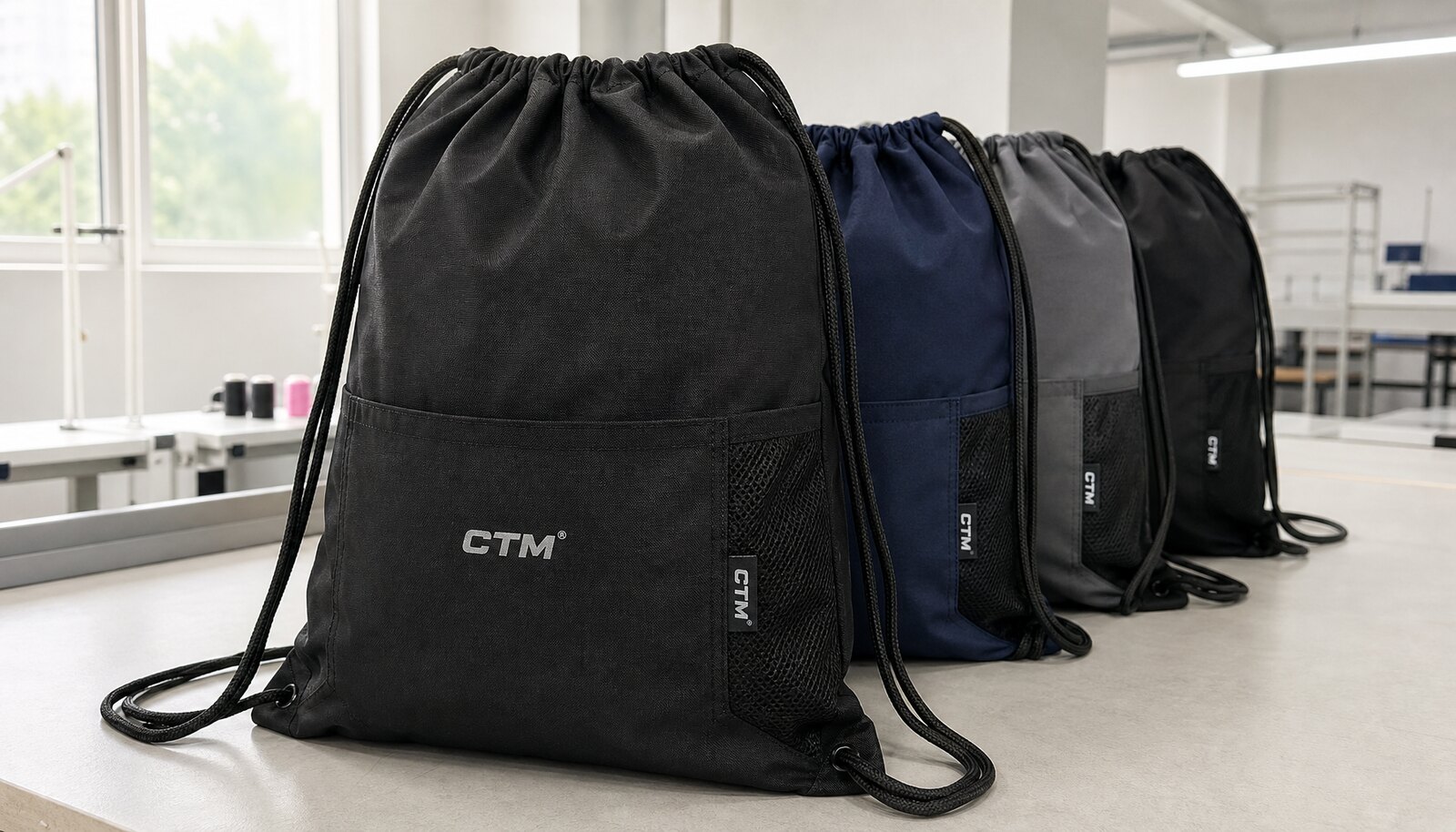
Why school drawstring backpacks work for brand launches
School drawstring backpacks are one of the easiest softgoods to launch when you need a low-complexity item with broad use. They ship light, print well on large flat panels, and do not require the fit consistency or hardware sourcing headaches you get with molded or zippered bags. For brand launches, that matters because your first PO usually needs to balance margin, visibility, and speed to market.
The real buying problem is not whether the bag can hold a few books or sports clothes. It is whether the bag can be produced at a cost that supports your target channel, while still looking good in photos, opening cleanly, and surviving everyday school use. A poor spec choice shows up quickly: thin fabric wrinkles around the print, weak tunnels tear at the drawcord, and overpacked cartons create creases that hurt retail presentation.
- Best use cases: school programs, youth sports, campus stores, back-to-school promotions, and retail starter assortments.
- Worst use cases: heavy laptop carry, premium gift programs that need structure, or launches requiring rigid shape retention.
- Typical buyer goal: keep the base bag simple, then add value through print quality, packaging, and color strategy.
Spec decisions that change cost and shelf appeal
For a launch program, the most common base construction is 210D polyester. It is light, economical, and can be screen printed cleanly when the panel is flat and the ink load is controlled. If the brand wants a more substantial hand feel, 300D polyester is a reasonable step up. Cotton canvas is also viable, but once you move into 8–10 oz canvas, you need to think about shrinkage, crease behavior, and freight weight more carefully.
Finished size should be chosen around how the bag will be used, not around an arbitrary catalog dimension. A mid-size format around 33 x 44 cm works for most school launch programs. If the bag is intended for books and gym kit together, the spec may need a slightly wider body or a gusset-style base. A gusset adds usability, but it also adds sewing time and can change how the print sits across seams.
- 210D polyester: lowest cost, easiest to scale, good for promo and school launch programs.
- 300D polyester: better body, slightly better perceived value, higher fabric and freight cost.
- Canvas: stronger hand feel and retail appeal, but more weight and more care in shrink control.
- Standard size: 33 x 44 cm is a practical starting point for most RFQs.
Choosing fabric weight, construction, and drawcord details
If the bag is going into schools, the fabric has to survive daily abrasion and frequent floor contact. In practice, that means the cloth needs enough body to avoid collapsing into a wrinkled tube after one use. For polyester programs, ask for the exact denier and whether the fabric is coated. A light coating can improve hand feel and reduce moisture pickup, but it may also change print absorption and make some inks sit higher on the surface.
The drawcord and tunnel are where many low-cost bags fail. Braided polyester cords are common because they are inexpensive and stable in production. The tunnel opening should be reinforced, either by tighter stitch density or a small internal patch, especially on lighter fabrics. If the program is school-focused rather than giveaway-focused, the buyer should treat cord anchoring as a durability item, not just a visual detail.
- Specify cord material and diameter instead of saying only “drawstring.”
- Use reinforced corners if the bag will carry books, bottles, or sports gear.
- If the design includes eyelets, require metal quality and rust control or move to stitched tunnels.
- Ask for a finished sample with both cords pulled taut so you can see tunnel distortion.
Print method selection for launch artwork
Most brand launches need a logo, a simple slogan, or a school graphic rather than a full photographic print. That makes screen printing the best default for volume. It is usually the most economical on simple artwork and gives a solid, opaque finish on darker bags if the underbase is handled correctly. The print area should be wide enough to read at a distance but not so large that it wraps into seam stress zones.
Heat transfer or digital transfer can make sense for short runs, more colors, or names that vary by school or region. The tradeoff is durability and folding behavior. A transfer can look sharp on day one, but if the bag is compressed tightly in a carton, the print can pick up crease memory. For launch merchandise that may be stocked for months, screen print remains the safer commercial choice unless the art is too detailed.
- 1–2 color screen print: best balance of cost and durability for most launch programs.
- Heat transfer: useful for small MOQ, complex graphics, or variable personalization.
- Embroidery: rarely the first choice on drawstring backpacks because it adds weight, cost, and puckering risk.
- Always approve the exact logo size on the panel, not only the artwork file.
MOQ logic and how to avoid paying for too many versions
MOQ should be evaluated by total program structure, not just by the quoted minimum number of bags. A factory may offer a lower total MOQ if all units share the same base fabric, same thread color, same cord, and same print method. Once you split into multiple school colors, regional logos, or language versions, the factory has to stop and reset cutting, printing screens, or transfer setup. That setup time is what drives the MOQ logic.
For brand launches, it is often smarter to keep one base bag spec and create variation through print only. If the artwork needs to change by region, try to hold the bag color constant and vary the print panel. This reduces fabric lot risk, simplifies shade matching, and lowers the chance that one color becomes stranded inventory. A buyer comparing quotes should always separate MOQ by color from MOQ by artwork version.
- Single base bag with multiple prints is usually the cleanest launch structure.
- Multiple bag colors increase dye lot and carton complexity.
- Multiple logos or school names raise setup cost even when the bag itself stays identical.
- Ask whether the quote includes one print screen or one transfer setup, then add extra setup charges explicitly.
How to read factory quotes beyond the unit price
A useful quote for school drawstring backpacks should break out fabric, print, packing, and carton information. If the supplier gives only one unit price, you cannot tell whether you are comparing the same product. For example, one quote may include 210D polyester, a one-color screen print, and bulk packing, while another quietly uses a lighter cloth and excludes inner packing. Those are not comparable offers.
The best way to compare quotes is to convert them into a landed-cost view. Start with ex-factory unit price, then add print setup if separate, packaging upgrades, cartonization, domestic transport to port or warehouse, duty, and any rework allowance for artwork or packing errors. For a school launch, the cheapest factory price is not always the best landed cost if the supplier is weak on sample control and creates delays before back-to-school season.
- Ask for separate lines for base bag, decoration, packing, and sample cost.
- Request carton dimensions and gross weight so freight can be estimated properly.
- Compare quotes on the same incoterm, or normalize them before judgment.
- Check whether artwork revisions, extra colors, or packaging changes trigger new fees.
Comparison of sourcing routes for launch buyers
The right sourcing route depends on how much control your team needs. Direct factory sourcing is usually best when you want to lock the fabric, print, and packing with one production owner. Trading companies can be helpful if you need a broader product basket or local coordination, but they can add margin and reduce visibility into the actual production line. Ready-stock plus custom print can work for urgent launches, but it should only be used when the base bag quality has already been verified.
For school drawstring backpacks, the biggest sourcing mistake is treating every supplier like they sell the same thing. Some are bag factories with in-house stitching and printing. Others are general merchandisers who outsource both. If your brand launch depends on consistent color and crisp logo placement, you want evidence of real process control, not just polished sales sheets.
- Direct factory: stronger for specification control and repeat orders.
- Trading company: useful for bundled buying, but request proof of the actual factory and QC flow.
- Ready-stock route: fastest, but least flexible on fabric color and branding accuracy.
- Hybrid route: base bag from factory, decoration and packing handled at one controlled site.
Product-specific sourcing comparison table to use before RFQ shortlisting
Before you shortlist suppliers, it helps to compare the sourcing route against the buying objective. The table below is not just about spec fields; it shows how different sourcing paths affect launch timing, cost stability, and production control. This is the kind of comparison procurement teams should use before asking for final quotes.
The key is to choose the route that matches the launch risk. If the brand is testing demand, speed and low commitment may matter more than premium finish. If the launch is tied to a school calendar, on-time delivery and repeatability matter more than finding the absolute cheapest bag.
- Write decisions in measurable language, not only descriptive wording.
- Ask for sample photos plus one physical approval sample for important orders.
- Keep quotation, sample approval, and inspection notes tied to the same spec version.
Sample approval and pre-production checks that prevent rework
The sample stage should be treated as a production control point, not a formality. A good sample confirms the cloth hand feel, cord behavior, print color, seam shape, and packing fit. The buyer should inspect the bag with real use in mind: pull the cords hard, load a few notebooks, fold the bag once, and look for seam distortion or print cracking. If the sample already looks weak, bulk production will not improve it.
A pre-production sample should match the proposed bulk materials, not a prettier substitute. That means the same fabric lot or equivalent cloth, same print method, same thread color, and same packing format. If the supplier sends a hand-finished sample that does not reflect the factory line, the bulk run may drift in size, texture, or logo placement.
- Measure finished dimensions after light handling, not only as laid-flat dimensions.
- Inspect the print edge for sharpness and ink coverage at the corners of the artwork.
- Pull each drawcord several times and check that the tunnel does not bunch.
- Confirm label placement, barcode position, and carton marking before bulk release.
Packing, cartonization, and schedule risk
Packing matters because drawstring backpacks are flexible and easy to crush. Bulk packing keeps costs down, but it requires better carton discipline. One-piece polybag packing improves retail appearance and protects print surfaces, but it adds labor and plastic cost. If the launch is going direct to distribution centers, bulk packing with clear inner counts is usually acceptable. If the bags go to shelf or e-commerce fulfillment, retail-ready packing may be worth the extra charge.
Lead time risk usually comes from late artwork changes, fabric shade approval delays, and missing packing instructions. A typical production schedule for a simple launch bag may be fast once everything is approved, but only if the supplier has the right fabric and printing capacity already in place. If the supplier must source custom color fabric or open new print screens late in the order, the schedule can slip quickly.
- Specify inner count per carton and master carton label format.
- Use carton marks that clearly show color, artwork version, and PO number.
- Ask whether the factory can show bulk-production photos before shipment.
- Avoid late changes to size, logo location, or packing without written cost and date impact.
Specification comparison for buyers
| Spec decision | Recommended option | When it fits | Buyer risk to check |
|---|---|---|---|
| Fabric route | 210D or 300D polyester for the base program | Launches that need a low unit cost, light weight, and easy print registration | Thin fabric can distort under screen print and show string tension marks if seam allowance is weak |
| Premium route | 210D polyester with PU backing or 8–10 oz cotton canvas | Retail brands that need a more tactile product or a higher perceived value | Heavier cloth raises freight and can push MOQ higher; canvas may need pre-shrinking logic |
| Print method | 1–2 color screen print for volume, heat transfer for small artwork counts | Simple logos, sports club graphics, or school campaign marks | Fine lines can fill in on screen print; transfers can crack if the bag is folded tightly in packing |
| Closure detail | Braided polyester drawcord with reinforced eyelets or stitched tunnels | General school use and brand giveaway programs | Eyelets can pull out on low GSM fabric if reinforcement patches are omitted |
| Size choice | 33 x 44 cm or similar mid-size standard | Most school launch programs, youth events, and retail starter SKUs | Too small reads as promo-only; too large may look bulky and raise carton volume |
| Supplier route | Direct factory with sample room and in-house printing | When you need control over fabric, stitching, and decoration timing | If printing is subcontracted, artwork color and placement drift between sample and bulk |
| Trading company route | Use only when they control a known factory and provide production photos | When your team needs one point of contact across multiple product lines | You may lose visibility on fabric lot, print ink, and QC ownership |
| MOQ strategy | Split by color or print variant but keep the same base bag spec | Launches with multiple school colors or regional programs | Too many SKUs at low quantities increases setup cost and delays approval |
| Packing route | Bulk pack in cartons with clear inner count, or one-piece polybag when retail-ready | Bulk distribution, kit assembly, and shelf-ready retail programs | Retail-ready packing adds labor and plastic cost; bulk packing needs clear barcode and count control |
Buyer checklist before sampling
- Confirm the base fabric, GSM or denier, and whether the quote includes coating or lining.
- Lock the finished size, drawcord type, and reinforcement method before sampling.
- Specify print area, artwork color count, and acceptable color tolerance in writing.
- Ask for sample photos, pre-production sample approval, and bulk-production start photos.
- Define packing format, carton pack count, carton master label details, and barcode needs.
- Request MOQ by color, by print version, and by total order so you can compare real flexibility.
- Build landed cost from product, print, packing, inland freight, and duty—not bag price alone.
- Set QC thresholds for stitch density, print alignment, seam strength, and odor before mass production.
Factory quote questions to send
- What is the exact fabric spec, including GSM or denier, coating, and whether the cloth is stock or mill-dyed?
- What is your MOQ per color and per print version, and what changes the MOQ if we use multiple logos or school names?
- Which print method do you recommend for this artwork, and how many colors are included in the quoted price?
- Can you share a pre-production sample plan, including sample lead time, revision charges, and approval point before bulk cutting?
- What is your standard carton pack count, carton size, and gross weight, and can you quote retail polybag packing as an option?
- What QC checks do you run on stitching, drawcord attachment, print position, and final count before shipment?
- What is the production lead time after sample approval, and what steps create delay risk if artwork or material is revised late?
- Can you quote at least two sourcing routes, such as direct factory and ready-stock base bag with custom print, so we can compare landed cost?
Quality-control points to confirm
- Finished size tolerance should stay within a practical band of about +/- 1 cm on width and height unless the artwork depends on exact placement.
- Drawcord length should be even on both sides, with knots secured and no loose fiber ends at the tunnel entry points.
- Stitching at the bottom corners and tunnel openings should be dense and straight, with no skipped stitches or seam puckering.
- Print registration should stay centered within the approved tolerance, and solid ink areas should not crack when the bag is folded once by hand.
- Fabric should be free of oil marks, dye streaks, broken yarns, and strong chemical odor before packing.
- Carton count should match the master label exactly, and random inner bags should be checked for mixed colors or artwork variants.
- If a woven label, side label, or care tag is included, verify placement, thread color, and edge finish on the pre-production sample.