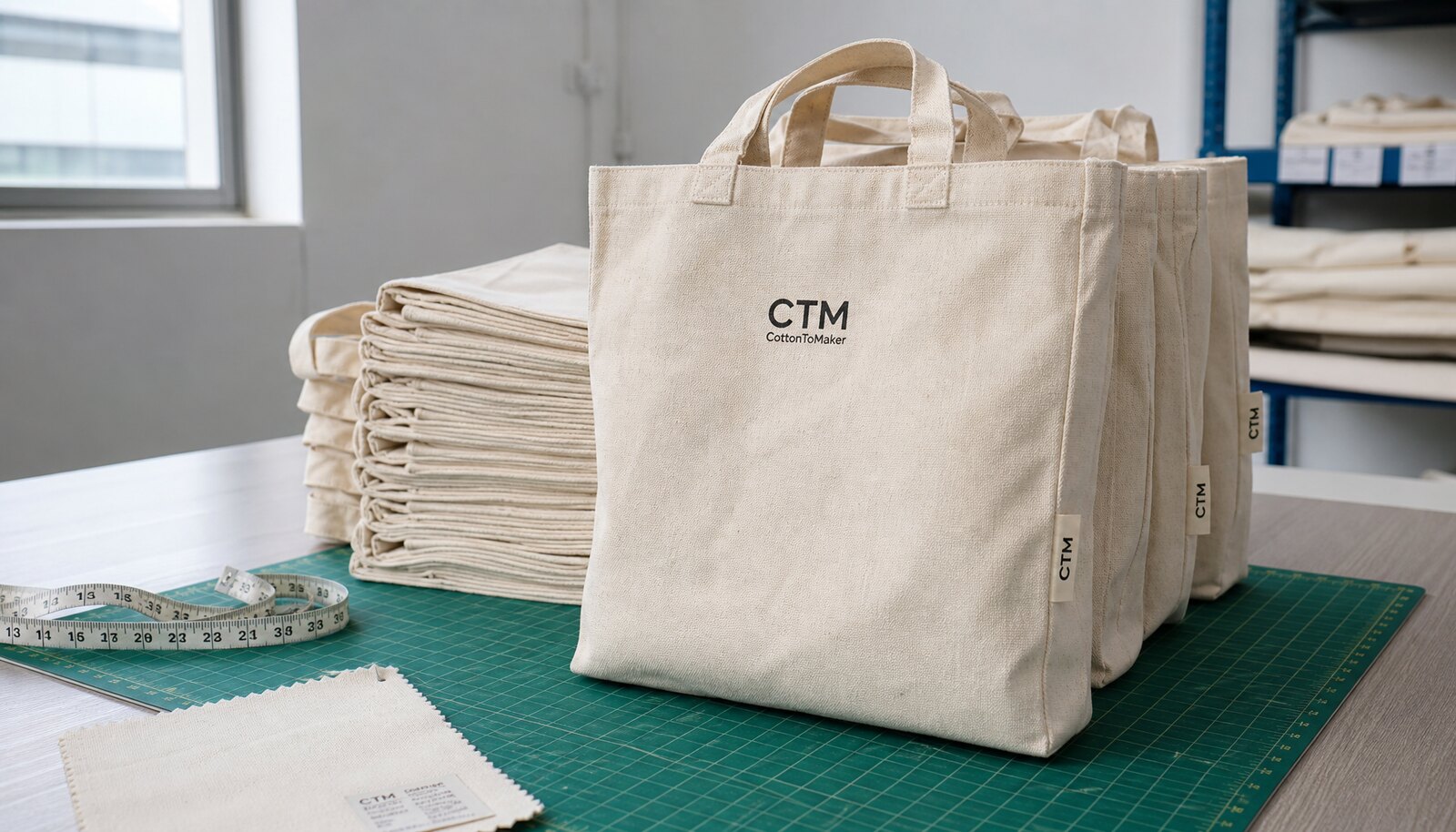
How school orders differ from retail tote buying
Schools buy totes for distribution, utility, and brand visibility at the same time. That changes the buying logic. A bag for an admissions day only needs to carry brochures, a schedule, and a few samples. A bag for students or bookstore use may need to handle notebooks, textbooks, or a laptop sleeve for months, not hours. Those are different products even if they share the same silhouette.
The procurement mistake is to start with artwork and treat the bag as a generic promotional item. Buyers get better results when they start with the job the bag must do, the expected load, and the number of times it is likely to be reused. A tote that is too light can fail in use and create complaints. A tote that is too heavy can waste budget on fabric and freight that do not improve the program outcome.
For schools, the practical decision is usually between three routes: a light handout carrier, a mid-weight reusable tote, or a heavier book-carry bag. The right answer depends on event length, distribution volume, and whether the tote is meant to leave the event with the user or stay in circulation across campus. If the answer is unclear, the school should not default to the heaviest option just because it feels more premium.
- Use case first, artwork second.
- Separate one-day distribution bags from reusable student bags.
- Treat load, reuse rate, and delivery timing as the main buying inputs.
Canvas versus paper, rPET, and plastic: a reuse-based comparison
A useful sustainability comparison starts with reuse, not with material labels. Canvas can be the strongest option when the bag will be reused many times, because the higher upfront material cost gets spread over more uses. If a $1.50 canvas tote is used 10 times, the rough cost per use is $0.15. If the same tote is used 20 times, it drops to $0.075. That is the logic procurement teams should care about, because it shows when the higher initial spend pays back in utility.
Paper carriers can still make sense for admissions handouts, event tickets, or low-load items. They are usually cheaper up front, but they are not durable in wet weather or under book loads. In a simple planning model, a $0.25 paper bag used once is still $0.25 per use, and if it fails early the real cost rises because the school has to replace it or deal with damaged contents. Paper is not a bad choice; it is just the wrong choice when repeat use matters.
Recycled-content rPET or nonwoven bags sit in the middle. They can provide a lighter reusable option with lower shipping weight than canvas, but the school should verify the actual recycled content, stitching quality, and handle strength. A recycled claim is not enough on its own. If the bag is used 3 to 10 times, these materials can be a sensible compromise, especially for mass events where cost and volume matter more than a premium handfeel.
Single-use plastic carriers usually win only on low unit price and moisture resistance. For school procurement, they are hard to justify when the bag is visible to parents, students, and sponsors, unless the program needs water protection or a very low-cost disposable solution. The decision rule is straightforward: if the tote will be reused enough to offset the extra material, canvas can be the best total-value option; if not, compare the lighter alternatives honestly instead of assuming heavier is greener.
- Plan around realistic reuse counts, not the idea that reusable is always better.
- Use cost per use when comparing canvas to paper or nonwoven options.
- Verify recycled-content claims before treating them as a sustainability advantage.
- Reserve single-use plastic for cases where moisture protection or cost dominates.
The spec that matters: fabric, size, handles, and closure
For most school programs, 10 oz to 12 oz canvas, about 340 to 410 GSM, is the practical starting point. That range gives the bag enough structure to stand up on a table, carry brochures or books, and accept basic branding without looking flimsy. Going lighter can reduce cost and freight weight, but it can also make the bag feel soft, collapse under load, or show the contents through the weave. Going heavier can improve stiffness, yet it also increases material cost and shipping weight. The buyer should only pay for extra weight if the program truly needs it.
Size should be set by contents, not by guesswork. A school admissions pack might need a compact tote with a modest gusset so brochures and forms sit flat. A bookstore or student tote usually needs more depth so it can hold notebooks or a lunch container without bulging at the seams. The handle drop matters as well: too short and the bag is awkward on the shoulder, too long and it drags on the ground or feels unstructured in hand.
The handle is often the first failure point. Cotton webbing usually gives the best balance of strength and comfort, while self-fabric handles can be acceptable on lighter programs if the attachment is reinforced correctly. Ask for the handle width, stitch density, and reinforcement method at the root of the handle. If the tote needs to carry books or be reused across campus, treat the handle and side seam as a critical engineering feature, not a cosmetic detail.
Closures should be added only when there is a clear need. Open-top totes are cheaper, easier to inspect, and simpler to distribute. Zippers and snap closures can be useful for student-use bags, but they add trim sourcing, labor, and defect risk. If the contents do not need to be secured, the cleanest spec is often the best one.
- Use 10 oz to 12 oz canvas for most school orders unless the load justifies more weight.
- Set finished size and handle drop in exact measurements.
- Use webbing or reinforced self-fabric handles for repeat-use bags.
- Avoid zippers unless the use case genuinely requires a closure.
Printing and branding without overcomplicating the bag
Canvas is forgiving for bold logos and short messages, but it is not a smooth retail surface. The artwork should be built for the weave. Screen printing remains the most practical method for one or two colors because it is durable, repeatable, and usually more cost-effective than decorative alternatives. It works especially well for school crests, event marks, and simple campaign messages. If the school wants a softer feel or lower-coverage finish, water-based inks can be a good fit, but the supplier should confirm opacity and dry-down behavior on the chosen canvas.
Complex art is where buyers get into trouble. Gradients, fine lines, tiny copy, and detailed illustrations can look clean on a screen and fail on fabric. If the logo has more than two or three colors, the school should ask whether a transfer method is more appropriate, then evaluate the tradeoff between visual fidelity and wear life. Transfers can solve complex branding, but some types are more vulnerable to cracking or edge lift after repeated folding. Embroidery can look premium, but it adds cost and can pucker lighter canvas, so it is usually better for premium merch than for mass distribution.
The approval step should be more specific than a yes or no on a PDF. The buyer should confirm print size, placement from the top edge and side seam, color target if it matters, and minimum line thickness. Then request a strike-off or a sample made on the actual fabric. That physical sample is where the real decision happens, because weave texture, ink coverage, and seam interaction cannot be validated on a flat digital proof.
- Use screen print for simple school logos and repeat runs.
- Use transfer only when artwork complexity justifies the extra risk.
- Use embroidery sparingly because it adds cost and can distort lighter canvas.
- Approve a strike-off on the actual fabric before mass production.
School buying scenarios that deserve different specs
Admissions and open-day packs are usually distribution items. The bag must look neat, hold brochures, and survive a day of handling, but it does not need the same reinforcement as a student book tote. In this case, buyers can often save money by choosing a lighter canvas, simple one-color print, and bulk packing. The goal is low friction at the event and a presentation that looks intentional without overbuilding the product.
Student-use or bookstore totes are different. These bags are expected to carry heavier loads, be reused often, and show wear in public. That makes handle strength, seam reinforcement, and body depth more important than decorative finishes. For this use case, a heavier canvas, stronger bartacks, and a more durable print method are worth the higher cost because the bag has to survive regular use. If the school wants a retail-like item for resale, the tolerances on finish and color consistency should be tighter as well.
Donor packs and alumni gifts sit in the middle. They often need to feel elevated, but they still need to be practical. A well-made canvas tote with minimal branding, clean stitching, and good presentation in the carton can do that job without adding unnecessary hardware. The buyer should decide whether the bag is being purchased for utility, for brand image, or for both, because that choice drives where the budget should go.
If the program covers multiple campuses or regions, the spec should also account for local climate and handling. A bag intended for a rainy climate may need more attention to carton protection and print durability. A bag distributed in a campus bookshop may need a cleaner finish and more retail-friendly packing. The same tote can serve all three, but only if the buyer is clear about which scenario is primary.
- Admissions packs can usually stay simple and light.
- Student book totes need stronger handles and seam reinforcement.
- Donor and alumni packs often need better presentation, not just stronger fabric.
- If there are multiple campuses, define the primary use case before quoting.
Supplier vetting and regional sourcing checks
The supplier conversation should focus on production control, not just price. For a school tote, ask who actually sources the fabric, who cuts and sews the bags, who prints the logo, and who packs the cartons. If those steps happen in different places, the risk of substitution rises. That does not make the quote bad, but it does mean the buyer needs clearer approvals and tighter sample control. A transparent factory is easier to manage than a broker that only forwards files.
Regional sourcing matters because lead time, freight, and compliance expectations change by market. A domestic supplier can be useful when the school needs a small order, rapid reorders, or fewer customs variables. An offshore factory may make more sense for larger runs when the buyer can tolerate longer lead time and wants more control over fabric and sewing costs. If the order is going across borders, the buyer should ask for incoterms, carton dimensions, gross weight, and the documents needed for import or receiving. The quote should make the freight assumption explicit instead of hiding it in a line that only says shipping extra.
Public-sector and school buyers also need to think about internal approval. Some institutions want supplier tax details, insurance, vendor registration, or material declarations before they can issue a purchase order. Others need confirmation that the product content matches a sustainability statement used in marketing or procurement review. The point is not to overcomplicate the order; it is to avoid a late-stage blocker that forces the school to rework the bag or lose the delivery window.
If the school serves multiple regions, a practical question is where the bag will be received. Warehouse delivery is different from direct-to-campus delivery, and different receiving teams interpret carton labels differently. The supplier should understand the final handoff point and pack accordingly.
- Ask who controls fabric, sewing, printing, and packing.
- Compare domestic and import options on lead time, freight, and approval complexity.
- Make freight, incoterms, and carton data part of the quote, not an afterthought.
- Check whether the receiving site needs campus labels, palletization, or vendor paperwork.
How to write an RFQ that produces comparable quotes
The best RFQ is short, but it must be measurable. If the buyer only asks for a custom canvas tote, every supplier fills the gaps differently. One quote will assume a thin bag, another will assume a heavy one, and a third will include a different handle or packing format. The result is not a comparison; it is three different products wearing the same name. The RFQ should force alignment on bag size, fabric weight, handle construction, print method, carton count, destination, and target due date.
It also helps to say what the school values most. If the program is sustainability-led, define which claims are allowed. If the program is cost-led, say that the quote should prioritize a clean, durable, bulk-packed tote without optional extras. If the program is a brand item or retail product, ask for a more finished appearance and tighter color consistency. The supplier can only optimize the design when the priority is visible in the brief.
One useful way to request pricing is to ask for a base bag price plus separate lines for print, sample, packaging, and freight assumptions. That makes it easier to compare suppliers and see where the cost moves when the artwork changes. It also prevents a low base quote from hiding expensive add-ons. For school buyers, transparency is more valuable than a single rounded number because the actual approval path often involves sample revisions and a second pricing pass.
- Include size, fabric, handle, print, pack, destination, and due date in the first request.
- Separate base bag price, print cost, sample cost, packaging cost, and freight assumptions.
- Tell suppliers which features are required and which are optional.
- Reject quotes that do not state the assumptions behind the unit price.
Sample approval and quality control that catches real defects
A sample is only useful if the school inspects what will actually matter in bulk. That means checking the fabric handfeel, the seam finish, the print density, the handle attachment, and the way the bag behaves when loaded. A tote can look flat and neat on a table and still twist, sag, or tear at the handle once books are placed inside. For school use, a simple load test is worth doing because the end user is often less careful than a retail customer and the bag will be reused in more variable conditions.
The approval record should be written down. Capture the approved fabric reference, print placement, handle type, color target, and packing format. Also define what is not acceptable. Loose threads in visible areas, crooked seams, weak bartacks, print misalignment, stains, and carton mismatches should all be called out before the bulk order starts. If the sample is wrong, the right answer is to request a corrected pre-production sample, not to approve it because the calendar is tight.
A small inspection plan is enough for most school orders. Check size, weight, seam reinforcement, print alignment, color consistency, carton labeling, and pack count against the purchase order and the signed sample. If the bags are being delivered to a school with a fixed event date, inspection should happen early enough to leave time for corrections. The goal is not to catch every tiny flaw; it is to stop a predictable flaw from becoming a lot-wide failure.
- Load-test the tote with books or equivalent weight before approval.
- Measure size, print position, and handle symmetry against the signed sample.
- Reject visible defects, weak reinforcement, and poor logo alignment.
- Do not approve bulk production until the sample-to-bulk match is confirmed.
Packing, freight, and the hidden cost of the order
Packing often decides whether the order feels efficient or wasteful. Bulk packing is usually the right default for school distribution because it keeps labor low and avoids unnecessary polybags. If the bags are going into a shop, a donor kit, or a branded retail shelf, then individual packing or a barcode label may be justified. The buyer should choose the pack format based on how the bag will be handed out, not on the supplier's standard.
Cartonization affects both freight and product condition. A carton that is too tightly packed can leave fold marks or crease the print. A carton that is too loose can waste volume and create unstable stacks. Ask for carton dimensions, gross weight, and pieces per carton before accepting the quote. If the order is being shipped through a warehouse or to multiple campuses, ask how cartons will be labeled and whether mixed assortments can be separated cleanly. That reduces receiving errors, which are often more expensive than the bag itself.
This is also where sustainability claims should stay precise. If the order is bulk packed, say bulk packed. If plastic is minimized, say that. If the print is water-based, only say so if the supplier can confirm it. Buyers should avoid broad language such as green or eco-friendly unless they can prove the exact reason. Precise wording is safer for procurement review and less likely to create embarrassment later if someone asks for documentation.
- Use bulk packing unless retail presentation or barcode control is needed.
- Ask for carton dimensions and gross weight before comparing freight.
- Confirm packing protects the print and the bag shape.
- Keep sustainability wording tied to the actual material and pack spec.
When canvas is the right answer, and when it is not
Canvas is the right answer when the bag must be reused, the contents are moderately heavy, and the school wants a more durable brand object rather than a throwaway carrier. It is also a strong choice when the tote itself is part of the program, such as a campus shop item, a student welcome pack, or a reusable bag that will be seen by parents and visitors after the event. In those cases, the extra material is justified by function and lifespan.
Canvas is not the right answer when the bag will almost certainly be discarded after one event. If the primary goal is low-cost handout packaging, paper or a lighter reusable option may fit better. The school should not buy canvas simply because it looks more sustainable or more premium. That can lead to overspecification, higher freight, and a bag that is too heavy for the actual job.
The cleanest decision rule is to compare material choice against the real distribution model. If the bag will be reused often, canvas may provide the best value per use and the best brand impression. If it will not be reused, the school should consider lighter materials and spend the budget where it creates more value. Procurement gets better when the bag is treated as a tool, not as a generic sustainability symbol.
- Choose canvas when reuse, durability, and brand presentation all matter.
- Choose a lighter option when the bag is low-load or likely to be discarded soon.
- Use expected reuse count as the deciding factor, not the word sustainable.
Specification comparison for buyers
| Decision area | Recommended option | Cost and sustainability implication | Buyer risk to check |
|---|---|---|---|
| Expected reuse window | Paper for 1 to 2 uses, canvas for 5 to 20+ uses, rPET/nonwoven for 3 to 10 uses | A tote only becomes a sustainability win if it is reused enough to offset the extra material and freight. As a planning rule, a $1.50 canvas tote reused 10 times costs $0.15 per use; a $0.30 paper carrier used once costs $0.30 per use. | Do not approve canvas if the bag will be handed out once and discarded. Match the material to the expected reuse pattern. |
| Fabric weight | 10 oz to 12 oz canvas, about 340 to 410 GSM, for most school use cases | This range usually balances body, print quality, and shipping weight. Going lighter can save cost but may reduce perceived quality and durability; going heavier adds cost without always improving actual utility. | Thin fabric can slump or show contents. Very heavy canvas can inflate freight and unit price without a meaningful gain. |
| School scenario | Paper for admissions handouts, canvas for book carry or recurring events, rPET/nonwoven for mid-tier reusable packs | Admissions bags are often distribution items, not long-life products. Book-carry and recurring campus use justify stronger seams and handles. Mid-tier reusable bags can be enough when the school wants a lighter alternative. | Do not let one spec serve every scenario. An open day, a bookstore tote, and a donor pack do not need the same build. |
| Print method | 1 to 2 color screen print for simple school logos; transfer only for complex artwork; embroidery only for premium merch | Simple print keeps cost and setup risk low. Complex decoration increases revision risk, especially on coarse canvas. A softer print can be enough if the school only needs a brand mark, not a retail-style graphic. | Fine type, gradients, and thin lines may fail on weave texture. Confirm minimum line thickness before quoting. |
| Handle construction | Cotton webbing or self-fabric handles with bartack or reinforced X-stitch | Handle reinforcement drives real-world lifespan more than decorative features. Better reinforcement improves reuse potential and reduces returns or complaints. | The handle root is the common failure point. Ask for a construction photo or sample, not just a description. |
| Packing format | Bulk pack for distribution events; individual pack only when retail display or barcode control is required | Bulk packing usually cuts labor, plastic, and carton volume. Individual polybags add waste and can increase freight density. | Overpacked cartons can crease the bag; underpacked cartons can waste freight space and storage volume. |
| Sourcing route | Direct factory for repeat school programs; local converter or decorator for urgent small runs | Direct factory sourcing gives better control of fabric, sewing, printing, and cartonization. Local sourcing can be faster for small, deadline-driven orders. | Ask who actually sews and inspects the bags. A quote is not useful if the true production source is hidden. |
| Sustainability claim | Use specific statements only: reusable canvas, recycled-content fabric if documented, bulk packed, water-based print if verified | Specific claims are safer for procurement review and public communications. Vague eco language creates reputational risk if the supplier cannot prove the input or process. | Do not use recycled, sustainable, or eco-friendly unless the supplier can back the statement with documents or a clear material declaration. |
Buyer checklist before sampling
- Start with the use case: admissions handout, open day giveaway, student book tote, donor pack, or campus shop merch, because each one needs a different load rating and finish.
- Lock the finished dimensions, gusset depth, and handle drop in exact measurements before requesting quotes.
- Specify the fabric in GSM or oz, plus whether it is natural, bleached, dyed, pre-shrunk, recycled-content, or enzyme-washed.
- Choose the decoration method based on artwork complexity, number of colors, and durability expectations, then approve the exact placement from the top edge and side seam.
- Set the handle material, width, and reinforcement method, and ask for a seam photo if the tote will carry books or folders.
- Define packing up front: bulk packed, individual polybag, barcode label, carton count, palletization, and destination delivery rules.
- Ask for a physical sample or pre-production proof that shows actual fabric handfeel, print density, stitch quality, and pack format.
- Agree substitution rules in advance, including fabric source, trim substitutions, print method changes, and whether a carton or color change requires re-approval.
- If the school has multiple campuses or regions, ask how the supplier will label cartons for split delivery and mixed assortments.
- Request the expected reuse assumption from the supplier or set your own, so the unit price can be evaluated on cost per use, not only on purchase price.
Factory quote questions to send
- What is the exact fabric spec, including GSM, weave density if available, finish, and whether the canvas is greige, bleached, dyed, pre-shrunk, or washed?
- What reuse assumption should we use for this bag, and what feature choices would you change if the bag must last through repeated student use?
- Which print method is included in the quote, how many colors are priced, and what is the surcharge for extra colors, extra placements, or a larger print area?
- What is the MOQ by fabric color, print color, trim color, and logo variation, and does the MOQ change if we add woven labels, hang tags, or custom packaging?
- Can you confirm the handle material, width, stitch density, and reinforcement at the handle root, and share a photo or pre-production sample of the construction?
- What is the sample cost, sample lead time, and production lead time, and which approval step can pause the schedule if the sample is not signed off on time?
- What packing format is included, how many pieces are in each carton, what are the carton dimensions and gross weight, and can the cartons be palletized for warehouse delivery?
- What inspection standard do you use for seam quality, print alignment, stains, loose threads, and carton count, and can you support buyer inspection or third-party inspection if needed?
- What incoterm is quoted, what freight assumptions are included, and which costs change if the order ships to a different destination or on a faster schedule?
- Which documents can you provide for material content, recycled content if applicable, and any claim you expect us to use in our internal or public copy?
Quality-control points to confirm
- Fabric weight tolerance: agree a reasonable range against the approved sample, then check that the production lot stays within it.
- Finished size tolerance: measure body width, height, and gusset depth against the spec sheet, not against a visual estimate.
- Handle symmetry: confirm both handles have equal length, equal stitch placement, and no visible twist or torque.
- Reinforcement quality: inspect the handle root, bartacks, and seam start and stop points for skipped stitches, loose ends, or seam puckering.
- Load test: fill the bag with books, folders, or equivalent school weight and check for seam stretch, handle pull, and body sag.
- Print registration: verify logo position is consistent and within the agreed placement tolerance on first-run pieces and random carton pulls.
- Print finish: check for pinholing, heavy ink buildup, bleeding at the edges, cracking on fold lines, and poor opacity on natural canvas.
- Color match: compare the approved sample against the production lot under the same light source used for sign-off.
- Surface defects: reject visible oil marks, broken yarns through the print area, needle holes on exposed panels, and severe slubs unless the fabric standard allows them.
- Packing accuracy: verify carton count, carton labels, barcode placement, and any assortment rules for campus or event distribution.