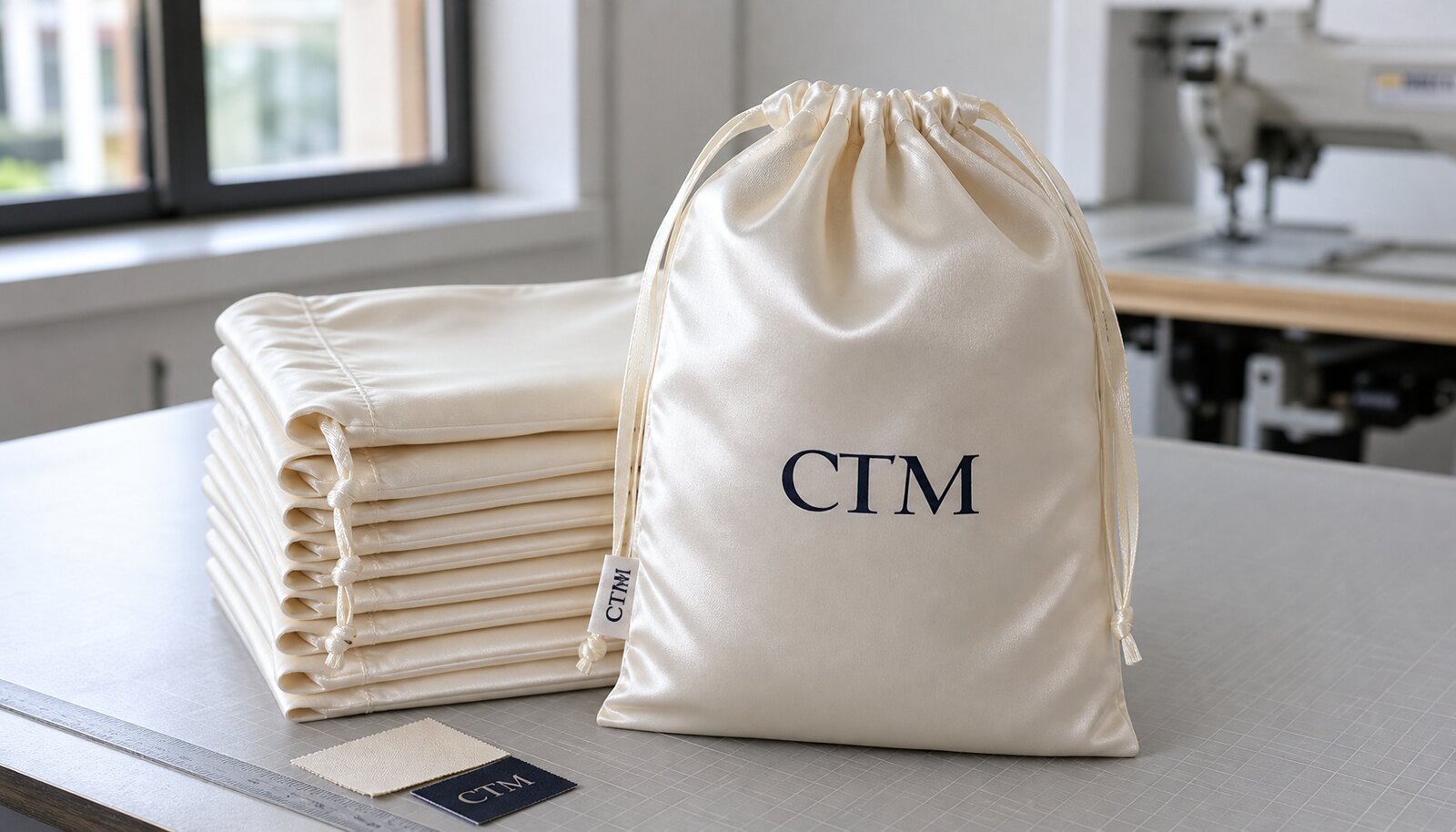
Why Satin Changes the Procurement Brief
Satin drawstring bags with logo are purchased for presentation first and utility second. That changes the sourcing brief. Buyers are not only paying for a pouch that closes; they are paying for how the surface catches light, how the logo reads on a reflective textile, how the bag folds in a carton, and how it looks after handling. A satin bag that appears clean on a sample card can still fail in bulk if the fabric is too light, the print cures poorly, or the seam line pulls the face panel out of shape.
The main procurement mistake is to treat satin like a generic drawstring fabric. It is less forgiving than cotton canvas, linen blend, or nonwoven material. A buyer should define the use case before asking for price: jewelry pouch, cosmetic pouch, wedding favor, retail insert, or branded gift packaging. Each use case changes the acceptable body, the acceptable amount of surface sheen variation, and the pack-out standard. A jewelry pouch can tolerate a softer build; a retail presentation bag usually needs straighter seams, better panel recovery, and a cleaner fold.
There is also a sourcing consequence. Satin can be made from different fiber compositions and finishing routes, so two suppliers may quote what looks like the same product but actually offer different surface behavior and handling. That is why the RFQ needs enough detail to make quotes comparable. The buyer should not ask only for “satin bag with logo.” The supplier should know the finish target, the decoration method, the color expectation, and whether the bag must arrive shelf-ready or only functional.
A practical way to think about the brief is to separate appearance, structure, and logistics. Appearance covers the fabric sheen, logo clarity, and color stability. Structure covers seam strength, channel construction, and cord behavior. Logistics covers packing, carton marking, and delivery timing. If those three parts are not written down, the supplier fills the gaps with assumptions, and those assumptions often surface later as dispute points.
For procurement teams, the value of this style is not in chasing the lowest unit price. It is in buying a repeatable result. A well-written satin bag brief reduces sample cycles, reduces rework, and helps the factory choose the right decoration path before production starts.
The more premium the end use, the more disciplined the brief should be. When the bag will sit beside a higher-value item, a small defect becomes visible very quickly. In that sense, satin is less a commodity pouch and more a presentation component that needs controlled sourcing.
The right starting point is to define what “acceptable” means on the face panel, seam line, closure, and carton presentation before the first quote is requested.
- Treat the bag as a presentation component, not only a container.
- Write the use case first, because jewelry, promo, and retail packaging have different tolerance bands.
- Split the brief into appearance, structure, and logistics so the supplier does not guess.
- Ask for a sample that reflects the final use, not only a stitched prototype.
Set the Base Spec Before You Touch Artwork
Artwork should not be the first decision. Fabric and construction should be locked first, because they determine whether the logo can be printed cleanly and whether the bag holds its shape after sewing. For many polyester satin programs, buyers often end up in a medium-to-heavier fabric build rather than the thinnest available satin. The reason is practical: a fuller fabric usually handles seams better, shows fewer distortions at the channel, and gives a more predictable print surface. That is a common sourcing preference, not a universal rule; the exact GSM or denier still needs to match the bag size and contents.
The procurement brief should name the finished size, the internal usable depth, the seam allowance, and the height of the drawstring channel. Those details matter because a bag that measures correctly when flattened can become functionally smaller after the top is folded over and stitched. Buyers sometimes discover too late that the bag cannot hold the intended insert or that the logo sits too close to the channel and gets visually crowded. This matters if the bag will hold a box, bottle, or other item with rigid edges.
Cord selection deserves the same level of attention. Round polyester cord, flat cord, and satin ribbon all close differently and create different presentation effects. Round cord is common and practical, but ribbon can look more premium in gift use. A cord that is too thin can cut into the hand or look weak; a cord that is too thick can distort the channel and make the closure look bulky. Ask the factory how the cord end is finished as well. Clean-cut, knot, heat-sealed, or crimped ends all have different appearance and durability implications.
There is also a structural choice between single-layer and reinforced construction. Single-layer satin keeps cost down and gives a softer drape, but it can be less stable for heavier contents or tighter logo placement. A reinforced top hem or stronger channel can help the bag keep its shape during repeated opening and closing. That is a functional control point for presentation bags that must arrive looking consistent.
When buyers ask the factory for a quote without these details, they often receive a price that cannot be compared across suppliers. One quotation may assume lighter fabric, another may assume a stronger cord, and a third may assume a different hem construction. The price difference is then misleading.
If you want a meaningful RFQ, write the spec so a supplier can quote one build, not several possible interpretations.
This is where procurement discipline pays off: the clearer the base spec, the fewer exceptions you need to manage later during sampling and bulk approval.
- Write finished size, usable depth, seam allowance, and channel height in the RFQ.
- Choose cord type intentionally; it affects both use and presentation.
- Ask whether the bag is single-layer or reinforced, because that changes body and price.
- Do not approve artwork until the underlying build is locked.
Choose the Logo Method by End Use, Not by Habit
Logo method should follow the role of the bag. If the bag is a simple branded accessory or a promotional giveaway, a one-color print may be the most efficient choice. If the art includes fine text, gradients, or multiple colors, a transfer method may be necessary. If the objective is subtle premium branding, a woven label or seam label can look more controlled than a heavy print field. The wrong decision is usually made when the buyer starts from a favorite decoration method instead of the end use.
Screen print is often the most economical for simple logos, but it still needs the right ink system and curing process for satin. A print that looks strong on paper or on a different fabric can appear dull, uneven, or slightly elevated on the satin in ways the buyer did not want. Buyers should ask to see the actual substrate before release. The supplier should show the print on the real bag fabric, not a nearby substitute, because satin sheen changes how color reads under different lighting.
Heat transfer and DTF methods can handle more complex artwork and small text better than traditional print in some cases. The tradeoff is appearance and durability control. On a smooth satin surface, the transfer can show gloss contrast, edge lift, or a more applied feel than the buyer expected. That does not automatically make it wrong; it means the buyer should define the acceptable finish in advance and test it under folding, rubbing, and warehouse handling conditions. If the bag will be folded repeatedly, the transfer should be checked after flexing, not only on day one.
Woven labels are often the cleanest choice when the brand wants low visual noise. They are useful when the bag itself is part of a larger set and should support the product instead of competing with it. A sewn patch can also work, but buyers should check whether the stitching distorts the satin panel or creates a rough edge that could scratch contents. On thin fabrics, embroidery is a special case. It can create puckering or panel pull unless the bag is built heavier or stabilized properly. It is not impossible; it is simply a method that needs careful approval on satin.
The most reliable practice is to request a strike-off or decorated sample on the final satin fabric and then check it in realistic light. A logo that looks elegant in the sample room can change on the warehouse floor. This is especially true for metallic shades, pale colors, or very dark satin, where the shine changes perceived contrast.
A buyer should also define the placement tolerance. On a reflective surface, a logo that is slightly off-center can look worse than the same drift on matte fabric. That is why centerline, top distance, and seam reference points should be part of the approval notes.
In short, decoration is not only about art; it is about how the chosen method behaves on this particular textile and under this particular use case.
- Use screen print for simple logos when unit economics matter most.
- Use transfer methods when art complexity is high, but test flex and rub behavior.
- Use woven labels or seam labels when the brand wants subtle, premium branding.
- Ask for a strike-off on the actual satin, under real lighting, before bulk approval.
How to Build a Quote That Lets Suppliers Price the Same Product
A weak quote request is one of the fastest ways to create sourcing confusion. If two suppliers are allowed to infer different fabric weights, different cord types, or different pack-out standards, the buyer will compare numbers that are not truly comparable. A strong RFQ should force the supplier to quote the same product, not a similar-sounding one. That means spelling out the fabric, size, logo method, print area, packaging format, and shipping term with enough clarity that the quote has little room for interpretation.
The quote should also separate the cost components. Ask for the bag body cost, decoration cost, setup cost, sample fee, packing cost, and any surcharge for custom color or additional logo position. If the supplier bundles everything into a single figure, it becomes difficult to see whether a lower unit price is being offset by a high setup fee or a strict MOQ. Procurement teams should ask for tiered pricing by volume so the price curve is visible. That matters because some satin bag programs are economically attractive only after the production run crosses a certain quantity.
MOQ is often not just a factory rule; it is a reflection of how the factory sources fabric, prepares decoration tools, and packs finished goods. A stock satin bag with one simple logo may have a manageable MOQ. A custom-dyed satin program with multi-color branding and individual retail packing may require a higher commit because multiple upstream steps must be aligned. Buyers should ask which variable actually drives the MOQ: fabric color, logo complexity, size, or packing. That answer is more useful than a generic minimum order number.
It is also important to compare sourcing routes on equal terms. A direct factory may quote a lower ex-factory number but require the buyer to manage more process steps. A trading company may offer more convenience and fewer coordination tasks, but the buyer should know who actually makes the bag and who controls the inspection process. A local decorator may shorten some timing risks, yet the available satin substrates may be narrower and the unit cost may be less favorable at scale. The comparison should be made on landed value, not only on invoice value.
For procurement teams, the smartest comparison is often a simple matrix: unit price, sample fee, setup fee, MOQ, lead time, packing standard, and defect risk. If a supplier will not break out those items, the buyer should ask again before moving forward.
That discipline prevents a common mistake: selecting the cheapest line item and discovering later that the real cost sits in color changes, repacking, or rework after approval.
In practice, the best quote is the one that lets you understand not just how much the order costs, but why it costs that much and where the hidden exposure sits.
- Ask for line items: bag body, decoration, setup, sample, packing, and surcharges.
- Require tiered pricing so the price curve is visible.
- Identify what actually drives MOQ: fabric color, logo method, size, or packing.
- Compare landed value, not only ex-factory price.
Use a Sample Approval Sequence That Mimics Production
A satin sample should be approved like a production control sample, not like a display sample. The first decision is whether the fabric shade and surface behavior match the target use. Then the buyer should check seam alignment, channel shape, cord movement, and logo placement. Because satin reflects light, a sample can look different under the warm lamp in the sample room than it does in a warehouse or office environment. Approval should therefore happen under at least two lighting conditions, and the buyer should keep the sample in the same fold and pack style expected in bulk.
The approval sequence should be staged. Start with the fabric or shade confirmation if the satin is custom-colored or highly brand-sensitive. Then approve the pre-production sample made with the final fabric lot, final cord, final print tool or label, and final pack-out. That pre-production sample is the version to freeze. Buyers should mark what is approved in writing, including the exact placement reference, the acceptable shade range, and the fold style. A photo is helpful, but it should sit alongside written notes and measured dimensions. If it is not written, it is easy for the factory to treat a later variation as acceptable when the buyer does not agree.
If the supplier wants to change anything after approval, the buyer should treat it as a revision. That includes a different cord supplier, a lighter or darker satin lot, a changed label size, or a shift in carton quantity. Small changes can alter the appearance more than expected, especially on satin. This is where buyers protect themselves by freezing the approved sample set and linking it to the purchase order. The goal is not to be difficult; the goal is to make sure the bulk order matches the approved reference.
The practical sample checklist should include: size measurement, seam straightness, logo position, print clarity, closure function, fold quality, and packed appearance. A bag can be technically correct and still fail because it does not sit well when empty or because the face panel wrinkles too much after packing. For retail or gift use, that visual standard matters as much as the dimensions.
If the program is time-sensitive, ask the factory to send photos or video of the first off-line run before continuing the lot. That simple checkpoint can catch a registration shift or seam issue before too many pieces are completed. It is cheaper to stop early than to inspect and rework a full batch later.
A controlled sample approval sequence is one of the most effective ways to reduce surprises, especially when multiple suppliers are competing for the same order.
It also gives procurement a cleaner basis for escalation if bulk production deviates from what was approved.
- Approve the sample under more than one lighting condition.
- Freeze the pre-production sample using the final fabric, cord, logo tool, and packing format.
- Treat any later change as a revision, not a casual substitution.
- Ask for first-offline-run photos or video before bulk continues.
Packing Is Part of Product Quality, Not Just Logistics
Satin marks easily, wrinkles easily, and shows fold lines quickly. That means the pack-out decision affects the customer’s first impression. If the bags are for retail, premium gifting, or branded presentation, individual polybags often make sense because they protect the finish and help preserve the face panel. For internal promotions or giveaway programs, bulk packing may be acceptable if the bags are not being sold as a presentation item and if the carton is not overfilled. The key is to match the pack-out standard to the buyer’s use case, not to default to the cheapest method.
The supplier should explain the folding method as well. The logo side should usually be visible in the inner pack or arranged so it does not get crushed against the fold. A bad fold can create a permanent crease through the logo area, especially if the carton is packed too tightly. Buyers should ask how many pieces go into an inner pack, how the inner pack is sealed, whether a desiccant or moisture control step is needed in humid shipping lanes, and whether the carton quantity is optimized to avoid compression. These are small details, but on satin they matter.
Retail programs need extra discipline on labeling. Barcode position, carton marks, and any hangtag or insert requirement should be agreed before production, not after the bags arrive. If the warehouse must relabel or re-pack the cartons, the buyer loses both time and finish quality. It is also worth asking the supplier to stage cartons for final photo approval before shipment. That gives the buyer a chance to confirm pack count, mark placement, and visible condition without waiting for the freight forwarder to discover a problem.
For promo programs, the pack standard can be lighter, but there should still be a clear rule on how the bags are compressed and whether the printed face is protected. Promo buyers sometimes assume bulk packing is “good enough,” then discover that the satin has taken on a crushed look by the time it reaches the distribution center. A low-cost bag can become a poor value if it arrives with avoidable surface damage.
The real procurement question is whether the packed bag arrives ready for use or requires correction. If it needs correction, the buyer is paying for extra labor somewhere else in the chain.
That is why packing belongs in the quotation and QC plan, not in an afterthought email after production starts.
- Use individual polybags when the bag is sold, gifted, or displayed as part of a premium set.
- Define the folding method so the logo area is not crushed in transit.
- Agree barcode, carton mark, and inner pack rules before production.
- For promo use, bulk pack can work only if surface damage risk is controlled.
Lead Time Problems Usually Start Before Sewing
When satin bag orders run late, the issue is often not the sewing line. The delays usually start with artwork approval, fabric confirmation, label sourcing, or dye lot availability. Satin is sensitive because a buyer may approve the logo quickly and still need a separate shade approval on the fabric. If the order requires custom-dyed satin, the supplier may need time to confirm the right lot before cutting begins. That means the schedule should be built around sequential gates, not around a vague total lead-time promise.
A useful internal approach is to map the order in stages: sample development, material approval, pre-production sample, bulk cutting, decoration, sewing, finishing, packing, and final inspection. Each stage should have an owner and a deadline. If the factory says all steps are included in one broad timeline, buyers should ask for a more granular breakdown. That makes schedule slips easier to spot and easier to escalate. It also helps procurement decide whether the order can still meet a retail launch, event, or seasonal deadline.
Seasonality matters. Cosmetic launches, wedding seasons, gift periods, and trade show calendars all create pressure on presentation packaging. A satin pouch that seems simple can still compete for the same machinery and material supply as other branded packaging jobs. If the ship date is fixed, ask the factory which step is the bottleneck and which step can be started earlier. For example, print tools or woven labels may be prepared while fabric confirmation is still in process, but only if the supplier has the discipline to stage work correctly.
Buyers should also ask what happens if a step slips. Is there a formal escalation point? Will the supplier update the delivery date as soon as fabric approval is late, or only after the production window has already been lost? A good supplier will tell you where schedule risk sits and what they can do about it. A weak supplier will keep saying “no problem” until the delay is already visible.
The most practical schedule control is simple: request the planned date for each gate, the name of the responsible contact, and the trigger for immediate buyer notification if that gate is missed. It is not fancy, but it prevents a large amount of preventable confusion.
In sourcing terms, schedule discipline is often the difference between an order that lands in time and an order that forces an expensive air shipment or a compromised launch.
For this style, early clarity is more useful than a later apology.
- Build the schedule by gates, not one broad lead-time number.
- Ask for the owner and deadline for each stage: materials, sample, bulk, pack, inspection.
- Define the escalation point if a gate slips.
- Do not wait until the ship week to find out the fabric is not ready.
QC Thresholds That Catch Real Problems on Satin
Quality control for satin drawstring bags is mostly about visible consistency and closure function. The surface is unforgiving: a pull mark, oil spot, or seam ripple that might pass unnoticed on a matte fabric can be obvious here. QC should therefore start with the fabric face, move to the seam line, then to the logo, then to the cord action and final pack. That sequence mirrors how the end user will see the product. It also helps the inspector avoid spending time on secondary checks before the obvious defects are filtered out.
Procurement teams should ask the factory to define measurable thresholds where possible. Size tolerance should be stated for both width and height after final pressing. Logo placement should be tied to a reference point from the side seam or centerline, not only described visually. Stitch quality should have a visible standard, such as no skipped stitches, no open seams, no loose thread tails beyond an agreed limit, and no puckering at the channel. If the bag includes a printed logo, add a rub resistance expectation appropriate to the decoration method. If the bag includes a cord knot or heat-sealed end, add a tug or pull test so the closure does not fail in handling.
AQL guidance should be written into the QC plan. The exact AQL level depends on the buyer’s risk tolerance and the product’s end use, but a common procurement approach is to set a tighter standard for appearance and a slightly more flexible standard for minor packaging issues. What matters most is that the buyer and supplier use the same standard during inspection. The factory should know whether the buyer is inspecting to a retail standard, a promotional standard, or an intermediate standard for internal use. A bag sold as part of a premium gift set should not be inspected to the same visual standard as a low-cost giveaway pouch.
For buyers who need a practical defect plan, it helps to classify issues into three buckets: critical, major, and minor. Critical issues might include wrong size, wrong logo, open seams, or severe shade mismatch. Major issues might include visible staining, off-center decoration, or broken cords. Minor issues might include slight trim variation or tiny loose threads that do not affect function. The supplier should know what happens at each level: accept, rework, sort, or reject.
Inspection should also include the bag in its packed state. Some defects only become visible after folding and carton compression. Satin wrinkles, face-panel crushing, and print gloss differences can appear only after packing. That is why a final carton check is not optional on this style.
If the factory is serious, it will be willing to show in-process photos, final inspection photos, and carton staging before shipment. Those images do not replace inspection, but they do shorten the feedback loop if something is drifting.
The buyer’s goal is not to find every tiny flaw; it is to stop the wrong lot before it ships.
- Inspect satin first for visible surface defects, then seams, then logo, then closure and pack-out.
- Write measurable tolerances for size, placement, and stitching.
- Use critical/major/minor defect buckets so the response is consistent.
- Inspect packed cartons as well as loose bags, because compression can create new issues.
Compare Sourcing Routes by Control, Speed, and Risk
The sourcing route matters as much as the product spec. Direct factory sourcing generally gives the buyer the most control over fabric, sewing, print, and packing. That control can reduce misunderstanding, but it also means the buyer must be ready to manage details such as artwork approval, sample revision, and freight timing. A trading company can reduce the coordination burden by acting as a single point of contact, which is useful for buyers handling multiple packaging items at once. The tradeoff is that the buyer needs to verify where the product is actually made and who has the authority to fix problems.
Local decoration or finishing can be useful for urgent programs or small tests, especially if the buyer already has blank satin bags available. The advantage is speed and proximity. The downside is that local decorators may have fewer fabric options, less control over custom satin consistency, or a higher per-piece cost once the order grows. This route works best when the buyer values turnaround more than fabric customization. It does not always scale well into a larger retail program.
There is also a hybrid route: sample and development from one source, fulfillment or regional packing from another. This can be practical when a brand needs speed in one market and production in another, or when a program must be split for logistical reasons. The risk is responsibility blur. If the sample owner, the production factory, and the packing partner all touch the order, the buyer must define who owns final inspection, carton labeling, and shipping documents. Without that clarity, a defect can be passed from one party to the next until nobody feels responsible.
Procurement teams should compare routes using the same scorecard: landed cost, sample speed, lead-time reliability, defect response, and change-control discipline. A lower invoice price does not always translate into a better outcome if the supplier is weak on approval management or pack quality. A slightly higher price can be justified when it reduces rework, reshipment, or warehouse labor.
For satin drawstring bags with logo, route selection is really a control decision. The buyer should ask: who owns the fabric, who owns the decoration, who owns the packing, and who is accountable when the approved sample is not matched? If those answers are vague, the sourcing route is not ready.
The best route is the one that matches the complexity of the program, not the one that sounds easiest in the first conversation.
That keeps the buying decision practical rather than theoretical.
- Direct factory sourcing gives the most control; verify they own the actual process steps.
- Trading companies simplify coordination, but the factory identity and change authority must be clear.
- Local decoration can work for speed and tests, but it may not scale well.
- Use one scorecard for all routes: landed cost, speed, defect response, and change control.
A Practical Decision Matrix for Buyers
Procurement teams often need a faster way to decide which version of the bag to buy. The matrix below is useful because it ties product decisions to commercial tradeoffs. It is not enough to know which decoration method looks nice; the buyer needs to know what it does to cost, lead time, and approval risk. Satin is especially sensitive to these tradeoffs because the material can magnify small differences in print, seam, and packing behavior.
If the program is simple, recurring, and controlled, a direct factory with one-color print or a woven label is usually the cleanest route. If the artwork is more complex but the order is smaller, a transfer method may be justified, provided the buyer tests it properly. If speed matters more than fabric precision, stock blanks plus local decoration may be the better compromise. If the bag is part of a retail system where color consistency matters, custom-dyed satin can be worth the extra lead-time discipline.
The matrix should be used alongside the RFQ, not instead of it. It helps the buyer decide what to ask for and where the risk sits. Once the option is chosen, the RFQ should still name the spec, the sample path, the packing standard, and the inspection threshold. That way, the supplier understands not only what to make but also what success looks like.
A practical rule: if two options have similar unit cost, choose the one with lower process ambiguity. On satin, ambiguity is where trouble starts. A supplier who can clearly explain material source, decoration step, and pack-out standard is usually a safer partner than one who only offers a low number.
For internal approvals, it can help to score the options on five dimensions: appearance control, lead-time confidence, MOQ flexibility, packing quality, and correction cost. Any option with weak control on two or more of those dimensions should be treated as a risk purchase, not a routine buy.
That is the procurement lens that keeps the order grounded in operational reality rather than in a price-only comparison.
And it is usually the most useful way to evaluate satin drawstring bags with logo when multiple routes are available.
- Use the matrix to compare cost, lead time, MOQ, and correction risk together.
- Choose the lower-ambiguity option when unit prices are similar.
- Score options on appearance control, lead-time confidence, MOQ flexibility, packing quality, and correction cost.
Specification comparison for buyers
| Buying route or spec choice | Best fit | Procurement tradeoff | Cost / lead-time / MOQ implication | Buyer risk to check |
|---|---|---|---|---|
| Direct factory with sewing + decoration in-house | Repeat programs, branded replenishment, and orders that need one accountable owner | Best control over fabric, stitching, print placement, and final packing, but requires a tighter RFQ and sample discipline | Usually the most stable unit cost on repeat orders; lead time can tighten after process lock; MOQ is often driven by fabric color, decoration setup, and packing format | Verify the factory truly owns cutting, sewing, decoration, and final packing—not just the quotation |
| Trading company or sourcing agent | Multi-SKU packaging programs, buyers needing one contact, or teams without in-house sourcing capacity | Simplifies communication and bundling, but can hide factory capability, change control, and inspection ownership | May accept smaller mixed orders; lead time is more variable; MOQ may be influenced by upstream availability and consolidation strategy | Ask for factory identity, sample traceability, and who approves production changes |
| Stock satin blank + local logo application | Launches, events, market testing, and lower-volume branded giveaways | Faster start, but the blank bag may not be optimized for your logo method or presentation standard | Lower setup burden if blanks are available; lead time can be short; MOQ may be lower, but unit cost can rise with local decoration and handling | Confirm the substrate accepts the decoration method without ghosting, cracking, or shade change |
| Custom-dyed satin from a mill-backed factory | Retail programs and brand systems where color consistency matters more than speed | Better shade control and brand matching, but more approval steps and a higher risk of delay if the dye lot is off | Higher setup effort and longer pre-production; MOQ often increases because dyeing and cutting need a committed run | Approve strike-off or shade swatch under realistic light before fabric cutting |
| One-color screen print | Simple logos, short text, and the cleanest unit economics for many promo bags | Strong value when art is simple, but depends on ink choice, opacity, cure settings, and satin surface behavior | Low setup relative to multi-color methods; lead time is moderate; MOQ often stays accessible unless screens or color matching are complex | Check rub resistance, opacity on dark satin, and print placement tolerance |
| Heat transfer or DTF decoration | Fine text, gradients, multi-color logos, or small test runs | Flexible for artwork, but can feel more applied to the surface and may show gloss difference or edge wear | Can reduce art limitations, but setup and rework risk can increase; MOQ may be lower for small runs, yet per-piece cost may be higher | Test flexing, cracking, and surface appearance after packing and opening cycles |
| Woven label or sewn patch | Subtle premium branding and bags where the logo should not dominate the face panel | Durable and visually neat, but does not provide the same full-face brand impact as print | Setup can be manageable; lead time depends on label sourcing; MOQ can be reasonable if labels are standard, but custom labels add time | Confirm label size, edge finish, stitch count, and seam interaction |
| Dual-source workflow: sample owner plus fulfillment/packing partner | Programs that need speed, regional packing, or backup capacity | Can help timelines, but splits responsibility across more than one party, which makes defects harder to assign | May shorten some steps and complicate others; MOQ can vary by the primary source; lead time risk rises if ownership is unclear | Define who owns final inspection, carton marking, and shipping documents |
Buyer checklist before sampling
- State the finished bag size, usable internal height, seam allowance, and top channel depth, not just a rough pouch dimension.
- Specify the satin construction by fiber content, denier, weave/finish type, and a target fabric weight or GSM range suitable for the use case.
- Define the logo method, artwork format, color count, exact placement, and minimum distance from the drawstring channel and top seam.
- Approve the fabric shade by physical swatch or strike-off under daylight and warehouse lighting before bulk cutting.
- Lock the cord type, cord length, end finish, and whether the cord is round, flat, ribbon, or another profile.
- Confirm packing format: bulk pack or individual polybag, quantity per inner bag, carton count, carton dimensions, and carton mark rules.
- Request sample lead time, bulk lead time, and the trigger points that require notice if the schedule slips.
- Ask for written size tolerance, logo placement tolerance, seam tolerance, and a defect acceptance standard.
- Require pre-production photos of the first off-line run, plus final carton staging photos before shipment.
- Tie payment milestones to the approved sample, the confirmed production plan, and inspection responsibility.
Factory quote questions to send
- What fabric is being offered, and can you state fiber content, denier, finish, and target GSM or fabric weight range?
- Is the satin stock color or custom-dyed, and what approval step is required before cutting starts?
- Is the logo printed, heat transferred, woven, sewn, or labeled, and is that decoration completed in-house or outsourced?
- What is the MOQ by size, color, logo color, and packing format, and which change forces a higher price tier?
- What are the sample charge, setup charge, tooling charge, and any extra fee for a second print position or label?
- What size tolerance, print placement tolerance, and seam tolerance do you guarantee in bulk production?
- How will the bags be folded and packed, and what are the inner pack, carton quantity, and master carton dimensions?
- What lead time applies after sample approval, and which step most often causes delay on this style?
- Can you show photos or video of the first production sample, in-line QC, final inspection, and carton marking?
- If the first bulk run shows shade mismatch, print shift, or seam defects, what is your correction process and timeline?
Quality-control points to confirm
- Fabric shade should match the approved swatch under both daylight and warehouse lighting, with no obvious lot-to-lot jump in the visible production run.
- Visible panels should be free from pulls, oil marks, scorch marks, holes, skipped weave areas, or surface distortion.
- Logo placement should stay within the agreed tolerance and remain square to the bag body rather than drifting toward the seam or drawstring channel.
- Print should not crack, smear, transfer, or show edge blur after the agreed rub test and repeated light flexing.
- Seams should be even, fully closed, and free from loose thread tails, skipped stitches, puckering, or channel twisting.
- Drawstring operation should be smooth on both sides, with secure knots or heat-sealed ends that do not loosen under a tug test.
- Bag dimensions should be checked after final pressing and packing, not only on the cutting table.
- Cartons and inner packs should match the approved packing list exactly, including quantity, barcode, carton mark, and label position.
- If the order is for retail use, inspect for presentation defects such as wrinkling, crushed face panels, and visible fold lines through the logo area.
- Define whether defects are judged per piece, per lot, or per carton, and set a written escalation path for rework or replacement.