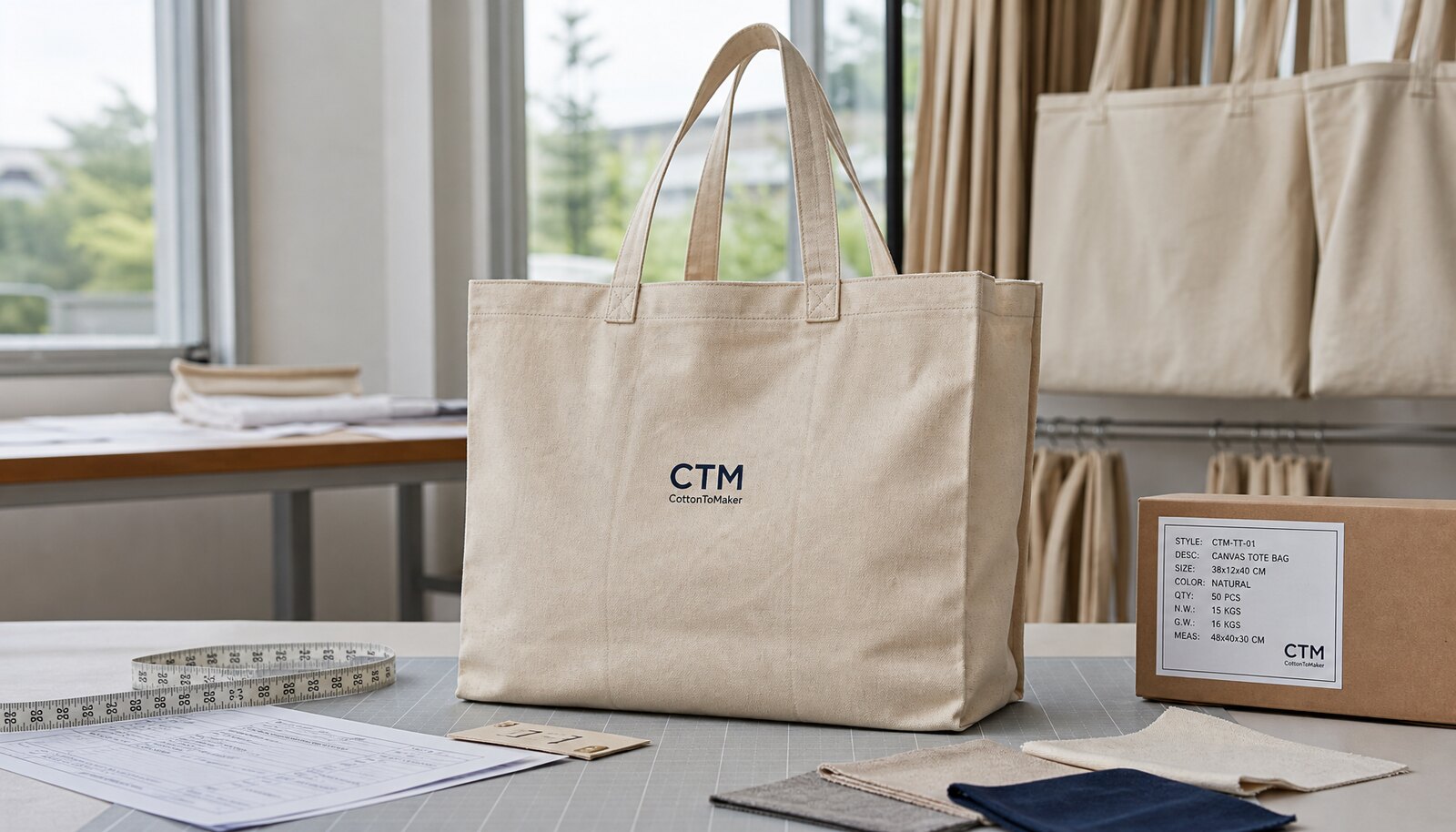
Start With The Use Case, Not The Logo
Reusable canvas bags are not one product. A bookstore tote, grocery tote, trade show giveaway, and retail carry bag fail for different reasons if the brief is vague. A quote can look low because the supplier assumed a lightweight promotional bag, then the order misses the real requirement once the bag has to carry weight, stand on a shelf, or survive repeated use.
The RFQ should begin with the job the bag has to do. State the primary use, target load, whether it needs to stand upright, whether it will be folded for mailing, and how the customer will handle it in the real world. Once those facts are fixed, the supplier can choose fabric weight, handle length, decoration method, and packing without guessing.
This is the fastest way to reduce quote noise. If the factory knows the end use, the comparison becomes about real performance tradeoffs instead of a generic tote bag price.
- State the size in mm, not only small, medium, or large.
- Tell the supplier what will go inside the bag, such as books, groceries, apparel, bottles, or paperwork.
- Note if the bag must fold flat for mailer inserts or retail shelf display.
- Say whether natural shade variation is acceptable or whether the order needs a controlled color target.
Specify The Bag As A Performance Item
Procurement teams should describe reusable canvas bags as a performance item, not a decorative accessory. The important variables are size, weight, structure, reinforcement, and decoration. A bag with the right logo but the wrong handle drop or seam build is a rejected product, not a successful one.
Finish the spec around what the bag must survive. If the tote is for daily retail use, the buyer should define a minimum carry expectation, such as a standard shopping load or a set number of books. If it is for events, define the carry time, folding requirement, and whether the bag must remain presentable after being packed and unpacked repeatedly.
The same principle applies to the panel layout. A flat art proof does not capture how the print lands across seams, gussets, or curved areas, so the RFQ should state the exact print area on the finished product.
- Include handle drop and handle width in the RFQ, not just total bag dimensions.
- Define whether the bag needs a gusset, a bottom panel, a lining, or a closure.
- If the bag is for retail, specify whether it must hang straight, sit upright, or keep a boxy shape.
- If the bag is for repeated use, ask for seam and handle reinforcement details in the quote.
Choose Fabric Weight, Weave, And Finish With Breakpoints
Canvas weight is the first line item buyers should compare, but GSM by itself is not the whole answer. An 8 oz canvas, roughly 270 to 280 GSM depending on weave and finish, is often acceptable for giveaways and light carry. A 10 oz canvas, around 340 to 350 GSM, is the common default for retail and daily use. A 12 oz canvas, around 400 GSM or higher, gives more structure and a heavier hand, but it increases material cost and sewing load.
The better decision is based on the load and the shelf expectation. If the bag has to carry books, bottles, or mixed retail items, start at 10 oz and add reinforcement. If the bag needs to feel premium or hold shape on display, move to 12 oz. If the bag is only a mailer insert or a low-cost event item, 8 oz may be enough and will keep unit cost lower.
Finish matters too. Washed canvas changes the hand feel and final dimensions. Natural canvas usually gives the lowest cost and the widest color range for print, but it also shows shade variation more clearly. If the buyer needs a controlled look, the RFQ should ask for the exact fabric finish and whether shrinkage has been accounted for after washing or dyeing.
- Use 8 oz for lightweight promo bags and short-lived event use.
- Use 10 oz for the default retail tote, daily errands, books, and mixed carry.
- Use 12 oz when the bag must feel substantial, keep its shape, or support heavier loads.
- Ask whether the fabric is pre-shrunk or washed, because that changes the finished size and the hand feel.
- Do not compare quotes that mix GSM values without normalizing the fabric and finish.
Design The Construction Around Failure Points
Most tote failures happen at the same places: handles, corners, top edge, and print area. A strong fabric cannot compensate for weak seam construction. Buyers should request the actual reinforcement method, not just a statement that the bag is durable.
Handle construction is especially important. If the bag is expected to carry weight, ask for reinforced handle joins, such as bartacks or box-X stitching, and define the handle width and attachment length. For most reusable canvas bags, a load-bearing seam should have enough allowance and stitch density to prevent fraying or seam slippage during normal use.
The buyer should also specify the top finish. Folded and hemmed tops create a cleaner look and better edge durability, while raw or lightly bound edges can lower cost but may not suit retail programs. If the tote has a gusset or a bottom panel, state how those panels should be joined, because construction changes can alter both appearance and strength.
- Request the reinforcement type at the handle join and stress points.
- Specify minimum seam allowance on load-bearing seams, commonly at least 8 mm.
- Set handle symmetry expectations so the two handles do not sit at different lengths or heights.
- If the bag will carry heavier items, require the factory to confirm how it tests handle pull or seam integrity.
Match Decoration Method To Artwork And Volume
Decoration should follow the artwork and order size, not a default supplier preference. Screen printing is usually the best fit for one to three solid colors and repeat orders because it is durable and cost-effective once setup is absorbed. For most reusable canvas bags, a clean single-color or two-color screen print remains the most commercial option.
Digital transfer or heat transfer is better when the artwork has gradients, many colors, or a short run that cannot justify screen setup. The tradeoff is abrasion resistance, feel, and sometimes cost. Buyers should not accept a method switch without seeing the actual finish on the same canvas color they plan to buy.
Embroidery can work on thicker canvas for premium branding, but it changes the back side and can distort lightweight fabric. A sewn woven label or side tab may sometimes be the better option when the buyer wants branding without covering the full front panel.
- Ask for a sample on the actual canvas color, not only on paper art proofs.
- Define print position after seams and gussets are formed, not just on a flat dieline.
- Set a registration tolerance for multi-color prints before production starts.
- Request a rub or cure test for any print that will be handled often or packed and repacked.
- For color-critical logos, ask how the supplier matches Pantone targets and who signs off the ink sample.
Compare Supplier Routes Before You Compare Prices
Supplier route changes both quote structure and risk. A direct factory usually gives the strongest control over fabric, stitching, printing, and packing. A trading company can be useful when the order includes multiple product types or when the buyer wants a single point of contact. A local decorator is useful for urgent work, but it often limits fabric choice and construction control.
The main mistake is comparing all routes on a single unit price. A direct factory may look expensive until you see that the quote includes the correct fabric, the print setup, and the retail pack. A trading company may look simple until the buyer discovers that the chain of custody, inspection ownership, and rework liability are not clearly defined.
The right question is not which supplier is cheapest in isolation. The right question is which route gives the best control over the attributes that can actually break the program: shade, print quality, cartonization, and repeatability.
- Use a direct factory when repeatability, traceability, and structural control matter most.
- Use a trading company when you need one contact for mixed baskets or multiple factory options.
- Use a local decorator when speed matters more than full specification control.
- Ask who owns sewing, printing, inspection, and packing if the supplier is not the factory of record.
Verify Traceability, Compliance, And Sustainability Claims
Reusable canvas bags are often sold as sustainable products, but the claim still needs backing. If the buyer needs traceability, ask which mill supplied the cloth, whether the fabric is greige, dyed, or washed, and whether the supplier can tie a fabric lot or dye lot to the order. If you need the same shade on reorder, lot control matters as much as price.
Compliance is market-specific, so the RFQ should ask for the documents that matter to the destination market. For some programs, that may include a material composition declaration, country of origin, REACH or azo dye statements, formaldehyde limits, Prop 65 support, or a certificate scope that covers a recycled-content or organic claim. Do not print unsupported claims on the bag or its packaging.
If the program uses sustainability language, require the supplier to prove it. A claim such as organic, recycled content, or recycled packaging should be backed by the relevant certificate scope, test report, or chain-of-custody document. If the claim cannot be documented, it should not be used in the marketing copy or on the product label.
- Ask for mill or fabric-source details so the order can be traced back to the cloth lot.
- Require a composition declaration if the bag content matters to customs, labeling, or customer policy.
- If you need recycled or organic claims, request the certificate scope that actually covers the order.
- Do not accept vague language such as eco-friendly unless the supplier can attach proof.
- If the destination market has specific chemical or labeling rules, ask for the relevant test support before approval.
Treat The Sample As The Production Reference
The pre-production sample should be a production reference, not a sales sample. It needs to use the same fabric weight, thread color, decoration method, and packing plan that the bulk order will use. If the sample uses different material or a different print process, it is only a design check and should not be treated as final approval.
The buyer should inspect more than one piece. Measure at least three to five samples from the sample set and compare them against the spec and the approved reference. Check dimensions, handle symmetry, seam quality, print placement, and fold behavior. Keep a dated photo record and retain the approved sample as the golden sample.
If the supplier changes any material or construction detail after approval, the change should be documented and reapproved. That includes fabric lot changes, print ink changes, handle width changes, and packing changes that affect retail presentation or warehouse handling.
- Use a golden sample with a sign-off date and keep it with the project file.
- Inspect the sample under consistent lighting so shade calls are not distorted.
- Measure at least three to five pieces instead of approving the best-looking one.
- Write any post-approval changes back into the spec before bulk production starts.
- If the sample is not made from the production-equivalent material, treat it as a design sample only.
Lock Packing, Cartons, And Freight Assumptions Early
Packing is where a low quote often stops being low. Canvas bags can crease, scuff, or pick up dust if they are packed loosely. If the order is retail-facing, the buyer should specify whether each bag needs an individual polybag, a barcode sticker, a hangtag, or a folded presentation that fits a shelf tray or mailer.
For export cartons, the packing rule should protect shape and make counting simple. Fix the bag count per carton, the carton size, the maximum carton weight, and the outer mark content before production starts. If the bags are printed on one side only, say which side faces out in the polybag. If the route is long, humid, or likely to see repeated handling, ask whether the supplier uses double-wall cartons, corner protection, or pallet wrap.
Freight assumptions must sit in the same RFQ as the product spec. A supplier can quote a bag cheaply and still miss the real landed cost if the quote excludes packing materials, inland freight, export handling, or destination charges. If the receiving warehouse has a carton height or weight limit, include it in the spec so the factory can pack accordingly.
- Specify whether the bag ships loose, polybagged, or retail-ready.
- Set the carton count so the bags are not over-compressed during transit.
- Put a maximum carton weight in the spec so warehouse handling stays manageable.
- Include carton marks, PO number, size, color, and country of origin on the outer label if required.
- Ask for carton size and gross weight so landed cost can be compared on the same basis.
Put QC Into The PO, Not Just The Inspection Report
QC for reusable canvas bags should be measurable before the goods leave the factory. Use a sampling plan such as ANSI/ASQ Z1.4 or ISO 2859-1, typically at General Inspection Level II, with AQL 2.5 for major defects, AQL 4.0 for minor defects, and zero tolerance for critical defects. The point is not to use the acronym for its own sake. The point is to give the factory a clear acceptance rule before production starts.
Major defects should be defined in advance. For canvas bags, that usually includes broken seams, open seams, missing or mis-sewn handles, print position outside tolerance, major shade mismatch, or a carton count error. Minor defects can include slight thread tails, small cosmetic marks, or minor packing imperfections if the bag still meets the approved standard.
A good acceptance sheet turns subjective judgment into pass or fail rules. Define the allowed size variance, the handle variance, the print placement tolerance, the shade standard, and the carton variance. If the factory cannot measure those items, the buyer is too dependent on visual judgment and the inspection becomes harder to defend.
- Set a numeric tolerance for size, stitching, print placement, and carton weight before the PO goes out.
- Use one approved golden sample as the reference for incoming inspection.
- Reject visible oil spots, broken stitches, open seams, or panel shade mismatch.
- For color-critical work, require an agreed Delta E target or a signed visual standard.
- Confirm that the inspection plan is written into the purchase order or quality appendix, not only in email.
Specification comparison for buyers
| Spec decision | Threshold or default | Typical cost impact | When it fits | Buyer risk to check |
|---|---|---|---|---|
| Launch test under 1,000 pcs | Stock blank bags with simple decoration | Lowest setup burden, but unit price is often volatile | Short market test, event giveaway, or pilot order | Stock availability can change without notice and decoration may be added by a third party |
| Retail repeat order | Direct factory, 10 oz canvas, one to two print colors | Usually the best balance of control and unit cost | Annual replenishment or branded retail tote program | Setup fees and packing extras can be hidden if the quote is only a finished unit price |
| Move from 8 oz to 10 oz | Approx. 280 GSM to 340 to 350 GSM | Often +8% to 15% versus an 8 oz baseline | Daily retail use, books, or mixed promotional carry | Low quotes may quietly downgrade GSM or soften the weave |
| Move from 10 oz to 12 oz | Approx. 340 to 350 GSM to 400 GSM plus | Often +5% to 12% versus a 10 oz baseline | Heavier loads, better shape retention, premium retail feel | A stronger fabric still fails if seam and handle reinforcement are weak |
| One-color to two-color screen print | One extra screen and one extra setup | Often +3% to 8% plus setup cost | Brand logos with a secondary accent color | Registration tolerance must be agreed on the actual bag, not only on a flat art proof |
| Screen print to digital or transfer | Useful for gradients, fine detail, or short runs under about 1,000 pcs | Often +15% to 35% versus a simple single-color screen print | Artwork has multiple colors or a limited order quantity | Hand feel and abrasion resistance need testing on the real canvas color |
| Add retail-ready packing | Individual polybag, barcode, fold spec, and shelf-ready carton marks | Often +3% to 8% depending on labor and materials | Shelf display, distributor programs, or e-commerce handling | Packing details can sit outside the base quote unless you list them explicitly |
| Require fabric lot reservation for reorders | Same mill lot or reserved dye lot where feasible | May add holding cost or a small premium, but reduces rework risk | Programs needing repeat shade consistency | Replenishment order can drift in shade if the supplier sources fabric after confirmation |
| Use a trading company instead of direct factory | One contact for mixed product baskets | Often +5% to 12% versus direct factory pricing | Consolidated orders with pouches, totes, and other SKUs | Traceability and QC ownership must be written down clearly |
Buyer checklist before sampling
- Finished size in mm, including body height, width, gusset, handle drop, and any fold requirement
- Target load in kilograms, and whether the bag must stand upright when filled
- Canvas GSM or oz weight, fiber composition, and whether the fabric is bleached, dyed, washed, or natural
- Print method, number of colors, print area, Pantone target if applicable, and artwork placement on the finished bag
- Handle width, handle length, seam allowance, reinforcement method, and whether the handles are self-fabric or webbing
- Bottom construction, gusset type, and whether the bag needs lining, zip closure, or interior pocket
- MOQ per size, per color, per artwork, and per packing configuration
- Sample approval path, number of allowed revisions, and how the golden sample will be stored and referenced
- Packing unit, fold method, polybag requirement, carton count, maximum carton weight, and outer mark requirements
- Incoterm, destination port or warehouse, currency, quote validity date, and any excluded charges
Factory quote questions to send
- Is your price for a blank bag only, or for a finished printed bag with packing included?
- What exact canvas weight, weave, finish, and fiber composition are you quoting, and what tolerance do you allow on the fabric spec?
- Is the fabric from stock, a reserved lot, or a newly sourced lot, and can you keep the same lot for reorders if we approve it?
- How many print colors are included, what is the setup fee, and what artwork size and placement are you assuming?
- What is the MOQ per size, per color, and per decoration method, and does MOQ change if we alter the packing configuration?
- What reinforcement do you use at the handle joins and stress points, and what seam allowance is built into the bag?
- Can you make the pre-production sample on the same fabric lot and with the same ink system as bulk production?
- What packing is included in the quote, including polybag, fold method, inner pack, carton count, and carton marks?
- What is the lead time after artwork approval and after pre-production sample approval, and which step is the critical path?
- What inspection standard do you use before shipment, and who signs off the final release?
Quality-control points to confirm
- Finished dimensions match the approved sample within the agreed tolerance, typically +/- 5 mm for smaller dimensions and +/- 8 mm for larger dimensions
- Handle length, handle drop, and handle symmetry are within +/- 5 mm, and the two handles do not differ by more than 3 mm
- Seam allowance on load-bearing seams is at least 8 mm, with no open seams, skipped stitches, or broken thread at stress points
- Stitch density is consistent at the approved level, commonly 7 to 9 stitches per inch on load-bearing seams, with no more than 1 skipped stitch per 300 mm seam
- Handle reinforcement uses the approved method, such as bartack or box-X stitching, and bartacks are intact and fully sewn
- Print position is within +/- 5 mm of the approved placement, and fine text or registration-critical artwork does not show visible misalignment at normal viewing distance
- For color-critical programs, the print shade matches the approved master sample, and any instrument-based target is within the agreed Delta E tolerance, commonly no more than 2.0 against the master
- Panel-to-panel fabric shade does not show a visible mismatch from 1 meter away, and dye lots are not mixed unless the buyer has approved the variation in writing
- Carton count is exact, carton marks match the PO, and gross carton weight stays within +/- 5% of the approved packing spec without exceeding the buyer's handling limit
- Use ANSI/ASQ Z1.4 or ISO 2859-1 as the inspection framework when appropriate, with a common starting point of General Inspection Level II, AQL 2.5 for major defects, AQL 4.0 for minor defects, and 0 tolerance for critical defects