Start With the Quote Problem, Not the Tote
Most startup brands do not lose money because the tote itself is complicated. They lose money because the first quote is vague. One supplier prices a light canvas bag, another assumes a heavier cloth, a third prices a different print method, and suddenly the numbers look comparable when they are not. A usable retail canvas tote quote should let you compare like for like: fabric weight, construction, print method, packing, and delivery terms all need to sit on the same page.
For procurement teams, the point is not to chase the lowest unit price. The point is to define the tote clearly enough that the quote reflects the product you can actually sell at retail. If the bag will sit near checkout, be bundled with apparel, or ship in e-commerce orders, the quote needs to account for appearance, durability, and packing efficiency. A cheap quote that ignores those details usually comes back as a revised invoice or a weak retail sample.
- Ask for one quote on one exact spec sheet.
- Separate product cost, setup cost, packaging cost, and freight cost.
- Do not compare a printed sample price with a bulk price as if they are the same line item.
Define the Tote Structure Before You Ask for Price
The first buying decision is fabric weight. For a retail canvas tote, the practical range is often 8 oz to 12 oz, which is usually easier for buyers to translate than vague terms like lightweight or premium. An 8 oz bag is often suitable for lower-cost retail programs and event crossover items, while 10 oz is a common middle ground for brands that want a cleaner feel without pushing the cost too hard. 12 oz and above gives a fuller hand feel and a more substantial shelf presence, but it also changes sewing effort, packing, and the way print sits on the surface.
Do not treat the weight number as a branding ornament. The fabric choice affects print opacity, bag body shape, seam stability, and how the tote hangs on a rack. If your retail program includes a logo print that must look dense and clean on natural canvas, the cloth surface matters as much as the ink method. Ask the factory whether the stated weight is based on finished fabric or raw fabric, because that detail can shift the real quote and the real performance.
- 8 oz to 10 oz: lighter retail entry price, good for broad distribution.
- 10 oz to 12 oz: stronger shelf presence, better for premium positioning.
- Ask whether the quote uses oz, gsm, or both so you can compare suppliers accurately.
Use a Material Comparison That Exposes Hidden Tradeoffs
A quote is easier to read when you compare material choices by the buying problem they solve. For startup brands, the real tension is usually between cost, print quality, and perceived value. A thinner cloth lowers the invoice, but if it looks limp or prints unevenly, the tote can feel like a promo item rather than a retail item. A heavier cloth improves structure, but if the price jump is too steep, the bag may no longer fit the shelf price point.
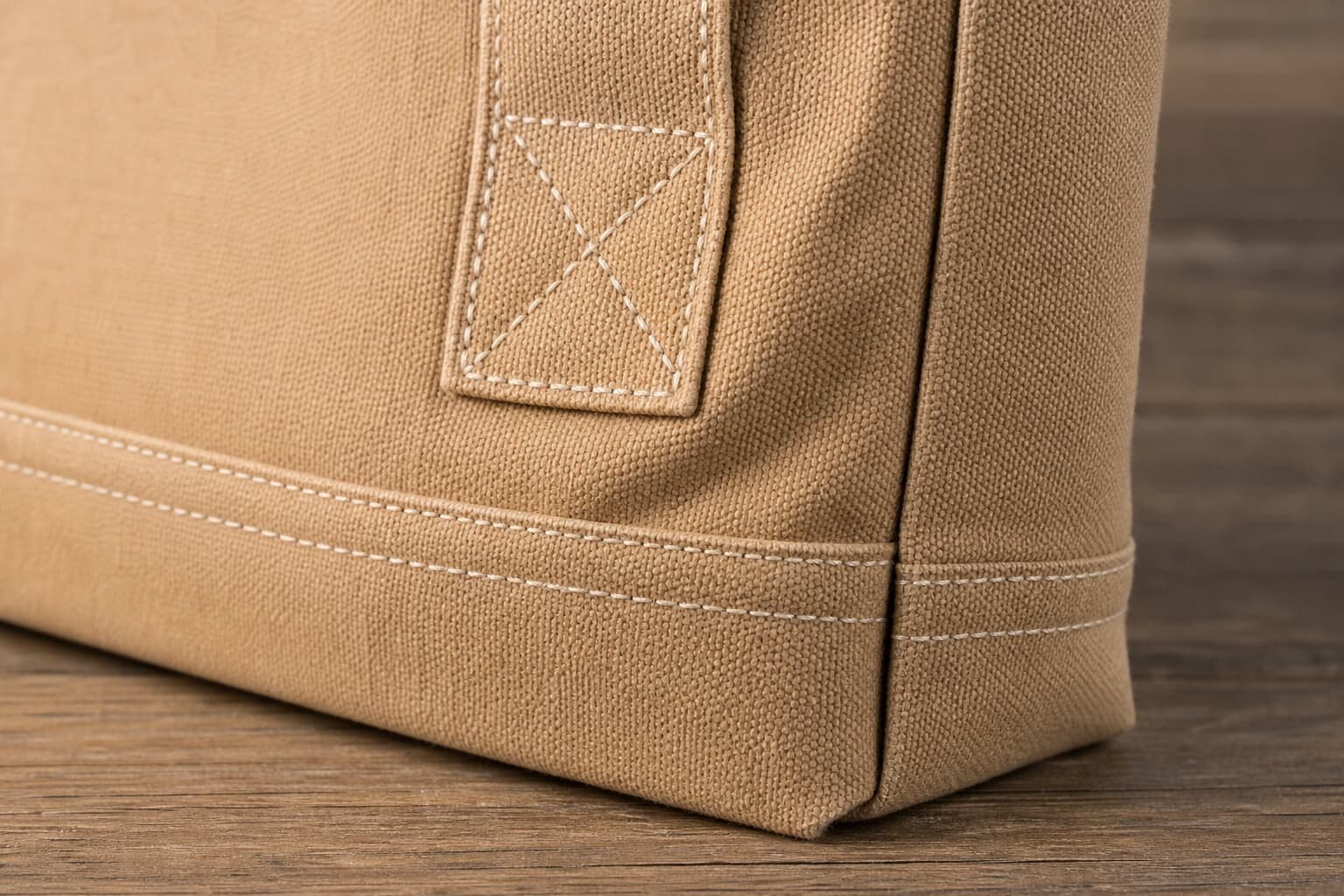
The same is true for handles, seams, and finishing. A simple cotton web handle with reinforced stitching is usually the safest retail choice because it balances cost and wear. If the supplier proposes self-fabric handles or extra trim, ask what that does to labor time and line efficiency. More decoration is not automatically better. In tote production, every change in construction should be tested against the quote and the retail use case.
- Check whether the body fabric and handle fabric are the same or different.
- Confirm if the tote is fully stitched, folded, or boxed at the base and side seams.
- Ask for one approved sample with the same build, not a similar bag from another program.
Choose the Print Method the Quote Is Really Pricing
Print cost is where many startup quotes become misleading. A one-color screen print and a multi-color transfer print may look similar in an email, but the production logic is completely different. Screen print is usually the cleaner choice when the artwork is simple, the quantity is stable, and the brand wants a true fabric feel. Transfer methods can help with small runs or more detailed art, but they may add a surface layer, durability risk, or extra labor cost that should be visible in the quote.
Ask the factory to spell out the print area, color count, and setup assumption. A logo on one side is not the same as a double-sided print, and a 12 cm mark is not the same as a full-front art panel. If the supplier gives one price without specifying screen count or transfer size, the quote is not complete enough for a procurement decision. For startup brands especially, a clear print specification is what stops the first reorder from becoming a redesign.
- Request print method, artwork size, and color count in writing.
- Confirm whether the quote includes screen charges, plate charges, or transfer setup.
- Ask for a strike-off or printed sample before bulk approval when the artwork is sensitive.
Read MOQ Logic as a Cost Formula, Not a Negotiation Game
MOQ on a retail canvas tote is usually driven by fabric procurement, cutting efficiency, printing setup, and packing labor. Suppliers often quote a lower unit price at higher quantity because the fixed costs spread out, not because the bag suddenly becomes cheaper to make in a magical sense. That is why a low-MOQ quote can look expensive on paper even when it is fair. The real task is to understand where the price breaks sit and whether your launch volume justifies them.
For startup brands, it helps to ask for separate pricing bands. For example, request pricing at sample quantity, pilot quantity, first retail run, and reorder quantity. That lets you see whether the supplier is using MOQ to manage risk or to protect margin aggressively. If the MOQ jumps only because of one print color or one special label, you can often simplify the spec and get back to a manageable launch quantity without weakening the product.
- Ask for price breaks at 300, 500, 1,000, and 3,000 units if your project is uncertain.
- Confirm whether MOQ applies per color, per artwork, or per shipment.
- Check whether the factory can combine colors into one production run without changing the unit price.
Use Sample Checks to Protect the Quote Before Bulk
A sample is not just a nice-to-have. It is the first physical proof that the quote matches the production reality. For a retail canvas tote, check the hand feel, bag structure, handle security, print opacity, and the way the bag stands when filled. A sample that looks acceptable on a bench can still fail in retail if the opening collapses, the print looks uneven under store lighting, or the handles twist after a few carries.
Ask for the sample type that matches your risk level. A blank sample is useful for shape and construction. A printed sample is necessary when artwork and color are part of the retail value. A pre-production sample is the final gate before bulk, especially if the order has custom labels, special packing, or a strict retail due date. Never let a supplier treat a rough sample as approval for bulk if the final spec still has unresolved details.
- Measure finished width, height, gusset, and handle drop on the sample.
- Check print alignment, ink coverage, and rubbing resistance.
- Open and close the tote repeatedly to see whether seams distort or handles shift.
Quote the Packing as Hard as You Quote the Bag
Packing can quietly change the economics of a tote program. A retail canvas tote may look simple, but the factory still needs to decide whether it goes flat packed, folded with tissue, polybagged, stickered, tagged, or carton-packed by dozen or by inner pack. If your retail channel depends on shelf appearance, barcode scanning, or e-commerce fulfillment, the packing method is part of the product spec, not an afterthought.
The same is true for carton data. A buyer who ignores carton size may get a unit price that looks fine but ships badly. Large cartons may waste freight space; overly compressed cartons can crease the bag or distort the print. Ask for outer carton dimensions, gross weight, net weight, and carton count per order so you can estimate landed cost with real numbers instead of guessing.
- Confirm whether each tote is folded with a board or packed loose.
- Ask if the factory can apply barcode stickers or retail hangtags before carton closing.
- Request carton dimensions and count so freight quoting is accurate.
Look at Lead Time by Stage, Not as One Blind Date
Lead time for a retail tote is usually a chain of smaller steps: sample approval, fabric sourcing, printing setup, cutting and sewing, finishing, packing, and final inspection. When a supplier says four weeks, the question is not whether that number sounds good. The question is what starts the clock and what can stop it. If artwork approval is late, or if the factory has to source a special color canvas, the schedule can move quickly from plausible to painful.
A good quote breaks lead time into clear stages. That helps startup brands plan marketing, retail launch, and replenishment without overpromising. Ask the factory whether the timeline changes for printed versus blank stock, whether color matching requires extra time, and whether the quoted delivery window assumes no artwork revision. The more specific the timing is, the easier it is to trust.
- Ask for separate timing for sample, approval, bulk production, and shipping.
- Clarify whether the lead time is working days or calendar days.
- Confirm whether reorder timing shortens if fabric and trims are already in stock.
Compare Quotes by Line Item, Not by Emotion
The cleanest way to compare suppliers is to divide the quote into visible cost layers. First is the base bag: fabric, cutting, sewing, and standard finishing. Next is decoration: screens, transfers, embroidery, labels, or woven side tags. Then comes packing: polybags, inserts, barcode labels, and carton marks. Finally, you have commercial terms such as tooling, sample reimbursement, payment timing, and freight. When those items are separated, the true difference between suppliers becomes obvious.
This is also where hidden quote gaps show up. One factory may include the label but exclude the print setup. Another may include unit price but not carton packing. A third may quote a lower tote cost and recover margin through handling fees or freight assumptions. For a startup brand, the right buying instinct is to ask where each missing line item lives, not to assume the cheapest quote is the best one.
- Compare every quote against the same bill of materials.
- Mark each excluded cost before you approve the supplier.
- Do not let freight, packaging, or label costs hide inside the word optional.
Avoid the Production Mistakes That Hurt Retail Buyers Most
The most expensive mistakes on tote orders are rarely dramatic. They are the small mismatches that become visible only after cartons arrive. Fabric is lighter than expected, print coverage is patchy, handle length is inconsistent, or the bag does not fold neatly for display. These issues are painful because they are entirely predictable once you know where to look. The quote stage should catch them, not the warehouse receiving team.
Startup brands should be especially careful about treating a tote like a simple commodity. Retail buyers need a repeatable item that looks the same every time it is reordered. That means writing a spec that covers fabric weight, seam construction, print area, packing, and acceptance criteria. A supplier can only price a product precisely if the product is defined precisely. That sounds obvious, but it is the part that gets skipped most often.
- Do not approve a quote that uses vague terms like premium canvas without a weight.
- Do not accept sample approval if the sample lacks the final print, label, or packing method.
- Do not rely on a supplier verbal promise when the line item is missing from the written quote.
Specification comparison for buyers
| Spec decision | Recommended option | When it fits | Buyer risk to check |
|---|---|---|---|
| Fabric weight | 8 oz to 10 oz canvas | Retail starter programs, lower landed cost, lighter hand feel | Check if the cloth becomes too sheer after dyeing, washing, or dark print coverage |
| Premium feel | 12 oz canvas or heavier | Brand launches, boutique retail, repeat-use positioning | Confirm whether weight changes handle strength, sewing speed, and quote price |
| Print method | 1-color screen print | Simple logo, large volume, controlled artwork | Watch for extra screens, flash curing, and setup charges on repeat colors |
| High-detail artwork | Heat transfer or digital transfer | Small logo runs, multi-color art, low MOQ testing | Ask about durability, wash resistance, and whether the finish feels plastic on canvas |
| Construction | Self-fabric or cotton web handles with reinforced stitching | Retail totes that need to survive daily carry and shelf inspection | Check handle length, stitch count, and whether stress points are bar-tacked or only sewn once |
Buyer checklist before sampling
- Confirm target fabric weight in gsm or oz, not just the word canvas
- Lock the tote size, seam allowance, handle length, and finished handle drop
- Approve print method, print area, ink color count, and artwork format
- Ask for a sample from the same fabric and construction method as bulk
- Request carton count, polybag requirement, and barcode or hangtag placement
- Check whether the quote includes tooling, screens, plates, and freight to the named port
- Verify lead time separately for sample, lab dip or strike-off, and bulk production
- Compare no less than two quotes on the same spec sheet, not on email summaries
Factory quote questions to send
- What exact fabric weight, yarn count, and finishing are included in this price?
- Does the unit price include one print location, setup, and all color charges?
- What is the MOQ by color and by artwork version?
- Which sample type will you supply before bulk: blank sample, printed sample, or pre-production sample?
- What carton size, inner packing, and outer master carton count are included?
- What is the expected lead time after sample approval and deposit?
- Which tolerance do you allow for size, stitching, and print placement?
- What charges are excluded from the quote, such as hangtags, labels, barcode stickers, or freight?
- Can you confirm whether the quote is based on raw fabric weight before washing or finished fabric weight after treatment?
- What happens to the price if I change handle length, print size, or carton count after approval?
Quality-control points to confirm
- Fabric weight matches the approved specification within the agreed tolerance
- Canvas surface is even, with no thin areas, slubs, stains, oil marks, or weave gaps that affect retail appearance
- Seams are straight, secure, and reinforced at handle stress points
- Handle length and drop are consistent across cartons and match the buyer spec
- Print registration, ink density, and edge sharpness match the approved sample
- Bag dimensions, gusset depth, and finished opening width are within tolerance
- Labels, hangtags, barcodes, and care marks are placed exactly where required
- Carton packing matches the order sheet, with correct quantity, inner pack method, and carton mark details