1. Why Startup Brands Need a Different Tote Inspection Plan
A startup brand usually buys retail canvas totes in smaller volumes, but the commercial risk is not small. A weak tote can damage the first customer experience, create refund requests, and make retail buyers hesitate on reorder. The problem is that many first RFQs describe the bag only as “canvas tote with logo,” so suppliers quote different fabrics, different stitch standards, and different packing assumptions. The lowest quote then looks attractive until the received goods feel lighter, print poorly, or arrive with inconsistent finishing.
A useful inspection plan starts before the purchase order. It tells the factory what the product must do, what defects are unacceptable, and how the buyer will judge the shipment. For retail canvas totes, quality is not only about whether the bag looks nice in a photo. It includes fabric weight, handle strength, logo durability, seam finishing, dimensional consistency, folding, carton packing, and odor control. These details decide whether the tote can be sold at retail price or only used as a low-value giveaway.
- If the tote is sold as merchandise, inspect for appearance, structure, and repeat-use durability.
- If the tote is gift-with-purchase, inspect for brand presentation, clean print, and packing efficiency.
- If the tote carries another product, inspect load strength, size tolerance, and carton allocation.
- If the order has multiple colors or designs, inspect SKU separation and carton labeling more strictly.
2. Set the Retail Standard Before Asking for Quotes
The most common sourcing mistake is asking five factories for a quote without fixing the retail standard first. One supplier may quote 8 oz cotton, another may quote 12 oz canvas, and a third may quote a blended fabric with a similar appearance. The price gap is then not a true supplier comparison. For startup brands, the RFQ should define the buyer’s minimum acceptable product, not just the desired look.
For a retail tote, a practical middle standard is often 10 oz to 12 oz cotton canvas, approximately 280 to 340 GSM, with a folded top hem, reinforced handles, and a logo process tested on actual fabric. This does not mean every brand must choose this weight. A beauty brand selling lightweight accessories may accept 8 oz. A bookstore or grocery lifestyle brand may need 12 oz or heavier. The point is to name the use case and make suppliers quote the same construction.
- State bag size in finished dimensions, such as width x height x bottom gusset, not only flat cut size.
- State handle drop and handle width, because comfort and carrying capacity depend on both.
- State fabric as cotton canvas with oz and GSM, not only “cotton bag.”
- State whether natural specks, slubs, and shade variation are acceptable for the brand look.
- State whether the tote must stand more structured or can have a soft, foldable hand feel.
3. Fabric Weight, GSM, and Hand Feel Inspection
Canvas tote quality starts with fabric. GSM is measurable, but hand feel also matters because weave tightness, yarn count, finishing, and washing can make two fabrics with similar GSM feel different. A 10 oz canvas from one mill can feel tighter and smoother than another 10 oz canvas with more open weave. If your brand sells online, the customer cannot touch the tote before purchase, so product photos and actual hand feel must match expectations when the parcel arrives.
Ask for a fabric swatch before sample approval and keep it as the control standard. During final inspection, the inspector should compare the bulk bags to the approved sample and, where possible, cut and weigh a fabric piece to verify approximate GSM. Natural cotton canvas can have small seed specks and minor slubs, but oil marks, mold spots, heavy shade bands, dirty fold lines, and inconsistent dye lots should be treated as defects. Dyed canvas requires additional color consistency checks under stable light.
- 6 oz to 8 oz: suitable for low-cost campaigns, inserts, and lightweight giveaways.
- 10 oz to 12 oz: common for retail merchandise and startup brand launch totes.
- 14 oz to 16 oz: stronger retail feel but higher cost, bulk, sewing difficulty, and freight volume.
- Natural canvas: check acceptable specks and shade range before production.
- Black or dark dyed canvas: check crocking risk, lint visibility, and print opacity.
4. Print Method Checks: Logo Quality Is Not Only Artwork Approval
For most startup retail totes, screen printing is still the practical choice for clean logos, slogans, and simple graphics. It is economical for repeat orders, works well on cotton canvas, and gives stable results if the artwork, mesh, ink, and curing are controlled. The inspection risk is that canvas texture can reduce edge sharpness, absorb ink unevenly, or create pinholes in large solid areas. Fine serif text, small QR codes, and thin lines need test printing before committing to bulk.
Digital print, DTF transfer, heat transfer, and embroidery can also be used, but each creates different inspection points. Digital print may show color shift on natural fabric. DTF can have a different hand feel and visible film edge. Embroidery adds premium texture but may pucker light fabric and costs more for large designs. Your approved sample should use the final print method, final fabric, final logo size, and final placement. A photo of a print strike-off is useful, but it is not a substitute for a physical sample.
- For screen print: check ink opacity, edge sharpness, registration, curing, and rubbing resistance.
- For DTF or transfer: check film edge, cracking after folding, hand feel, and adhesion.
- For digital print: check color shift, banding, and wash or rub performance.
- For embroidery: check backing, thread tension, puckering, needle holes, and reverse-side finish.
- For dark canvas: confirm whether an underbase is included in the quote.
5. Sewing, Handle Strength, and Construction Defects
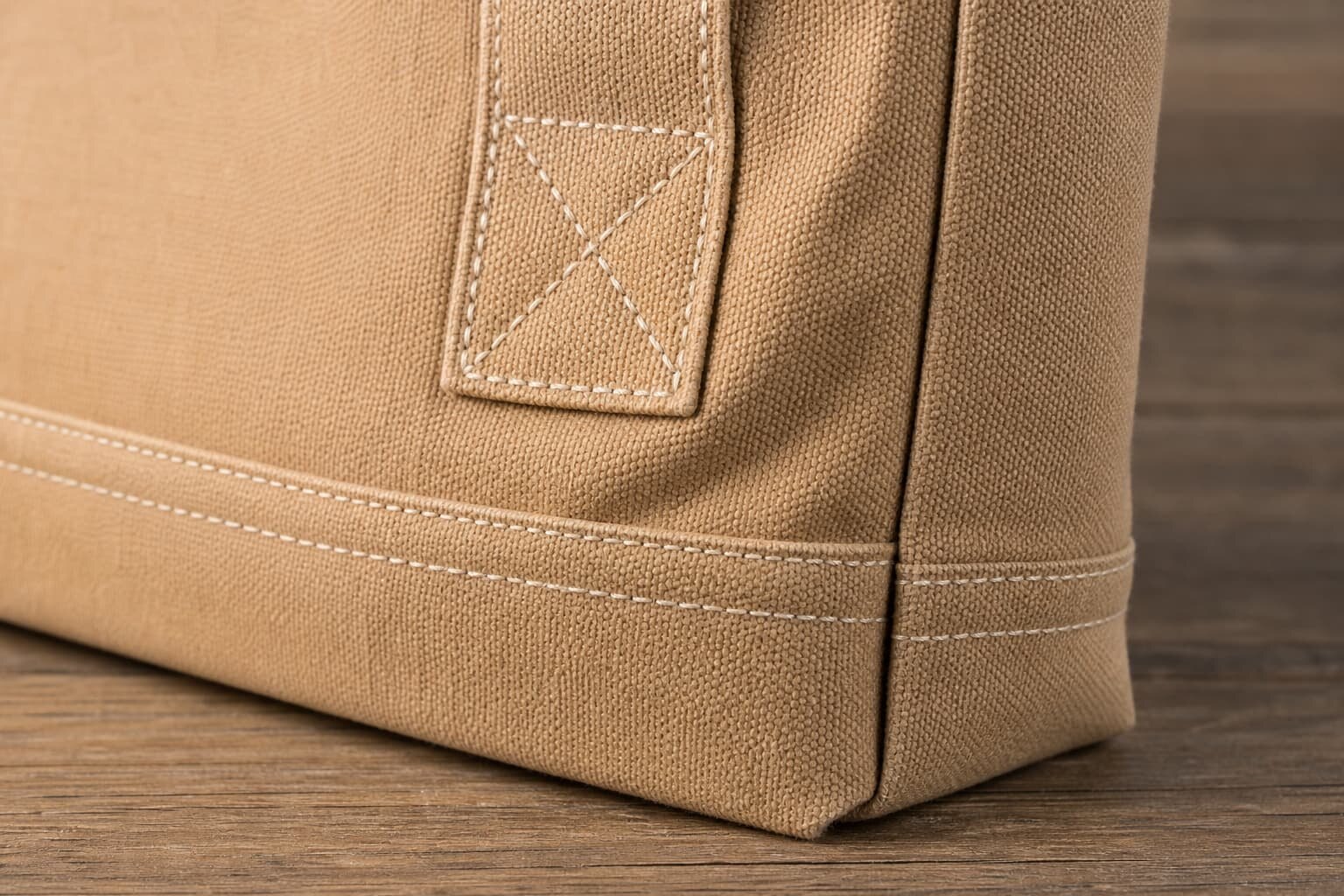
Retail buyers often judge tote quality by the first things they touch: handles, top hem, and side seams. A tote can use good fabric but still fail because the handle reinforcement is weak or the stitching is loose. For daily-use retail totes, box-X reinforcement or a clear cross-stitch pattern at the handle joint is safer than a single row hidden inside the hem. Stitch density should be consistent, and the seam allowance should be sufficient to prevent fraying under load.
Inspection should include both visual review and a practical strength check. The exact load test depends on the intended use, but the buyer should tell the factory what the tote is expected to carry. A bag designed for apparel packaging does not need the same strength as a tote promoted for books, groceries, or laptops. If the quote does not define construction, suppliers may reduce sewing time by using fewer reinforcement stitches, narrower handles, or a smaller seam allowance.
- Check handle drop with the bag laid flat and compare it to the approved sample.
- Check that both handles are the same length and are not twisted.
- Inspect top hem stitching for straightness, skipped stitches, and thread tension.
- Look inside the bag for open seams, loose overlock threads, and raw fabric edges.
- Perform a reasonable pull and load test on samples from different cartons, not only the top carton.
6. Sample Approval: What the Pre-Production Sample Must Prove
A pre-production sample is not just a sales sample. It is the control document for the order. It should prove that the factory understands your fabric, dimensions, logo process, construction, finishing, and packing. If the sample is made from similar leftover fabric or printed by a different workshop, it can mislead the buyer. For first orders, it is better to spend time on one correct sample than to rush into bulk production with assumptions.
Keep one approved sample with the buyer and one sealed reference sample with the factory. Mark the approval date, version number, fabric weight, print method, and any accepted deviations. If the sample has a minor issue that will be corrected in production, write that correction clearly. Do not approve a sample verbally with a message such as “looks okay, please improve in bulk.” That type of approval creates arguments later because the factory may treat the sample as accepted quality.
- Measure finished width, height, gusset, handle width, and handle drop.
- Compare fabric weight and hand feel to the swatch approved for quoting.
- Check logo placement from top edge, side edge, and bottom seam using a ruler.
- Fold and rub the printed area to see if cracking, dusting, or tackiness appears.
- Check inside seam finishing and trimming, not only the front view.
- Approve the actual folding and packing method if retail presentation matters.
7. MOQ Logic and How It Affects Inspection Risk
MOQ for canvas totes is not only a factory preference. It is connected to fabric purchasing, dyeing, cutting efficiency, print setup, sewing line arrangement, and packing labor. A factory may accept a low MOQ for natural canvas with one-color screen print because the materials are common and setup is simple. The same factory may require a higher MOQ for custom dyed fabric, heavy canvas, multiple logo colors, embroidery, custom labels, or many small SKU splits.
Startup brands often want several colors or designs in the first order to test the market. This is understandable, but SKU splitting increases inspection risk. Each fabric color and print design must be checked separately. Cartons must be labeled correctly. If the order includes five small designs, the cost per unit rises and the chance of mixed packing increases. A better first production plan may be one or two core tote styles with tighter inspection, then expand after retail feedback.
- Natural fabric plus one logo normally has simpler MOQ logic than custom dyed fabric.
- Multiple print artworks require separate screens, setup checks, and inspection records.
- Embroidery MOQ may depend on thread colors, machine setup, and logo size.
- Custom woven labels, hangtags, or barcodes can create separate accessory MOQs.
- Small split shipments increase carton marking and warehouse receiving risk.
8. Packing and Carton Inspection for Retail Distribution
Packing is part of product quality, especially for startup brands selling through boutiques, ecommerce warehouses, or retail partners. A good tote can arrive looking cheap if it is folded poorly, stained by carton dust, compressed in weak cartons, or mixed with wrong SKUs. Before placing the order, decide whether each tote needs an individual polybag, paper band, belly band, hangtag, barcode sticker, or no individual packaging. Sustainability preferences should be balanced with warehouse handling and moisture protection.
Final inspection should verify packing quantity, carton mark, SKU separation, gross weight, carton strength, and the condition of the folded bags. Natural canvas picks up dirt easily, so packing tables and carton interiors should be clean. If the bags are folded with the print facing outward, check that ink is fully cured and will not transfer. If the bags are packed tightly, check crease marks and whether the retail presentation is still acceptable after unpacking.
- Confirm pieces per inner pack and master carton before carton labels are printed.
- Use carton marks that match the purchase order, SKU, color, and destination warehouse rules.
- Check that barcode labels scan correctly if they are applied at factory.
- Avoid overpacked cartons that deform handles, print areas, or gussets.
- Ask for moisture control if goods ship during humid seasons or long ocean transit.
9. Lead Time Control: Where Quality Problems Usually Start
Lead time should be broken into stages: artwork confirmation, sample making, sample approval, material purchasing, cutting, printing, sewing, trimming, final inspection, packing, and shipment handover. When buyers only ask for one total delivery date, both sides may underestimate the time needed for sample correction or fabric preparation. Startup launches often have fixed campaign dates, so a two-week sample delay can push the whole order into rushed sewing or skipped inspection.
A realistic supplier quote should state what starts the production clock. Many factories count lead time after deposit, artwork approval, and sample approval, not after the first inquiry. If custom dyed canvas, special labels, or retail barcode packing is needed, accessory lead time must be included. Quality problems increase when factories cut inspection time to recover from late artwork, late payment, or late packaging approval.
- Ask for separate timing for sample, bulk material, production, final inspection, and export handover.
- Approve artwork at final size with Pantone or color reference before print screens are made.
- Confirm whether bulk fabric is in stock or must be woven, dyed, or washed.
- Leave inspection time before shipment booking instead of inspecting after the vessel deadline.
- For first orders, request production photos at fabric arrival, printing, sewing, and packing stages.
10. Quote Data That Lets Buyers Compare Suppliers Fairly
A useful tote quote should be detailed enough that procurement can compare factories on the same product. If one supplier includes individual packing, heavier canvas, reinforced handles, and barcode labeling while another quotes a lighter bag in bulk pack, the lower price is not necessarily better. Startup brands need quote transparency because small changes in fabric weight, print method, handle construction, and packing can change both cost and retail value.
Ask suppliers to list assumptions clearly instead of hiding them in a unit price. The quote should identify fabric weight, bag size, handle size, logo size, print colors, MOQ, sample terms, packing, carton quantity, lead time, and validity period. If the supplier offers alternatives, ask them to explain the quality tradeoff, not only the price difference. This helps the buyer decide where to save cost without damaging the retail product.
- Fabric: composition, oz, GSM, color, finishing, and whether bulk swatch approval is included.
- Construction: finished size, gusset, handle material, handle reinforcement, seam type, and stitch density.
- Branding: print method, number of colors, logo size, print position, label, hangtag, and barcode.
- Commercials: MOQ per style and color, sample fee, tooling or screen cost, payment terms, and quote validity.
- Logistics: pieces per carton, carton dimensions, gross weight, packing material, and delivery term.
- Quality: sample approval process, inspection standard, tolerance, defect handling, and replacement policy.
Specification comparison for buyers
| Spec decision | Recommended option | When it fits | Buyer risk to check |
|---|---|---|---|
| Fabric weight for retail tote | 10 oz to 12 oz cotton canvas, roughly 280-340 GSM | Paid retail, brand merchandise, bookstore, boutique, and subscription kit bags | Supplier may quote lighter plain cotton or blended fabric unless GSM, weave, and shrinkage are confirmed |
| Budget promotional tote | 6 oz to 8 oz cotton canvas, roughly 180-240 GSM | Giveaways, launch events, lightweight inserts, short-term campaigns | May feel too thin for retail pricing and may show dark contents through natural fabric |
| Premium structured tote | 14 oz to 16 oz canvas, roughly 400-500 GSM | Higher retail price point, heavy daily use, limited-edition brand drop | Higher unit cost, bulkier carton volume, longer sewing time, and possible print cracking if ink is not adjusted |
| Logo printing | Screen print with water-based or plastisol ink depending on color coverage | Most one to three color logos and repeat retail production | Poor ink curing, uneven opacity, and registration shift on textured canvas |
| Full-color artwork | DTF transfer or digital print after testing on canvas | Gradients, photographic artwork, small batches, or many SKUs | Hand feel, wash durability, edge mark, and color shift must be checked on an actual fabric sample |
| Handle construction | Self-fabric handles with box-X reinforcement or cross stitch | Retail bags expected to carry books, groceries, apparel, or daily items | Handle tearing is common when reinforcement size, stitch density, or load test is not defined |
| Inside finishing | Overlock seam plus folded top hem | Standard retail tote with clean appearance and controlled fraying | Loose threads and skipped stitches increase if seam allowance and trimming are not inspected |
| Packing method | Individual polybag or paper band plus export carton with carton mark | Retail distribution, warehouse receiving, or direct-to-store allocation | Creases, moisture, mixed colors, and wrong carton quantities create downstream sorting cost |
Buyer checklist before sampling
- Confirm exact fabric description: cotton canvas, weight in oz and GSM, weave style, natural or dyed, and whether fabric is pre-shrunk or washed.
- Approve a physical pre-production sample made with the correct fabric, handle length, logo size, print method, seam construction, and packing method.
- Set measurable tolerances for bag size, handle drop, logo position, print color, stitch density, carton quantity, and acceptable fabric defects.
- Ask the factory to separate sample approval, bulk fabric inspection, inline sewing inspection, printing inspection, and final random inspection.
- Check that the supplier quote includes fabric weight, print process, number of colors, MOQ per colorway, sample fee logic, packing, carton size, lead time, and payment terms.
- Request production photos during cutting, printing, sewing, trimming, packing, and carton sealing for first orders or tight launch schedules.
- Define whether the tote is for retail sale, gift-with-purchase, event giveaway, or product packaging because acceptable feel and durability are different.
- Review shipping carton strength, moisture protection, and folding style before approving the packing standard.
Factory quote questions to send
- What exact canvas weight are you quoting in oz and GSM, and can you provide a fabric swatch from the same source used for bulk production?
- Is the quoted fabric 100% cotton canvas, recycled cotton blend, organic cotton, or mixed composition, and how is composition verified?
- What is your MOQ per bag size, per fabric color, and per print design, and what changes if we split the order across several SKUs?
- Which print method do you recommend for our artwork and fabric weight, and what are the limitations for fine lines, large ink coverage, and wash resistance?
- Can the pre-production sample be made with bulk fabric and the final logo process, not only a similar blank tote?
- What stitch type, stitch density, handle reinforcement, and seam allowance will be used for the retail tote?
- What are your normal tolerances for bag dimensions, handle drop, logo placement, and color difference, and can these be written into the order confirmation?
- How do you inspect fabric defects, printing defects, sewing defects, thread trimming, odor, stains, metal contamination, and packing quantity before shipment?
- What packing is included in the quote: individual bag, hangtag, barcode label, inner carton, master carton, carton mark, and pallet requirement?
- What is the realistic lead time for sample, material purchasing, printing, sewing, final inspection, and shipment handover after artwork and deposit approval?
Quality-control points to confirm
- Fabric GSM and hand feel match the approved sample, not only the quote sheet.
- Bag dimensions and handle drop are measured after sewing and after any washing process.
- Logo size, color, placement, registration, and curing are checked against the approved artwork and sample.
- Handle attachment uses agreed reinforcement and passes a practical load pull test suitable for the intended retail use.
- Seams are straight, stitch density is consistent, and there are no skipped stitches, broken threads, or open seams.
- Natural canvas has controlled slubs and shade variation within the approved standard, with no oil stains, mold spots, or dirty marks.
- Trimming is clean, loose threads are removed, and inside seams do not fray excessively.
- Packing quantity, SKU separation, barcode labels, carton marks, and carton condition match the purchase order.