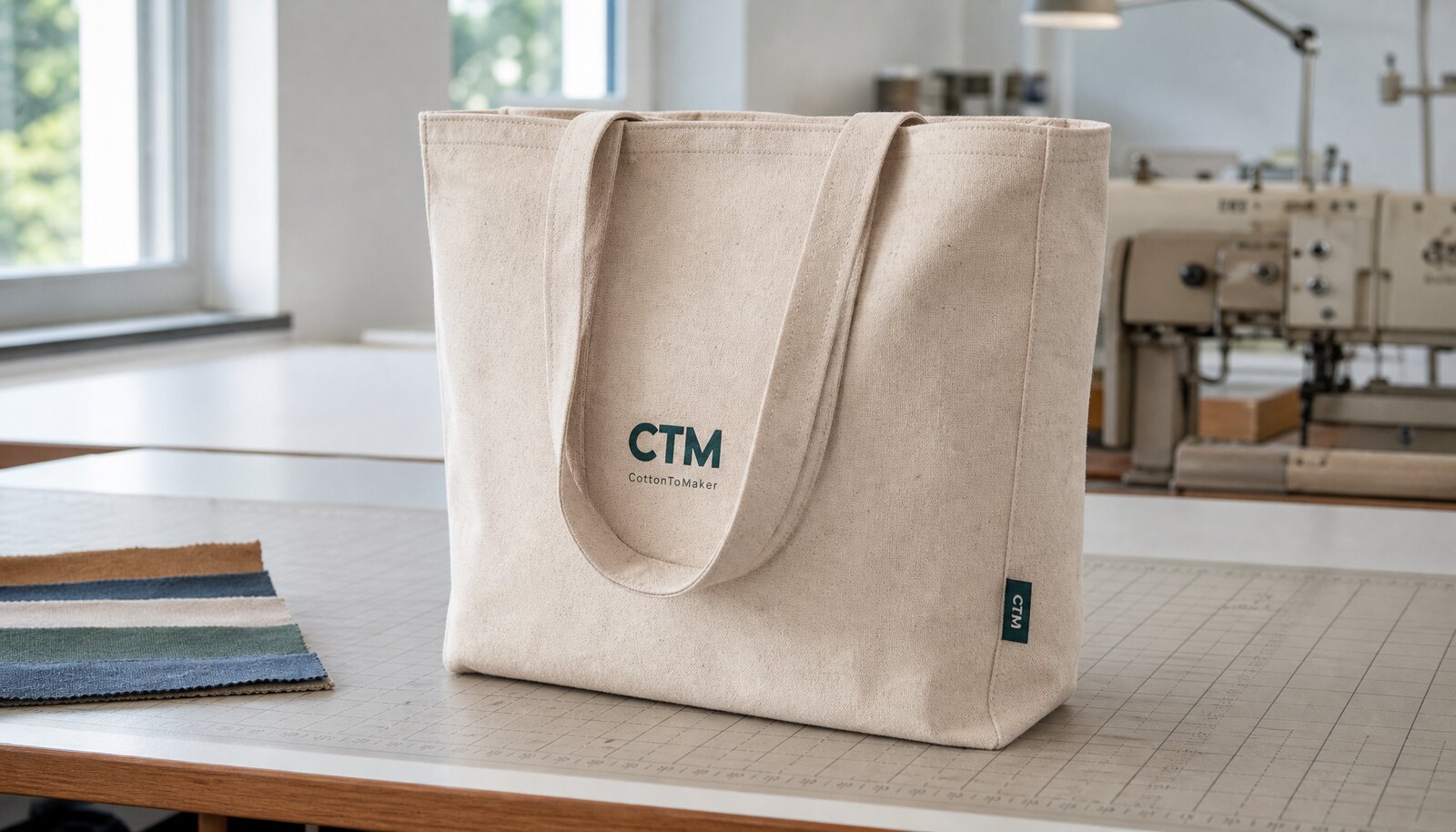
What a wellness brand is really buying when it orders a recycled canvas tote
For a wellness brand, a recycled canvas tote is not just a promotional item. It is a visible packaging extension that may carry retail purchases, sample kits, event materials, staff kits, or subscription add-ons. That means the buying decision is not only about price per unit. It is about how the tote represents the brand in hand, how often it will be reused, and whether it will still look intentional after it has been filled, folded, and carried several times.
Procurement teams should treat the tote as a packaged product with a spec, a claim, and a quality standard. If the tote will sit on a retail shelf, the finish and visual consistency matter. If it will live in a conference bag or wellness kit, the load performance matters more. If the brand plans to call out recycled content, the documentation behind that claim matters just as much as the fabric itself. The right purchase starts by separating these outcomes instead of asking for a generic “eco tote” quote.
This guide is written for buyers who need a practical wholesale decision path: what to specify, what to verify, what to compare, and what to reject before bulk production starts. A good sample photo is not enough. You need a brief the supplier can build from, a quote you can audit, and a QC plan that catches problems before they become inventory write-offs.
- Start with use case: retail, event, kit, or daily carry.
- Treat sustainability claims as part of the spec package, not as marketing copy.
- Buy for repeat use, not for a single unboxing image.
Set the tote performance target before you compare factory pricing
The fastest way to misread quotes is to compare bags that are not actually the same product. A 10 oz recycled canvas tote, a 12 oz tote, and a 14 oz tote may all look similar in a supplier PDF, but they behave very differently in use. A lighter tote can be acceptable for flyers, skincare samples, or low-weight event handouts. A heavier tote is usually the safer choice when the bag is expected to hold bottles, jars, books, or multiple wellness products without collapsing.
For most wellness brands, 12 oz to 14 oz recycled canvas is the commercial sweet spot when the tote is intended to feel premium and survive repeated use. That range generally gives a better balance of structure, print stability, and perceived quality than thinner fabric. If the product is meant to feel more substantial or carry heavier contents, 14 oz can justify the extra material cost. If budget is the main constraint and the tote will not carry much weight, 10 oz may be acceptable, but the buyer should accept the tradeoff: more drape, more wrinkling, and less shelf structure.
Do not stop at oz weight alone. Ask for GSM, weave density, and a tolerance range. Ask whether the fabric is recycled cotton, a recycled blend, or a recycled-content canvas with a specific percentage basis. Ask how the material behaves after steam pressing or a wash-like finishing step, because some canvas shrinks or softens more than expected. Buyers who lock this early avoid the common problem of discovering that the ‘same’ tote from two factories differs in hand feel, shrinkage, and print clarity.
- Use the same fabric weight across all supplier quotes.
- Request GSM/oz plus tolerance, not a single number with no range.
- Ask for a swatch from the actual production material, not a generic archive sample.
Recycled-content claims need documentation, not just a product description
A recycled canvas tote can only support a serious wellness-brand claim if the documentation is aligned with the statement you plan to make. Some suppliers use broad catalog language that sounds compliant but does not tell you what is recycled, how much is recycled, or how the percentage is calculated. Procurement should ask for the exact claim wording in advance and ask the supplier what evidence they can provide to support that wording. If you are labeling the tote or listing it in a retailer product file, that evidence matters.
A practical documentation request list is simple: written composition statement, recycled-content basis, relevant mill or material paperwork, invoice trail or transaction reference if available, and any third-party certification the supplier can legitimately provide for the material route. If your organization has legal or retailer review, ask whether the claim is for pre-consumer recycled cotton, post-consumer content, or a blend. Those are not interchangeable in buyer review, even if the bag looks the same.
You should also define what you will not accept. For example, do not rely on “eco-friendly” language alone, and do not accept a recycled claim if the supplier cannot identify whether the content is measured by weight of the textile, by component, or by a broader product basis. If the tote will be sold through wholesale channels, this is where procurement protects the brand from later rework, relabeling, or rejected vendor onboarding. The safest rule is straightforward: if the claim cannot be documented, it is not ready for packaging or sales copy.
- Request the exact recycled-content basis in writing.
- Ask whether the content is pre-consumer, post-consumer, or a verified blend.
- Collect claim support before bulk production, not after shipment.
Choose the fabric construction and seam type for the load the tote must carry
Once weight and claim basis are set, the next decision is construction. Canvas bags are often sold as if they are simple, but the seam structure changes how long the tote survives real use. A single-needle side seam can be adequate for light promotional bags, but for heavier wellness bundles it can be too fragile if the buyer loads bottles or boxed products repeatedly. A double-needle side seam, a bound seam, or a turned/French seam provides a cleaner and more durable result, though each raises sewing complexity and cost.
Handle construction matters just as much. Self-fabric handles create a unified look, which works well for a clean retail aesthetic, but they can twist if the cutting or folding is inconsistent. Webbing handles are stronger and often more stable under pull, but they can read more utilitarian unless color-matched carefully. Buyers should also ask whether the handle attachment is a simple top stitch, a box stitch, or a box-X reinforcement. For a wellness brand that expects daily reuse, reinforcement is not decorative; it is the difference between a tote that feels premium and one that fails at the first heavy load.
A procurement-ready spec should include stitch density, seam allowance, and reinforcement points. A practical target for visible sewing on canvas is usually a consistent stitches-per-inch range rather than a vague instruction like “strong stitching.” If the supplier cannot state the seam type, cannot show where the bartacks are placed, or cannot explain how the handle is anchored, the buyer does not yet have a quote they can trust. Construction details are where low-cost bags quietly become high-risk bags.
- Specify seam type: single-needle, double-needle, bound seam, or turned seam.
- Ask where the handle is reinforced and what stitch pattern is used.
- Use stitch density and seam allowance as part of the purchase spec.
Pick a decoration method that fits the logo, the hand feel, and the wear cycle
Decoration should follow the artwork and use environment, not the other way around. For many wellness brands, a one- or two-color screen print is still the most economical and reliable route. It reads clearly on textured canvas, works well for repeat orders, and is easy to control if the artwork is simple. The buyer should still define print placement, Pantone targets, and acceptable registration drift so the first batch does not become a visual mismatch from the approved sample.
When the brand wants a more elevated or tactile result, a woven label, stitched patch, or embroidery patch can work better than a print-heavy solution. Those methods can feel more premium and may tolerate repeated handling more gracefully than a delicate print. But they add their own risks: label curl, stitch distortion, edge fray, patch bulk, and extra labor. A procurement team should compare the visual effect against the production complexity, because the decoration method influences not only aesthetics but also lead time and defect potential.
The main failure mode on canvas decoration is not total print failure; it is subtle inconsistency. Fine text can disappear into the weave, light ink can look patchy on darker canvas, and centered artwork can drift enough to look amateur. Buyers should ask for a strike-off or pre-production sample on the actual material. If the tote will be packed flat and handled repeatedly, also ask how the decoration behaves after folding. A logo that looks clean on a table may crease or crack in cartons if the ink system or patch placement is wrong.
- Use screen print for simple, repeatable branding.
- Use labels or patches if a softer, premium presentation matters more than the lowest cost.
- Approve artwork on the real fabric, not only on a digital mockup.
Write an RFQ that forces a true apples-to-apples comparison
A strong RFQ prevents most pricing confusion. If one supplier quotes a 10 oz blank tote and another quotes a 12 oz printed tote with a woven label and retail packing, the prices cannot be compared. The request for quote should specify the finished size, body dimensions, gusset depth, handle length, seam type, reinforcement method, decoration process, packing format, carton count, and recycled-content wording. The more exact the RFQ, the less room there is for a supplier to win business by assuming a cheaper product than the one you actually need.
Include a simple drawing or tech pack, even if the project is straightforward. Front, side, and handle views help factories quote the same geometry. If your logo has minimum line widths or requires Pantone matching, state that too. If the tote must fit into a retail hanger, shelf tray, or subscription box, say so. A good RFQ also names what the supplier should break out separately: fabric, cutting, sewing, decoration, labels, setup charges, packing, and carton work. That visibility allows procurement to see whether the apparent savings are real or only hidden in a different line item.
For wellness brands, packing can be a silent margin trap. A quote that assumes loose carton packing may be cheaper than a retail-ready pack, but the local warehouse may spend more to relabel and repack later. Ask suppliers to quote blank, decorated, and packed versions separately if necessary. That makes the commercial tradeoff visible before you approve bulk.
- Attach a dimension sketch or tech pack to every RFQ.
- Ask for separate line items for setup, labels, packing, and cartons.
- Quote the exact same tote spec to every supplier route.
Compare supplier routes by control, not only by price
The best sourcing route depends on how much control you need and how repeatable the program must be. A direct factory can offer the strongest control over fabric, sewing, printing, and packing, but only if those processes are truly in-house. A trading company can be useful when the buyer needs multi-category support or faster communication across several factories, though the buyer must verify who is actually making the bag. A domestic decorator can support urgent launches or small replenishment runs, but the blank tote may come from a different source and may not match the exact recycled-content story you want to tell.
When comparing routes, ask the same operational questions in each case. Who owns cutting? Who controls print screens or patches? Who signs off on carton packing? Who is responsible for defect correction if the tote arrives with misaligned handles or wrong carton counts? These questions matter because a low unit price is not useful if responsibility is fragmented across three vendors. In procurement terms, fewer handoffs usually means fewer hidden quality gaps.
For recurring wellness programs, direct factory sourcing often makes the most sense because repeat orders depend on consistency. For test orders or seasonal drops, a domestic route may be justified if speed outweighs depth of customization. The key is not to declare one route superior in all cases. The key is to understand which supplier model matches your demand pattern, quality expectations, and documentation burden.
- Verify process ownership: cutting, sewing, printing, packing.
- Ask for the name and location of the actual production site.
- Choose the route that best matches repeatability, not the one with the prettiest quote.
Use samples to test measurable fit, finish, and failure modes
A sample is only useful if it tests the things that can break in production. The approval sample should confirm more than appearance. It should confirm body dimensions, gusset depth, handle length, handle drop, stitch quality, print placement, and how the tote folds for packing. If the sample looks good but no one measured it, the bulk order can still fail on scale variation or sloppy finishing. Buyers should approve against a short list of measurable criteria, not a general impression that the tote feels premium.
Practical acceptance criteria are easy to define. Set the acceptable dimensional range, define the maximum allowed print shift from center or edge, and note whether minor canvas slub is acceptable or not. If the tote is meant for retail, inspect the sample under the same lighting that your buyer or store team will use. If the tote is meant for heavier contents, load it with product or dummy weight and observe seam stress, handle twist, and bottom shape recovery. Many tote problems show up only when the bag is filled.
Also use the sample to evaluate finishing. Are loose threads clipped? Are side seams neat at the top edge? Does the fabric pucker around the handle anchor? Is the print opaque enough on a textured weave? Are there odor issues from finishing, packing, or dye? The sample should answer these questions before you release bulk because once the order is sewn, those problems become expensive to correct.
- Measure the sample, don’t just approve it visually.
- Test the tote under a realistic load.
- Use the sample to judge seam neatness, thread trim, and odor before bulk release.
Set QC standards that a factory inspector can actually follow
QC for a recycled canvas tote should be practical, measurable, and tied to the way the bag will be used. Start with dimensional checks: body width, body height, gusset depth, handle length, and handle drop. Then define the tolerance range in the purchase order so the inspector knows what is acceptable. Without a tolerance, every disagreement becomes subjective. A procurement team can avoid this by stating the exact acceptable variance up front rather than arguing after the cartons are packed.
Next define defect types. Common failures include off-center print, mismatched handle lengths, skipped stitches, crooked bartacks, loose threads, oil stains, dirty folding marks, shade variation across panels, and distorted bags caused by poor pressing or packing. If the tote is intended for retail, visible cosmetic issues matter more than they would on a back-of-house promotional bag. If the tote carries heavier products, seam failures and handle attachment failures matter most. The buyer should weight defect severity to match use case.
A useful practical approach is to request an AQL-based pre-shipment inspection or, at minimum, a clearly defined inspection sample size and defect classification system. The supplier does not need a textbook-quality manual, but they do need a standard. Ask which defects are critical, major, and minor. For example, a broken seam at the handle anchor is critical; a small loose thread might be minor if it can be clipped; an off-center logo may be major if your brand is presentation-sensitive. That clarity protects both parties and reduces last-minute dispute risk.
- Set measurable tolerances for size, placement, and stitch quality.
- Define critical, major, and minor defects before inspection.
- Use an AQL-based pre-shipment check if the order matters to retail or repeat wholesale.
Inspect packing, labeling, and carton performance before goods leave the factory
Packing is not a clerical step; it is part of product quality. A tote that was approved in sample form can arrive wrinkled, overcompressed, or mislabeled if the packing plan is vague. For wellness brands, the packing format should match the channel. Retail programs often need neat folding, barcode labels, and clean carton marks. DTC or fulfillment-center programs may prefer flat packing to reduce warehouse handling and repack labor. The buyer should make the supplier quote the actual packed condition, not just the sewn product.
Master carton details should be specified clearly: carton dimensions, units per carton, gross weight, outer markings, and whether the bags are individually wrapped or banded. If your organization wants a lower-plastic presentation, make that explicit and define the allowed alternative, such as tissue, paper band, or no individual wrap. If the tote needs a hangtag or retail barcode, specify exact placement and format so the factory does not improvise. A mispacked tote can create downstream labor that was never visible in the unit price.
It is also worth asking for a simple carton handling check before shipment. Cartons should close without excessive compression, should not split at the edges, and should maintain legible marks after normal warehouse movement. If the tote is folded too tightly, the canvas can develop sharp crease memory that customers notice on opening. If the carton is overloaded, the tote may arrive crushed or dirty. Good packing protects both presentation and yield.
- Define folded or packed condition, not just finished dimensions.
- Require carton dimensions, count, and gross weight in the quote.
- Check that folding does not damage the presentation or crease the canvas excessively.
Specification comparison for buyers
| Decision area | Options to compare | Best fit / tradeoff | Buyer checks before PO |
|---|---|---|---|
| Supplier route | Direct factory; trading company; domestic decorator with imported blanks | Direct factory is best for repeat programs and control. Trading can help with coordination. Domestic decorating can shorten delivery but may weaken recycled-content consistency. | Confirm the actual maker, who cuts/sews/prints, and who owns QC. Ask for factory name, audit status, and process ownership. |
| Fabric weight | 10 oz; 12 oz; 14 oz; 16 oz | 10 oz works for light event kits. 12–14 oz is the common retail-safe range. 16 oz is stiffer and more premium but heavier and costlier. | Request GSM or oz weight, tolerance, shrinkage after washing/steam, and a swatch from the same lot if possible. |
| Canvas construction | Plain weave recycled canvas; tighter weave; brushed finish | Tighter weave reduces slub and improves print clarity. Brushed finishes can look softer but may fuzz more with use. | Ask for weave count, surface finish, and whether the fabric is post-washed or enzyme-treated. |
| Recycled-content proof | Supplier declaration; traceable mill paperwork; third-party certification if available | A declaration alone is weak. Traceable paperwork or certification is stronger if your customer-facing claims depend on it. | Request claim wording, basis of recycled percentage, supporting docs, and chain-of-custody or transaction records. |
| Seam construction | Single-needle side seam; double-needle side seam; French seam / turned seam; bound seam | Double-needle and bound seams are better for heavier loads. French/turned seams improve a clean interior but increase sewing complexity. | Check seam type, stitch SPI, seam allowance, and whether stress points are bartacked or box-X reinforced. |
| Handle construction | Self-fabric handles; webbing handles; folded handles with reinforcement | Self-fabric looks unified. Webbing adds strength. Folded and reinforced handles reduce twist and improve durability. | Confirm handle width, length, attachment method, stitch pattern, and pull-test expectation. |
| Decoration method | 1–2 color screen print; heat transfer; woven label; embroidery patch; debossed leather-like patch | Screen print is most common for clean logos. Labels and patches read more premium and can be more durable in wear zones. | Ask for Pantone targets, print placement tolerance, opacity, and rub resistance. Check if decoration survives folding. |
| Packing route | Flat-packed; lightly stuffed; banded; with hangtag/barcode; carton-ready retail pack | Flat-packed saves freight and warehouse space. Retail-ready packing reduces local labor but can add supplier cost. | Define folded size, insert material, barcode location, carton count, and whether poly-free or paper-based packing is required. |
| Cost model | FOB unit price only; landed cost; all-in delivered cost | FOB alone hides setup, packing, inspection, freight, and duty. Landed cost is the real comparison for procurement. | Ask for separate line items for fabric, sewing, decoration, labels, packing, setup, cartons, freight, and exclusions. |
Buyer checklist before sampling
- Define the tote use case first: retail shelf item, event giveaway, subscription insert, staff kit, or bundled product carrier.
- Choose the minimum acceptable fabric weight before asking for pricing, and keep that weight constant across suppliers.
- Specify recycled-content wording exactly as you intend to use it in packaging or product copy, then ask suppliers to confirm whether they can support it in writing.
- Lock body dimensions, gusset depth, handle length, handle drop, and seam type in a simple tech pack or dimension sketch.
- State the decoration method, number of print colors, Pantone references, logo size, and exact placement from seam and top edge.
- Ask suppliers to quote blank, decorated, and packed versions separately so setup fees and packing labor do not hide in the unit price.
- Request a sample from the same construction route you intend to buy, not a substitution that only looks similar in photos.
- Define packing format in detail: folded or flat, with or without tissue or insert, barcode position, carton count, and master carton markings.
- Set measurable QC tolerances for size, print registration, color variation, stitch defects, handle alignment, and carton count.
- Require a pre-shipment checklist and inspection evidence before paying balance or releasing shipment.
Factory quote questions to send
- What is the exact fabric composition, recycled-content basis, and GSM or ounce weight for the quoted tote?
- Can you name the mill or material source, and what document supports the recycled-content claim?
- Is cutting, sewing, printing, label attachment, and packing done in-house, and if not, which step is subcontracted?
- What seam type and seam allowance are included, and where are bartacks or box-X reinforcements placed?
- What are the exact body dimensions, handle length, gusset depth, and handle drop included in the quoted price?
- What is the print process, how many colors are included, and what are the Pantone match limits or ink constraints on recycled canvas?
- What are the MOQ and price breaks by color, artwork, and packing configuration?
- What one-time charges apply for screens, plates, embroidery digitizing, woven labels, hangtags, or carton printing?
- What is the sample charge, sample lead time, and sample revision policy if the first approval is not acceptable?
- What packing method is included per unit, and what are the folded size, carton dimensions, and unit count per master carton?
Quality-control points to confirm
- Fabric weight matches the approved reference within the agreed tolerance, and the hand feel is consistent across the lot.
- Body size, gusset depth, and handle length stay within the dimensional tolerance in the purchase order.
- Seam construction is even, thread tension is consistent, and seam allowances are not so narrow that the canvas frays or pulls open.
- Handle anchors have clean bartacks or box-X reinforcement, with no skipped stitches, puckering, or uneven alignment.
- Stitch density is consistent across visible seams; buyers should agree on a practical range such as 6–9 stitches per inch unless a different spec is needed for the style.
- Print placement stays within the approved positional tolerance, with no obvious off-center logo, ghosting, blur, or pinholes.
- Print opacity covers the canvas texture adequately; wash or rub checks should not reveal premature cracking or flaking if the tote is meant for repeated use.
- No visible oil stains, loose threads, broken needles marks, fabric holes, shade variation within the same lot, or distorted panel shaping.
- Handles lie flat, do not twist excessively, and survive a practical pull check without seam failure or fabric tearing.
- Carton count, carton marks, barcode labels, and packing configuration match the packing list exactly.