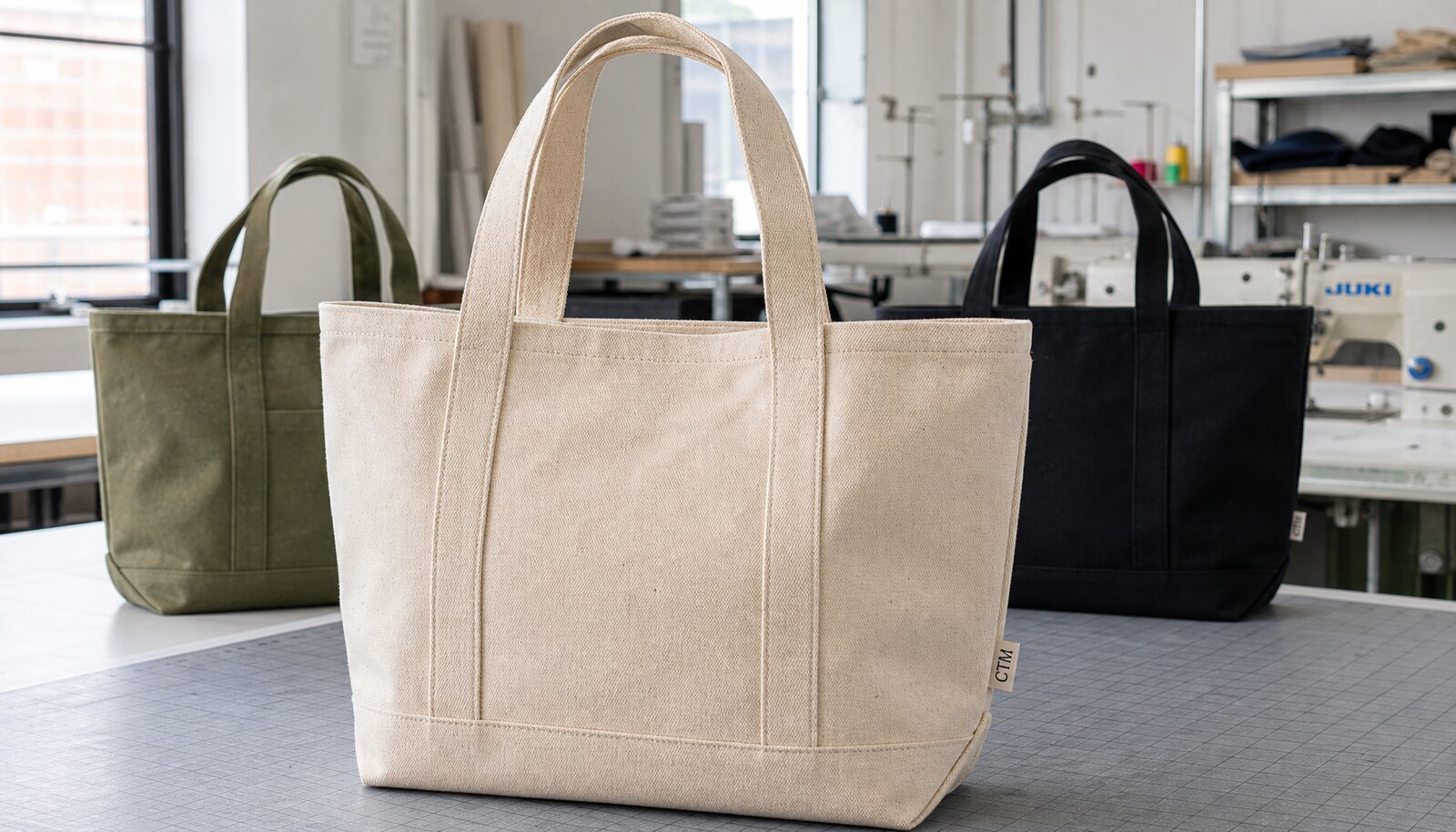
What Procurement Teams Are Actually Buying
Recycled canvas totes for trade shows and retail launches are not just low-cost bags with a logo. They are distribution tools, brand carriers, and often the first physical product a buyer sees from a launch program. That means procurement has to manage more than the piece price. The real buying decision is about how the tote will behave in the channel, how it will present on arrival, and how much effort it will take to get from factory floor to the customer’s hand.
Trade show use and retail launch use overlap, but the priorities are different. A trade show tote needs to be easy to hand out, strong enough for brochures or samples, and inexpensive enough that the event team does not ration it. A retail launch tote needs better body, cleaner finishing, and a more controlled appearance because the bag itself is part of the product mix and has to survive repeated handling. If you buy both use cases from one generic spec, one of them usually ends up compromised.
This is why a sourcing guide for recycled canvas totes should be built around use-case decisions, not around a template RFQ. The spec needs to answer simple commercial questions: what is the bag for, how will it be packed, what kind of decoration is allowed, and what can fail without damaging the launch? Once those are clear, the fabric, sewing, print, and logistics choices become much easier to compare.
- Trade show bags are judged by carry comfort and fast distribution.
- Retail launch bags are judged by shelf appearance and repeat handling.
- Hybrid programs usually need one primary spec and one controlled fallback spec, not a single compromise without limits.
Set the Spec Around the Channel, Not the Catalog Description
The most useful starting point for recycled canvas totes is the fabric weight, but not in isolation. For a procurement buyer, the right question is how the fabric behaves once the bag is sewn, printed, folded, and shipped. A 10 oz tote can be perfectly acceptable for an event handout if the load is light and the print is simple. The same tote can feel underbuilt on a retail shelf if the bag is expected to sit upright, hold shape, and be handled by shoppers before purchase.
A realistic working range for many programs is about 8 oz to 13 oz recycled canvas, or roughly 270 to 440 GSM depending on the weave and finishing. That is not a universal recommendation. It is a sourcing band that helps buyers compare quotes without defaulting to a vague label like heavy canvas. In practice, the middle of that range often gives the best balance of cost, body, and print performance. Lower weights reduce fabric and freight cost but increase the risk of sagging and print show-through. Higher weights improve structure and perceived value but increase sewing time, material cost, and carton weight.
Fabric weight is only one input. Buyers should also ask whether the cloth is washed, pre-shrunk, brushed, or left raw, because finishing changes the hand feel and dimensions. Recycled content can also be built in different ways. Some suppliers quote recycled cotton canvas, some quote recycled fiber blends, and some quote a conventional canvas with recycled content in the yarn or blend. Those are not interchangeable if your documentation, shade consistency, or print result matters. The spec should make that clear before you ask for a price.
- Use 8 oz to 9 oz for light distribution if cost and volume matter more than structure.
- Use 10 oz to 12 oz for most trade show and retail launch programs that need a balanced bag.
- Use 13 oz and above when the bag needs premium body, stronger shelf presence, or heavier carry load.
- Ask for the finish state of the fabric, because washed and raw canvas behave differently in sewing and print.
Compare Buying Routes Before You Compare Price
Supplier route changes the commercial outcome as much as fabric weight does. A direct factory quote often gives the best visibility into what is actually being made, which is important when you need to control recycled content claims, sewing details, and quality tolerances. It also tends to be the best route for repeat orders because the buyer can standardize the spec and create a stable replenishment path. The tradeoff is that the buyer has to own more of the detail work: sample approval, artwork control, and production signoff.
A trading company or sourcing agent can be useful when the program is fragmented, when you need mixed SKUs, or when the internal team does not have time to coordinate several factories. The risk is that the quote may be clean but incomplete. The buyer may not see the underlying fabric source, the true MOQ by color or decoration, or the exact factory responsible for a defect. That can complicate root-cause analysis if something is off in bulk production.
A domestic decorator or converter is often the fastest route when the launch date is fixed and the order is relatively small. That route can make sense for a retail activation or a short event window, especially if you want fast sample turns and lower transit risk. The commercial tradeoff is higher piece cost, and usually less room to optimize margin on larger volume. Procurement should compare landed cost, lead time, and operational risk, not just unit price ex-factory.
- Direct factory is usually strongest on visibility and repeatability.
- Trading routes can reduce internal coordination, but they need stronger documentation discipline.
- Domestic conversion can win on speed, but it often raises the all-in cost per usable tote.
Choose the Structure That Matches the Bag's Job
The structure of the tote should follow the end use. A trade show tote usually needs efficient sewing, a clean print face, and enough strength to survive a full day of distribution. A single-layer body with reinforced self-fabric or twill handles is often enough if the event load is mostly printed collateral. If the bag is handed out with samples or a product kit, a gusset may be worth the added cost because it changes the usable volume more than the flat dimensions suggest.
Retail launches generally need more structure than event bags. That does not automatically mean the heaviest canvas available. It means the bag should stand up to shelf handling, in-store browsing, and customer photos without looking collapsed. For some brands, that means a lined tote or a gusseted tote with cleaner finishing and a more deliberate fold. For others, it means a stronger canvas weight and a better print zone instead of extra internal complexity. The correct choice is the one that protects margin while still looking intentional in a store environment.
The handle design matters more than many RFQs acknowledge. Handle width, stitch count, drop length, and reinforcement affect both comfort and failure risk. A handle can look acceptable in a sample but still twist under load if the attachment is weak or the stitching pattern is too light. If the tote will be used for catalogs, samples, or retail purchases, the handle spec should be tested with the actual expected weight, not just visually inspected.
- Flat body: efficient for brochures and lighter event kits.
- Gusseted body: better for samples, retail purchases, and shelf value.
- Lined body: useful when internal finish and premium presentation matter more than production speed.
- Reinforced handles: necessary when the bag is expected to carry real load instead of light promotional material.
Decoration Choices Should Follow Artwork, Not Habit
Screen print is still the most common decoration method for recycled canvas totes because it gives strong opacity and durable color for simple logos. It is usually the best fit for one to three spot colors and repeat orders where the art is stable. The common mistake is to force a complex design into screen print because it looks cheap on the quote sheet. If the artwork includes gradients, small type, or fine lines, the print may need simplification or a different method entirely.
Heat transfer and digital print can be the better commercial choice for short runs, variable art, or launch programs that need fast sampling. The right use case is not only about print quality. It is also about how much risk the buyer can tolerate if the design changes late. If the brand is still settling artwork, a flexible method may save time even if the unit cost is higher. That can be a better procurement decision than approving a cheaper method that forces a redesign later.
For some retail launches, a woven label or embroidery may be a better signal of quality than a large printed logo. That is not always the least expensive path, but it can be the right one if the tote is part of a premium brand story. The key is to compare decoration methods on durability, visual result, setup cost, and reorder behavior, not just on the first quote number.
- Use screen print for simple logos and repeatable bulk orders.
- Use heat transfer or digital print when the artwork is complex or the run is short.
- Use woven labels or embroidery when brand positioning justifies a more premium hand feel.
- If the quote says decoration included, confirm the number of colors and the setup charges in writing.
Build an RFQ That Exposes Real MOQ and Cost Drivers
A tote RFQ should not ask only for price and lead time. It should expose the decision points that move the quote. For recycled canvas totes, that means fabric weight, fabric finish, body structure, handle specification, decoration method, label type, packing format, and delivery terms. If any of those are left open, the factory will fill in the blanks with its own standard, and the comparison between suppliers becomes unreliable.
MOQ deserves more precision than a single number. In tote programs, MOQ may be driven by style, by color, by print setup, by label type, or by packaging. A low headline MOQ can hide a higher effective minimum once the buyer adds a second print color or a second colorway. Procurement teams should ask the supplier to separate the minimums so that the true cost of a launch split is visible before approval.
The cleanest way to compare quotes is to ask for at least two or three cost scenarios. For example, one version for a simple single-color trade show bag, one version for a retail launch with more finishing, and one version with alternate packing. That makes the commercial tradeoffs obvious. It also reduces the risk of approving a quote that looks strong only because important cost items were left out.
- Ask for separate pricing by body spec, decoration, packing, and shipping terms.
- Break MOQ out by style, color, print color, and accessory.
- Request at least one alternate quote with a simpler spec so you can see the cost of each upgrade.
Samples Must Prove the Bulk Order, Not Just the Concept
A sample is only useful if it reflects the production reality. Sales samples are often attractive but misleading because they may be made with better material, more time, or extra hand finishing. A pre-production sample should use the final fabric lot, the final print method, the final label, and the final packing method. If any of those differ, the sample is a concept check, not a production approval.
For recycled canvas, the sample stage is where you define acceptable shade variation and print behavior. Natural recycled canvas can vary more than buyers expect because the feedstock and finishing can change from batch to batch. That does not automatically make the product unacceptable, but it does mean the buyer should ask what the factory considers normal variation and what level of mismatch triggers a rework or rejection discussion. Without that agreement, the buyer is left comparing bulk goods to an unqualified sample.
Do not limit sample review to a visual check. Put brochures, sample items, or retail purchases into the bag and see how it performs. Check handle comfort, folding behavior, body collapse, and how the print looks at normal viewing distance. If the tote is for a trade show, test how it stacks and whether it can be distributed quickly. If it is for retail, place it on a shelf or tabletop and see whether the shape looks intentional after handling.
- Approve the sample with the exact fabric lot whenever possible.
- Use the final decoration method, not a placeholder decoration.
- Test the tote with the real intended load.
- Review the sample under normal lighting and at arm's-length viewing distance.
Quality Control Needs Clear Tolerance Limits
The most common tote defects are not mysterious. They are usually off-size panels, weak handle attachment, loose threads, skewed print, inconsistent fold quality, and carton mix-ups. Buyers prevent those problems by defining tolerances before production starts. If the supplier is allowed to use its standard tolerance without discussion, the order may be technically compliant but commercially wrong for the channel.
A useful QC plan should separate functional issues from presentation issues. For trade show bags, the primary concern may be whether the tote is strong enough, printable, and packed correctly. For retail launches, symmetry, fold consistency, label placement, and print alignment may matter just as much as strength. A tote can pass a basic sewing inspection and still be unacceptable on a store shelf if the panel twists or the branding sits too high or too low.
Procurement teams should also ask how the factory handles exceptions. If a batch has slight fabric shade variation, what is the tolerance? If print alignment drifts at the edge, what is the allowed shift? If a handle stitch is repaired, what does the rework process look like? These are not theoretical questions. They determine whether the buyer gets a clean bulk order or a shipment that requires downstream sorting.
- Set measurable tolerances for width, height, gusset depth, and handle placement.
- Define acceptable print shift and color variation before mass production starts.
- Require carton, outer mark, and packing list checks together, not separately.
- Add a simple pass-fail rule for shelf presentation if the bag is retail-facing.
Packing and Logistics Decide the True Landed Cost
Packing format changes the real cost of the tote more than buyers often expect. Bulk packing is the lowest-cost option at the factory and usually the most efficient way to move volume. But if the destination is a retail warehouse or a branded event team that wants clean, ready-to-use bags, bulk packing can shift labor downstream. That means the quote may be low while the all-in handling cost is high.
Retail fold, individual polybagging, hangtags, and case-ready packing add cost, but they can also reduce rework and improve the customer experience. The right answer depends on who touches the bag after it arrives. A 3PL that bills by cubic volume and labor may prefer a tighter carton spec and clear inner pack counts. A store team may need the bag folded a particular way so it lands correctly on shelf. Those details should be part of the buying decision, not an afterthought.
Carton sizing also matters. A carton that is too large raises freight and warehouse cost; one that is too full can crease the bags or damage the print. Ask the supplier for carton dimensions, carton count per pallet, and an actual packing method, not just a vague packed in cartons statement. If the order is going to multiple regions, ask whether carton assortment can be separated by color or size so receiving is simpler.
- Bulk pack is cheapest, but it may create downstream labor.
- Retail-ready packing costs more, but it can reduce handling and improve shelf presentation.
- Ask for carton dimensions and pallet assumptions before comparing freight.
- Standardize carton labels so warehouse receiving can count without opening every case.
Lead Time Should Be Built Backward from the Launch Date
The most common planning error is treating lead time as a single production number. In practice, recycled canvas tote lead time includes fabric availability, sampling, decoration setup, sewing, packing, and transit. A quote that says 25 to 40 days after approval may be reasonable for a standard order with stable artwork and available materials, but it is not a promise that every step can run in parallel. If the fabric must be sourced or dyed, or if the print needs multiple screens or setup rounds, the schedule can extend quickly.
Trade show orders are usually date-fixed. Missing the event is more expensive than paying a slightly higher unit cost for a faster route. Retail launches are different. On-time arrival matters, but so does the time needed for inbound QC, shelf labeling, and allocation to stores or channels. The buyer should build a buffer before the public launch date, not just before the factory ship date.
A practical way to reduce delay risk is to freeze the artwork and carton marks early, then keep the remaining approvals narrow. Late design changes are expensive because they often reset print setup or require a fresh pre-production sample. If the launch date is firm, procurement should treat art finalization as a critical path item rather than a marketing task that can drift.
- Separate sample lead time from bulk lead time.
- Ask which steps are sequential and which can overlap.
- Build a buffer for inbound QC and warehouse handling, not only for transit.
- Freeze artwork and carton marks early if the delivery date is fixed.
Specification comparison for buyers
| Buying decision | Option to quote | When it is the better route | Commercial impact to watch |
|---|---|---|---|
| Fabric weight | 8 oz to 9 oz recycled canvas | Light promotional handouts with lower load, low print coverage, and cost-sensitive event distribution | Lower sewing cost and freight weight, but higher risk of sagging, show-through, and shelf fatigue |
| Fabric weight | 10 oz to 12 oz recycled canvas | Trade show bags that must hold catalogs or samples, and retail launches that need body on shelf | Usually the most balanced cost-to-appearance range; slightly higher fabric and sewing cost, but fewer complaints about floppiness |
| Fabric weight | 13 oz and above recycled canvas | Premium retail programs or bags that need stronger structure and a more substantial hand feel | Better structure and perceived value, but slower sewing, higher piece cost, and larger freight cost per unit |
| Supplier route | Direct factory | Repeat programs with stable artwork, clear spec ownership, and forecastable volume | Best visibility on fabric, sewing, and QC; usually better for margin, but requires tighter spec control and stronger buyer follow-through |
| Supplier route | Trading company or sourcing agent | Mixed-SKU launches, multi-country coordination, or orders that need broader vendor coverage | Can reduce coordination burden, but may add margin layers and make fabric origin, MOQ, and defect responsibility less transparent |
| Supplier route | Domestic decorator or converter | Short lead time, small runs, or launches where local turnaround matters more than unit cost | Can simplify approvals and reduce transit risk, but unit price is often materially higher and scale-up options may be limited |
| Decoration method | 1 to 3 color screen print | Simple logos, repeat orders, and programs where durability matters more than visual complexity | Lowest decoration cost at moderate volume; setup charges are predictable, but artwork must be simplified |
| Decoration method | Heat transfer or digital print | Short runs, variable artwork, or multi-color graphics that need fast sampling | Better for launch speed and artwork flexibility, but unit cost and handfeel can be less stable than screen print |
| Packing choice | Bulk packed in cartons | Trade show distribution, warehouse rework, or programs where the buyer will repack later | Lowest packing cost and usually the smallest carton count, but more handling is needed downstream |
Buyer checklist before sampling
- Start with the channel: trade show handout, retail shelf item, or a hybrid launch bag, because that decision drives fabric weight, structure, and packing.
- Write the fabric spec in GSM or oz and state the yarn basis if you need recycled content documentation, because recycled canvas can be built from different fiber mixes.
- Approve the bag dimensions as usable volume, not only flat width and height, so the bag fits brochures, sample kits, or retail purchases.
- Specify handle length, handle width, stitch count, and reinforcement at the stress points, then test with the actual intended load.
- Choose the print method after you define artwork complexity, opacity needs, and expected reorder volume.
- Request a pre-production sample made with the final fabric lot, final print method, final label, and final packing style.
- Ask for carton dimensions, carton count, inner pack count, and pallet assumptions if your warehouse, 3PL, or retailer charges on cubic volume.
- Separate MOQ by style, color, print, and accessory before comparing quotes, because a low headline MOQ can hide a much higher true order floor.
Factory quote questions to send
- What is the exact fabric specification in GSM or oz, and what recycled content basis can you document on the spec sheet or test report?
- Is the MOQ quoted per style, per color, per print color, or per total order, and what changes if we add a second decoration or label type?
- Which decoration method is included in the price, and what are the setup charges for each additional color, plate, screen, or digital file adjustment?
- What is included in the sample charge: fabric, sewing, printing, label, packing, and courier?
- What are your standard tolerance limits for width, height, gusset depth, seam placement, print alignment, and color variation?
- Can you quote the same tote in bulk pack, individual polybag, retail fold, and hangtag format so we can compare true landed cost?
- What is the lead time after sample approval, and which steps run in parallel versus sequentially?
- What carton size, carton quantity, and pallet plan do you recommend for this style, and what would change if the bag is folded differently?
- If the canvas shade or recycled fiber blend varies by batch, how do you control shade consistency across the order?
- What is your rework policy if the print, sewing, or packing does not match the approved sample?
Quality-control points to confirm
- Fabric weight should match the approved spec within the supplier's stated tolerance, and the buyer should get the tolerance in writing before production starts.
- The recycled canvas surface should be even enough for the chosen decoration method, with no oil marks, major yarn contamination, or print-blocking defects in the decorated area.
- Handle stitching and bar-tacks should be symmetrical and clean, with no twisting, skipped stitches, or weak stress points visible at the attachment area.
- Print opacity should be acceptable on the actual fabric color, especially on natural canvas where underbase performance can vary by method.
- Bag dimensions should remain within the agreed tolerance after pressing and folding, not just when measured flat before finishing.
- Labels, care tags, and side branding should be centered, legible, and attached exactly as approved.
- Carton quantity and assortment should match the packing list, and mixed colors or sizes should be separated exactly as approved.
- The pre-production sample, carton mark, and outer pack should all be signed off together before release to bulk production.
- For retail launches, add a short check on fold appearance, because a bag that passes sewing inspection can still fail shelf presentation if it creases badly.
- For trade show orders, verify the bag can be counted and distributed quickly without damage to the print or handles during event setup.