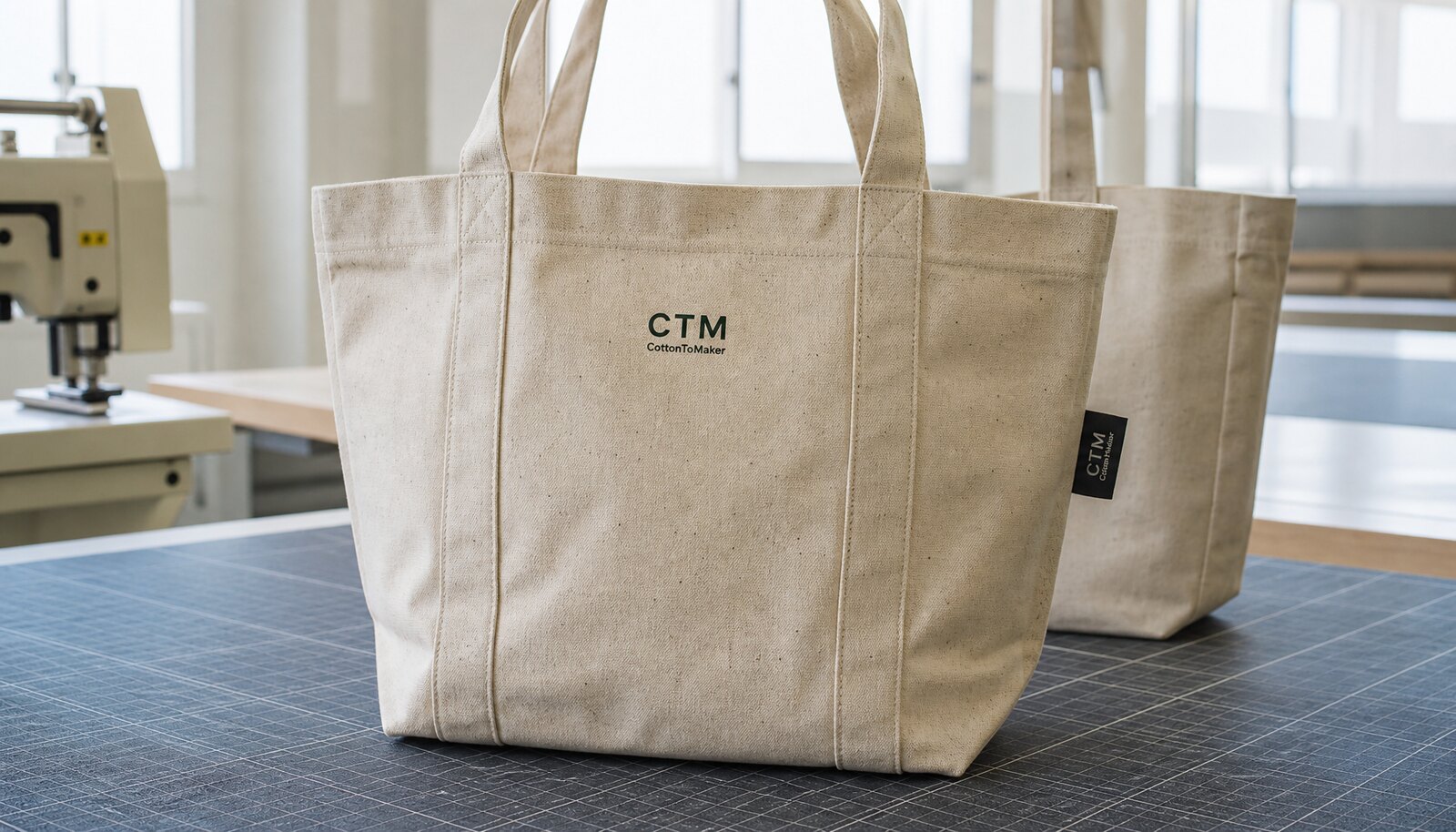
What the tote has to do on a trade show floor
A trade show tote is not just a giveaway. It is a carrying tool, a brand surface, and a moving storage unit for brochures, samples, notebooks, and sometimes a water bottle or two. If the bag collapses, twists, or sheds threads after a few hours on the show floor, the buyer notices that failure long before they notice the logo. For that reason, the first spec decision is not the artwork. It is the load the bag must carry and the way the bag will be handled during the event.
For most show programs, a recycled canvas tote in the 8 oz to 12 oz range works well, but the right answer depends on what goes inside. Lightweight literature handouts can work on an 8 oz body around 240 to 280 GSM. If the bag will carry product samples, catalogs, and a notebook, 10 oz around 280 to 340 GSM is usually the safer default. If the bag needs a more substantial hand and better stand-up shape, 12 oz or higher may be justified. The goal is not the thickest canvas available. The goal is the lightest structure that still keeps shape, prints cleanly, and survives repeated use during and after the show.
- Define the expected load in real items, not only in kilograms.
- State whether the tote needs a soft drape or a boxier shape.
- Decide whether the bag must survive repeat use after the event or only one-day distribution.
- Match the fabric weight to the load before you negotiate print details.
Define the recycled canvas before you compare quotes
The term recycled canvas is used loosely in the market, so the quote only becomes useful when the fiber content is clear. Some suppliers mean recycled cotton canvas, some mean a recycled cotton and polyester blend, and some use recycled yarn in a woven fabric that still behaves differently from conventional canvas. The fabric story matters because it affects print absorption, surface texture, color consistency, and how the tote folds in transit. If the supplier cannot state what is recycled, the claim is too vague for a procurement file.
Ask for the fabric weight in GSM or ounces, and make sure the supplier states whether the number is before or after finishing. A fabric that looks identical on a swatch card can behave differently once it is washed, dyed, or coated. Natural and undyed recycled canvas often has more visible slub and shade variation, which is acceptable if your brand accepts a rustic look. If your design uses a dark logo on a light base, that variation can still work. If your brand needs a very uniform background, ask for a pre-dyed stock color or accept that the print comparison will be against the finished production lot, not the catalog photo.
- Confirm the actual fiber content, not only the word recycled.
- Ask whether the fabric is undyed, piece-dyed, or yarn-dyed.
- Request a swatch with the same finish planned for bulk production.
- Check shrinkage and color variation before approving the final fabric.
Match print method to artwork and volume
For most trade show bags, screen printing is still the workhorse. It handles simple logos well, gives solid ink coverage on canvas, and usually offers the best balance between unit cost and durability at medium to high volume. One-color or two-color art is the easiest route. If the logo includes fine type, small registration gaps, or a lot of tonal detail, the print becomes more sensitive to fabric texture and curing quality. On recycled canvas, that texture can be part of the look, but it can also make small type harder to read if the artwork is too delicate.
When the artwork is more complex, DTF or heat transfer can solve the color problem, but the buyer should evaluate hand feel, edge lift, and fold resistance. Embroidery works when the logo is small and the brand wants a premium finish, but it increases sewing time and can distort on thin or heavily woven canvas. Woven labels and side labels are useful for subtle branding, especially when the front print is intentionally minimal. For a show tote, the best method is usually the one that matches the artwork with the fewest production steps, not the one that sounds most versatile.
- Choose screen print for simple logos and repeat orders.
- Use transfer methods when the artwork needs more color detail than screen print can handle well.
- Use embroidery or woven labels when the brand wants a premium finish on a small logo zone.
- Approve the exact print size and placement on a physical sample, not only on a digital proof.
Build an RFQ that exposes the real price
A useful RFQ separates the tote into its cost drivers instead of asking for a single number. The supplier should quote fabric weight, body size, handle length, print method, print colors, packaging, and shipping term separately enough that you can compare two offers line by line. If one supplier includes a reusable polybag and another omits it, the lower number may be incomplete. If one quote assumes a generic tote size and another assumes a larger gusset, the comparison is also misleading. The objective is not just to get a low unit cost. The objective is to know what the unit cost actually includes.
MOQ logic usually follows the most expensive fixed elements in the job. Screens, plates, setup labor, cutting markers, and color matching all carry fixed cost that gets spread across the order. A 500-piece order with three print colors often carries a much higher setup burden per bag than a 5,000-piece order with one color. That is why buyers should ask for a quote ladder, not only a single quantity. A proper ladder shows what happens at 300, 1,000, 3,000, and 5,000 pieces so procurement can see where the step-down in cost begins and whether the event volume justifies the setup work.
- Request a price breakdown for blank bag, print setup, packing, and freight term.
- Ask for quote tiers at multiple quantities.
- Specify the artwork colors and print size in millimeters or inches.
- Include the target delivery window so the factory can price the real production path.
Choose the supplier route that fits the schedule
The right supplier route depends on how much control you need and how fast the bags must move. A direct factory usually gives the best control over sewing, fabric allocation, and print alignment, which makes it the strongest option for repeat programs and larger trade show orders. A regional converter can be faster when blank stock is already on hand, but the buyer loses some control over fabric provenance and long-term repeatability. A trader can simplify communication when several SKUs need to ship together, yet the buyer should expect an extra layer between the order and the factory floor.
The main question is not which route is good in general. It is which route is the least risky for your event date. If the show date is fixed and the logo is simple, a blank-stock route may be acceptable. If the brand needs exact color matching, documented recycled content, and consistent reorders, the direct factory route is usually cleaner. Use the supplier table to compare those options against your actual constraints, especially when the order is tied to a marketing calendar and a missed window makes the bag useless.
- Use a direct factory when control and repeatability matter most.
- Use a regional converter when speed matters more than deep customization.
- Use a trader only if the extra coordination layer is worth the convenience.
- Treat the event date as a production constraint, not as a soft target.
Supplier evidence that matters before you place the order
Buyers do not need a long marketing deck. They need evidence that the supplier can make the exact tote being quoted. Useful evidence includes clear photos of the sewing line, a sample room with similar bag builds, a swatch or strike-off that matches the quoted fabric, and recent production photos of a comparable canvas tote. If the supplier claims recycled content, ask how it is tracked and whether the claim applies to the fabric batch being quoted or only to the general product line. A general sustainability statement is not the same as batch-level evidence.
Look at the sample path as much as the factory photo set. A supplier that can produce a blank sample quickly, then a pre-production sample with print and packing, usually has a more reliable process than one that jumps straight to bulk promises. The quote should also identify who owns each step. If the factory outsources printing or label application, that is fine, but the buyer needs to know where the handoff happens and who is responsible if a color or placement issue appears after approval. A clean process is more valuable than a polished sales pitch.
- Request photos of the actual sewing and print areas, not only product shots.
- Ask for a sample path that shows how approval moves from swatch to bulk.
- Confirm whether printing and sewing happen in the same facility.
- Treat recycled content claims as batch-specific until proven otherwise.
Lock the sample before bulk sewing starts
The pre-production sample should answer more questions than the artwork proof. It should confirm body dimensions, handle drop, seam alignment, print position, print density, and packing style. For a trade show tote, the sample also needs to show how the bag behaves when folded. A tote that looks good flat on a table can still be awkward in a show kit if the gusset is too stiff or the handle length makes the opening collapse. That is why a real sample matters more than a screen image or a PDF proof.
Once the sample is approved, the buyer should treat it as the golden reference. Seal one unit, label it with the order number, and make sure both sides agree on the acceptance point. If a later bulk bag differs in print density, stitching detail, or fabric shade, there is no room for debate if the signed sample is the reference. Sample approval should also include a simple check of logo placement against the finished bag dimensions, because even a few millimeters off can make a stacked brand wall look inconsistent.
- Approve one sealed golden sample before bulk cutting begins.
- Measure the sample against the final spec, not against the artwork file alone.
- Check print edges, handle attachment points, and seam finish on the sample.
- Record the sample approval date so later changes are easy to trace.
Specify packing for the way the bags will be used
Packing changes both cost and event readiness. If the totes are going straight to a trade show booth and will be handed out in bulk, carton packing is usually more efficient than individual retail-style folding. If the bags will be distributed through multiple distributor locations, a cleaner fold with individual polybags may be worth the labor. The buyer should choose the packing format based on how the bags will be unpacked, stored, and handed out, not on what looks neat in a catalog.
Carton size and count matter more than many buyers expect. Oversized cartons can save carton cost but make receiving and shelf handling harder. Small cartons are easier to move but may add packing labor and freight cost. If the bags are printed on one side only, the fold should protect the logo from rubbing against the next bag in the carton. If an insert card, barcode sticker, or hangtag is required, write that into the quote. These small items often create the hidden labor that turns a cheap bag into an expensive finished unit.
- Choose bulk carton packing for event distribution when retail presentation is not required.
- Use individual polybags only when the distribution channel needs it.
- Specify the fold direction so the logo does not rub during transit.
- State barcode, label, and insert requirements in the RFQ.
Protect the schedule from the usual bottlenecks
Most tote delays do not come from sewing alone. They come from slow artwork approval, fabric shade clarification, print setup changes, and sample revisions. A buyer can lose a week by sending an editable logo late or by changing the logo position after the strike-off. Recycled canvas can also introduce an extra lead-time risk if the exact fabric weight or color is not in stock and needs to be woven or finished first. The safer approach is to treat the order as a chain of dependent approvals, where one delay pushes the whole schedule.
A realistic planning window often includes time for sample making, sample review, production, packing, and freight booking. The exact number depends on fabric availability and print complexity, but the buyer should always leave buffer before the event. If the tote is part of a full trade show program, the risk is not only late arrival. A partial arrival or a carton-count mismatch can create booth disruption that is harder to fix than a slightly higher unit cost. The schedule should be planned backward from the show date, with a hard freeze point for artwork and packing details.
- Freeze artwork before sample approval, not after.
- Build buffer for fabric sourcing if the recycled canvas is not stock held.
- Treat freight booking as part of the production schedule.
- Do not combine logo changes and packing changes in the same approval round if the deadline is tight.
Compare landed cost, not just the tote price
The unit price on the quote is only one part of the finished cost. Buyers should compare the landed cost of the tote after print setup, packing labor, carton count, freight term, import duty where relevant, and receiving labor are included. A lower unit price with expensive packing can cost more than a higher unit price with simpler bulk packing. For trade show programs, the tote should also be judged by how much space it consumes in transit and storage, because carton volume can affect freight more than buyers expect.
Common quote mistakes are easy to avoid once you know where they hide. One quote may be based on a blank bag and a separate print charge while another bundles both. One supplier may assume 10 oz canvas and another quote 8 oz. One may include a woven side label and another may exclude it. If procurement compares those offers as if they are identical, the chosen supplier may look cheaper on paper but become more expensive once all the missing pieces are added. The cleanest approach is a quote matrix that lists fabric weight, print method, packing method, MOQ, sample cost, and freight term in the same row set for every supplier.
- Compare the full landed cost, not just the ex-factory tote price.
- Normalize all quotes to the same fabric weight, print count, and packing format.
- Include freight volume and receiving labor in the comparison where possible.
- Use the same quote matrix for every supplier so missing items are easy to spot.
Specification comparison for buyers
| Spec decision | Recommended option | When it fits | Buyer risk to check |
|---|---|---|---|
| Lowest landed cost for a standard giveaway | Direct factory with in-house screen printing | You want one or two logo colors, a repeatable size, and a larger order that can absorb setup costs | Confirm print setup fees, fabric shade tolerance, and whether the factory controls sewing and printing in the same plant |
| Fastest replenishment before the event | Regional converter with blank stock and local decoration | You need a short turnaround and can accept a narrower fabric or color range | Check actual stock availability, recycled content proof, and whether the decorating shop can match the required logo quality |
| Small pilot order for a new trade show program | Factory with a flexible sample room and lower MOQ on sewn goods | You are testing response before committing to a full rollout | Watch for higher unit cost, limited color options, and a sample process that is not identical to bulk production |
| Complex full-color artwork | Supplier offering DTF or heat transfer on canvas with controlled curing | Your logo has gradients, fine text, or multiple brand colors | Verify hand feel, crack resistance, and whether the print survives folding and transport without edge lifting |
| Best brand consistency across multiple events | Direct factory with in-house sewing, printing, and packing | You need the same body size, handle length, and print placement every time | Request a sealed golden sample and batch records so later reorders do not drift from the approved standard |
| Strong sustainability story for buyer decks | Factory that can document recycled fiber content and lot traceability | Your customer asks for materials evidence and a clear supply chain narrative | Do not rely on a vague recycled claim; ask what is recycled, how it is measured, and which batch was used |
| Mixed SKU shipment with multiple show items | Trader or consolidator that can combine several product lines | You need one freight movement for totes, pouches, and other giveaways | Check carton marks, split production responsibility, and who owns quality if one item arrives late or off spec |
| Tight Pantone matching on natural canvas | Supplier with a separate print room and an approved strike-off process | Your brand color must read correctly under show lighting | Natural canvas absorbs ink unevenly, so require a signed pre-production color reference and tolerance agreement |
Buyer checklist before sampling
- Define the tote size, gusset, handle length, and target carrying load before asking for quotes.
- State whether the recycled canvas must be recycled cotton, recycled poly-cotton, or another verified blend.
- Send vector artwork, Pantone references, and the exact print placement with measurements.
- Ask for the fabric weight in GSM or oz, plus whether the weight is before or after finishing.
- Request a breakdown for blank bag cost, print setup, sample charge, packing, and freight terms.
- Confirm the MOQ by fabric color and by print color, not just the total order quantity.
- Insist on a pre-production sample or signed strike-off before bulk sewing starts.
- Specify carton packing, polybag use, and outer carton marks for the event receiving team.
Factory quote questions to send
- What is the exact fiber content, fabric weight, and finishing method for the recycled canvas you are quoting?
- Is the print method screen print, DTF, heat transfer, embroidery, woven label, or a combination, and what is included in the unit price?
- What is the MOQ by bag color, logo color, and print position?
- What sample stage do you provide first: fabric swatch, blank sample, strike-off, or pre-production sample?
- What tolerances do you accept for body size, handle length, seam alignment, and logo placement?
- How are the bags packed for bulk shipment, and can you quote carton dimensions and carton count per case?
- What is the lead time after artwork approval and after sample approval, separately?
- Which costs are excluded from the quote, such as screens, plates, cartons, inserts, or special packing?
Quality-control points to confirm
- Fabric weight matches the approved spec and is measured with the same basis used in the quote.
- Recycled content claim is supported by supplier documentation tied to the quoted batch.
- Body size, gusset, and handle length stay within the agreed tolerance on a random production check.
- Handle attachments, side seams, and bottom seams have no skipped stitches, loose threads, or weak reinforcement points.
- Print placement is centered and consistent, with no obvious ghosting, smudging, or under-cured ink.
- Logo color is accepted against the signed strike-off or Pantone reference, not against a screen image.
- Pack count per carton is correct, with the agreed polybag, desiccant, or insert requirements if used.
- Final cartons are marked clearly with item code, quantity, and destination details for event receiving.