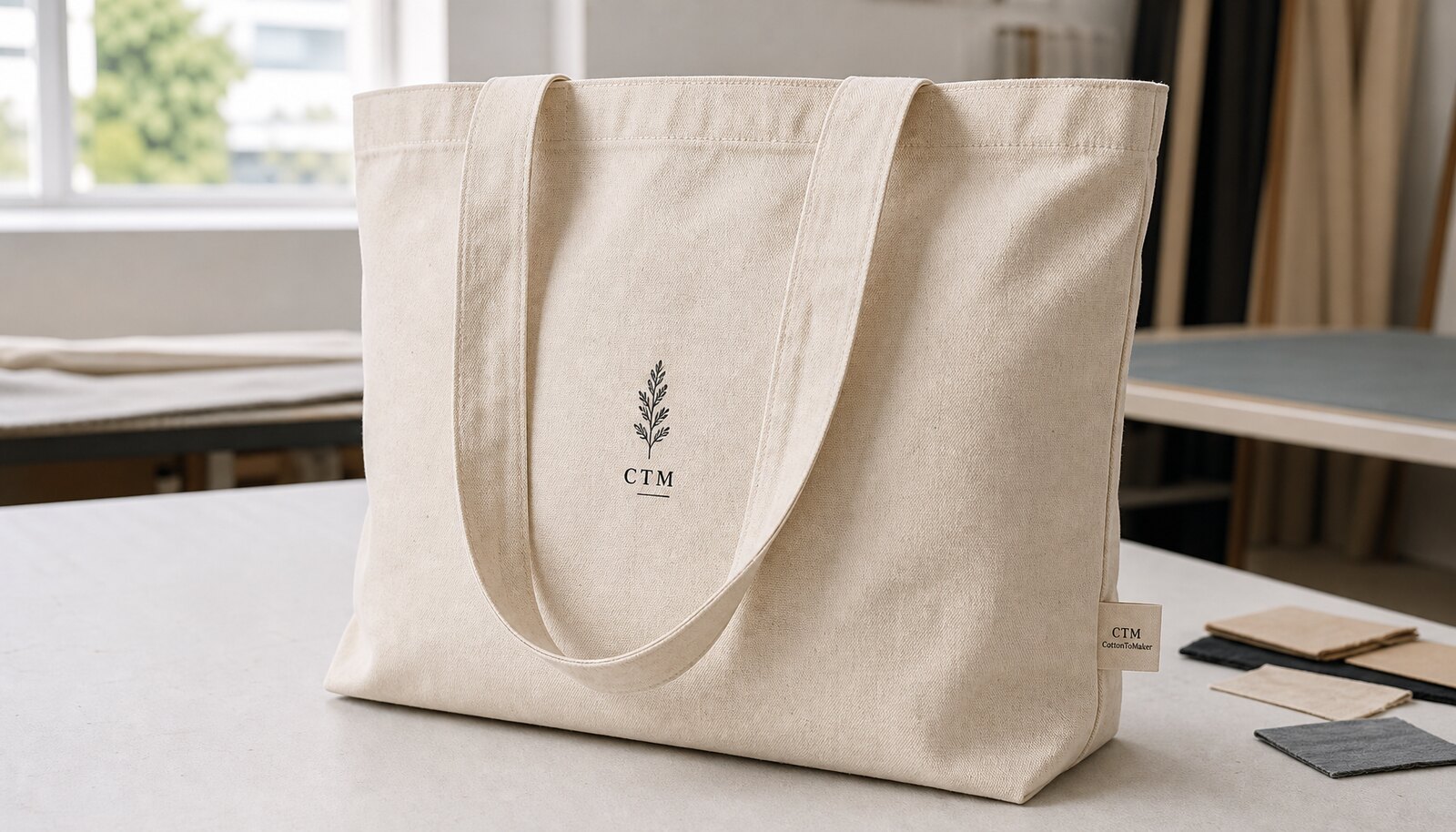
Why apparel brands need a stricter sample approval step
For apparel brands, a recycled canvas tote is usually not a commodity bag. It is a carry item that sits next to garments, receives close retail inspection, and often needs to match a brand’s visual standard more closely than a promo tote. If the sample looks a little stiff, the logo is slightly off-center, or the handle reinforcement feels weak, the bag can be rejected before a buyer even reaches unit cost discussion.
That is why the sample approval checklist matters more than a simple yes/no on price. The real job is to confirm that the factory can repeat the same fabric weight, same print behavior, and same sewing quality in bulk. A sample that looks good on a sample table can still fail in production if the quote was built on a different GSM, a different dye lot, or a different packing method.
- A sample should prove bulk feasibility, not just appearance.
- Apparel buyers need both brand presentation and functional carry performance.
- Most failures come from missing detail on fabric, print, or reinforcement rather than from the tote shape itself.
Start with the right fabric weight, finish, and recycled content
For recycled canvas totes for apparel brands, the most practical starting point is usually 12 oz to 14 oz recycled canvas, roughly 340 to 400 GSM. This range gives enough body for a retail-ready tote without becoming so heavy that the bag feels bulky when folded into a shipment carton. If the bag is meant for folded apparel, lookbooks, or gift-with-purchase programs, the fabric should hold shape but still pack flat.
The recycled canvas spec needs to be written clearly in the RFQ. Ask for the composition, yarn type, wash effect if any, and whether the fabric is natural, dyed, or bleached after weaving. Recycled yarns can show minor slubs and fiber specks, which is normal, but a buyer should define what is acceptable. If the brand wants a cleaner premium look, a tighter weave and controlled finishing matter more than just a higher GSM number.
- Use 12 oz to 14 oz for most apparel retail totes; go heavier only when the bag must carry dense items or hold structure.
- Specify whether the tote should be soft, crisp, enzyme-washed, or unwashed.
- Write the acceptable shade range for natural recycled canvas, especially across repeat orders.
Choose the print method based on artwork complexity and volume
The best print method depends on both artwork and order size. For simple logos and flat brand marks, water-based screen print is usually the cleanest option because it sits well on canvas and keeps unit cost under control for repeat programs. If the artwork has fine detail, gradients, or multiple seasonal colors and the run is small, heat transfer can be useful for sampling or limited drops, but it must be tested on the exact recycled canvas being used in bulk.
Do not approve a sample just because the logo looks sharp on one piece. Recycled canvas surface texture changes how ink lays down, especially on rougher weaves or washed fabrics. Check one-color and multi-color coverage under normal store lighting, not only under bright factory lights. The edges should be crisp, color density should be even, and the print should not crack when the bag is folded at the center panel.
- Screen print suits simple logos and larger repeat orders.
- Heat transfer can be useful for small batches, but the buyer should test fold durability.
- Confirm Pantone targets, print size in centimeters, and placement distance from seam and top edge.
Use a supplier comparison that reflects real sourcing routes
A procurement team comparing quotes should not only compare the unit price. It should compare the supplier route: direct factory, trading company, or print specialist buying fabric from a third party. Each route has different control over fabric lot consistency, sample speed, defect handling, and packing accuracy. For recycled canvas totes, the route often matters as much as the spec because fabric variation can change both appearance and print quality.
Direct factories with an in-house sample room are usually better when the brand wants to lock GSM, reinforcement, and carton packing. Trading layers can help with communication or smaller order handling, but they may not control the sewing floor or print process directly. If the buyer needs a retail program with multiple replenishments, source from the route that can prove repeatability, not only the route that can quote the fastest.
- Compare who owns fabric sourcing, print production, sewing, and packing.
- Ask which step is done in-house and which is outsourced.
- Prefer the supplier that can show a reference sample from the same construction and fabric lot family.
Comparison table: sourcing routes and spec choices that affect approval
The table below is useful when buyers are deciding whether to approve the first sample, request a rework, or move to bulk with a controlled reference sample. It is intentionally built around sourcing routes and production choices because that is where most quote comparisons go wrong. A lower unit price can easily hide a weaker process.
The sample record for recycled canvas totes for apparel brands sample approval checklist should include front, back, side, seam, logo, label, inside, and packed-carton photos. For important programs, keep one signed physical sample and record the sample version in the approval file.
- Write decisions in measurable language, not only descriptive wording.
- Ask for sample photos plus one physical approval sample for important orders.
- Keep quotation, sample approval, and inspection notes tied to the same spec version.
Define sample approval criteria before the factory cuts bulk
A useful sample approval checklist should translate brand expectations into measurable acceptance criteria. That means written size tolerance, print placement tolerance, seam allowance, and handle length. If the buyer only writes “approve quality,” the factory will assume its own internal standard, which may be good enough for promotion bags but not for retail apparel programs.
For recycled canvas totes, the sample should be judged in the same order the production line will follow: fabric hand-feel, color, print, stitching, handles, shape, and packing. Keep one approved reference sample sealed for comparison. When bulk units arrive, compare them under the same lighting and by the same measurements so there is no disagreement about what was approved.
- Approve against a physical reference sample, not only images.
- Write the allowed tolerance for dimensions and print placement.
- Record the exact sample version: sales sample, corrected sample, or pre-production sample.
The buyer checklist that should be in every approval file
The most common production mistake is approving a bag without documenting the details that later drive disputes. Procurement should keep one file that includes size, fabric weight, print file, carton spec, label position, and approval notes. This does not need to be complicated, but it must be complete enough that another buyer on the team can compare bulk against the same standard.
A tight checklist also shortens the next reorder. If the sample record clearly shows the approved canvas weight, stitch type, and packing format, the supplier can quote the repeat program faster and with fewer assumptions. That reduces the chance of surprise surcharge language appearing in the next quote.
- Finished size and tolerance band
- Recycled canvas GSM or ounce weight
- Artwork file, Pantone target, and print area
- Handle length, width, and reinforcement pattern
- Packing format, carton marks, and barcode placement
- Approved sample version and approval date
QC thresholds that catch tote problems before shipment
A recycled canvas tote should be checked with tote-specific criteria, not only a general garment checklist. Focus on dimensions, symmetry, print alignment, handle attachment, and carton count. The bag may pass a visual glance but still fail in retail if one handle sits higher than the other or the printed logo drifts too close to the seam.
Set practical thresholds that your supplier can actually measure. For example, size tolerance is often best written as plus or minus 0.5 cm to 1 cm depending on bag size and fabric behavior, while print placement should be controlled within a smaller band if the logo sits near the center. If the order is a premium apparel tote, the buyer should be stricter on visual symmetry than on a basic promotional bag.
- Check top opening symmetry and seam straightness.
- Inspect print edges for bleeding, pinholes, or misregistration.
- Pull handles manually and inspect the stress points for stitch opening.
- Count cartons and inner packs against the packing list before release.
Packing and carton planning can change the landed cost
Packing details affect both freight and receiving accuracy. Flat-packed recycled canvas totes are usually the most efficient route for apparel brands because they reduce carton volume and make warehouse handling easier. If the tote includes a printed front panel, the fold direction must avoid deep creases on the artwork. Inner polybags are not always necessary, but they may be useful when the bags will sit in dusty warehouses or be inserted into retail kits.
The quote should clearly say whether carton marks, barcodes, hangtags, silica gel, and polybags are included. These items often get left out of the first quotation and added later, which makes unit cost look lower than it really is. Ask the factory to quote the packing format you actually need in distribution, not the simplest possible packing for the sewing line.
- Prefer flat pack unless the tote shape must be pre-formed.
- Keep folded size and carton cube in mind when comparing freight quotes.
- Define whether individual bag protection is required or if bulk pack is acceptable.
Lead time, sampling delay, and reorder risk
For a standard recycled canvas tote program, a realistic bulk lead time is often 25 to 40 days after sample approval, but that number only works if the fabric and trims are already available. If the order requires custom dyed canvas, special washing, or a new print plate, the schedule can extend quickly. A buyer should separate sample time from bulk time in the plan, because sample approval often becomes the hidden delay that pushes a retail launch.
Reorders are faster when the factory has a locked sample reference and a written bulk spec. Without that, the supplier may recreate the bag from memory or from a previous production file that no longer matches the current brand requirement. That is how small changes in handle length, print size, or canvas shade end up causing a dispute on repeat orders.
- Plan for sample development, correction, and bulk separately.
- Do not accept a delivery date that ignores fabric procurement time.
- Keep the approved sample and the approved spec sheet together for reorders.
Specification comparison for buyers
| Spec decision | Recommended option | When it fits | Buyer risk to check |
|---|---|---|---|
| Fabric weight | 12 oz to 14 oz recycled canvas, around 340 to 400 GSM | Apparel brands wanting a premium retail feel, better drape, and enough body for print clarity | Light cloth can wrinkle, show lining marks, or make the tote look cheap on shelf |
| Print method | Water-based screen print or heat-transfer only for small artwork; direct screen print for repeat orders | Simple logos, flat art, and medium-volume programs where color control matters | Fine lines can close up on rough recycled yarns; confirm ink coverage on actual sample fabric |
| Supplier route | Direct factory with sample room and in-house print/packing | Brands that need tighter control on fabric lot, stitch spec, and carton packing | Trading layers can hide where the defect happened and slow corrective action |
| Sample stage | Pre-production sample after fabric and trim confirmation | Programs with multiple colors, custom handle length, or special wash effects | Do not approve a sales sample if the final bulk fabric weight or dye lot is still unknown |
| MOQ logic | 1,000 to 3,000 pcs per color for standard specs; lower only if fabric is stock and print is simple | Launches, seasonal capsules, or retail test orders | Very low MOQ often means mixed fabric lots, weaker QC, or higher unit cost hidden in setup fees |
| Handle construction | Cross-stitch plus reinforced box-X at stress points | Totes carrying apparel, folded textiles, catalogs, or bundled gift sets | Thin handle webbing or weak bar-tacks can fail after repeated retail use |
| Packing format | Flat packed with size/PO sticker, bulk carton inner poly as needed | Retail distribution, warehouse picking, or e-commerce insertion | Loose packing can create bent shape, dust marks, and count errors at receiving |
| Lead time | 25 to 40 days after sample approval, depending on print color count and raw material availability | Repeat orders with confirmed specs and available recycled canvas greige | Promised dates often ignore sample approval delay, fabric sourcing, and carton lead-time |
| QC standard | AQL-style inspection plus tote-specific acceptance criteria for size, print, and stitch | Buyer teams that need a defensible go/no-go standard before shipment release | Generic garment QC plans miss tote-specific issues like handle symmetry, gusset shape, and print offset |
Buyer checklist before sampling
- Confirmed finished size, allowable tolerance, and whether the bag must stand open or can remain soft-folded
- Locked recycled canvas weight in GSM or oz, plus whether the fabric is bleached, natural, dyed, or washed
- Approved print method, artwork file type, Pantone reference, and maximum acceptable register shift
- Defined handle length, width, reinforcement pattern, and target load use case
- Reviewed sample carton marking, inner packing, hangtag, and barcode or sticker requirements
- Set the sample approval path: sales sample, pre-production sample, and top-of-production reference sample
Factory quote questions to send
- What exact recycled canvas weight, composition, and finishing method will be used in bulk, not just in the sample?
- Is the quoted price based on one sample type or does it include pre-production sample, lab dips, and carton proofing?
- What print method is included, how many colors are priced, and what is the surcharge for each additional color?
- What is the MOQ by color and by artwork, and what happens to unit price if we reduce quantity below that level?
- Which packing format is included in the quote, and are polybags, silica gel, inserts, and master carton marks extra?
- What inspection standard will you use before shipment, and can you share stitch, size, and print acceptance limits in writing?
- How many days are required after sample approval, and which steps can extend lead time if fabric or trims are not in stock?
Quality-control points to confirm
- Measure finished width, height, and gusset at three points; keep within an agreed tolerance band, typically plus or minus 0.5 cm to 1 cm depending on construction
- Check fabric face and reverse for shade variation, slub concentration, recycled fiber specks, and weak weave areas that may affect print
- Inspect print edges for halo, pinholes, misregistration, and ink strike-through on lighter colors
- Pull both handles under load by hand and inspect bartack ends, cross-stitch density, and seam distortion at the upper opening
- Open and close the tote repeatedly to confirm side seam alignment and opening symmetry after stitching
- Confirm fold pattern, carton quantity, and label placement so the tote packs efficiently without creasing the artwork
- Compare first sample, approved reference sample, and bulk pre-shipment units under the same lighting before release