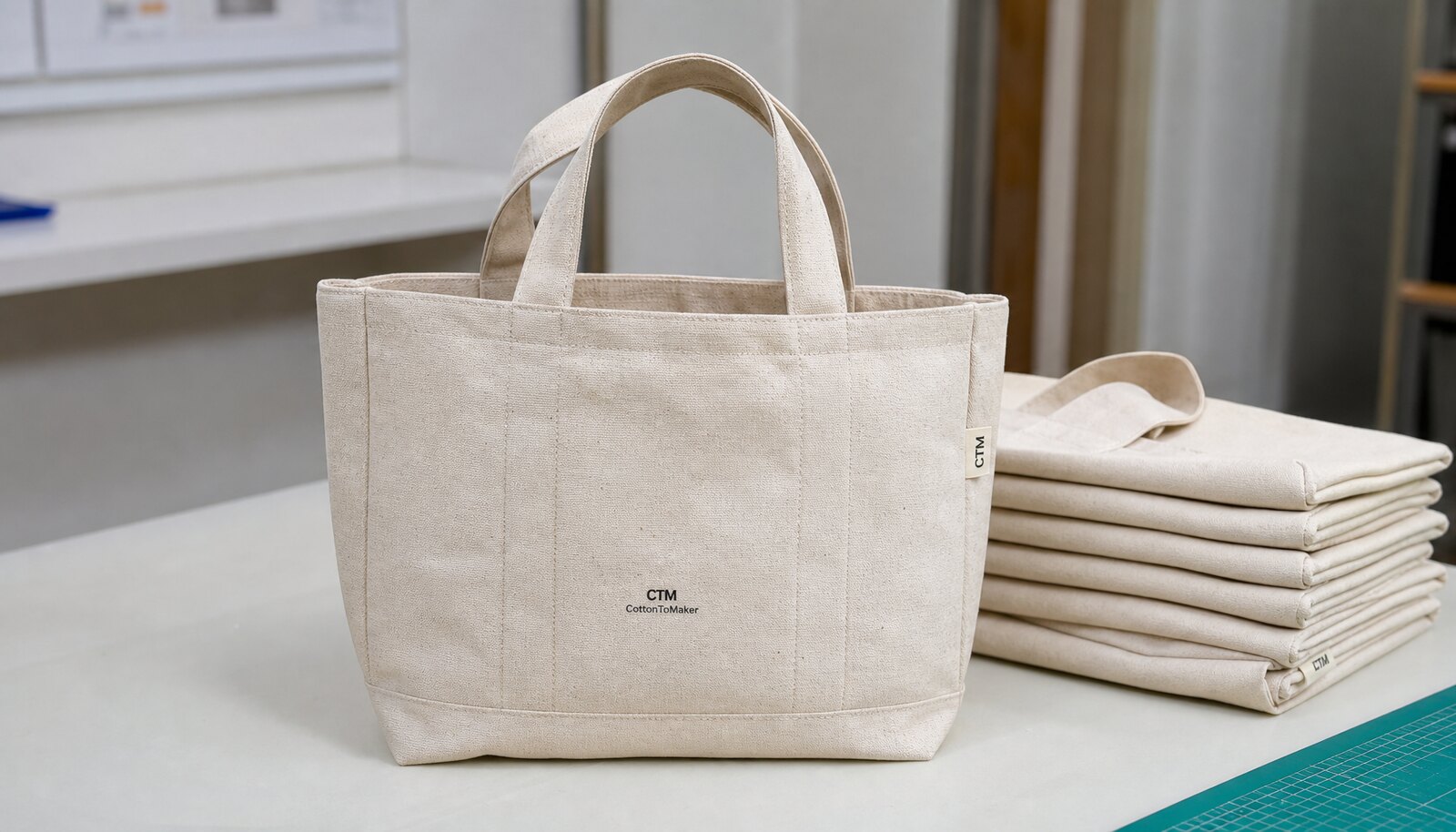
Why carton planning matters before you approve the tote spec
For retail chains, recycled canvas totes rarely fail because of one obvious defect. The bigger problem is that the bag is approved in isolation, then the carton plan is handled later. By the time the factory packs the first bulk lot, the folded tote may be too thick for the intended inner count, the carton may be overweight, or the print may sit in a crease line that looks fine on a sample but damages the retail presentation in transit.
If you are buying for multiple stores or distribution centers, carton planning affects more than freight. It changes carton cube, labor time, pallet pattern, carrier charges, receiving speed, and how easy it is for store teams to replenish units. The most reliable RFQ ties the bag spec to the packing spec from day one, not as a separate afterthought.
- Plan bag dimensions and fold size together, not separately.
- Choose carton counts based on gross weight and compressed thickness.
- Protect the printed face only when the ink system or fold method requires it.
- Treat carton cube as part of landed cost, not just a shipping detail.
Start with the right recycled canvas weight for retail use
For standard retail chains, 12 oz to 14 oz recycled canvas is usually the practical middle ground. It gives the bag enough body for shelf presentation and daily shopping use without pushing freight cost too high. If the bag is too light, it can look limp on shelf and crease badly in the carton. If it is too heavy, carton count drops, carton weight rises, and the cost per landed unit can move up faster than the factory quote suggests.
A 16 oz recycled canvas tote is often better for premium retail programs, books, groceries, or mixed-use shopping bags where customers expect a sturdier feel. The tradeoff is not only fabric cost. Heavier cloth usually needs stronger thread, tighter stitch control, and more attention to handle reinforcement. A buyer should never compare fabric cost alone; compare the finished packed carton cost per thousand units.
- 12 oz-14 oz: standard chain retail, better cube efficiency, balanced feel.
- 16 oz: premium presentation, heavier carry, more freight weight.
- Ask for finished bag weight, not only fabric weight.
- If the tote will be folded flat, test whether the fabric recovers after carton compression.
Printing choices that survive folding, packing, and shelf handling
Screen print is still the safest option for most retail chain orders when the artwork is simple. One to three colors, clean placement, and repeat orders are where screen print performs well. The real advantage is consistency. Once the screens are set and the factory controls ink viscosity and curing, the print tends to stay stable across a long run. The real risk is fold-line damage if the print sits too close to the crease or if the tote is packed too tightly in the carton.
Transfer print or digital transfer is useful for short runs, pilot launches, or artwork with fine details. It can help with small test orders when a chain wants to validate sell-through before committing to a larger run. But the buyer should not accept a vague “same as sample” promise. Require a rub test, folding test, and a clear description of how the print behaves after pressure in the carton. A logo that looks sharp on the sample sheet may still crack if the bag is packed flat under load.
- Simple logos: screen print usually gives the best repeatability.
- Detailed art or short runs: transfer methods can reduce setup time.
- Place the print away from sharp fold lines whenever possible.
- Define acceptable color variance and cure standard before bulk approval.
How MOQ logic changes when carton efficiency is part of the order
Many buyers look at MOQ only by bag design, but carton planning can change the true order economics. A factory may quote a minimum of 1,000 pcs per color, yet the carton configuration may only work at 12 pcs per inner carton or 24 pcs per master carton. If your retail program needs a different store allocation, the factory may need extra packing labor, more carton sizes, or a different fold method. That is where quote comparisons become misleading.
For chain retail programs, it is better to compare MOQ by production block. Ask whether the MOQ is driven by fabric dye lot, print screen setup, sewing line efficiency, or carton packing labor. Those are not the same constraint. If the supplier says the MOQ is low but then charges for special packing, custom inserts, or mixed-carton sorting, the real cost may be higher than a larger but cleaner production run.
- Separate MOQ for fabric color, print design, and carton configuration.
- Clarify whether mixed-color cartons are allowed.
- Ask whether packing labor is included or billed as a special service.
- Use one carton standard across SKUs whenever store routing allows it.
Comparing supplier routes for retail chain tote programs
For recycled canvas totes, the supplier route matters as much as the spec. A direct factory is usually the strongest choice when you need repeat orders, carton discipline, and one team responsible for sewing, print, and packing. A trading company can be useful if you are still comparing construction options or want quick market coverage, but you should verify who actually controls the carton spec and who signs off on final inspection. Split responsibility often creates split accountability.
Retail chains should compare sourcing routes using the same landed-cost logic. Some suppliers quote a good unit price but use oversized cartons, add packing charges later, or send a mixed lot that slows receiving. Others may quote higher on paper but ship in cleaner carton counts with fewer handling errors. The cheapest ex-works price is not always the best chain program quote.
- Direct factory: best for stable repeat programs and tighter process control.
- Trading route: useful for comparison shopping, but confirm actual production owner.
- Look beyond unit price to carton count, gross weight, and packing labor.
- Ask for a carton plan before you compare supplier totals.
Buyer comparison table: which sourcing route fits the program
The table below is the fastest way to compare options without getting trapped in unit-price noise. Use it when you are reviewing quotes from different suppliers or deciding whether to go directly to a factory. The key is to compare what affects the finished shipment, not just what appears on the first price sheet.
Define the measurable checks around fabric weight, size tolerance, handle pull, seam strength, logo rub, stains, loose threads, and carton count verification. Add tolerance ranges only where the buyer truly cares, and ask for photos that show the measurement point, not just a finished product overview.
- Write decisions in measurable language, not only descriptive wording.
- Ask for sample photos plus one physical approval sample for important orders.
- Keep quotation, sample approval, and inspection notes tied to the same spec version.
Sample approval: the bag must fit the carton, not just the artwork
A strong sample process for recycled canvas totes starts with the folded unit, not the flat sewn bag. Measure the finished bag, fold it exactly the way the factory will pack it, then test how many fit into the proposed carton without forcing the stack. If the sample needs manual reshaping to fit, the bulk run will not pack consistently. That is the point where many programs fail quietly and become expensive later.
The buyer should approve the sample on four things at once: appearance, stitch quality, packed thickness, and carton fit. A tote can look fine on the table and still create problems in the DC if the handles spring up, the print wrinkles, or the carton top bows after tape closure. If the sample carton is wrong, change the carton plan before bulk, not after the first shipment is already on the water.
- Use the same fold method intended for bulk packing.
- Check handle lay-flat behavior inside the carton.
- Approve one physical sample carton, not only bag photos.
- Measure the packed sample height after 30 minutes of compression.
Packing methods that protect margin during shipping
Packing is where recycled canvas totes either become efficient retail freight or turn into bulky, expensive shipments. The common method is flat folding with a fixed inner count, then master carton packing based on the final packed height. Tissue or interleaf paper is only worth the extra labor if the print surface needs protection from rub or if the tote has a finish that marks easily. Many chain buyers add tissue by default and pay for extra cube they do not need.
Carton size should follow the folded tote dimension with a small tolerance, not a generous gap. Too much space lets the bag shift and crease; too little space crushes the corners and deforms the top edge. For ocean freight, the most useful metric is not simply carton count, but cartons per cube and the gross weight per carton. That is what drives container efficiency and warehouse handling.
- Flat pack is usually best unless the print requires protection.
- Avoid oversized cartons that create dead space and freight waste.
- Keep gross carton weight manageable for warehouse receiving.
- Use consistent carton marks for SKU, color, and quantity.
Lead time risk comes from approvals, not sewing speed
Factories often give a lead time that sounds reasonable because it covers sewing days only. For retail chain orders, the real schedule is longer. Artwork approval, sample confirmation, carton proofing, material sourcing, and packing trial all add time. If the buyer changes print placement after the sample is approved, the carton fit may also change. That means the timeline slips even when the sewing line stays available.
The safest way to manage timing is to separate the schedule into stages: pre-production sample, carton sample, bulk material reservation, bulk production, packing, and final inspection. Ask the supplier which step has the longest risk window. For recycled canvas programs, fabric availability and print setup are often more sensitive than the sewing itself. A buyer who treats everything as a single “production lead time” usually underestimates risk.
- Confirm lead time after sample approval, not from order placement alone.
- Reserve fabric and packaging early if the program is seasonal.
- Build buffer time for carton proof and barcode verification.
- Do not change artwork after carton sizes have been approved.
Quote comparison: how to read the numbers like a merchandiser
When you receive three factory quotes, compare them line by line. Start with fabric GSM, then print method, then sewing details, then packing and carton data. A quote that looks cheaper may be using lighter fabric, fewer stitches, or a looser fold that reduces packing labor but increases transit damage. If the supplier does not show carton dimensions and gross weight, the quote is incomplete for retail chain buying.
A practical landed-cost view includes the bag, print, packing labor, cartons, and freight impact. For example, two suppliers may both quote the same ex-works price, but one packs 24 pcs per carton while the other only fits 12 pcs because the fold is thicker. The second quote may double carton count and freight handling. That is why the best buyer analysis starts with carton planning and ends with landed cost, not the reverse.
- Compare ex-works price plus packing, not ex-works alone.
- Use carton cube and gross weight to estimate freight impact.
- Treat carton count as a cost driver, not a packaging detail.
- Ask for a quote breakdown if the supplier only gives one total number.
Specification comparison for buyers
| Spec decision | Recommended option | When it fits | Buyer risk to check |
|---|---|---|---|
| Supplier route | Direct factory with in-house cutting, printing, sewing, and carton packing | Best for retail chains ordering repeat programs, mixed color runs, or custom carton counts | Confirm whether packing is done on the sewing line or by a separate team; carton mistakes often happen after sewing is finished |
| Supplier route | Trading company or sourcing agent coordinating multiple factories | Useful when the buyer needs fast price coverage across several bag constructions | Ask who controls carton spec, labelling, and final inspection; divided responsibility usually creates claim disputes |
| Fabric weight | 12 oz to 14 oz recycled canvas for standard retail tote programs | Fits everyday retail carry bags where the product must feel substantial on shelf | Light fabric can stretch or crease in transit; heavy fabric increases carton weight and freight cost |
| Fabric weight | 16 oz recycled canvas for premium chains or heavy-load use | Best when the bag must support more weight, hold shape, or survive repeated shopping use | Check whether handles, side seams, and stitch density are upgraded to match the heavier cloth |
| Print method | Screen print for simple 1-3 color logos | Best for high-volume chain programs with stable artwork and controlled color use | Ink thickness can crack on tight folds if the fabric is over-compressed in packing |
| Print method | Heat transfer or digital transfer for detailed art and short runs | Useful when artwork changes often or small-batch test orders are needed | Transfer durability varies; require wash/rub testing and define pass criteria before bulk |
| Pack count per inner carton | 10 to 20 pcs per inner carton depending on bag thickness and folded size | Fits retail distribution centers that want easy count control and manageable unit weight | Too many pieces per carton can deform bags; too few pieces raise carton and handling cost |
| Master carton plan | Export carton sized to cube efficiently around the folded tote dimensions with 5-10 mm clearance | Best for ocean freight programs where container space and carton stability matter | If cartons are oversized, freight cost rises; if too tight, corners crush and handles crease |
| Closure and protection | Flat folded with tissue or interleaf only when print rub risk is high | Works for printed retail bags with dark ink or coated specialty finishes | Extra inserts add labor and carton volume; use only when the print surface needs protection |
Buyer checklist before sampling
- Final bag size, fabric GSM/oz, handle length, handle width, and seam allowance are written in one spec sheet.
- Artwork file states print size, print position, number of colors, and acceptable color tolerance.
- Fold method, unit pack count, inner carton count, and master carton dimensions are approved before sampling.
- Carton test fit confirms the tote can be packed without forcing, wrinkling, or handle distortion.
- Sample approval includes print alignment, stitch density, seam strength, and fabric handfeel.
- Freight plan distinguishes air, sea, and mixed shipment cost impact by carton cube and gross weight.
- Retail distribution needs for shelf-ready labeling, barcode placement, and carton marks are included in the RFQ.
Factory quote questions to send
- What recycled canvas GSM do you recommend for this size and retail use case, and what is the finished bag weight?
- How many pieces per carton can you pack without crushing the bag shape, and what are the exact carton dimensions and gross weight?
- Which print method is being quoted, what are the setup charges, and what is the expected color tolerance on bulk production?
- Do you quote sewing, printing, packing, and carton marks as one package or as separate line items?
- What is the MOQ by color, by print design, and by carton configuration?
- Can you share sample photos of the folded bag inside the proposed carton and the carton closure method?
- What lead time applies after sample approval, and what part of the schedule is most likely to move if artwork changes?
- Which inspection points are included before shipment, and can you provide carton drop or compression test results if available?
Quality-control points to confirm
- Fabric weight matches the agreed GSM/oz within a reasonable production tolerance and is verified on cut swatches, not only visually.
- Bag dimensions are measured after sewing and after folding, because carton fit depends on finished size, not pattern size.
- Handle attachment uses consistent stitch count and reinforcement at stress points; loose stitching at the handle root is a common failure.
- Print alignment is centered within the approved tolerance and does not drift into the seam allowance or fold line.
- Carton loading does not bend the top edge excessively or force handles into sharp creases that may become permanent.
- Inner pack count is uniform across cartons, with no mixed counts in the same SKU or color lot.
- Barcode, carton mark, and color label placement are readable after taping and palletizing.
- Sample carton closure survives a short transit simulation without burst seams or corner crush.