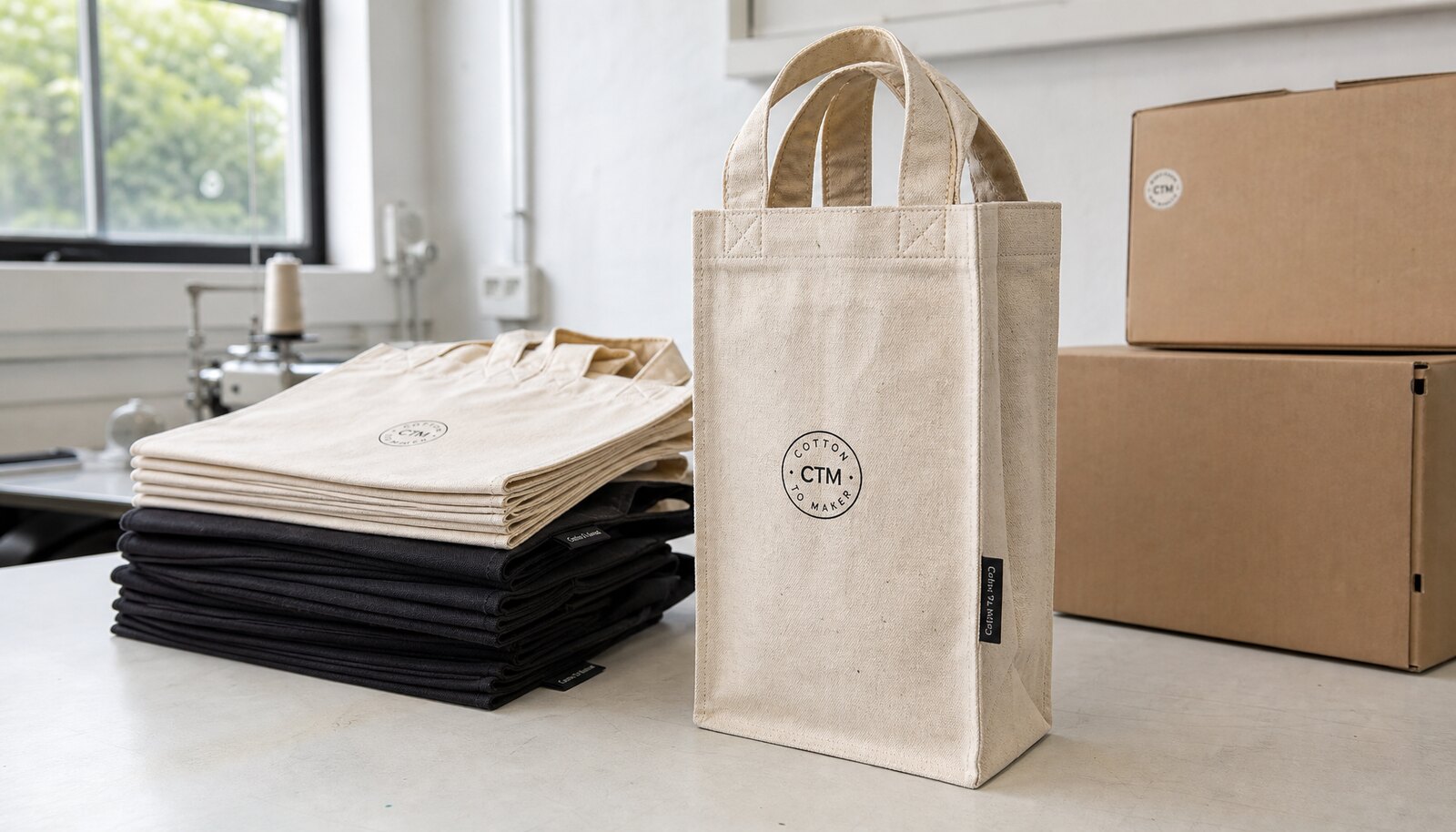
Why winery tote cartons cause avoidable cost
For wineries, the bag itself is usually not the hardest part of the order. The real problem is packing a recycled canvas tote so it ships cleanly, stores efficiently, and lands without extra cube cost or damage. A tote that looks fine on a shelf sample can become a freight problem if the fold is bulky, the handles spring open, or the carton size was guessed instead of calculated.
This matters more with recycled canvas because the fabric often has more body and texture than a smooth cotton twill. That is good for retail perception, but it also makes the carton fill pattern less forgiving. If you are buying for a tasting room, wine club, private label, or distributor warehouse, carton planning should be part of the bag specification, not an afterthought.
- A small change in fold thickness can reduce carton count by 10–20%.
- An oversized carton can trigger cubic freight waste even if unit price is lower.
- A tight retail pack can crush handles and create rejectable crease memory.
Start with the right recycled canvas spec, not just the right price
Most winery buyers narrow the search by appearance first, then discover the bag does not hold its shape, print cleanly, or pack efficiently. For recycled canvas totes, the useful starting point is finished fabric weight. In practice, 12 oz to 14 oz recycled canvas is a strong range for wine retail programs because it keeps enough body for premium positioning without becoming so stiff that folding and carton packing become inefficient.
If the tote is meant to carry one bottle, two bottles, or a bottle plus accessory set, the handle and side seam construction matter as much as the cloth. Ask for the finished GSM or finished oz after dyeing or washing, not only the source cloth weight. A supplier can quote a base weight that looks good on paper but loses structure after processing.
- 12 oz works for lighter retail carry and gift packaging.
- 13–14 oz is usually safer for premium winery positioning and better shape retention.
- If the bag includes bottle dividers or gussets, confirm the fold still fits the carton target.
Choose the sourcing route that matches your carton control needs
There are three practical sourcing routes for this item: direct factory, trading company, or local distributor. For carton planning, direct factory is usually the best route because the same team that makes the bag can also lock the inner pack, master carton, and export marks. That matters when the bag is being shipped to multiple warehouse locations or retail channels.
A trading company can help when you need mixed SKUs or a small order across several colors, but make sure they are not simply relaying a bag quote without carton data. Local distributors are faster, but they often bundle hidden margin into freight and domestic handling. If you only compare unit bag price, you can easily miss the real landed cost.
- Direct factory: best for repeat orders and custom packing requirements.
- Trading company: useful for mixed programs, but verify who controls final carton spec.
- Local distributor: good for speed, weaker for cost transparency and packing customization.
Use a comparison table before you approve the supplier route
When buyers compare quotes, they often receive one price for the tote and a separate freight estimate with no carton detail. That is not enough to judge the landed cost. The carton format affects how many units fit per master carton, how much cube you buy, and how much damage risk the warehouse absorbs on receipt.
A useful comparison is not just supplier A versus supplier B. It is direct factory versus trading company versus local source, with the same bag spec, the same print method, and the same carton target. Only then can procurement see whether the lower ex-factory quote actually wins.
- Use one approved sample size across all sources.
- Keep print count and carton count fixed during comparison.
- Ask every supplier to quote carton dimensions and gross weight.
Comparison of sourcing routes for winery recycled canvas totes
The table below is meant to help procurement teams compare the routes that actually affect carton planning and landed cost. It is less about general capability and more about how the supplier structure changes control over packing, freight cube, and quality consistency.
The sample record for recycled canvas totes for wineries shipping carton planning should include front, back, side, seam, logo, label, inside, and packed-carton photos. For important programs, keep one signed physical sample and record the sample version in the approval file.
- Write decisions in measurable language, not only descriptive wording.
- Ask for sample photos plus one physical approval sample for important orders.
- Keep quotation, sample approval, and inspection notes tied to the same spec version.
Print method and artwork choices that survive coarse canvas
Recycled canvas is not the right surface for every design. The texture is visually attractive, but it can break up small text and thin lines. For wineries, the best-performing artwork is usually one-color screen print, a woven label, or a simple heat-applied mark if the bag surface is smooth enough. If the brand needs a more premium finish, embroidery can work, but it adds thickness and may affect carton fit.
For a bottle tote, keep the artwork area practical. Large logos and clean typography tend to print more reliably than gradients or highly detailed vineyard illustrations. Before bulk approval, inspect the strike-off at arm’s length and also from a normal shelf distance. What looks acceptable on a sample sheet can become muddy on the textured bag surface.
- One-color screen print is usually the lowest-risk method for recycled canvas.
- Woven or sewn labels reduce ink spread risk and can feel more premium.
- Multi-color logos increase setup cost and can require higher MOQ per color.
MOQ logic: why total quantity is not the only number that matters
A low total MOQ can be misleading if the order includes multiple logo versions, bottle formats, or handle options. In most factories, the real cost drivers are fabric cutting setup, print screens, label runs, and packing changes. If you split a small order across too many variants, the per-unit cost rises and the carton plan becomes harder to standardize.
For wineries, MOQ should be discussed by color, artwork, and pack pattern. If you have a seasonal label change, it may be better to hold the same bag body and adjust only the print or woven label. That keeps carton dimensions stable and reduces the chance of warehouse confusion between vintages.
- Ask whether MOQ is per color, per artwork, or per handle style.
- Keep the bag structure consistent if the label artwork changes seasonally.
- Use one master carton spec where possible to simplify reorders.
Packing design: the carton spec that protects margin
The carton is not just shipping protection. It is a margin control tool. A tote that folds too loosely wastes cube; a tote that folds too tightly creates handling damage. The right answer is usually a flat-fold pack with a carton quantity that balances retail appearance, warehouse handling, and freight efficiency. For many recycled canvas tote programs, the carton count should be based on both usable interior space and how quickly warehouse staff can receive and count the goods.
If the tote includes extra structure, such as a gusset, bottle divider, or reinforced base, sample the exact fold before the quote is finalized. Some bags look compact on the table but spring open inside the carton. That one detail can force a larger carton, reduce pallet density, and push up the landed cost more than any change in unit bag price.
- Define whether the bag ships retail-ready, bulk-packed, or pallet-prepared.
- Confirm if inner polybags or tissue are needed to protect print and finish.
- Request carton mock-up photos with the approved fold before mass production.
Lead time and schedule risk for seasonal wine programs
Wine programs are often tied to harvest, gifting season, club shipments, or event calendars. That means lead time risk is not just production time; it is also sample approval time, carton approval time, and freight booking time. A factory may quote 25 to 35 days for production, but if artwork approval drifts or carton specs change after sampling, the real schedule expands quickly.
Plan the timeline in three blocks: sample development, bulk production, and shipping. For imported orders, add margin for customs clearance and warehouse receiving. If the order is for a gift set or retail launch, the warehouse may need advance carton labels, outer marks, and pallet configuration before the cargo leaves the factory.
- Use a signed sample to lock print placement and carton fit.
- Do not release bulk production until carton dimensions and outer marks are approved.
- Reserve freight capacity early when the order hits peak season.
What to inspect in the pre-production sample
The sample should prove more than appearance. A good pre-production sample confirms fabric handfeel, stitch balance, handle length, print legibility, and carton fit. For recycled canvas totes for wineries, the critical test is whether the bag folds naturally into the agreed pack size without forcing the handles or creating a hard ridge in the body.
Use the sample to compare against the quote line by line. If the sample looks better than the quote spec, production may drift downward. If the sample includes hidden improvements like extra stitching, a denser label, or thicker fabric, the quote may not be sustainable at scale. The goal is to align exactly what will be made, packed, and shipped.
- Check print registration on both smooth and textured areas.
- Measure handle drop and seam allowance against the approved drawing.
- Fit the sample into the proposed carton quantity before sign-off.
Specification comparison for buyers
| Spec decision | Recommended option | When it fits | Buyer risk to check |
|---|---|---|---|
| Fabric weight | 12–14 oz recycled canvas, finished weight confirmed by pre-production swatch | Premium winery retail programs, gift shops, bottle-pairing sets, and reusable carry bags that need structure | Some mills quote greige weight only; verify finished GSM after washing, coating, or dyeing |
| Print method | 1-color screen print or woven/printed label for tighter logo control | Most winery SKUs with simple branding, QR codes, or vintage names | Fine type can fill in on coarse recycled canvas; approve strike-off under production lighting |
| Supplier route | Direct factory with carton-packing spec and export experience | Buyers shipping mixed SKUs or private-label programs with repeat orders | Factories may quote bag cost only; carton, inner packing, and pallet data must be included |
| MOQ logic | MOQ by color + print setup, not just total bag count | Multiple wine labels, club tiers, or seasonal artwork variations | A low total MOQ can hide high per-color setup cost and excess stock risk |
| Carton pack-out | Inner poly or tissue + master carton sized to avoid over-compression | Recycled canvas that must keep a clean fold and retail-ready appearance | Overpacked cartons crush handles and create fold memory that buyers notice at opening |
| Carton strength | Export-grade corrugated with burst and drop performance aligned to route | Ocean freight, long dwell times, or mixed warehouse handling | Thin cartons may pass a packing photo but fail in transit under stack pressure |
| Sample approval | Pre-production sample with print placement, stitch count, and carton fit confirmed | New bag shape, new handle length, or first-time winery branding | A good-looking sample can still fail carton fit if fold direction changes carton count |
| Sourcing route | Factory direct plus freight forwarder quote comparison | Buyers needing landed-cost control and repeat replenishment | Ignoring carton dimensions can distort cubic freight and make the cheapest bag quote the most expensive landed |
| Packing format | Flat-folded bags with carton quantity optimized for carton cube and warehouse handling | Standard retail replenishment and importer distribution | Too many pieces per carton can create deformation; too few increases freight cost per unit |
Buyer checklist before sampling
- Confirm finished fabric weight in oz/GSM, not only the supplier’s base cloth spec.
- Lock the bag fold size, handle lay-flat direction, and carton quantity before quoting freight.
- Request a pre-production sample that includes print placement, seam construction, and carton-fit test.
- Ask for master carton dimensions, gross weight, and pieces per carton on the first quote.
- State whether cartons need retail-ready appearance, warehouse-only protection, or palletized export loading.
- Align logo color count, print size, and artwork tolerance with the chosen recycled canvas texture.
Factory quote questions to send
- What is the finished fabric weight in GSM or oz after processing, and is it measured on dyed/washed material?
- How many pieces per inner pack and master carton are you quoting, and what are the exact carton dimensions and gross weight?
- Is your MOQ based on total pieces, per color, per print setup, or per handle option?
- Which print method is included in the quote, and what is the cost difference for one-color versus multi-color artwork?
- Will you provide a pre-production sample that matches final fabric, print, stitch density, and folding method?
- What carton strength or export packing standard do you use for ocean freight or long warehouse storage?
- Can you show the unit price broken out by bag, print, packing, and carton so landed cost can be compared fairly?
Quality-control points to confirm
- Fabric weight tolerance: allow a practical range, but reject lots that are visibly lighter than approved sample or that lose structure under normal fill weight.
- Stitching: handle attachment must be even, with no skipped stitches, loose threads, or seam puckering at the load point.
- Print placement: logo centered within the approved tolerance and readable on coarse recycled canvas without broken lines or heavy ink bleed.
- Carton fit: folded bags must slide in without forcing, over-compressing handles, or bending the top edge into a permanent crease.
- Carton labeling: SKU, color, quantity, and PO reference must match the packing list exactly to avoid warehouse receiving errors.
- Sample-to-bulk match: compare bulk to signed sample under daylight and warehouse light, not only under showroom lighting.