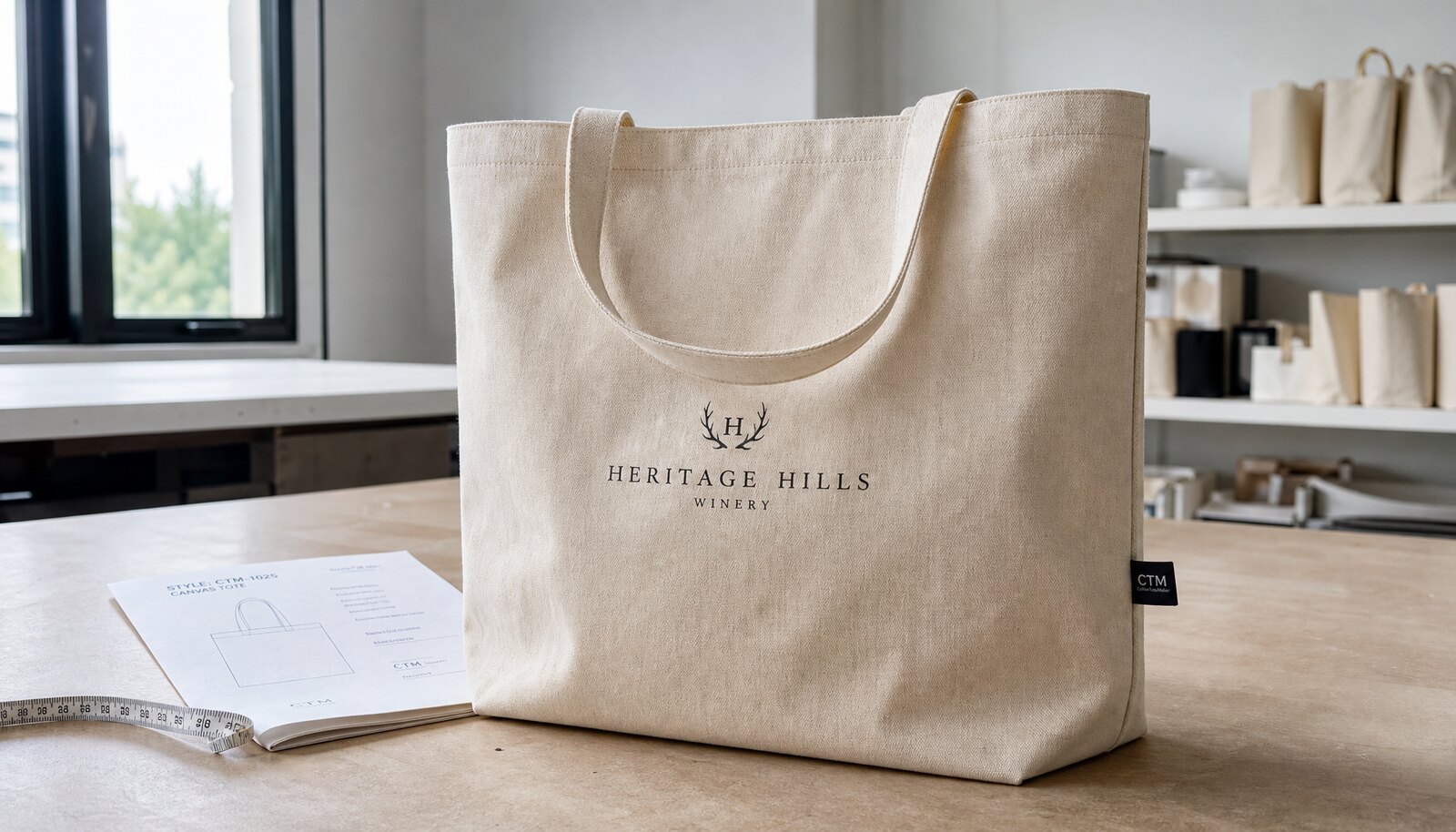
Why winery tote failures are usually spec failures, not sewing failures
Recycled canvas totes for wineries look straightforward, but most production problems start with a vague brief rather than a bad sewing line. Buyers often ask for a sustainable tote, a premium look, and enough strength to carry bottles, yet they do not define the actual carry load, bag use case, or acceptable finish level. That leaves the factory to make assumptions. One supplier may build a soft promotional bag, while another quotes a structured retail tote. Both can be “correct” from their own point of view, and both can still miss what the winery needed.
For procurement teams, the real risk is not only a weak bag. It is a bag that looks acceptable in a sample photo but becomes expensive once bulk production starts: logos shift, handles twist, bottom seams pull, or the canvas arrives lighter than expected. In a winery setting, those issues matter because the tote is both a carry item and a brand touchpoint. If it feels flimsy at the tasting room counter, it can undercut the bottle or gift set it is meant to elevate.
The strongest buying process starts with functional clarity. State whether the tote is for retail sale, gift-with-purchase, tasting-room merchandising, or event giveaway. Then define the bottle count, weight load, shelf display expectations, and any warehouse constraints. Once those are fixed, the supplier can quote the right fabric, reinforcement, and packaging without padding the spec in ways that increase cost but do not improve performance.
- Winery buyers should define use case first, then fabric, print, and packaging.
- Most cost overruns start with missing assumptions, not with the final sewing operation.
- A tote that passes visual approval but fails under bottle load is still a reject.
Set the product brief before you ask for price
If the bag spec is not written down, supplier comparisons become unreliable. The brief should include the finished dimensions, gusset depth, handle length, bottle count, recycled content claim, print method, and pack-out format. That sounds basic, but these are the points that separate a solid quote from a dangerous one. A supplier can only price what it can measure, and a procurement team can only compare what is written the same way across vendors.
For winery programs, the brief should also state the expected retail impression. A tasting-room resale tote needs cleaner stitching, more controlled print edges, and better fold presentation than a short-run promotional handout. If the buyer wants a premium feel, that should be expressed in the spec: tighter finishing, more structured base, consistent label placement, and a cleaner internal seam appearance. If the buyer only needs a functional carrier for a seasonal promotion, the spec can be simpler and cheaper.
The best RFQ format is not long; it is complete. One page of exact dimensions, artwork placement, material requirement, and pack rules will usually outperform a three-page prose description. Include annotated drawings or a tech pack if available. For recurring orders, keep the approved sample, the revision number, and the inspection criteria together so reorders do not drift by interpretation.
- Write the tote’s purpose in one line: retail, gifting, event use, or POS carry-out.
- Include a dimension drawing with body width, height, gusset depth, and handle drop.
- State whether the buyer needs a premium retail finish or a utility-grade promotional finish.
- Keep the spec version number on every sample and quote response.
Choose the recycled canvas construction that matches the load and the shelf
Fabric choice is where a lot of tote orders go wrong because buyers anchor on fabric weight without connecting it to use. For recycled canvas, the practical range for winery bags is often about 12 oz to 16 oz, or roughly 400–540 GSM. The lower end can work for lightweight promo use. The middle and upper range is usually better for retail presentation, better shape retention, and more comfortable bottle carry. But a heavier number alone does not guarantee a better bag. A loose weave can still feel soft and a denser weave can still distort if the sewing is weak.
Buyers should specify whether the fabric needs to be 100% recycled cotton canvas or a recycled blend. That affects texture, color variation, and how consistent the print surface will be. Natural undyed recycled canvas usually has more fiber variation, which can suit earthy winery branding. Dyed canvas can look cleaner and more retail-ready, but it needs stronger shade approval because recycled fiber lots can vary from batch to batch. If the program will be reordered, insist on a stable base fabric and a documented shade reference.
For bottle support, look beyond fabric weight to the construction. A gusseted base with reinforced stress points is usually more reliable than a flat bag if the tote will be used to carry glass bottles. If the buyer wants a flatter silhouette for merchandising, that can work too, but the load test should be stricter. The bag should not twist at the bottom or buckle at the side seam when the bottle weight settles.
- 12 oz / about 400 GSM: suitable for lighter promotional or giveaway use.
- 14 oz / about 450–480 GSM: a practical middle ground for winery retail totes.
- 16 oz / about 500–540 GSM: better for stronger structure, bottle support, and a premium hand feel.
- Ask for a swatch and a finished sample; do not approve fabric from a catalog description alone.
Side-by-side sourcing comparison: what each supplier route really changes
Procurement teams often compare recycled canvas tote quotes as if they were all coming from the same kind of supplier. They are not. A factory direct quote, a factory with outsourced printing, a trading company, and a low-MOQ specialty vendor each create a different cost structure and different inspection burden. The table below is not just about specs; it is about the sourcing model itself, because that is where lead-time and quality risk usually live.
The key procurement question is not which route is cheapest in a spreadsheet. It is which route gives the winery enough control over print quality, bottle-carry performance, and delivery certainty for the intended use. A premium retail tote can justify more QC work. A one-off event bag may justify a simpler route if the design is short-lived. Matching the route to the program avoids overbuying quality where it is not needed and underbuying where the brand will see the defect every day.
What to inspect on the sample: body, handles, print, and fold
A useful sample approval process goes beyond saying yes or no to a visual mockup. Start with the blank swatch, then the print strike-off, then the full pre-production sample. Each stage answers a different question. The swatch tells you whether the canvas surface and shade are acceptable. The strike-off tells you whether the logo fits, the ink coverage is solid, and the artwork reads cleanly on the weave. The full sample confirms the finished geometry, seam quality, handle reinforcement, and fold behavior in the carton.
For wineries, sample testing should mimic real use. Put the intended bottle load into the tote and observe how the base sits, whether the handles remain comfortable, and whether the print area distorts under tension. Check the distance from the logo to the top seam and side seam with a ruler. Measure the handle drop so the tote carries correctly in the hand or over the shoulder. If the tote is supposed to sit neatly on a tasting-room shelf, fold it and confirm the crease line does not break the visible print area.
If the sample looks good only from a distance, keep digging. Inspect the inside seams, the top edge finishing, the handle attachment points, and any label stitching. The best sample approval records include photos, measurements, a dated sample card, and the exact revision of the artwork used. That way bulk inspection can compare the shipment to the same standard rather than to memory.
- Approve a physical pre-production sample, not just a mockup.
- Measure bag height, body width, gusset depth, and handle drop against the approved drawing.
- Check the inside seams, top edge, and handle join for loose thread or uneven reinforcement.
- Record the approved sample date, artwork revision, and fabric batch reference.
Quality thresholds that are specific enough to reject bad lots
A buyer-facing checklist only works if it uses measurable standards. For recycled canvas totes, the most important criteria are not subjective phrases like “good quality.” They are specific limits for stitch quality, seam placement, print alignment, stain control, and load performance. If a supplier understands the rejection threshold, the inspection becomes more consistent and the negotiation becomes easier. Without thresholds, every discussion turns into opinion.
Below is a practical threshold approach for winery tote programs. These are procurement-oriented benchmarks, not universal laws, but they are far more usable than generic wording. Define what counts as a critical defect, what counts as a major defect, and what counts as a minor defect. Critical defects should trigger rejection or rework because they affect function or retail acceptance. Major defects may be isolated but still costly. Minor defects can be allowed in a limited percentage if they do not affect brand presentation or use.
For example, a loose thread end may be minor if it is trimmed easily and does not sit on a visible front panel. A seam opening at the handle base is critical because it affects load safety. A one- to two-millimeter print shift may be acceptable if it remains inside the agreed tolerance; a logo that sits visibly off-center on the front panel is not. The goal is not perfection. The goal is a repeatable standard the factory can actually meet.
Recommended buyer thresholds: set stitch density, seam allowance, and print tolerance in the purchase file; define stain limits by visibility and size; and require the factory to explain the cure method or drying method for printed bags if the print is likely to be rubbed or folded in transit.
- Critical defects: seam failure, handle detachment, wrong size, missing bag pieces, major logo misplacement, heavy stains, or broken functionality.
- Major defects: loose reinforcement stitching, visible print distortion, uneven panel alignment, or repeated thread breaks in stressed areas.
- Minor defects: small trim tails, slight texture variation in recycled fiber, or limited shade variation within the approved lot window.
- Ask the supplier to state the stitch count per inch and seam allowance target used on the production sample.
- For print, require a measurable placement tolerance rather than “centered by eye.”
QC checklist for sewing, printing, and bottle-load performance
Factory inspection should cover three layers: sewing integrity, print quality, and practical load performance. Sewing checks confirm whether the tote survives real use. Print checks confirm the brand appearance. Load checks confirm that the bag can actually carry the bottles the winery intends to sell or give away. If the inspection only reviews appearance, the bag can still fail in the hand. If it only reviews strength, the brand can still reject it for a crooked logo.
Sewing checks should include straightness of seams, consistency of seam allowance, reinforcement at handle anchors, and the absence of skipped stitches. Printing checks should include color density, edge clarity, registration, and whether the ink surface cracks or transfers when folded. Load checks should use the agreed bottle weight or a substitute weight equivalent to the intended use. One practical approach is to place the intended bottle load in the bag, carry it by the handles for a defined period, and then inspect for seam opening, handle stretch, or base distortion.
For wineries, the tote often needs to look good on shelves and work in use. That means the QC team should inspect both a clean, empty bag and a loaded bag. Some defects only appear after the bag is under strain. For example, the logo can wrinkle once the canvas pulls across the front panel, or the handle stitch can look fine until weight shifts into one corner. Those are the failure modes that matter most because customers see them immediately.
- Stitch count: confirm the production target and inspect for skipped or loose stitches at stress points.
- Seam allowance: confirm the allowance is consistent enough that the seam line does not wander visibly or weaken the edge.
- Load test: use the intended bottle count or equivalent weight, hold for a fixed period, and reject seam opening or handle stretch-out.
- Print tolerance: define how far the logo may shift from the approved placement before it becomes a reject.
- Rub/fold check: fold the tote and rub the print area to confirm the finish does not crack, smear, or transfer easily.
MOQ, price drivers, and why low minimums can cost more later
MOQ is not just a factory policy; it is a reflection of setup labor and process complexity. Cutting, screen preparation, sample approval, color matching, and packing all create overhead before the first tote is sewn. If the buyer wants a lower MOQ, the factory usually has to simplify the product somewhere: fewer print colors, standard stock fabric, fewer label components, or less custom packing. That is normal. What is not normal is accepting a vague low-MOQ quote and discovering later that the supplier hid the extra cost in setup, sample fees, or a weaker QC process.
Price changes are usually driven by fabric weight, print method, handle reinforcement, packaging level, and artwork complexity. A thicker canvas requires more material and often more labor at the needle. Multiple print colors can add screens and setup time. Reinforced handles add stitching time. Retail-ready packing adds handling and insert costs. Even freight assumptions can make one quote appear cheaper than another if the terms are not aligned. For that reason, the buyer should always compare quotes on a common basis: product only, packing included or excluded consistently, and freight separated from manufacturing cost.
The operational question is whether the supplier can hold the same spec during reorder. For wineries, that matters because the bag often becomes part of a seasonal line or a standing retail SKU. A low price is useful only if the supplier can repeat the same canvas shade, print placement, and sewing standard on the next order without surprises.
- Lower MOQ usually means higher cost per piece or fewer options in fabric and finishing.
- Custom dye, custom labels, or premium packing can raise MOQ more than the print itself.
- Ask whether setup charges are one-time or repeated on every reorder.
- Compare supplier quotes only after confirming the same trade term and packing basis.
Packing, carton marks, and warehouse receiving controls
Packing should be treated as part of quality control, not just a shipping step. Winery totes often go into seasonal storage, gift sets, or retail replenishment. If the bags are folded too tightly, they can hold crease lines across the face of the tote. If they are packed loosely, carton counts become unstable and receiving slows down. If carton marks are vague, the DC may waste time reconciling the shipment against the purchase order. These are preventable issues if the buyer writes the packing spec clearly.
Flat packing is usually the safest default for recycled canvas tote programs. It gives better carton density and easier receiving. But the fold method still matters. The fold should keep the print area readable and avoid deep compression at the front panel. If the tote includes a tag, woven label, barcode sticker, or insert card, the supplier should show where it is placed and how it is protected from scuffing. For retail resale, a cleaner fold and better presentation may justify slightly higher labor cost.
Carton control should include the count per carton, gross weight limit, style code, PO number, and destination mark. Ask the factory to send carton photos before shipment if the order is time-sensitive or retail-critical. That simple step catches mixed counts, wrong carton labels, and poor packing discipline before the shipment reaches the warehouse.
- Specify the fold line so the print area does not crease badly in transit.
- Confirm whether individual polybags, tissue wrap, or no inner wrap is acceptable.
- Make carton quantity, gross weight, and style mark part of the approved pack spec.
- Request carton photos or a packing sample before final shipping when the order is for retail resale.
Lead time risk: where winery tote orders usually slip
The promised lead time on a tote order is only useful if the starting point is clear. A factory may quote production days from order confirmation, but the clock should really start after the physical sample is approved and deposit terms are complete. Otherwise the buyer inherits hidden delay from lab dips, artwork revisions, or revised packing instructions. For seasonal winery launches, those delays can be the difference between being on shelf for a promotion and missing the window entirely.
Most schedule slips happen in the early stages. Material confirmation takes longer than expected. The first print strike-off needs a second round. The sample arrives with the wrong handle length. Or the plant discovers that the requested packing format requires more labor than planned. Buyers can reduce this risk by requiring the supplier to confirm which materials are in stock, which processes are in-house, and which steps depend on outside vendors.
The most useful schedule question is not just “how long?” but “what has to happen before production can start?” If the supplier relies on outsourced printing, ask who controls the print slot and who signs off the final image. If the bag needs a specific shade, ask whether a lab dip or shade reference is needed before cutting. If the order is calendar-sensitive, build a buffer into the plan for rework and packing approval.
- Ask for lead time from physical sample approval, not just order placement.
- Confirm whether fabric, printing, and packing are all in-house or split across vendors.
- Build schedule buffer for artwork revisions, shade approval, and carton artwork sign-off.
- For seasonal programs, back-plan from the in-store date rather than the PO date.
Specification comparison for buyers
| Sourcing route | Typical fit for winery buyers | Pricing and MOQ profile | QC burden | Use-case tradeoffs |
|---|---|---|---|---|
| Factory direct, in-house sewing and printing | Best for repeat retail programs, private label reorders, and buyers who need spec control | Usually strongest on unit cost once volume reaches roughly 500–1,000 pcs; setup costs are more visible but easier to negotiate | Lower handoff risk because one supplier owns more of the process; still requires clear inline and final inspection checkpoints | Best when you need stable quality, repeatable color, and one accountable factory; less flexible if you want very low MOQ or unusual packaging |
| Factory direct with outsourced printing or finishing | Useful when you need a broad material choice but the factory does not run every process internally | Can look competitive on paper, but quote may exclude subcontractor charges, extra sampling, or longer schedules | Higher QC burden because print, sewing, and packing are separated; buyer should confirm who signs off each stage | Works for standard bags, but lead-time risk is higher if the printer or finisher slips |
| Trading company or sourcing agent | Useful for buyers who want one contact point, multi-supplier comparison, or broader category support | MOQ can be flexible, but fees may be embedded in the unit price; price transparency is weaker unless the quote is broken out clearly | QC burden shifts to the buyer unless the agent provides written inspection records and corrective-action follow-up | Can help with coordination, but responsibility can be fragmented if defects appear after shipment |
| Low-MOQ specialty supplier | Best for trials, small winery runs, seasonal promotions, or artwork testing before a full retail program | Lower entry volume, but higher per-piece cost and fewer material/finishing options | QC is manageable if specs are simple; becomes risky when the buyer asks for custom color, label, or complex construction | Good for testing the market, not always ideal for matching long-term retail presentation or replenishment consistency |
| Retail pack-out / gift-ready supplier | Fit for tasting room resale, corporate gifting, and presentation-focused programs | Higher labor and packing cost; MOQ often rises because of extra handling and component control | QC must include fold consistency, label placement, carton cleanliness, and insert accuracy | Best when the bag is part of a premium gift set; not the cheapest route for simple carry-out use |
| Material | cotton canvas, jute, felt, nonwoven, or laminated paper sized to bottle diameter, weight, and condensation risk | Before price comparison | Different cloth weights, backing, or certification claims make quotes hard to compare | |
| Construction | bottle fit, bottom reinforcement, handle or cord strength, divider option, seam allowance, and upright stability | Before sampling | Weak stress points create returns and failed inspections | |
| Decoration | screen print, hot stamp, woven label, embroidery, or paper label positioned for curved bottle presentation | Before artwork approval | The wrong method can crack, bleed, pucker, or fail on the chosen fabric |
Buyer checklist before sampling
- Confirm whether the recycled canvas is post-consumer, pre-consumer, or blended, and ask for the finished fabric weight in both oz and GSM.
- State the intended bottle load in the RFQ: one bottle, two bottles, or mixed retail carry, because the load requirement changes the base, handle reinforcement, and seam spec.
- Approve a physical pre-production sample, not a photo only. The sample should show fabric, print placement, stitching, packing fold, and carton mark.
- Ask for a tolerance sheet that defines acceptable finished dimensions, logo placement, handle length, stitch spacing, and color shade variation.
- Request a load test method in writing: how many bottles, what total weight, how long the bag must hold the load, and what counts as failure.
- Define packaging requirements up front, including flat fold, inner polybag, insert card, barcode label, and master carton count.
- Separate quote lines for fabric, sewing, printing, labels, packaging, and freight assumptions so suppliers can be compared on the same basis.
- Ask the supplier to name the inspection stage that catches problems before shipment and to show the defect categories used for pass/fail decisions.
Factory quote questions to send
- What recycled canvas weight do you recommend for a one-bottle, two-bottle, or mixed retail tote, and what finished bag weight will that produce after sewing and washing loss?
- Is the quoted fabric weight mill weight or finished fabric weight after processing, cutting, and shrinkage?
- Which print method is included in the quote, how many colors are priced, and what are the setup charges per design or per screen?
- What MOQ applies to this exact spec, and which changes would raise it: handle length, gusset size, lining, label, or print complexity?
- Can you share seam standards, handle reinforcement detail, seam allowance target, and stitch count per inch used on stress points?
- What sample sequence can you provide before bulk: fabric swatch, print strike-off, and full pre-production sample?
- What is the standard lead time after physical sample approval, and what events usually push production beyond that schedule?
- How do you pack the bags for export, what carton dimensions and gross weight should we expect, and can you confirm pack count by carton?
- Which inspection point do you use before shipment, and what are your defect thresholds for print misalignment, stains, broken stitches, and carton count errors?
- Can you provide photos or a written report from your final inspection, including lot quantity, sample size, and any rework performed before packing?
Quality-control points to confirm
- Fabric weight must match the approved range; set a minimum acceptance floor so lightweight substitutions are caught before cutting.
- Finished dimensions should stay within an agreed tolerance band, especially bag height, body width, gusset depth, and handle drop; record the actual tolerance in millimeters or inches.
- Handle reinforcement must be symmetrical, securely bartacked or box-x sewn where specified, and free from loose thread bundles at the upper stress points.
- Seam allowance should be consistent across the sample and bulk run; where the spec calls for a target allowance, check that it does not visibly drift from panel to panel.
- A practical load test should use the intended bottle count and a defined weight. Example: place the approved bottle load in the tote, lift by the handles for a fixed period, and reject any seam opening, handle stretch-out, or bottom distortion.
- Print placement should be checked against the approved artwork position with a measurable tolerance; reject obvious offset, rotation, bleed, haloing, or text fill-in that affects readability.
- Stain control should be written into the standard: reject oil marks, glue spots, dye smears, or heavy soil that would be visible at arm’s length on retail goods.
- Canvas surface should not have broken fibers, foreign threads, hard inclusions, or slubs that affect function or appearance in the approved retail zone.
- Carton checks should verify pack count, barcode or style mark, carton quality, top-to-bottom compression, and whether the carton contents match the packing list.
- Bulk goods should be checked against the approved sample version and revision date so the wrong trim, artwork, or fabric shade does not enter shipment.