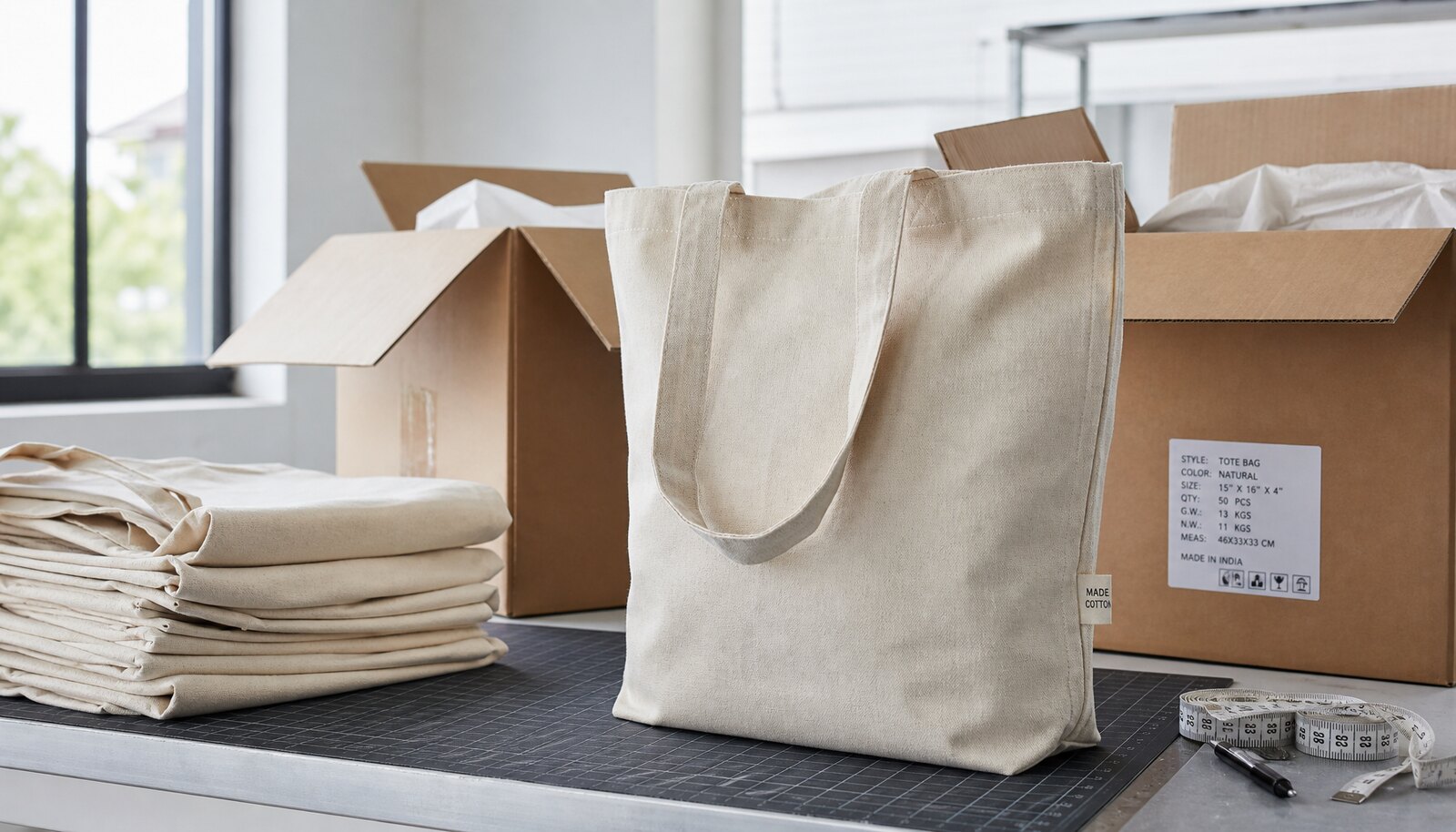
Why carton planning matters more for trade show totes than for normal retail orders
Trade show tote bags are bought to solve a date-driven problem. The bags have to arrive on time, open cleanly, and look presentable at the booth or in attendee kits on a fixed schedule. That means procurement is not just buying a tote; it is buying a packaging and logistics outcome. If the cartons are planned poorly, the bags can arrive overcompressed, hard to distribute, or expensive to ship even when the tote unit price looks competitive.
For recycled canvas tote programs, carton planning affects several commercial levers at once. It influences freight cube, gross weight, handling labor, carton damage risk, and the amount of time the show team spends opening and sorting cartons on site. A supplier can offer a sharp tote price and still be expensive overall if the packing method forces low carton efficiency or a repack at destination.
The practical buyer question is simple: what does one ready-to-use carton cost, not just what does one tote cost? That framing changes the discussion from decorative samples to operational reality. For show programs, especially those going through a forwarder, a booth contractor, or multiple destinations, the carton specification is part of the product spec. Procurement teams that write it that way usually get more usable quotes and fewer surprises after production.
- Trade show orders are deadline-driven, so packaging must be specified before bulk cut, not after decoration approval.
- Carton size affects freight cube, warehouse handling, and booth unpacking time.
- The best quote is the one that arrives at the venue in the right condition, not the one with the lowest tote-only unit price.
Start with the tote spec that can survive folding, stacking, and handling
The most common practical starting point for recycled canvas totes for trade shows is 10 oz to 12 oz canvas. Ten ounce recycled canvas is often enough for lighter giveaway programs: brochures, one or two samples, or a small catalog set. Twelve ounce is the safer choice when the bag must feel more structured, recover better after folding, or carry enough weight that the handle and top hem matter as much as the print.
Fabric weight is only part of the story. Weave density, finishing, and seam construction can change how the bag behaves in a carton. A looser weave at the same nominal weight can crease more visibly, and a soft finish can make the tote look relaxed but also collapse easier under carton pressure. If the bag is expected to stand upright on a booth counter or inside a kit box, the buyer should ask for a firmer hand feel and a pattern that does not twist after packing.
It helps to define the tote in production terms rather than marketing terms. Instead of only asking for a “recycled canvas tote,” write down finished dimensions, gusset depth, handle length, top hem construction, seam type, and the intended fill weight. The factory can then decide the best cutting and packing method for shipping. That is especially important when the bags will be folded for export, stored for several weeks, and then opened at a show where presentation still matters.
A useful rule of thumb is to balance structure against shipping weight. If the tote will be a premium trade show giveaway or part of a booth kit, 12 oz recycled canvas usually gives the better commercial result. If the tote is a one-time handout and total logistics cost is tight, 10 oz can be acceptable, but only if the supplier’s folding method and carton spec are proven with a packed sample.
- Use 12 oz recycled canvas when presentation, body structure, and handle durability matter more than the absolute lowest freight cost.
- Use 10 oz recycled canvas when the order is price-sensitive and the bag will carry lighter contents.
- Write the spec in measurable terms: finished size, gusset, handle length, top hem, and reinforcement points.
- If the tote needs to look crisp after unpacking, ask for a firmer weave and a packing sample rather than assuming fabric weight alone will solve the issue.
Choose the branding method based on carton risk, not just artwork preference
Screen print is usually the most straightforward option for trade show totes when the logo is simple and the order volume is large enough to absorb setup cost. One-color and two-color prints are common because they keep the production process manageable and can still deliver strong booth visibility. The key procurement point is not only print appearance on a single sample, but whether the print holds up after stacking, folding, and transit. A thick print layer can block or offset if the cure is weak or the cartons are packed too tightly.
Woven side labels and sewn badges make sense when the buyer wants a cleaner canvas surface, a more premium signal, or lower risk of ink rub during carton storage. They are also useful when the same base tote will support several events with different logos or seasonal inserts. The downside is that labels need a placement spec, trim standard, and seam allowance. If those details are vague, the final look can drift from the sample because the label sits too close to a seam or handle line.
For procurement, the better question is: which branding method creates the least risk in the actual packing route? If the totes will be stacked in cartons for a long freight leg, a clean, well-cured screen print or a smaller woven label usually performs better than heavy ink coverage. If the bags will be displayed as folded giveaways on the booth table, print position and fold line placement should be reviewed together so the logo is visible immediately when the bag is opened.
When requesting quotes, ask the supplier to show the same tote in two decoration options if feasible. That lets the team compare not only unit cost but also total carton behavior, net weight, and the visual impact after unpacking. For event buyers, the cheapest decoration is not always the best one if it increases blocking risk or forces lower pack density.
- Screen print fits simple logos and larger order volumes, especially when brand visibility is the main goal.
- Woven labels fit premium programs and reduce ink rub risk, but need tighter placement control.
- Ask how the factory prevents blocking, offset, or print transfer after bags are folded and stacked.
- If the artwork is large and solid, get the cure method in writing and request a packed sample, not only a decorated flat sample.
Use a sourcing comparison that includes carton labor and freight behavior
A meaningful supplier comparison needs more than tote price and print price. Two suppliers can quote the same recycled canvas tote very differently once packing and freight behavior are included. One may give a low unit price but pack densely into cartons that create creasing or higher freight cube. Another may quote slightly higher, yet save money by optimizing carton dimensions and reducing handling at the destination. For trade show programs, the second quote can be the better commercial decision.
This is where direct factory quoting tends to outperform a layered trading route. A factory can usually adjust folding method, carton dimensions, carton count, and carton marks in a more controlled way because the people making the bag also control the packing line. A distributor or trading company may still be useful when the buyer needs speed or mixed sourcing, but they often add margin without improving the packing design. If the forwarder or show contractor has strict carton limits, direct factory coordination usually produces cleaner compliance.
Buyers should also ask suppliers to quote the same packing assumptions. If one supplier is quoting 30 pieces per carton and another is quoting 40, the numbers cannot be compared until the carton dimensions, gross weight, and pack method are normalized. The most useful comparison spreadsheet for this type of buy includes fabric spec, decoration method, pack count, carton size, net weight, gross weight, and any special labor for labeling or destination split. That makes hidden cost visible before the order is placed.
- Compare unit price together with carton count, carton dimensions, gross weight, and estimated freight cube.
- Ask each supplier to quote the same folding method before comparing their numbers.
- Treat carton labor, label labor, and destination sorting as real cost items, not minor extras.
- Prefer suppliers who can produce a packed sample and explain their palletization method in writing.
How MOQ logic changes once carton size is part of the order
MOQ for recycled canvas totes is not only a fabric and sewing issue. It can change when the buyer adds custom printing, custom cartons, carton marks, or multi-destination packing. A factory may be comfortable with a smaller bag quantity but require a standard carton size if a custom carton would waste board or slow the line. Another supplier may offer custom carton marks at a low quantity but increase the price if the order needs labor-intensive split labeling. The only way to see the real minimum is to separate those items in the RFQ.
A practical procurement structure is to ask for three MOQ numbers: the tote body MOQ, the decoration MOQ, and the packaging MOQ. That tells the buyer where the true constraint sits. For example, a supplier may accept 1,000 tote units but insist on 3,000 printed units because of screen setup. Or they may accept the tote and print quantity, but only if all cartons are packed to a standard size that fits their production line. Those details matter because a “yes” at the quote stage can become a change order later if the carton plan was not clarified early.
If the show program requires multiple destinations, ask whether the supplier will pack by booth, by event, or by warehouse code. Mixed-destination packing is a real labor cost and sometimes changes the carton MOQ because it requires extra labels, checks, and sorting. Buyers should get that labor listed before approval rather than discovering it at dispatch. For event-based orders, MOQ should be treated as a combined production-and-logistics threshold, not just a factory sewing threshold.
- Separate MOQ for tote body, print setup, and carton/packing in the RFQ.
- Ask whether custom carton dimensions change the minimum order or price tier.
- Confirm whether mixed artwork SKUs or mixed destinations can share one production run.
- If you need split shipments to several show sites, get a minimum per destination and a labeling charge per carton.
What a useful sample approval stage should include
Artwork approval alone is not enough for a trade show tote program. A useful sample path should include at least three checkpoints when the order is new or when the carton plan is unusual: a blank or base sample, a decorated sample, and a carton pack sample that reflects the actual fold and quantity. The reason is simple: the tote can look correct on a desk and still fail when packed for shipping. The cartoning method may create visible creases, handle dents, or print transfer that were not visible in the first sample.
The buyer should inspect the bag for the things that show up after folding. Does the fold line sit across the logo? Do the handles spring back and create bulges? Does the top edge hold shape after pressing? Are seams pulling sideways once the tote is flattened? The carton pack sample should also prove the count and gross weight. It is the only stage that tells the procurement team whether the carton plan is operationally realistic.
For repeat programs, keep one signed carton pack sample as the packing standard. It should note the approved carton dimensions, units per carton, folding sequence, and whether tissue, inner wrap, or corner protection is used. This is a small discipline, but it saves time later because the buyer does not have to reinterpret the pack method from memory during a live production run. In a time-sensitive event order, that reference can prevent avoidable disputes over what was actually approved.
- Approve the folding method, not only the tote appearance.
- Keep one signed carton sample as the production reference for bulk packing.
- Check print rub, handle alignment, and seam symmetry under actual handling conditions.
- Record approved carton dimensions and gross weight on the sample sign-off.
Packing choices that protect appearance without wasting freight
Packing should be chosen according to how the tote will be opened. If the bags go directly from the carton to the booth table or into attendee kits, a clean folded pack in a strong export carton is often enough. That keeps labor down and reduces plastic. If the bags are going to distributor fulfillment, retail-facing kits, or a program where every bag must look pristine on first touch, a polybag or tissue wrap may be justified. Procurement should make that decision based on presentation needs, not habit.
Carton strength matters because recycled canvas tends to hold creases if it is compressed hard. A 5-ply export carton is usually the better choice for longer transit, stack-heavy handling, or mixed freight. The carton should have clear markings: SKU, quantity, carton number, destination, and any show-specific handling note. If the same tote is going to several shows or warehouses, the carton label should be readable from a distance and placed consistently on the same panel so the receiving team can sort quickly.
Packing density should be tested rather than guessed. A carton with more bags is not automatically more efficient if the bags arrive wrinkled or the handles deform. In many programs, a slightly lower pack count saves money because it reduces rework, repacking, and show-floor disappointment. The right answer is usually the smallest carton that still protects the tote shape and keeps gross weight within a safe handling range for the people unloading it. For most buyers, that means the factory should present two or three pack-count options with dimensions and gross weights, not just one quote.
If a supplier offers corner protection, ask when it is actually needed. It can help when the tote is structured, gusseted, or printed with a heavy ink area that might scuff during stacking. If the tote is soft and flat, the same protection may add cost without enough benefit. The carton plan should be fit for purpose, not oversized by default.
- Choose pack density based on crease risk, not on the maximum possible count.
- Use a carton size that fits pallet stacking and the forwarder’s handling limits.
- Add corner protection only when the tote shape, print area, or stacking route makes it necessary.
- Keep packing instructions simple enough for the factory line to repeat consistently.
Carton planning examples buyers can use immediately
The fastest way to judge carton planning is to test the quote against a few practical examples. A medium-size recycled canvas tote, folded flat and packed without polybags, might fit comfortably at 24 to 30 pieces per carton if the bag is 10 oz and the print is small. A heavier 12 oz tote with a gusset and a large print area may be better at 20 to 24 pieces per carton because the extra thickness and print face need room to avoid scuffing. Those are not universal numbers, but they are good starting points for quote review.
Consider a tote finished at roughly 38 x 42 cm with a 10 cm gusset and a simple one-color print. If the factory proposes 30 pieces per carton at about 55 x 40 x 25 cm, the buyer should check the gross weight and whether the handles compress too much. If the same tote is quoted at 20 pieces per carton in a smaller carton, the freight cube may go up less than expected if the board protection improves handling and reduces repack. The right decision depends on the event route, not only on carton count.
As a decision threshold, buyers should watch for three red flags. First, carton gross weight above the handling limit used by the forwarder or warehouse team. Second, carton walls bulging so much that the carton no longer stacks cleanly. Third, bags opening with deep fold marks or print offset that would look poor on a booth table. If any of those appear during sample packing, reduce count or change the carton size. The cost of a slightly larger carton is usually smaller than the cost of damaged presentation at the show.
If the order is going by air, the buyer should lean toward lower carton count and tighter weight control. If it is going by sea or consolidated truck freight, the buyer can often optimize for cube more aggressively as long as the carton is still safe to handle. That is why a supplier quote should include net weight, gross weight, and carton dimensions together. Without all three, the buyer cannot make a real packing decision.
- For 10 oz simple totes, test a pack range around 24 to 30 pcs per carton.
- For 12 oz structured totes, test a pack range around 20 to 24 pcs per carton.
- Treat carton gross weight, carton cube, and visible crease level as the three main decision thresholds.
- Ask the supplier to quote at least two pack-count scenarios when the event timing or freight mode is sensitive.
A landed-cost view that goes beyond unit price
Landed cost for trade show totes should include the tote, decoration, carton materials, packing labor, inspection, and the freight behavior created by the carton. A low ex-factory quote can become expensive if the cartons are oversized, the gross weight is awkward, or the bags require repacking before the booth opens. The real commercial question is not what the tote costs at the factory gate, but what one usable carton costs at destination.
A useful buying habit is to normalize quotes to a carton scenario. For instance, compare Supplier A at 24 pieces per carton with 58 x 42 x 30 cm cartons and Supplier B at 30 pieces per carton with 62 x 45 x 28 cm cartons. Even if the tote unit price is lower at Supplier B, the freight cube, handling time, and crease risk may make Supplier A the better total value. The opposite can also be true if Supplier A’s smaller carton creates more labor at the booth. The point is to compare the real operating cost, not just the invoice line.
If the order has a fixed show date, add a penalty for delay risk. A cheap quote that cannot support the sample stage, or one that leaves no time for carton approval, can cost more than a slightly higher quote with a better timeline. Buyers often underestimate this because the delay cost does not show on the purchase order. But when the cartons are late, the team ends up paying for express freight, overtime sorting, or emergency replacement stock. That is a procurement cost, even if it sits outside the supplier invoice.
For that reason, landed-cost analysis should include a simple question: will this carton plan reduce the chance of repacking or damage enough to justify a modest unit increase? In many event programs, the answer is yes. A small difference in carton design can save far more than it costs if it prevents last-minute handling problems.
- Compare cost per finished carton, not only cost per tote.
- Include destination labeling, palletization, and repack labor if they are not standard.
- Ask suppliers to show the net weight and gross weight per carton in the quote.
- Build a delay-risk allowance into the evaluation when the show date is fixed and non-negotiable.
What good quality control looks like for canvas tote orders
Quality control for recycled canvas totes should be specific enough to catch visible failures but not so vague that no one can enforce it. The buyer needs tolerances for size, stitching, printing, and carton condition. Otherwise the factory will use its own internal standard, which may be fine for general merchandise but too loose for a trade show where the bag is handled in front of customers. The RFQ should state what is acceptable before production starts, not after the shipment is already in the warehouse.
At the sewing level, a practical QC plan checks seam consistency, handle attachment, and bar-tack strength. Many buyers use a stitch density target in the 7 to 9 stitches per inch range for body seams, with reinforced bar-tacks at handle stress points. That does not replace the factory’s method, but it gives the supplier a measurable target and gives the buyer a basis for rejecting weak seams. The exact construction may vary by pattern, but the reinforcement should be visible and consistent.
At the print level, the buyer should test for alignment, cure, and rub resistance. A screen print should not feel tacky after normal cooling and stacking, and it should not transfer when rubbed lightly with a clean cloth or another bag surface. If the print is large or contains solid blocks, the buyer should ask how the factory prevents blocking in the carton. If heat curing is used, the supplier should describe the cure process rather than simply saying the print is “dry.” That distinction matters because dry ink and fully cured ink are not the same thing.
At the carton level, inspect for exact count, strong corners, no excessive bulging, and no visible crushing after stacking. If the shipment will be handled multiple times, ask for a basic drop or compression test on a packed sample. A reasonable buyer request is that the packed carton should survive normal handling without seam failure or bag distortion, and that the top and bottom bags should not be more heavily damaged than the approved sample. QC should be tied to the end use, which in this case is a visible trade show handout program, not just warehouse storage.
- Define size tolerance, print tolerance, and stitch tolerance before production begins.
- Use 7 to 9 stitches per inch as a practical body-seam benchmark unless the design requires otherwise.
- Require visible bar-tacks or reinforced stitch points at handle stress areas.
- Check for print cure, rub resistance, carton count accuracy, and carton wall integrity at pack-out.
- If cartons are stacked, verify that compression does not distort handle shape or create deep permanent folds.
Specification comparison for buyers
| Spec decision | Recommended option | When it fits | Buyer risk to check |
|---|---|---|---|
| Fabric weight | 12 oz recycled canvas, or 10 oz for lighter giveaway programs | Use 12 oz when the tote carries catalogs, samples, or repeated daily use; use 10 oz when shipment weight and budget matter more than structure | Too-light fabric can collapse in cartons and show creases; too-heavy fabric raises carton weight, carton cube, and freight cost |
| Fabric construction | Tighter weave recycled canvas with finished edges and reinforced top hem | Use when tote shape and presentation matter on the booth table or in attendee kits | Loose weave and weak hemming can warp after folding, especially if cartons are stacked or held in humidity |
| Print method | 1-color or 2-color screen print, or woven side label for low-ink branding | Screen print fits large-volume trade show totes with a simple logo; woven label fits premium, durable branding or when ink coverage must stay minimal | Large solid prints can crack or offset if curing is weak; woven labels need placement, seam allowance, and trim standards |
| Carton pack count | 20 to 50 pcs per outer carton depending on size and fabric weight | Use lower pack counts for gusseted or heavily printed bags; use higher counts only after a crush test and dimensional check | Overpacking creates bottom creases, print transfer, and carton bulging that triggers freight rework |
| Carton dimensions | Target a finished carton that stays close to an efficient pallet footprint, often around 40 x 30 x 25 cm to 60 x 40 x 35 cm depending on tote size | Use the smallest carton that still protects the tote shape and keeps gross weight manageable for handlers | Oversized cartons waste cube; undersized cartons compress handles, distort folds, and raise damage claims |
| Gross weight target | Keep most cartons in the 8 to 14 kg gross range when possible, unless local handling rules allow more | This range is easier to move by hand and usually safer for booth teams, show contractors, and warehouse staff | Cartons above 15 to 18 kg often slow handling, invite crushing, and create unloading delays |
| Polybag use | Skip individual polybags unless the trade show requires pristine retail presentation | Works for B2B giveaways, distributor kits, and warehouse-to-booth delivery where open-box packing is acceptable | Polybagging adds labor, plastic volume, and carton fill; it can also hide print rub defects until opening |
| Carton style | 5-ply export carton with clear carton marks and corner protection if needed | Best for mixed freight, long transit, or multi-stop distribution to show sites | Thin cartons crush at pallet corners and can distort tote handles during stacking |
| Branding placement | Center-front print or side label, with handle area kept clear | Use center-front for high visibility; use side label when the buyer wants subtle branding or multiple logo variants | Print placed too close to seams can distort after heat curing or in carton compression |
Buyer checklist before sampling
- Approved tote spec sheet with fabric weight, finished size, handle length, seam construction, and logo placement
- Confirmed packing method: folding style, units per inner pack if any, and units per export carton
- Carton dimensions and max gross weight approved against warehouse or forwarder limits
- Print file approved with ink coverage, Pantone target if used, and cure requirement noted
- Pre-production sample or carton pack sample signed off before bulk cut
- Lead time broken into material booking, production, packing, inspection, and dispatch
- Incoterms, palletization rules, and labeling requirements written into the RFQ
- Tolerance list for size, stitch count, color variation, and print alignment
- Spare units and carton overage allowance defined for show replacements
Factory quote questions to send
- What exact recycled canvas fabric weight are you quoting, and is that before or after washing/finishing?
- How will the bags be folded and packed per carton, and what carton size do you propose for that pack count?
- Can you quote both screen print and woven label options so we can compare carton weight and unit cost?
- What is the MOQ for the tote itself, the print setup, and any custom carton spec?
- What is included in your sample stage: blank sample, printed sample, and carton pack sample?
- What is the expected net weight and gross weight per carton at your recommended pack count?
- Which inspection points do you use for handles, seams, print alignment, carton compression, and carton edge crush?
- What lead time applies after artwork approval, after sample approval, and after deposit?
- If we need mixed carton destinations or booth-by-booth labeling, what labor charges apply?
- Can you quote carton optimization options with two or three pack-count scenarios so we can compare freight and handling impact?
Quality-control points to confirm
- Fabric weight matches the agreed GSM or ounce spec within the buyer tolerance window
- Finished tote size stays within agreed length, width, and gusset tolerance after pressing and folding
- Handle stitch length, bar-tack strength, and seam finish are consistent across the lot
- Typical stitch-density guidance is 7 to 9 stitches per inch on body seams and reinforced bar-tacks at handle stress points, unless the design spec states otherwise
- Handle attachment points should not show skipped stitches, broken ends, or uneven bartacks when visually inspected
- Print registration stays within the approved tolerance and does not smear, crack, or offset after curing
- For screen print, a practical acceptance check is that the ink is fully cured, non-tacky after stacking, and does not transfer when rubbed with light pressure
- Color variation is acceptable across panels and between samples and bulk lots
- Carton count is exact and inner packing method matches the approved packing sample
- Cartons should not bulge, lose shape, or exceed the agreed compression limit when stacked; if the carton walls visibly bow, reduce pack count or move to stronger board