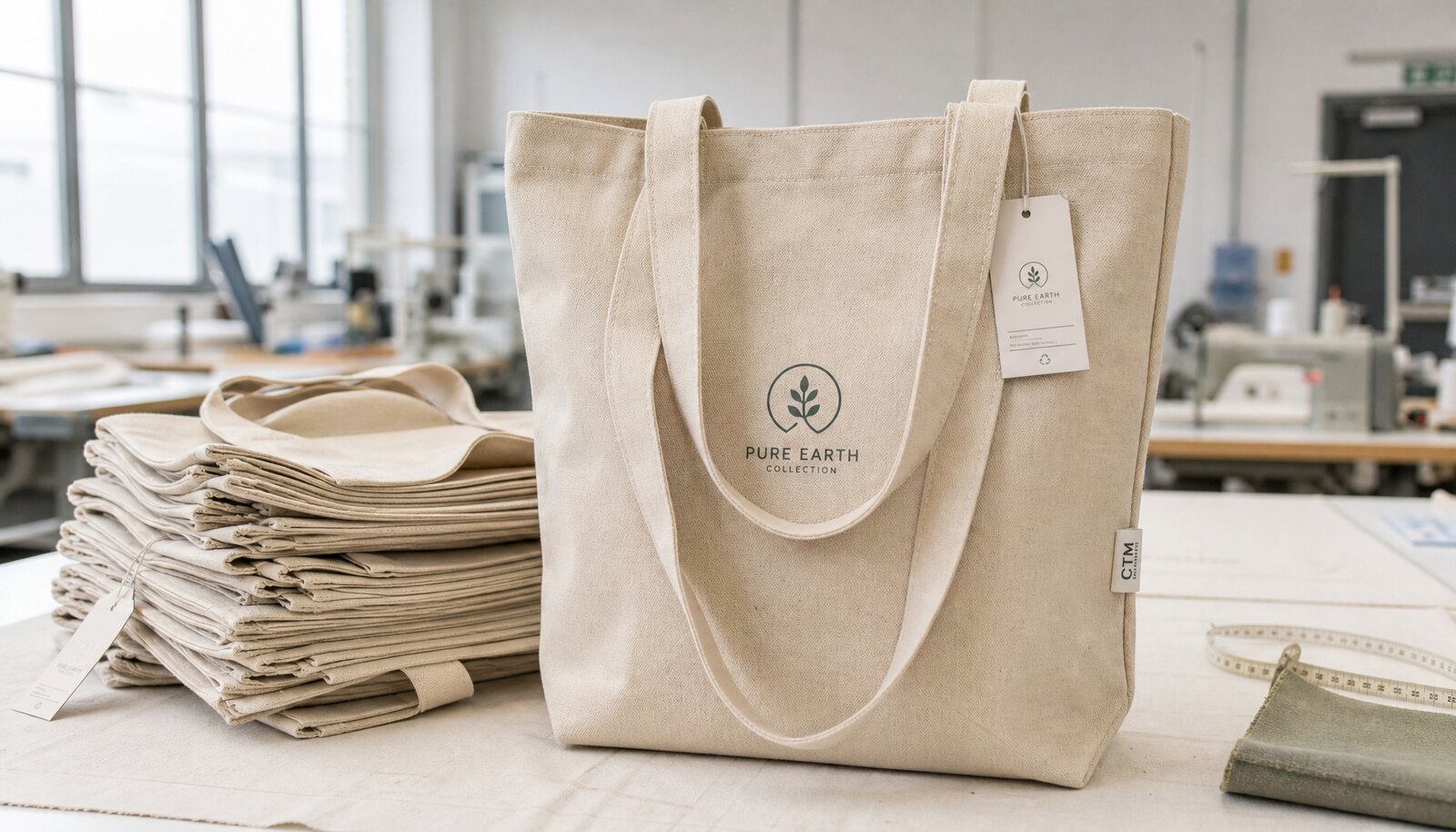
Why trade show tote packaging needs a tighter spec than retail totes
A recycled canvas tote for a trade show is not just a bag with a logo. It is a packing unit, a handout item, and often part of the event logistics plan. If the tote is too soft, the printed area wrinkles in the carton. If the fabric is too heavy, freight cost rises and the giveaway budget gets tight. If the carton pack is sloppy, the bags arrive creased, dirty, or short-counted at the venue.
For procurement teams, the problem is usually not the bag itself. It is the missing packaging spec. A factory can make a visually acceptable tote and still fail the program because the carton quantity, folding method, print protection, and label data were never written down. The result is quote noise, price add-ons, and avoidable rework.
- Trade show buyers need repeatable packing, not just a good-looking tote.
- A clear packaging spec reduces disputes about fold marks, print rub, and carton count.
- The goal is to make the quote compare cleanly across suppliers, not to over-engineer the bag.
Start with the fabric: recycled canvas weight, feel, and real-use durability
For most trade show programs, 10 oz to 12 oz recycled canvas is the practical range. Around 10 oz can work for light brochure kits and low-cost handouts. Around 12 oz gives better body, a cleaner stand-up shape in the booth, and less seam distortion after folding. If the bag is expected to hold catalogs, notebooks, or samples, 12 oz is usually the safer baseline.
Do not spec by weight alone. Ask the factory to state the fabric construction, weave density, and whether the fabric is pre-shrunk or enzyme washed. Recycled canvas can have more visible fiber variation than virgin canvas, and that is normal. What matters is whether the variation is consistent enough that the print still lands cleanly and the bag sews without weak corners.
- Typical buyer range: 280–340 gsm for light to medium trade show use.
- Ask for finished size tolerance, because heavy canvas can shrink differently after print curing.
- If the event kit includes bottles or sample jars, test a loaded prototype before release.
How recycled content should be written in the RFQ
Do not write only “recycled canvas” in the RFQ. That phrase can mean different fiber blends, different recycled sources, and different claim language from supplier to supplier. A better line is: recycled cotton canvas, target gsm, expected color tone, acceptable fiber slub level, and whether the buyer needs a material declaration for packaging records or sustainability reporting.
If your brand or distributor must make a claim later, specify the proof you need at the quote stage. That may be a mill declaration, fiber composition statement, or internal batch confirmation. A factory that cannot separate recycled claim support from basic production paperwork should be treated as a higher-risk quote even if the unit price looks low.
- Write the material as a measurable spec, not a marketing phrase.
- Separate recycled-content proof from general quality documents.
- If mixed recycled fiber is acceptable, say so clearly to widen supplier options.
Print method choice: what works on coarse recycled canvas
For trade show totes, screen print is still the most reliable choice when the artwork is bold and the order volume is stable. One- or two-color prints hold up well on recycled canvas and keep setup costs manageable. Direct-to-garment or complex full-color methods are usually a poor fit unless the artwork is soft, photographic, and the budget can absorb more setup and reject risk.
The main issue is not only image quality. Coarser recycled canvas can make small text fuzzy, and the texture can break fine linework. That is why the first sample should be a strike-off on the actual fabric weight, not a generic print proof on white cotton. If the logo has thin strokes, reduce detail early instead of forcing the factory to chase registration on a surface that will not support it cleanly.
- Use bold vector artwork and avoid tiny text below practical readability limits.
- Lock the print size and placement before bulk production.
- Approve the strike-off under the same lighting that will be used to review final goods.
Supplier options: factory-direct, trader, or local print house
The right sourcing route depends on who needs control more than who quotes the lowest price. A factory-direct bag maker usually gives better control over fabric, stitching, packing, and carton count. A trader can be useful when you need speed across multiple product types, but the risk is fragmented responsibility if the print, sewing, and packing happen in different places. A local print house may be workable for last-mile decoration, yet that often leaves you managing two supply chains instead of one.
For trade show packaging, compare suppliers on who owns the fabric lot, who prints, who packs, and who releases the final cartons. If one party owns all four, issue resolution is usually simpler. If you split the work, the quote may look cheaper, but the administrative load and defect risk rise quickly.
- Use one accountable owner when the show date is fixed and late delivery is expensive.
- Split sourcing only if you have internal QC strength and a spare timeline buffer.
- Ask for proof of similar recycled canvas production, not just general tote capability.
Comparison of sourcing routes for recycled canvas trade show totes
The table below is not about spec fields alone. It is about how each sourcing route affects quote stability, packing control, and schedule risk. Buyers often choose based on unit price, then discover that the cheapest route also has the weakest packaging discipline. That usually shows up as mixed cartons, poor print registration, or last-minute production change fees.
Use the comparison as a shortlisting tool before you request final samples. The most practical route is not always the lowest-cost route; it is the one that can repeat the same tote, the same pack, and the same carton labels across every venue shipment.
- Write decisions in measurable language, not only descriptive wording.
- Ask for sample photos plus one physical approval sample for important orders.
- Keep quotation, sample approval, and inspection notes tied to the same spec version.
Packing specification: the part that saves the shipment
Trade show totes should be packed to preserve print quality and make venue handling easy. Bulk packing is usually the default: a fixed quantity per inner bundle and a fixed number of bundles per carton. Polybags are optional and should only be added when print rub, dust, or surface contamination is a real risk. Adding poly to every unit increases labor and waste, and it can slow the packing line if the bags need to be repacked at destination.
The carton spec should not be left open. Ask for the exact inner count, carton dimensions, gross weight target, and shipping marks. If your logistics team needs palletization, build that into the quote. If the tote is going into a show kit with inserts, define whether the insert is packed inside the bag or separately in the carton. The factory cannot guess the handling flow and still hit the target cleanly.
- Set carton count by destination handling, not by factory convenience.
- Use outer cartons that protect corners from compression but do not create dead freight.
- Define whether tote handles are folded inside or outside the bag body.
MOQs, pricing logic, and what usually changes the quote
MOQ for recycled canvas totes is usually driven by three things: fabric procurement, print setup, and packing complexity. A single fabric color with one print area is easier to quote than multiple colors, multiple logo versions, or special folding instructions. If you want to lower MOQ, keep the structure simple and avoid changing the bag body, handles, and closure in the same program.
When comparing quotes, break the price into bag cost, print cost, packing cost, and any extra labeling or inspection charge. This makes the supplier’s logic visible. For example, a low blank bag price can be offset by a high print setup fee, while a slightly higher unit price may include better carton packing and fewer surprises at shipment.
- Request separate pricing for blank sample, printed sample, and bulk units.
- Ask which elements trigger a new setup charge: color, placement, size, or carton format.
- Treat very low MOQ quotes carefully if they hide oversized setup or packing fees.
Sample approval and QC thresholds that prevent event-week failures
A useful sample process for trade show totes has three stages: blank sample, printed strike-off, and pre-production sample if the order is large or the timeline is tight. The blank sample confirms hand feel, dimensions, and stitch quality. The strike-off checks print scale, ink density, and how the artwork sits on the fabric grain. The pre-production sample is the final control point for actual packing and carton labeling.
Define acceptance thresholds before you approve anything. If you can tolerate small slub variation in recycled fabric, say so. If the logo must stay readable from a certain distance, write that into the approval note. QC is much easier when the buyer states the acceptable band in advance, rather than trying to argue about subjective appearance after bulk sewing is complete.
- Measure actual bag size and handle drop on the sample, not only the drawing.
- Rub-test the print by folding the sample several times in the same direction used for packing.
- Check stitch consistency at handle anchors and bottom seam corners under strong light.
Lead time planning: where trade show orders slip
The shortest route to a missed event is compressing sample approval into the production window. Recycled canvas often needs a little more lead time than a simple cotton tote because fabric lots, color consistency, and print behavior can vary. If the quote says a short production cycle but has no buffer for sample changes, assume the real schedule is tighter than it looks.
Build the schedule from backward planning. Work from show date to ship date, then to carton finalization, then to sample sign-off, then to artwork lock. If the tote is part of a larger booth kit, align the bag timing with the rest of the packing list. A bag that lands early but changes size later can create costly repacking or venue storage issues.
- Reserve time for one round of correction if the first strike-off is off-center or too light.
- Protect the shipping window with a buffer for carton rework and customs paperwork.
- If the event is fixed, prioritize predictable suppliers over speculative low-cost quotes.
Specification comparison for buyers
| Spec decision | Recommended option | When it fits | Buyer risk to check |
|---|---|---|---|
| Fabric base | 12 oz recycled canvas with confirmed mill shrinkage data | Standard trade show giveaways where the bag must feel substantial without pushing freight weight too high | Unspecified GSM can hide a thin hand feel or inconsistent weave; ask for actual gsm, yarn count, and shrinkage after wash or steam |
| Recycled content route | Post-consumer recycled cotton or mixed recycled canvas with fiber declaration | Brands that need a sustainability story tied to packaging or booth materials | Vague recycled claims can create compliance risk; request material composition statement and do not rely on marketing wording alone |
| Print method | 1-color or 2-color screen print for large flat logos | High-volume show programs with repeat artwork and stable artwork size | Multi-color or fine detail may blur on coarse recycled canvas; require strike-off approval on the actual fabric weight |
| Decoration placement | Front-center or lower-left placement with clear stitch-safe margins | When the tote will be packed flat and distributed in stacks | Artwork too close to seams, handles, or side gussets can distort during sewing and packing |
| Handle build | Self-fabric handles with reinforced cross-stitch or boxed stitch | Most trade show use where the bag carries catalogs, samples, or water bottles | Light handle stitching can fail during bulk distribution; specify stitch count, bar-tack locations, and load expectation |
| Closure choice | Open top unless the show kit includes loose small items, then add zipper or snap only if needed | Fast handout lines where speed matters and contents are bulky | Extra closures add cost, lead time, and defect points; don’t pay for them unless the use case requires containment |
| Supplier route | Factory-direct or trusted trade bag specialist with in-house print control | Program buyers needing repeatability, carton consistency, and better issue resolution | Trading-only routes can be cheaper on paper but weaker on QC and packaging control; verify who controls fabric, print, and packing |
| Packing format | Bulk packed by count per carton with poly protection only if print rub risk is high | Best for trade show inventory shipped to one or multiple venues | Overpacking in poly bags raises labor and waste; underpacking can cause print scuff and dirty bag edges |
| MOQ logic | Use one fabric/one print area/one carton spec to hold MOQ down | Pilot orders, regional shows, or first-year brand launches | Multiple colors, sizes, or closures can multiply MOQ and setup costs; ask how each variation changes unit price and lead time |
Buyer checklist before sampling
- Confirm the exact tote size, measured flat and finished, including seam allowance and handle drop.
- Specify recycled fabric weight in gsm or oz, plus acceptable tolerance.
- State print method, print size, Pantone targets if relevant, and artwork file format.
- Define packing: units per inner bundle, cartons per master, carton size target, and any polybag requirement.
- Request sample type: blank sample, pre-production sample, or strike-off on final fabric.
- Ask for fabric composition proof or mill declaration for recycled content claims.
- Set carton drop-test or transit expectations if bags carry promotional inserts or fragile items.
- Confirm lead time by stage: sample, production, and export booking.
- Get unit pricing separated by bag, print, packing, and any special inspection or labeling fees.
Factory quote questions to send
- What is the exact fabric construction, gsm or oz, and recycled content percentage for the quoted bag?
- Is the price based on blank tote, printed tote, or packed-to-spec tote, and what is excluded?
- What print method is included, how many colors, and what is the setup charge per color or side?
- What is the minimum order quantity per size, color, and artwork version?
- How many days are needed for blank sample, printed sample, and bulk production after approval?
- What carton pack quantity, carton size, and gross weight are you quoting?
- What inspection standard do you use for stitching, print alignment, and size tolerance?
- Can you share a previous production photo set or in-process QC images of similar recycled canvas totes?
- How do you handle shade variation, recycled fiber slubs, and print registration on coarse canvas?
- What are the shipping terms and which costs are included in the quote?
Quality-control points to confirm
- Fabric weight must match the approved target within the agreed tolerance and not feel thin at the seam corners.
- Recycled content declaration must match the quoted material and not change after sample approval.
- Bag dimensions must stay within the accepted tolerance for width, height, gusset, and handle drop.
- Handle stitching must show no loose ends, skipped stitches, or uneven reinforcement at stress points.
- Print must sit within the agreed placement window and remain legible after folding and carton compression.
- Color must match the approved strike-off or lab dip reference within practical canvas variation limits.
- Carton count must match the packing list, with no mixed sizes or uncontrolled color sorting.
- Units must be clean, dry, and free of oil marks, needle damage, broken threads, or odor before shipment.
- Each master carton should carry clear shipping marks, SKU, color, quantity, and destination labeling.