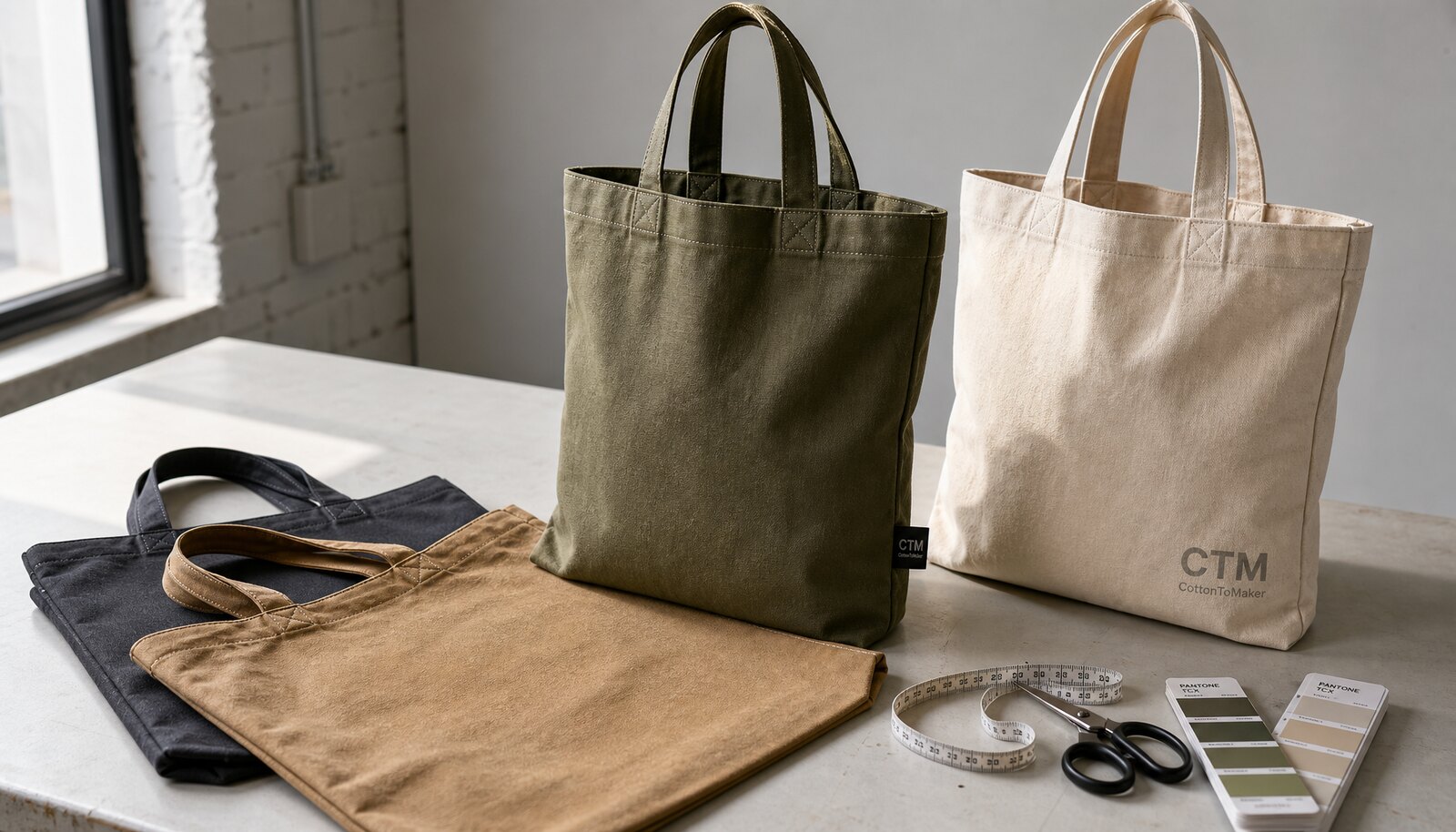
Why trade show totes need a different fabric decision
Trade show bags do more than hold brochures. They get loaded with catalogs, sample packets, notebooks, water bottles, and whatever else a visitor picks up during a long event day. The first failure mode is usually not style; it is fabric collapse, handle stress, or a print that starts to look tired before the booth traffic even ends. For recycled canvas totes for trade shows, the material choice shapes perceived quality, print clarity, unit cost, and the bag’s ability to survive repeated handling.
That is why procurement teams should start with use conditions, not artwork. A tote that looks appealing in a render but uses thin fabric, weak reinforcement, or a poor fold spec can create complaints on the show floor and quality disputes after delivery. The better approach is to define the load, the expected reuse cycle, and the decoration method first, then choose the recycled canvas construction around those requirements.
A useful way to think about trade show bags is that they are utility items with brand visibility attached. If the bag is too flimsy, the brand looks careless. If it is overbuilt, the buyer pays for material and freight the event does not really need. The goal is not maximum thickness. The goal is the lowest-risk fabric and construction combination that still feels credible in the hands of a visitor.
For B2B procurement, the material decision also affects quoting discipline. Once the weight, weave, handle build, and print method are fixed, the supplier can price accurately and you can compare one quote to another on a like-for-like basis. Without that discipline, recycled canvas quotes tend to hide spec differences behind similar-looking unit prices.
- Set the intended load: light handouts, mixed literature, or heavier sample kits.
- Choose the bag to survive event-day abuse, not just one-time giveaway handling.
- Treat the tote as a branded utility item, so material and construction matter as much as graphics.
- Define the event date and receiving window early so the material choice aligns with lead-time reality.
Recycled canvas is not one material: specify the construction clearly
Buyers often use recycled canvas as if it were a single category, but the construction can vary widely. The two most common routes are recycled cotton canvas and recycled-blend canvas. Recycled cotton usually gives the most natural hand feel and a matte, familiar appearance that works well for trade show branding. Recycled-blend fabric can improve consistency, cost stability, or texture control, but the buyer should still verify how the blend affects print and seam behavior.
The weave matters as much as the fiber story. A tight weave generally gives better print edges, better seam integrity, and a cleaner overall silhouette. A looser weave can be attractive when the design is intentionally rustic, but it increases the chance of ink spread, uneven bag shape, and rougher panel appearance. If the logo contains small text or thin lines, a more stable weave is usually worth the modest cost difference.
Recycled content also needs to be defined operationally. For some programs, a supplier declaration is enough. For others, the buyer may need a mill statement, recycled fiber documentation, or a documented chain of custody depending on internal sustainability rules. If the program will be discussed publicly as a recycled product, make sure the claim language matches what the supplier can actually support.
There is also a practical color issue. Recycled cotton canvas often comes with natural variation, slub, and subtle shade differences that are normal, not defects. Buyers should decide early how much variation is acceptable. If the brand wants a very uniform look, the specification should say so, because a more natural recycled fabric will not behave like a smooth synthetic textile.
- Ask for fiber content, weave type, and surface finish, not only the headline recycled claim.
- Use the tightness of the weave as a print-quality and seam-quality indicator.
- Define how recycled content will be documented if the claim matters in packaging, internal reporting, or customer-facing materials.
- Set a realistic expectation for natural slub and shade variation so normal recycled-fabric character is not rejected as a defect.
Choose the right fabric weight by use case, not by habit
For most trade show programs, 10–12 oz recycled canvas is the practical center of gravity. It usually balances structure, cost, print performance, and lead time well enough for standard event handout bags. At 10 oz, the bag may feel lighter and more economical, which can be suitable for brochures or lighter literature. At 12 oz, the tote generally has more body, a better upright feel, and a stronger perception of durability.
A 14 oz bag is not automatically better. It can be a smart choice when the tote needs to carry sample bottles, thicker catalogs, or repeated daily use after the event. But heavier fabric increases raw material cost, sewing load, and freight weight. It can also slow manufacturing throughput, especially if the handle joins and side seams are reinforced. In other words, a heavier bag may look more premium, but the commercial upside only appears if the use case truly needs it.
The useful question is not “what is the strongest canvas we can buy?” It is “what weight gives us a bag that looks credible, carries the expected load, and stays within the event budget?” If the tote is mainly a giveaway, overspecifying fabric weight can crowd out budget for printing, packing, or shipping. If the tote is part of a premium booth experience, under-specifying the fabric can damage the brand impression faster than the logo can compensate.
When buyers compare supplier quotations, fabric weight should be normalized to a real spec, not a marketing phrase. Two bags described as “heavy duty” can differ enough to change feel, freight cube, and print behavior. A procurement team should ask for oz or GSM, an allowed tolerance, and a sample from the exact production setup whenever possible.
- 10–12 oz is the normal sourcing range for a standard event tote.
- Use 14 oz only when the load case or brand positioning justifies the extra cost.
- Require the supplier to confirm weight measurement method and tolerance, not just the nominal number.
- Check whether a heavier fabric will force higher freight charges or a different carton plan.
Construction details that separate a usable tote from a cheap-looking one
The fabric weight is only part of the story. A trade show tote also needs the right construction details to hold shape and survive handling. Handle width, handle length, seam type, bottom gusset depth, and reinforcement method all change the way the bag feels in use. Buyers sometimes approve a low price on the assumption that the bag is “simple,” but construction shortcuts often show up first at the handles and corners.
Self-fabric handles are common because they are efficient and keep the visual language consistent. Folded canvas handles with bar-tacks at the stress points are usually a better option when the bag needs to carry more weight. Thin webbing handles may save a little cost, but they can twist visually, feel less integrated with the recycled canvas look, and look out of place if the brand wants a natural-material presentation.
The bottom structure deserves attention as well. A gusset improves usable volume and helps the tote stand open more reliably. That matters at events where the bag gets stuffed quickly. A flat bag may be acceptable for very light handouts, but once the visitor starts adding samples and brochures, the tote needs enough depth to avoid awkward bulging and seam strain. Side gussets and bottom gussets should be specified in the tech pack rather than assumed from a product photo.
Stitching language should be specific too. Ask whether seams are single-needle, double-needle, topstitched, or reinforced at load points. Ask where bar-tacks are placed and how many are included per handle. Those details matter because they affect both durability and quote price. A supplier who can describe the stitch path clearly is usually easier to manage than one who only shows a front-facing image.
- Specify handle width, drop length, and reinforcement method in millimeters.
- Require bar-tacks or equivalent reinforcement where handle stress is concentrated.
- State gusset depth and bottom seam style before quoting.
- Ask for a photo of the bag flat and filled so the structure can be judged realistically.
Match the print method to the artwork and the fabric surface
For recycled canvas totes, silkscreen is still the workhorse method for simple logos. It is dependable for one or two spot colors, produces strong opacity, and usually gives the cleanest cost-to-durability ratio at volume. If the artwork is bold and the print area is straightforward, silkscreen is often the most procurement-friendly choice because it is easy to quote, easy to repeat, and easy to inspect.
The challenge starts when the artwork becomes more detailed. Recycled canvas has texture, and texture works against thin lines, tiny typography, and some halftone effects. A logo that looks fine in a PDF proof may lose sharpness on fabric if the yarn texture interrupts the print edge. For this reason, buyers should ask for a strike-off or actual fabric sample, not only a digital approval file. If the logo has small type, the factory may need to simplify line weights or adjust spacing.
Transfer printing can be useful for short runs, multicolor art, or designs that cannot be economically separated for silkscreen. The tradeoff is that the hand feel may be less integrated with the fabric and abrasion resistance should be checked. For trade show bags that may be reused, buyers should ask how the print behaves under rub testing and whether the decoration is intended to sit through folding, packing, and light cleaning without visible deterioration.
Woven labels, sewn patches, and discreet woven branding are also relevant for some programs. These methods can create a premium, quieter look that works well when the buyer wants a natural aesthetic and does not want to rely on large printed coverage. They are not replacements for every logo use case, but they are often overlooked in early procurement discussions. In the right design, they can reduce print-risk and improve the perceived value of the tote.
- Silkscreen is usually best for bold, limited-color logos at volume.
- Transfers fit short-run or complex art, but require abrasion and adhesion checks.
- Woven labels and patches can reduce print risk while lifting perceived value.
- Always approve decoration on actual recycled canvas, not paper or screen preview only.
A sourcing route decision: factory-direct, trading, or hybrid
Quote source matters as much as quote content. Factory-direct sourcing usually gives the clearest view of material, sewing, and print control. If the supplier owns the cutting and sewing lines or tightly manages them, the buyer can get more accurate answers on fabric weight, handle reinforcement, production slotting, and defect control. For repeat trade show programs, that visibility is valuable because it keeps the item consistent from reorder to reorder.
Trading-company or sourcing-agent quotes are not inherently bad, but they should be treated differently. A trading partner can be useful if the buyer wants one contact point for multiple items, needs help coordinating samples quickly, or is buying across several factories. The risk is opacity. Some trading quotes bundle multiple subcontractors or omit details about where printing occurs. If the price looks good but the production path is unclear, ask more questions before awarding the PO.
Hybrid procurement is common and can work well. In a hybrid setup, a buyer may use a trading partner for communication and coordination while requiring disclosure of the actual factory, decoration site, and packing location. This route can be efficient if the buyer needs support but still wants enough transparency to compare quality and manage follow-up orders. The key is not the label attached to the supplier; it is whether the quote is traceable back to a real production process.
For urgent event programs, the supplier route also affects risk. Direct factories are often better when the buyer wants stable specs and recurring orders. Trading partners may be more flexible for combining SKUs or compressing communications, but they should not be allowed to obscure the true production lead time. The best procurement decision is the one that matches the need for control, speed, and visibility.
- Ask who actually sews the bag and who applies the print.
- Require the actual factory name if the quote comes through a trading partner.
- Use the sourcing route that best matches your need for control, speed, and repeatability.
- If the supplier cannot explain the production path clearly, treat the quote as incomplete.
Normalize the quote before you compare prices
A recycled canvas tote quote is rarely just fabric plus stitching. The real cost stack usually includes raw fabric, cutting waste, handle reinforcement, print setup, color matching, labor, folding, carton packing, and freight volume. If the supplier gives only one flat number, it becomes hard to compare vendors or understand why one quote is unusually low. Low pricing can signal a thinner fabric, weaker reinforcement, less careful printing, or a cheaper packing method that creates problems later.
The most useful buyer move is quote normalization. Make sure every supplier is pricing the same bag size, the same weight, the same handle construction, the same print method, and the same packing style. Then compare the actual differences instead of the headline unit cost. A quote that is slightly higher but includes a better carton plan, cleaner print setup, or tighter stitching logic can be the lower-risk purchase once the event date and receiving costs are considered.
MOQ and lead time are often where the hidden differences appear. One supplier may quote a lower price because they are using stock fabric and standard dimensions, while another may need a special fabric batch or a custom print setup. If a vendor is offering a short lead time, ask what assumptions make that possible. Is the fabric in stock? Is the print screen already prepared? Is the packing method simple enough to avoid delay?
Buyers should also separate unit cost from landed cost. A tote that is inexpensive at the factory can become expensive once the carton volume, airfreight need, or special packaging requirements are added. That is why carton dimensions, gross weight, and packing count should be treated as quote data, not afterthoughts.
- Normalize bag size, fabric weight, print method, and packing before comparing quotes.
- Ask for carton dimensions and gross weight so landed cost can be estimated early.
- Treat low quotes as incomplete until the supplier explains the spec basis.
- Separate factory price, sample cost, packing cost, and freight impact when reviewing the offer.
Sample approval is where most tote quality problems become visible
For this product, the pre-production sample is not a box to tick. It should show the actual canvas, actual handle build, actual print method, and actual fold or packing style. Buyers should inspect whether the bag stands as intended, whether the seams sit flat, whether the handles are symmetrical, and whether the logo placement matches the spec. If the tote has a gusset, the sample should be checked both flat and lightly filled, because a bag can look fine on a table and behave very differently once load is added.
A sealed reference sample is worth keeping. Recycled canvas is naturally variable in slub, shade, and texture, and that variation can become a dispute later if no reference exists. The approved sample should be physically retained by the buyer and, if possible, by the factory. That way there is a shared standard for future reorders and a clear baseline if the bulk shipment shows unusual print drift or a different feel.
This is also the best time to test practical details. Lightly rub the print to see if immediate transfer or smearing appears. Pull the handle joins by hand to look for seam separation. Fold and reopen the tote to see whether the print area creases badly. Check whether the bag mouth closes cleanly or twists. These are simple tests, but they reveal a lot about whether the production line has really matched the approved design.
If the order is large or the event date is non-negotiable, it is sensible to agree on the sample approval route before bulk production starts. State who signs off, how many sample pieces are required, and whether photo approval is acceptable for initial cuts. For higher-risk orders, a physical pre-production sample is the safer choice.
- Measure sample size, handle drop, gusset depth, and print placement against the tech pack.
- Rub the print with dry and slightly damp cloth to check immediate transfer risk.
- Pull the handle join and side seam to look for early weakness or seam slippage.
- Keep a sealed reference sample on both buyer and supplier sides if possible.
QC standards buyers can put into an RFQ without sounding vague
A good QC plan for recycled canvas totes needs to be specific enough for factory staff and inspectors to use. Phrases like “good quality” or “nice stitching” are too soft to stop a bad carton from shipping. The checks should focus on visible and measurable issues: dimensions, fabric weight, stitch quality, print placement, shade variation, stain limits, seam strength, and packing consistency. If the order is important, a simple inspection standard such as AQL can keep the conversation disciplined.
For major defects, buyers should reject holes, torn seams, missing bar-tacks, severe print misalignment, visible stains, wrong size, or mixed bag construction within the same carton. For minor defects, the buyer might accept small thread ends or slight natural slub variation if those items are within an agreed limit and do not affect use or appearance at the show. The key is to separate acceptable natural variation from true production mistakes.
Measurement methods should also be defined. Fabric weight can be verified by a supplier mill certificate or random cut-piece weighing. Size can be checked with a ruler or tape measure on a sample set. Print placement can be checked from fixed reference points on the bag. Stitch density can be measured on a short seam section if the buyer wants a numeric standard. None of this is complicated, but it must be written down before production starts.
A practical procurement approach is to state the defect thresholds in the RFQ, then keep the same standard through sample approval and final inspection. That avoids a common failure mode where the sample is judged informally and the bulk shipment is inspected by a much stricter or much looser standard. Consistency is what protects both timing and cost.
- Use an AQL plan for larger orders or define a clear random inspection count.
- Separate major defects from minor defects before production begins.
- Measure weight, size, and print placement with simple tools and written tolerances.
- Keep the same QC standard from sample approval through final shipment inspection.
Packing, cartonization, and freight planning can change the real cost materially
Canvas totes are bulky by nature, so packaging is not just a logistics detail. It directly affects carton count, freight cube, and receiving speed. Even a good factory price can become less competitive if the supplier packs inefficiently or overuses individual polybags. For many trade show programs, the bags only need to arrive clean, counted, and undamaged. In that case, bulk packing or bundled packing is usually more efficient than retail-style unit packaging.
The fold method matters more than buyers expect. If the bag is folded with the print face pressed sharply, the logo can arrive with stubborn creases that make the product look older than it is. If the fold is too loose, the cartons waste space and the goods may shift during transit. Good suppliers will know how to balance fold consistency with print protection. Buyers should ask to see the folded sample inside a carton photo or a packing sketch before production.
Carton labeling should be plain but complete: PO number, product code, size, color, quantity, and carton sequence if needed. If the goods are going to a warehouse, distributor, or event organizer, clear carton marking saves receiving time and reduces counting mistakes. If the bags are moving through multiple stops, carton strength and cleanliness matter even more than the internal presentation.
For landed-cost planning, ask for gross weight and carton dimensions as part of the quote. This lets the buyer estimate airfreight or sea freight cube before the order is approved. It also helps reveal when a low unit price is being offset by a poor packing plan. A tote is not a small item once it is boxed in volume.
- Compare bulk pack, bundle pack, and individual polybag options side by side.
- Ask for carton dimensions, gross weight, and estimated cartons per order.
- Require a fold method that protects the print panel.
- Use clear outer labels to speed warehouse receiving and event allocation.
Specification comparison for buyers
| Spec decision | Recommended option | When it fits | Buyer risk to check |
|---|---|---|---|
| Fabric weight | 10–12 oz recycled canvas; move to 14 oz only when the tote must carry sample kits, bottles, or repeated daily use | Standard trade show handout bags, visitor carry bags, and repeat re-use programs | Too light can collapse under brochures; too heavy raises fabric cost, sewing time, and freight cube |
| Canvas construction | Recycled cotton canvas or recycled-blend canvas with a tight weave, controlled slub, and stable panel shape | Brands that want a natural surface with better print behavior than loose duck cloth | Loose weave can cause ink spread, seam distortion, and inconsistent bag shape from lot to lot |
| Print method | Silkscreen for 1–2 colors; transfer print for short-run multicolor; woven label or patch for lower-ink premium branding | When the logo has bold shapes, limited colors, or small text that needs a cleaner edge | Fine text and thin lines can blur on textured recycled canvas, especially on dark fabric |
| Handle build | Self-fabric handles or folded canvas handles with bar-tack reinforcement at stress points | Trade show totes that may carry catalogs, samples, or bottled items during a long event day | Thin handles can twist, cut into seams, or fail early if load-bearing stitching is weak |
| Size | Medium tote around 35 x 40 x 10 cm or 38 x 42 x 12 cm | General exhibition giveaways and visitor carry bags | Oversized bags increase freight and carton cube; undersized bags reduce utility and perceived value |
| MOQ route | Factory-direct quote with stock fabric and standard dimensions | When speed, repeat orders, and price control matter more than custom construction | Special fabric dyeing, lining, or custom hardware can push MOQ higher and extend lead time |
| Packing method | Bulk packed with size-sorted polybag bundles and clear master carton labels | High-volume distributor or import orders where carton efficiency matters | Loose packing increases counting errors; over-polybagging adds labor, plastic, and cube |
| Supplier route | Direct bag factory with in-house or closely managed cutting, sewing, and printing | Best for RFQ control, sample feedback, and repeat production consistency | Trading-only quotes may hide actual fabric weight or outsource print and sewing quality |
| Lead time plan | Stock fabric + simple print + standard export packing | Trade show programs with fixed event dates and short approval windows | Late artwork approval, sample changes, or fabric sourcing delays can derail shipment even if sewing capacity is available |
Buyer checklist before sampling
- Confirm the actual canvas weight in oz or GSM, not just the phrase “heavy duty,” and require an allowed tolerance range in writing.
- Lock bag size, handle length, gusset depth, seam style, and fold method before quoting; small dimension changes can move freight cube and unit cost.
- Specify recycled content expectations and state whether recycled cotton, recycled blend, or post-consumer content is acceptable for the program.
- Match the print method to the artwork type: one-color logo, fine text, halftone, or full-color image.
- Request a pre-production sample, keep a sealed reference sample, and require photo approval of the first bulk output.
- Ask for carton count, inner packing style, and how bags are folded so the printed face does not crease or crack in transit.
- Request freight-ready carton dimensions and gross weight so landed cost can be compared before placing the order.
- Set QC thresholds for stitch count, seam slippage, print registration, shade variation, broken threads, and stain limits.
- Ask the supplier to identify the actual factory, printing site, and whether any part of production is subcontracted.
- Require a clear lead time breakdown: sample time, bulk production time, packing time, and estimated ship date window.
Factory quote questions to send
- What is the exact recycled canvas construction, weight, and weave density you are quoting for this tote?
- Is the quoted price based on stock greige fabric, stock dyed fabric, or custom dyed recycled canvas?
- Which print method is included, how many colors are covered, and what is the surcharge for extra colors or larger print area?
- What is the MOQ for this exact size, fabric weight, and print method combination?
- Can you quote with and without individual polybags, and show the carton pack count and carton size for both options?
- What sample charges apply, and will the sample fee be deducted from the bulk order if we proceed?
- What is your standard production lead time after sample approval, and what could extend it?
- Which QC checks are performed in-house before shipment, and can you share the inspection checklist or standard used?
- Who actually sews the bags and who applies the print: your factory, a subcontracted workshop, or a separate decorator?
- Can you confirm the recycled content claim you can document with a mill certificate, supplier declaration, or similar paper trail?
Quality-control points to confirm
- Fabric weight must match the agreed spec within the supplier’s stated tolerance and should be verified by random cut-piece weighing or mill documentation.
- Weave should be consistent across the lot with no visible holes, broken yarn clusters, or excessive slub bands in print zones.
- Stitching at handle joins and side seams should use even stitch density with reinforced bar-tacks where load is concentrated.
- Print placement tolerance should be defined in millimeters so logos do not drift across a carton run.
- Seams should not pucker after a moderate hand-load squeeze test or light steam/shape recovery check.
- Handles should pass a practical load check aligned to the bag’s intended use, not just a visual inspection.
- Bulk folding must avoid hard creases across the logo panel and should be consistent enough for efficient packing.
- Cartons should be clean, dry, and labeled with PO number, quantity, size, color, and carton sequence if required.
- Reject stains, oil spots, torn corners, missing bar-tacks, loose threads longer than the agreed limit, and obvious print misalignment.
- For larger orders, use a defined sample plan such as AQL 2.5 for major defects and AQL 4.0 for minor defects, or an equivalent buyer-approved inspection method.