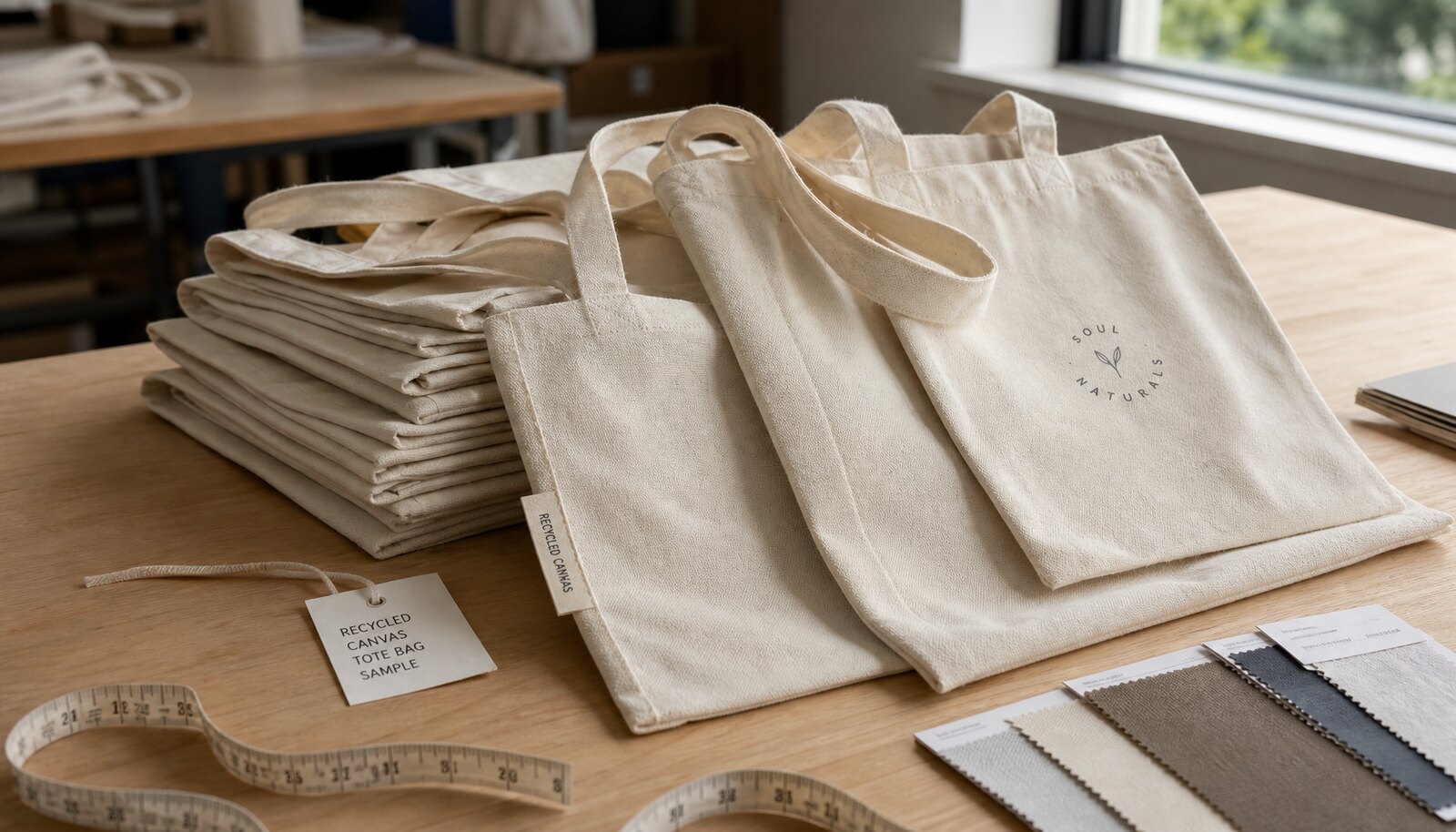
Why trade show tote quotes go wrong
A recycled canvas tote looks simple until a buyer tries to compare two quotes side by side. The bag has to do several jobs at once: represent the brand, hold brochures or sample packs, survive repeated handling on the show floor, and ship efficiently in cartons. If the request only says “recycled canvas tote with logo,” suppliers will fill in the blanks differently, and the numbers will not be comparable.
The most common procurement failure is not the tote itself but the quote structure. One supplier may be assuming stock fabric, bulk packing, and a single screen print. Another may be pricing a heavier body, reinforced seams, individual packing, and a different recycled-content document trail. Both quotes can look legitimate, but they are not quoting the same product or the same service scope.
The problem gets worse when the buyer starts with broad RFQ language and then copies the same phrasing into every follow-up. That creates the feeling of progress without actually tightening the spec. Procurement teams then spend the next round of emails trying to recover missing detail instead of negotiating a real comparison.
A better approach is to define the product as a working program. What does the tote need to carry? How will it be packed and distributed? What proof is required for recycled content? Is this a one-time event buy or a repeat event calendar item? Once those parts are fixed, the quote becomes a procurement tool instead of a rough estimate.
For trade shows, the landed result matters more than the apparent unit price. A cheaper tote that arrives with weak handles, wrong packing, or unclear documents can cost more in rework and onsite embarrassment than a slightly higher but better-specified quote.
- Treat the tote as a branded utility item, not a generic giveaway.
- Define construction and packing assumptions before comparing suppliers.
- Make the quote answer the commercial questions you will be judged on later: cost, compliance, and delivery reliability.
Build the spec like a buyer will audit it
The fastest way to get a usable quote is to reduce ambiguity. For canvas totes, that means writing the spec in terms a factory can measure and a buyer can later verify. Instead of saying the tote should be “mid-size” or “durable,” specify the finished width, height, gusset depth, handle length, handle drop, and whether the bag is intended for shoulder carry or hand carry. If the tote will hold a notebook, product samples, or a catalog set, say so directly.
For most trade show programs, a medium-weight recycled canvas is a practical starting point. But weight alone is not enough. Ask for the actual fabric specification used in production, whether the cloth is treated or washed, and what tolerance is allowed after sewing and pressing. A fabric that sounds substantial on paper can feel thin after cut loss, finishing, or a different weave than expected.
Handle construction deserves the same attention. A modest-looking bag can fail if the handle is too narrow to distribute weight, too short for comfortable use, or stitched without reinforcement where the bag will actually be pulled. If the tote will be carried around a large exhibition hall, handle comfort is not a cosmetic point; it affects whether the tote gets used at all.
The most useful spec sheets also include a tolerance note. Buyers do not need a textbook on patternmaking, but they do need to know what variation is acceptable. A quote is much more defensible when both sides agree whether the tolerance applies to the finished bag or the cut panel. Without that clarity, the supplier may be “correct” by its own method and still wrong for the buyer’s needs.
- Ask for finished size, not only cut size.
- Specify whether the canvas is untreated, washed, or otherwise finished.
- Include a realistic handle drop and a load expectation for the tote.
- Write a tolerance note for the dimensions that affect use, printing, and packing.
Recycled-content verification needs document language, not just a marketing claim
For B2B procurement, recycled content only matters if it can be supported by documents that follow the shipment. A supplier saying the fabric is recycled does not tell you whether the material is post-consumer or pre-consumer, whether the yarn lot is traceable, or whether the wording matches what your compliance team needs. This matters even more when the tote will be used in a sustainability-led trade show campaign or distributed to customers who may ask for proof.
The first buyer question should be: what exactly can you document for this order? That may include a mill declaration, a composition statement, a recycled-content certificate, or an order-specific declaration that names the material and percentage. The point is not to force one document format; it is to make sure the claim can be traced. If the factory normally writes only “recycled canvas,” but the buyer file requires a post-consumer statement, that gap should be resolved before production starts.
The second question is about wording consistency. The quote, the sample approval, the invoice, and the packing list should all use compatible language. If the factory can only support a generic statement, it is better to know that now than after the goods are booked. Procurement credibility is better protected by accurate wording than by a stronger-sounding claim that cannot be backed up later.
Do not ask the supplier to invent a sustainability claim. If the records do not support the exact wording your brand wants, the buyer should either adjust the claim or choose a supplier with better document control. That is especially important when legal review or customer-facing procurement portals are involved.
- Ask whether the material is post-consumer or pre-consumer recycled content.
- Request the exact document wording before production, not after shipment.
- Keep the claim on the quote aligned with the invoice, packing list, and any compliance file.
- If the supplier cannot explain the source of the recycled claim, treat that as a sourcing risk, not a minor paperwork issue.
Choose the print method by artwork, volume, and durability
Most trade show tote programs use straightforward artwork: a logo, a booth message, maybe a QR code or sponsor line. For that kind of artwork, screen printing is usually the most practical option because it is durable, repeatable, and often economical on canvas. But buyers should not accept “logo printed” as a complete answer. Ask what method is included, how many colors are covered, how many print positions are priced, and whether the setup fee is a one-time charge or part of the unit cost.
On recycled canvas, print appearance can change with the weave texture and the natural variation in the fiber. That means a digital proof can look perfect while the sewn tote looks different in real life. Buyers should ask the supplier to print on the actual substrate, not just send a flat mockup. The sample should show whether the ink lays cleanly over seams and whether the artwork remains readable where the fabric folds.
For more detailed graphics, a transfer method may be proposed. That can be acceptable if the buyer values small text or complex shapes, but it should be a deliberate choice. If the tote will be reused repeatedly, ask how the print will hold up against rubbing and folding. A trade show bag does not need industrial laundering resistance, but it should not flake or crack from normal attendee use.
The decision should also be tied to volume. Screen setup can be efficient at moderate and higher quantities, while smaller pilot orders may justify a different method if the artwork is simple and the schedule is tight. The key is to avoid mixing print logic with brand preference. Decide based on artwork complexity, durability expectation, and the number of units you truly need.
- Use screen print as the baseline quote for simple logos and volume runs.
- Ask what the quote covers: colors, positions, screens, and setup.
- Do not approve print from artwork alone; insist on a sewn sample for final judgment.
- If the logo includes fine text or a QR code, ask for a readability check at the size it will actually appear on the bag.
Comparison table: factory-direct vs trading-company sourcing
The sourcing route affects more than unit price. A factory-direct quote usually gives you clearer control over the build, the production line, and the document trail. A trading company or sourcing agent can be valuable if the buyer needs mixed SKUs, smaller pilots, or a coordinator who can chase revisions across several vendors. The right choice depends on how much product control, admin support, and document visibility you need.
For a repeated trade show program, factory-direct often makes the most sense because the specification can be repeated, the quality standard can be locked, and the packing and carton plan can be standardized. For a pilot order or a multi-item campaign, a trading route may save internal time even if the base unit price is a little higher. The procurement decision should weigh the total cost of ownership, not only the first quote line.
What matters most is whether the route can keep the same product definition from sample to bulk. If the factory can explain the line load, show the fabric lot, and confirm carton data directly, that is a strong sign the quote is operationally real. If the agent can coordinate multiple moving parts without losing the spec, that can be valuable too. Buyers should judge on control and clarity, not on labels like “factory” or “trader” alone.
- Use factory-direct when the spec is stable and volume is meaningful.
- Use a trading route when the order is small, mixed, or heavily coordinated.
- Compare document quality and quote transparency, not only the unit price.
- Ask who owns the final answer if sample details and bulk details disagree.
MOQ should be read as a pricing structure, not a single number
MOQ on recycled canvas totes is usually tied to setup cost, fabric booking, and production efficiency. That means the minimum can shift depending on whether the tote uses stock fabric, a special dye, a custom label, or unusual packing. Buyers often get into trouble when they accept one minimum quantity for the bag and later discover that print setup or packaging requires a different threshold.
A practical RFQ should ask the supplier to break MOQ into separate items. What is the minimum for the bag body? What is the minimum for the print setup? Does the label or packaging change the minimum? If the order is for a trade show, the buyer should also ask whether the supplier can quote a pilot quantity and a scale quantity so the business can compare the cost of test volume versus a full event run.
Tiered pricing is especially useful for event buyers because trade show volume often grows from one year to the next. Asking for price breaks at realistic levels such as 500, 1,000, 3,000, and 5,000 units helps the buyer understand where the economics improve. If the supplier cannot explain why the minimum exists, there is a good chance the quote will change later when the specification gets real.
MOQ discipline also protects the schedule. A supplier who accepts a very small order may be booking it into a less efficient production slot, which can affect line priority and lead time. That is not necessarily a problem, but it should be understood before approval. The useful buyer question is not “What is the lowest MOQ?” but “At what quantity does the quote become stable, repeatable, and worth scaling?”
- Separate MOQ for construction, print, labels, and packaging.
- Request tiered pricing at practical buy levels.
- Treat a very low MOQ as a signal to check the assumptions behind it.
- Ask whether the minimum assumes stock fabric, stock color, or stock print layout.
What a commercial quote should include and exclude
A good factory quote should read like a small project brief. It should identify the fabric, the finished size, the handle length and drop, the decoration method, the packaging style, the carton data, and the delivery terms. If the quote leaves those out, the buyer has to infer them later, and that is where margin gets lost and schedules slip.
Equally important, the quote should say what is not included. Sample freight, artwork revisions, screens or plates, special hangtags, inner bundles, and destination-side labeling can all sit outside the base price. Procurement teams often underestimate how much cost is hidden in these smaller items because they are not visible in the first line item that gets approved.
When comparing suppliers, use the same commercial frame: same incoterm, same destination, same pack method, same tote spec, and same sample assumptions. A quote that includes “delivery” without stating where or how is not comparable with a quote that is openly FOB or EXW. The goal is not to make every supplier quote identical; it is to make the differences visible enough that the purchasing decision is defensible.
If you are buying for a brand with presentation standards, ask for carton marks, unit packing, and the exact way the bags will be folded. The quote should show whether the bags are packed flat, once-folded, or bundled. That affects both arrival condition and freight cube. It also affects how fast a warehouse team can count and distribute the bags once they arrive.
- Ask for setup charges and recurring unit cost as separate lines.
- Confirm which incoterm the price is based on.
- Require carton dimensions and unit count before you compare freight.
- Ask for a written exclusions list so hidden costs are visible before approval.
Sample approval should test the real failure points
The sample stage is where many tote orders are saved or quietly compromised. A flat artwork proof is not enough because recycled canvas behaves differently once it is sewn, folded, pressed, and loaded with weight. A pre-production sample should show the actual canvas lot, the final thread color, the final print position, and the label or side tag placement if those parts are part of the order.
Procurement buyers should inspect the sample the way the event team will use the bag. Put brochures, catalogs, or sample packs inside it. Check whether the bag stands reasonably well on a table, whether the handles feel comfortable in hand or on the shoulder, and whether the gusset folds cleanly without twisting the print. If the tote is intended as a premium handout, these details matter more than a tiny price difference.
The sample should also be measured, not just looked at. Verify width, height, gusset, handle length, and key placement points against the spec sheet. If the sample is slightly out of range, the buyer should decide whether the deviation is acceptable before bulk production begins. It is much cheaper to correct a sample than to argue over a shipment that already moved into sewing.
For important orders, keep the sample approval in writing and tie it to the exact revision of the spec sheet. That prevents the common problem where everyone remembers the sample differently after the event date gets close. It also makes it easier to reject a bulk shipment if the factory changes the build without approval.
- Use the sample with real inserts and real handling conditions.
- Measure the sample after pressing and compare it to the spec sheet.
- Approve only after confirming print, stitch, handle, and label details together.
- Tie approval to a specific revision so the sample cannot be reinterpreted later.
QC should be written with acceptance and rejection logic
Quality control for recycled canvas totes should not stop at “check stitching” or “inspect print.” Buyers need a simple acceptance logic that tells the factory what is acceptable, what is reworkable, and what is a reject. That is especially important for trade show orders, where the bags may be distributed quickly and there is limited time to sort problems after delivery.
Start with the critical dimensions. If width, height, or gusset falls outside the agreed tolerance, the bag should not be treated as conforming. Next check the seam structure: side seams, gusset turns, and handle attachment points are the first places where stress shows up. A bag can look fine on a hanger and still fail when loaded. That is why a load-based check matters if the tote will carry printed material or product samples.
Print defects should also be graded. A tiny variation in a non-critical area may be acceptable on a sample, but visible misregistration, smearing, or weak opacity should be rejected in bulk production. On natural or recycled canvas, the texture will never be perfectly flat, so the buyer should judge the print against a realistic standard: clean edges, readable text, color consistency, and no obvious defects at normal viewing distance.
Inspection sequence matters as well. A sensible order is: verify material and dimensions, check sewing and reinforcement, inspect print and labels, then review folding and carton packing before shipment. If the final inspection is done too early, packing defects can still slip through. If it is done too late, the shipment may already be sealed and hard to correct. The buyer should also know whether the factory is checking enough units to catch a line issue rather than only a few representative bags.
- Write an explicit reject rule for dimension failures, open seams, and major print defects.
- Use a sequence: material, sewing, decoration, packing, cartons.
- Apply the same defect logic to sample approval and bulk inspection whenever possible.
- Ask how many pieces are checked per carton or per lot so the inspection scope is not guesswork.
Packing and carton planning change the real landed cost
Packing is not a minor detail. It affects labor, carton dimensions, freight cube, warehouse handling, and the condition of the tote when it reaches the event site. Recycled canvas bags are usually shipped flat-folded, but the fold direction, the number of folds, and whether the bag is bundled or individually wrapped all affect how the print sits and whether creasing becomes permanent. Buyers should ask the supplier to state the fold method in the quote, not improvise it later.
If the tote is going to a warehouse for distribution to a trade show, bulk packing is often the cleanest option. It avoids unnecessary plastic and reduces cost, but only if the warehouse can receive and sort the product without delay. Individual polybags can be useful for keeping bags clean, yet they add cost and can create disposal concerns. The right answer depends on the receiving process, not on a generic packaging preference.
Carton planning deserves specific attention. Ask for units per carton, carton dimensions, and maximum gross weight. Then check whether the carton loading assumption leaves enough headroom for safe stacking and no corner crush. Overfilled cartons can damage the bags or distort the gusset, while underfilled cartons waste cube and raise transport cost. A quote that ignores these details may look cheap until the freight bill arrives.
For higher-value event programs, it is worth asking for packing photos from the sample stage or a packing mockup before production. This is not about being fussy; it is about preventing avoidable damage and preventing the show team from opening cartons full of wrinkled, crushed, or misfolded bags. The landed cost of a tote includes how it arrives, not just what it cost to sew.
- Define the fold method and packing format in the quote.
- Ask for carton dimensions, units per carton, and gross weight.
- Use bulk packing only if the receiving process can handle it cleanly.
- Request packing photos or a packing mockup if presentation matters onsite.
Specification comparison for buyers
| Decision area | Factory direct | Trading company / sourcing agent | What procurement buyers should decide | Buyer risk to check |
|---|---|---|---|---|
| Unit price on a standard build | Usually the lowest starting price when the spec matches the factory’s normal line and the order size fits its efficient run length. | Often carries a service margin, but can be competitive if the agent consolidates orders or manages special packing. | Use factory-direct when the tote is a repeat program with fixed art and standard construction; use the agent route when internal buying time is limited or the program is mixed-SKU. | A low quote can exclude screens, recycled-content documentation, carton marks, or export packing. Ask for a line-item quote before comparing prices. |
| Custom construction changes | Better when you need tighter control over gusset depth, handle reinforcement, label placement, or carton configuration. | Useful if the agent can coordinate several factories or add accessories without forcing one factory to do everything. | Choose factory-direct if construction details affect performance or brand presentation; choose a trading route if the program needs coordination more than engineering. | If the supplier cannot explain how the sample differs from bulk, the build may drift after approval. |
| MOQ flexibility | Usually tied to fabric booking, cutting efficiency, print setup, and line scheduling. | Sometimes easier for small pilots because the agent can combine orders or place them against stocked materials. | Match the route to the actual program volume: pilot, seasonal event, or recurring trade show calendar. | A “low MOQ” quote may only apply to stock fabric or stock print layout, not your exact spec. |
| Recycled-content proof | May provide mill declarations, composition statements, or production records if the factory tracks material lots carefully. | May provide documents too, but upstream visibility can be weaker if the agent is not close to the mill or yarn source. | Ask who owns the declaration and whether the document can be tied to your specific production lot. | A vague recycled claim is not enough if your invoice, packing list, or compliance file needs exact wording. |
| Sampling control | Usually gives a shorter chain from buyer to sample room and fewer handoffs to manage. | Can be convenient if the agent handles revisions, communication, and multi-step approvals. | Choose the route that gives the most reliable sample-to-bulk control, not only the fastest email response. | A sample approved through a middleman can still miss bulk sewing details, thread color drift, or packing differences. |
| Lead-time visibility | Often clearer if the factory is transparent about line load and material booking. | May help chase multiple vendors, but schedule detail can be filtered or delayed. | For fixed event dates, prefer the route that can state sample date, bulk start date, and ship date in one timeline. | A short promised lead time is not useful if it ignores artwork approval, material arrival, or carton allocation. |
| Packaging and labeling detail | Better when you need exact carton marks, inner packing, or no-polybag requirements. | Useful when multilingual labeling or destination-specific pack-out has to be coordinated. | Decide who owns carton spec, master marks, hangtags, and any inserts before requesting pricing. | Packing costs and carton specifications are often hidden until after the quote is accepted. |
| Inspection and QC responsibility | The factory can inspect to its internal standard and share records, but the buyer still needs a clear threshold. | An agent may coordinate a third-party inspection or add a pre-shipment check. | If QC is critical, ask who conducts the final inspection and what defect threshold applies. | Responsibility becomes unclear if the seller and manufacturer are not the same entity. |
| Communication speed | Usually fast once the product is routine; slower when the spec is new or the factory is busy. | Often faster for day-to-day coordination and quoting follow-up. | Choose the route that fits your revision cycle and internal approval process. | Quick replies are not the same as accurate answers. |
Buyer checklist before sampling
- Write the tote spec in measurable terms: finished width, height, gusset depth, handle length, handle drop, fabric weight, print size, and an acceptable tolerance for each critical dimension.
- State whether you need recycled content only, or specifically post-consumer recycled content. If the claim matters to your brand or customer, require the wording you want on the invoice, packing list, or declaration before production starts.
- Ask for a line-item quote that separates fabric, sewing, print setup, print charges, labels, packaging, sample cost, carton cost, and freight assumptions. A single lump sum is hard to compare and easy to misread.
- Request carton data with units per carton, carton dimensions, gross weight, and loading assumptions. This matters for warehouse handling, cube planning, and freight comparisons.
- Define the folding method and packing configuration: flat-folded, once-folded, bulk packed, inner bundled, or individual polybag. The quote should state what is included and what is excluded.
- Ask for lead time in two parts: sample lead time and bulk production lead time after final approval. If your event date is fixed, add a ship-by deadline and ask the supplier to confirm feasibility in writing.
- Specify the decoration method, number of colors, print position, and whether color matching must follow a Pantone reference or a visual match only.
- If the tote will carry brochures or samples, tell the supplier the intended load. A tote that looks fine empty can fail when loaded, especially at the handle stitching and side seams.
- Ask for at least one pre-production sample and, where relevant, a packing mockup. Bulk approval should never rely on a flat artwork proof alone.
- If sustainability claims will be reviewed by legal, marketing, or a customer portal, confirm which documents will be provided with the shipment and whether they reference the same material wording as the quote.
Factory quote questions to send
- What exact recycled canvas spec are you quoting: fabric weight, weave, finishing, and finished size tolerance after sewing and pressing?
- Can you state whether the recycled content is post-consumer or pre-consumer, and which document supports that claim in the order file?
- If you put the recycled-content statement on the commercial invoice or packing list, what exact wording do you use? Please quote that wording so we can align it with our compliance file.
- What is included in the unit price and what is excluded: screens or plates, artwork setup, label sewing, hangtags, sample cost, carton marks, and export packaging?
- What MOQ applies to the bag body, the print setup, and the packing configuration separately? If they differ, please list them separately.
- Can you provide a pre-production sample that reflects the final fabric, thread color, handle reinforcement, print placement, and label construction?
- What carton size, units per carton, and maximum gross weight do you recommend for this tote, and is the bag packed flat or folded once?
- What inspection points do you check before packing, and what defect threshold do you use for stitch quality, print clarity, measurement, and contamination?
- If we request a buyer-side or third-party inspection, at what stage should it happen so it can still catch sewing or packing defects before shipment?
- What lead time can you commit to after sample approval, and which parts of the schedule are most likely to slip if artwork or material confirmation is delayed?
Quality-control points to confirm
- Confirm the fabric weight and recycled-content documentation against the approved sample and the production lot. Do not accept a vague statement such as “recycled material” without the supporting paper trail.
- Measure finished dimensions after the bag is sewn and pressed. Width, height, and gusset should stay within the buyer’s agreed tolerance, not a loose panel measurement.
- Use a practical tolerance standard in the RFQ. For event totes, buyers commonly tighten critical dimensions to a small band and reject anything that would affect print placement, packing, or shoulder carry. If the supplier cannot commit to a tolerance, the quote is not precise enough.
- Inspect stitch quality at the side seams, gusset turns, handle attachment, and top hem. Look for skipped stitches, loose threads, puckering, and needle damage around stress points.
- Check handle reinforcement by looking at both stitch symmetry and bartack consistency. If the bag is expected to carry catalog packs or samples, load-test at the agreed target weight and record whether handle stretch or seam opening remains acceptable.
- Review print registration, edge sharpness, opacity, and rub resistance on the actual canvas texture. A proof on paper or a flat image is not an acceptance standard.
- Inspect cleanliness before packing: no oil marks, loose lint, broken threads, or mixed sizes. Recycled canvas often has a more natural texture, but that does not excuse visible contamination.
- Confirm carton build and packing density before shipment. Cartons should close without crushing the bag shape, and the unit count should match the loading plan agreed in the quote.
- Use a simple acceptance/rejection rule for each critical defect: reject if the bag is outside dimension tolerance, if the print is materially off-position, if a seam opens under normal load, or if the carton is damaged enough to affect resale or presentation.
- Grade defects by severity so the supplier knows what can be reworked and what must be replaced. For procurement purposes, cosmetic issues may be tolerable in a sample, but not in the bulk shipment when the bags are for a trade show presentation.