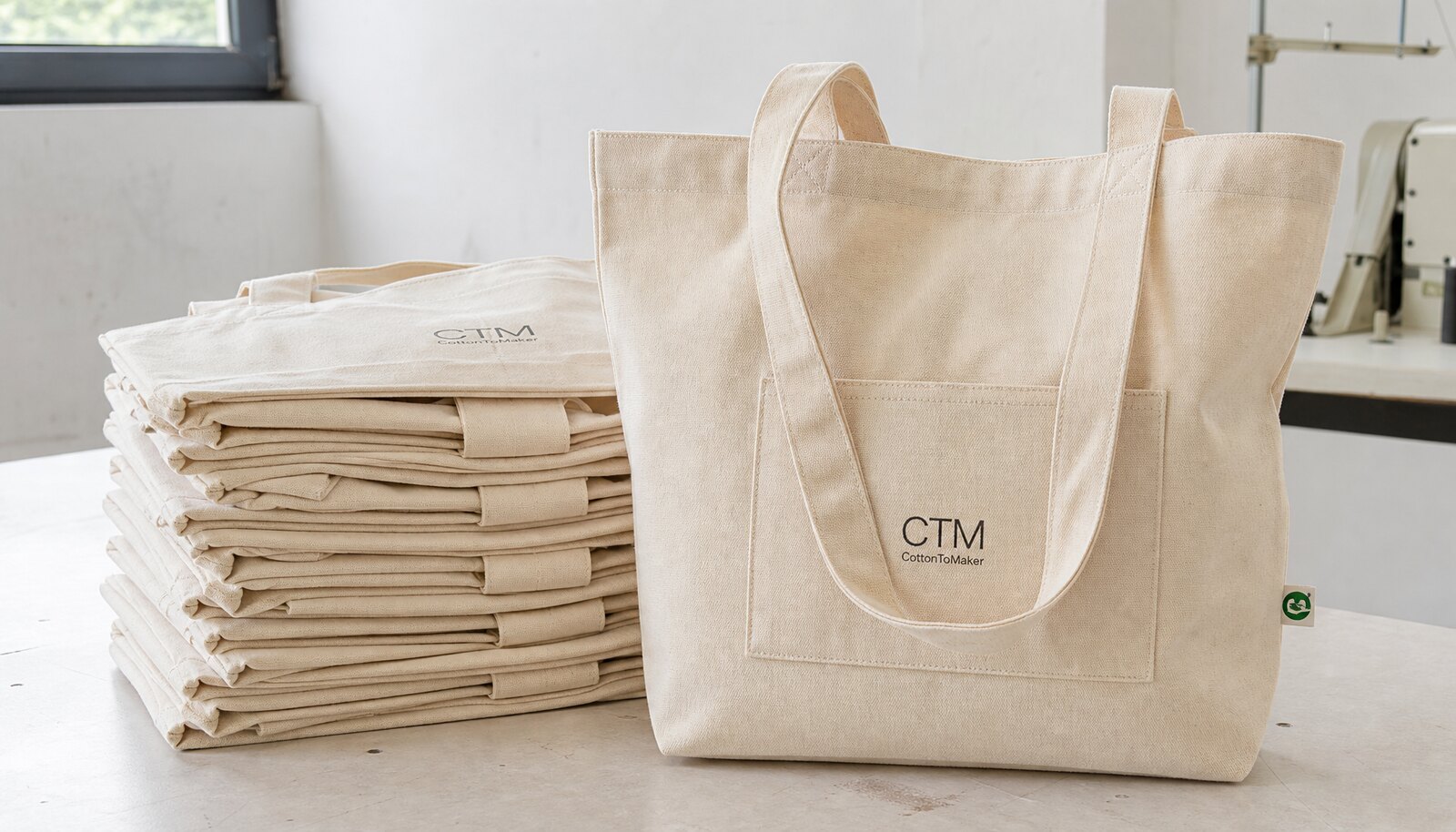
Why school tote sourcing needs a different buying lens
Recycled canvas totes for schools are not just promotional giveaways. They are working carry items that get folded, overfilled, tossed onto floors, and reused for months in classrooms, libraries, bookstores, and family take-home programs. Procurement has to treat the tote as a functional product, not only a printed surface. If the bag fails at the handle, seam, or print layer, the school program loses value even if the artwork looked good at approval.
That is why the buying brief has to start with use, not decoration. A tote for a back-to-school welcome kit has a different failure profile from a tote sold in a campus bookstore or handed out at a reading program. One program needs low unit friction and simple packing. Another needs better structure, stronger handles, and a finish that still looks acceptable after repeated use. The right spec depends on how the tote will actually live after it leaves the carton.
- Treat the tote as a utility item first and a branded item second.
- Define the end user, carry load, and distribution method before asking for prices.
- Plan for warehouse receiving, classroom handout, and reorder consistency at the same time.
Start with the school use case and build the spec around it
The fastest way to overspec or underspec the order is to start with artwork. A good procurement brief starts with the bag's job. If the tote will hold folders and handouts, a lighter build with standard handles may be enough. If it will carry books, notebooks, and a bottle, the bag needs a wider body, a practical gusset, and handle construction that does not cut into the shoulder. If the bag will be reused for field trips or library checkouts, durability and print longevity matter more than novelty.
For recycled canvas, the useful decision is usually not whether the bag is thick or thin in abstract terms. The decision is whether the fabric is heavy enough to keep its shape and strong enough to support the expected load without making the bag feel stiff or unnecessarily expensive to produce. Ask the supplier to state the fabric construction clearly, including the recycled input type, the measured weight basis, and any finishing that changes the hand feel or print behavior. Then align the dimensions with the actual contents the school will carry. A tote that fits papers but not a binder creates operational friction for the user and complaints for the buyer.
- Choose the tote around the real contents: folders, library books, lunch items, or staff materials.
- Lock the size, gusset, and handle length before art placement is finalized.
- Ask whether the recycled input is post-industrial or post-consumer and get the answer in writing.
Compare supplier quotes on the same commercial basis
A quote only becomes useful when the commercial assumptions are identical. A lower unit price can hide a different fabric weight, a lighter pack count, a different sample step, or freight that was excluded from the number. Before comparing suppliers, normalize the quote around one Incoterm, one packaging spec, one artwork version, and one destination. Without that discipline, the spreadsheet is not a comparison; it is a list of unrelated offers.
The supplier type matters too. A direct factory relationship is usually better when the tote will be reordered and the spec has to stay stable across seasons. The factory can control the material booking, sewing line, print process, and packing method more directly. A distributor or trading company can be useful when the order is small, the timeline is tight, or your team needs a simpler procurement path. The tradeoff is less visibility into how the product is actually built and what changes between quote and shipment. If the buyer cannot see the source of the fabric, the decoration process, or the packing arrangement, the risk moves from price to quality and traceability.
- Keep all quotes on the same Incoterm and the same destination so landed cost is comparable.
- Check whether sample charges, palletizing, carton labels, and export documents are included or excluded.
- Use direct factory sourcing when repeatability matters and distributor sourcing when speed or low internal workload matters more.
Ask for recycled-content and compliance proof that can survive review
If the tote is sold or described as recycled, a verbal claim is not enough. The buyer should ask for a document set that identifies the recycled input, the scope that covers the material, and the lot or batch trail that connects the source to the finished tote. If the supplier uses a recognized scheme such as GRS or RCS, ask for the scope certificate and confirm that the certificate holder and product scope actually match the fabric being quoted. A certificate image without scope context is weak evidence.
Compliance should be matched to the destination market, not guessed from the factory's standard paperwork. For the US, if the tote is being treated as a children's product, ask what CPSIA testing and tracking documentation applies. For the EU or UK, ask for the relevant REACH or UK REACH declarations and any restricted-substance statements your buyer or school district requires. If the bag includes printed coatings, synthetic trims, or decorative elements, ask what has actually been tested instead of assuming the whole product is covered by a blanket statement. The practical goal is simple: the supplier should be able to answer how the claim and the compliance file would be defended if procurement, legal, or a school administrator asked for backup.
- Request the exact document names, not a promise that documents exist.
- Confirm whether the certificate scope covers the mill, the converter, or the finished-goods factory.
- Make sure the recycled-content wording matches the language you plan to use in school communications or product copy.
Choose the decoration method for durability, not just visual appeal
For school tote programs, screen printing is often the cleanest answer when the artwork is straightforward. It works well for school names, mascots, event themes, and short sponsor marks. The main advantage is repeatability: when the art is simple, the print can be applied consistently across larger runs. The buyer still needs to confirm cure quality, placement, and color match, but the risk profile is usually predictable.
Transfer methods can be useful when the quantity is small or the art has more detail than a screen setup can handle efficiently. The cost of that flexibility is that the print surface may be more sensitive to folding, abrasion, or heat. Embroidery can be appropriate for premium school retail bags or donor merchandise, but it changes the hand feel and can create a different stress point on the front panel. The wrong choice is not a method in isolation; it is a method that does not fit the school's use pattern. A tote handed out at a one-day event has different durability needs from a bag that will be loaded every week at a library or classroom.
- Use screen print for simple, repeatable school graphics.
- Use transfers only when the art or quantity justifies the added risk and the finish has been tested.
- Keep decoration away from seams and fold lines so the print does not distort when the bag is packed or filled.
Use quote questions that expose real operating risk
Generic RFQs ask for confirmation. Good RFQs expose how the supplier actually works. The questions should make the supplier show the fabric spec, the commercial basis, the document trail, and the way exceptions are handled. If the supplier can only answer with a total price and a lead time, the buyer is missing the information needed to manage the order after the PO is issued.
This is especially important for school tote programs because the failure mode is often not catastrophic; it is operational. The bag arrives a little smaller than expected, the print sits too close to the seam, the carton count is inconsistent, or the bag finish does not match the approved sample. None of those issues looks dramatic in a quote. All of them become a problem during receiving or distribution. Ask questions that reveal those edge cases before production starts.
- What is the exact fabric construction, and what test or measurement backs that spec?
- Which recycled-content document covers this order, and what is the lot traceability path?
- What is included in the quote, and what changes if the packaging, print count, or destination changes?
- What is the MOQ by color and by artwork version?
- What is the difference between your sales sample and your pre-production sample?
- What are the lead times by stage: material booking, printing, sewing, packing, and shipment?
- What testing or declaration documents can you provide for the destination market?
- What is your default defect remedy if pre-shipment or arrival inspection finds a problem?
- Can carton and batch codes be tied to the production lot on shipping paperwork?
- If we change art placement or handle length after approval, what gets re-approved?
Approve samples as if they were the final shipment
A sample for a school tote should not be approved as a visual mockup. It should prove the final build. That means final fabric, final print method, final handle construction, final stitching pattern, and final packing arrangement. Sales samples are useful for concept discussions, but they can hide differences in the actual material, decoration finish, or reinforcement that will be used in bulk. If the production bag is not the same as the sample, the sample did not really approve the order.
The cleanest way to control this is a short sample signoff sheet that travels with the physical sample. Record the dimensions, gusset depth, handle length, print size, print placement, color reference, reinforcement pattern, carton count, and any insert or label requirement. Keep one retained sample and one photo record with a measurement reference. If the supplier changes any of those details later, treat it as a new approval event instead of a minor update. That discipline prevents the common problem where the approved sample gradually drifts away from the shipped order.
- Approve only a sample built with the same fabric and the same decoration process as the bulk order.
- Keep a retained sample and a written signoff record tied to the PO.
- Require re-approval if the supplier changes print placement, handle length, packing, or carton count.
Set QC thresholds around the failure points schools will notice first
For recycled canvas totes, the most useful QC plan is simple and specific. The buyer does not need a lab-style inspection on every shipment, but the order does need a defensible list of what counts as acceptable. The focus should be on the issues a school buyer, teacher, or warehouse team will actually notice: handle failure, crooked print, mixed counts, weak seams, and damage from packing or transit. If those items are controlled, the tote is usually fit for the intended program.
An AQL-based inspection is a practical starting point when it is paired with a product-specific checklist. The inspection should sample cartons from different parts of the lot, not just the easiest cartons to reach. Measure the key dimensions against the approved sample. Check the top hem, side seams, bottom seam, and handle anchors for skipped stitches, loose ends, or reinforcement that does not match the approved build. Use a short load test on selected bags if the tote is expected to carry books or other heavier items. Then look again after loading. A bag that looks fine when empty can show seam creep or handle distortion when stressed. That is the problem the buyer wants to catch before the shipment leaves the factory.
- Use an agreed AQL plan and write the major and minor defect rules before production starts.
- Measure dimensions, handle length, and gusset depth against the approved sample.
- Check print alignment after folding and light handling, not only when the bag is flat.
- Run a practical load check on sampled bags when the school use case involves books or repeated carry.
- Reject cartons that are damp, dirty, mislabeled, or packed with mixed counts.
Treat packing, freight, and receiving as part of the product spec
Packing is not an afterthought in a school tote order. Bulk master cartons are often the best option when the totes go into storage before distribution or are routed through a central warehouse. They reduce handling steps and keep the receiving process simple. Retail-ready packing can make sense for campus stores or gift-shop style programs, but it adds labor and changes the carton profile. The buyer should choose the format intentionally instead of accepting whatever the supplier defaults to.
Freight terms deserve the same discipline as the bag itself. Keep the quote basis consistent across suppliers so the landed cost can be read cleanly. If the buyer uses FOB or FCA, the freight picture is easier to separate from the factory price. If the buyer accepts DDP, the budget may look simpler but the underlying logistics assumptions are less visible. Whatever term is used, insist on a clear packing spec, carton count, and claim window. The receiving team should know what an acceptable carton looks like before the first pallet arrives, and the contract should state what happens if cartons are crushed, wet, shorted, or mislabeled.
- State the inner count, master carton count, and palletization plan before production begins.
- Ask who pays for pallet materials, wrap, and export documentation if pallets are used.
- Set the claim window and the evidence required for defects or shortages.
- Use the same packing spec on repeat orders so warehouse receiving stays predictable.
Plan reorders around the school calendar, not just the factory calendar
School tote programs have a deadline that is usually more important than the production finish date: the distribution date. That date may be a back-to-school event, an orientation week, a literacy campaign, or a bookstore launch. The schedule has to include sample approval, production, inspection, freight booking, customs clearance, and warehouse receiving. If any of those stages is compressed, the tote can arrive technically on time but practically too late for the program.
The cleanest way to protect reorder quality is to archive the spec. Keep the approved sample photos, the signed size sheet, the fabric declaration, the decoration file, the carton spec, and the final PO in one place. That makes the next order a repeatable procurement event instead of a new interpretation exercise. If the bag is going to be bought every year, the supplier should know which version is the master spec and which elements are locked. Stability is a procurement advantage because it reduces re-approval time, keeps the artwork consistent, and makes supplier performance easier to measure over time.
- Work backward from the school distribution date and include approval, production, inspection, freight, and receiving.
- Leave buffer for artwork fixes, sample corrections, and busy-season factory congestion.
- Keep one master spec for repeat orders so future quotes and QC checks stay comparable.
Specification comparison for buyers
| Spec decision | Best fit for school programs | What to verify before approval | Common failure mode |
|---|---|---|---|
| Fabric weight | Use a midweight recycled canvas for general school handouts and a heavier build when the tote must carry books or repeated daily loads | Ask for the measured fabric weight, weave description, finished width, and whether the recycled input is post-industrial or post-consumer | A tote that looks sturdy in a sample but feels underbuilt once folders, books, and bottles are added |
| Recycled-content proof | Use a material declaration that can survive internal review and school or district audit | Request a recycled-content declaration, the applicable RCS or GRS scope certificate if available, and lot or batch traceability to the finished goods | A marketing claim that cannot be tied to the exact fabric in your order |
| Handle construction | Use reinforced self-fabric handles for light to medium carry, or webbing handles when shoulder comfort and load security matter more | Confirm handle length, seam allowance, bar-tack pattern, and where the handle attaches to the bag body | Handle tear-out at the first stress point, usually near the top seam or anchor |
| Decoration method | Use screen print for simple school logos and repeatable artwork, or transfer methods only when the art is too detailed for screen print | Check print placement, cure method, edge sharpness, and resistance to folding, rubbing, and light abrasion | Cracking, peeling, or crooked artwork after the bags are folded, packed, and handed out |
| Compliance pack | Use a document set that matches the destination market and the school channel | Ask for an ISO/IEC 17025 lab report when testing is required, plus REACH or UK REACH declarations, and CPSIA documents if the tote is treated as a children's product in the US | Customs hold, internal legal review delay, or a bag that cannot be used in a school program without extra verification |
| Packing format | Use bulk master cartons for warehouse distribution, and retail-ready packing only when the school channel needs it | Confirm inner count, master carton count, carton labels, gross weight, and whether pallets are included | Short shipments, mixed counts, or cartons that arrive crushed, damp, or hard to receive |
| Incoterm and quote basis | Use one quote basis across all suppliers so the unit price can be compared cleanly | Keep EXW, FOB, FCA, CIF, and DDP separate; verify what is included and excluded in the number | A low quote that looks attractive only because freight, export docs, or local charges were left out |
| Sample route | Use a pre-production sample made from final materials and the final decoration process | Make sure the sample uses the same fabric, print method, handle build, and packing method as bulk production | A sales sample that approves the look but does not match the shipped product |
| Inspection standard | Use an agreed AQL approach and product-specific checks for dimensions, stitching, print placement, and carton condition | Confirm the major and minor defect limits, the sampling plan, and the exact defect list before production starts | A supplier that passes a vague inspection while still shipping bags with uneven seams or mixed carton counts |
Buyer checklist before sampling
- Write the school use case first: back-to-school distribution, bookstore retail, PTA fundraiser, teacher onboarding, library carry, or classroom supply kit.
- Define the expected load before you select fabric weight, handle type, and reinforcement. A tote for folders is not the same as a tote for books and a water bottle.
- Lock the finished dimensions, gusset depth, handle length, and print area before artwork is approved.
- State whether the bags will be handed to children, staff, or families so the compliance path is clear from the start.
- Ask for a recycled-content declaration that distinguishes post-industrial from post-consumer input and ties the claim to the actual fabric in your order.
- Request the destination-market test pack up front instead of waiting for the supplier to mention it after pricing is done.
- Choose one Incoterm and one packing spec before comparing quotes so you are not comparing different commercial assumptions.
- Insist on a pre-production sample made from final fabric with final print method, final handle construction, and final packing.
- Set defect rules in writing for dimensions, stitch quality, print placement, odor, shade variation, and carton condition.
- Confirm the remedy before the PO goes out: remake, replacement freight, credit, or refund, and who pays when the defect is clear.
Factory quote questions to send
- What is the exact fabric construction you are quoting, including measured weight, weave, finished width, and recycled input type?
- Can you provide the recycled-content declaration, the applicable scope certificate if you have one, and the batch traceability path from fabric to finished tote?
- Which Incoterm is used in the quote, and what is excluded from the number I will compare against other suppliers?
- What are the MOQ rules by color, print color count, and artwork version, and what changes if we reduce the MOQ?
- What setup charges apply for screen preparation, sampling, carton labels, palletizing, testing, or color matching?
- What is the difference between your sales sample and your pre-production sample, and which one will match bulk production?
- What destination-market documents can you provide, such as REACH or UK REACH declarations, a restricted substances statement, or CPSIA documents when the bag is treated as a children's product in the US?
- What tolerance do you hold for bag size, gusset depth, handle length, print placement, and shade variation on natural canvas?
- What thread type, seam allowance, and reinforcement pattern are used at the handle anchors and bottom seams?
- What is the production schedule by stage: material booking, printing, sewing, packing, inspection, and shipment booking?
Quality-control points to confirm
- Fabric weight matches the approved specification and is measured the same way across all quoted suppliers.
- Finished dimensions, gusset depth, and handle length stay within the agreed tolerance from the signed spec.
- Handle anchors, top hems, side seams, and bottom seams show no skipped stitches, loose thread ends, seam puckering, or weak reinforcement.
- The reinforcement pattern at the handle attachment matches the approved sample, including bar-tack count and placement.
- Print position, registration, color, and edge sharpness match the retained approved sample closely enough that the full lot reads as one program.
- There is no visible ink bleeding, cracking, ghosting, or transfer after a fold-and-rub check using the actual decoration method.
- Canvas shade variation stays within the accepted range for natural recycled material and does not create a mixed look across cartons.
- A sampled bag can carry the target load for a practical hold test without seam creep, handle distortion, or tearing.
- Cartons arrive dry, clean, and labeled with SKU, quantity, destination, and carton count that matches the packing list.
- The inspection plan uses an agreed AQL standard and a specific defect list, rather than a general approval on appearance alone.