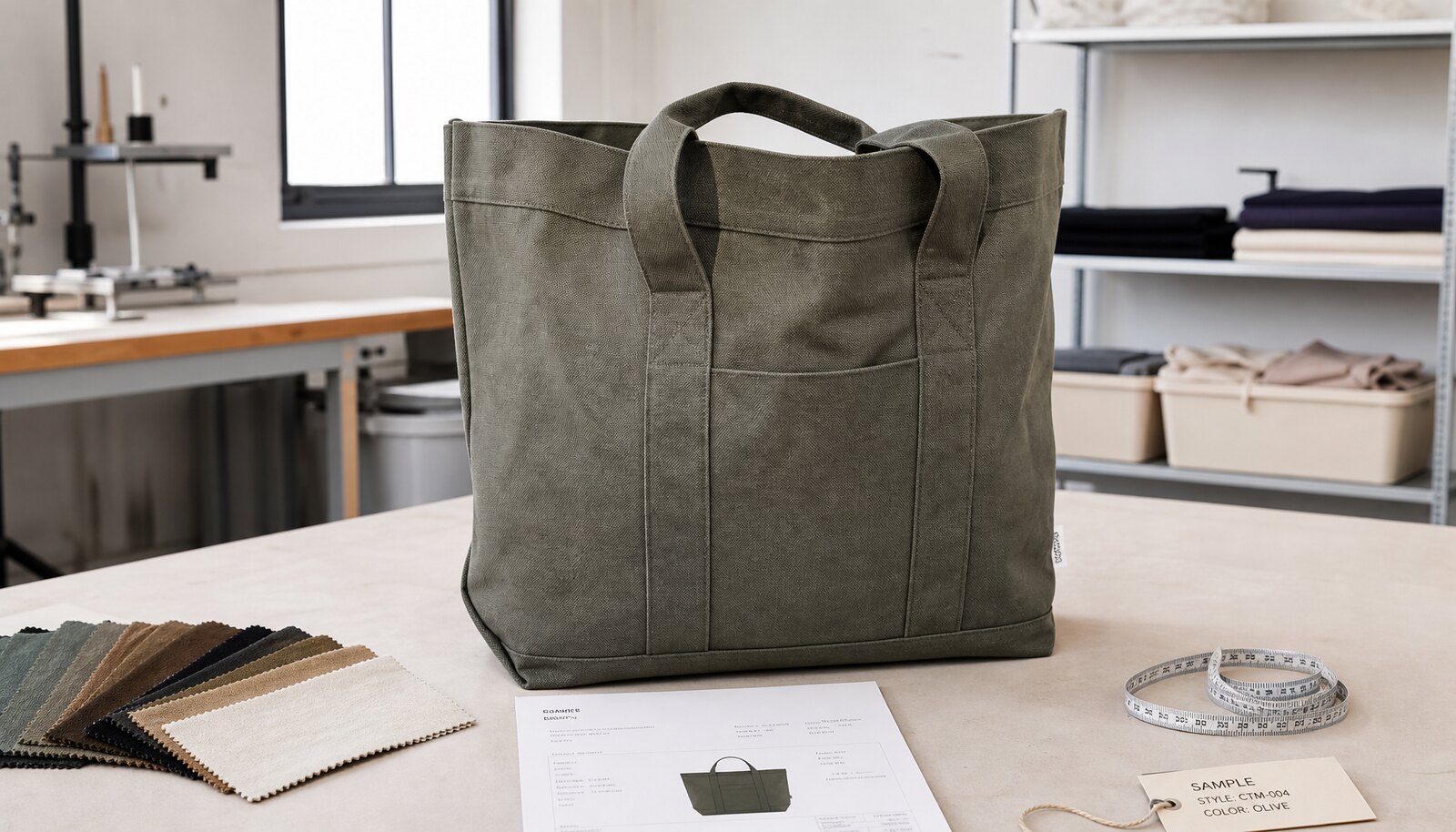
What retail chain buyers actually need from a recycled canvas tote
Retail chains do not buy recycled canvas totes as a design exercise. They buy a repeatable SKU that has to survive store handling, distribution center receiving, shelf presentation, and reorder cycles without drifting in look or cost. That is why the sourcing standard has to be tighter than a simple promotional bag order. The tote should be judged as a product system, not as a photo or a pre-production sample sitting alone on a table.
The first procurement mistake is treating every tote as the same product. A checkout add-on, a gift-shop item, and a premium branded resale tote may all use recycled canvas, but they do not need the same fabric weight, reinforcement, or packing format. A lighter construction can work if the goal is a low-cost seasonal item with short shelf life. A heavier build makes more sense if the chain expects the tote to carry real weight, sit upright for display, or support a stronger retail price point.
The second mistake is allowing the word recycled to stand in for a real material spec. The buyer should define whether the program requires recycled cotton, recycled cotton blend, post-industrial recycled fiber, or post-consumer recycled content. If the sustainability team needs a stronger claim, the supplier may need a certified chain-of-custody path. If the claim is only part of the product story, the buyer still needs a written basis so the quote can be compared on something concrete rather than on vendor language.
- Treat the tote as a repeatable retail SKU, not a one-off promotional item.
- Tie the spec to the use case before asking for price.
- Define the recycled-content basis in writing so later quotes stay comparable.
Turn the brief into a controllable specification
Most tote RFQs fail because the brief is too loose. If the request only says recycled canvas tote, every supplier will fill in the gaps differently. One will quote a soft 8 oz bag with a narrow handle. Another will price a structured 12 oz tote with reinforcement and bulk packing. Both may be honest quotes, but they are not comparable. Procurement needs a spec that controls the variables that actually move cost and quality.
The spec should lock the finished dimensions, gusset if needed, handle width, handle drop, seam allowance, and reinforcement method. If the bag needs to stand upright on shelf, say so. If it is meant to fold flat for hanging or carton efficiency, say that instead. This matters because structure changes the cutting pattern, sewing time, and defect profile. A bag that looks fine in a mockup may still fail in production if the handle geometry or gusset depth is not practical for the chosen fabric weight.
Decoration belongs in the same spec. Screen print is often the most efficient choice for simple art and recurring orders because setup is predictable and cost scales well. Heat transfer may work better for complex art or smaller runs, but it can introduce cracking or edge lift if the wrong film is used. Embroidery and sewn patches give a different retail feel, but they increase labor and placement risk. The buyer should choose the method based on the way the bag will be sold, handled, and restocked, not on what sounds premium in the quote.
- Put dimensions, handle geometry, seam type, and decoration method in one spec.
- Say whether the tote must stand upright or fold flat.
- Avoid vague terms like premium, durable, or eco-friendly unless they are backed by a measurable detail.
Compare sourcing routes on control, MOQ, and document burden
The right comparison is not supplier versus supplier. It is sourcing route versus sourcing route. A direct factory, a trading company, a domestic decorator using imported blanks, and a private-label specialist all solve different procurement problems. They also create different costs, different minimums, and different levels of traceability. The buyer should score each route on the practical question that matters most: can this setup repeat the same tote at the same standard on the next order?
A direct factory is usually the cleanest route for a repeat program because it can reduce handoffs and simplify corrective action. That advantage disappears if the factory outsources cutting, printing, or packing without clear disclosure. In that case, the buyer is still paying factory pricing but getting a multi-site process with more ways to drift. A trading company can be helpful when the buyer needs coordination across many products, but it often increases document burden because the actual production site is less visible. A domestic decorator on an imported blank can be fast for pilots, but the buyer must manage two quality systems instead of one.
The table should therefore reflect commercial tradeoffs, not just a generic procurement hierarchy. If a route lowers MOQ but raises certification burden, that is not a neutral detail. If a route is cheaper only because it removes packing labor from the quote, that is not a real cost advantage. For retail chain buying, the best route is usually the one that protects repeatability with the fewest hidden handoffs.
- Ask who actually makes the tote, who prints it, and who packs it.
- Treat hidden subcontracting as a risk item, not a convenience.
- Compare routes on repeatability, not only on first-order price.
Ask quote questions that reveal the real landed cost
A useful quote does more than name a unit price. It shows what fabric basis was used, what decoration method is included, what packing format was assumed, and which Incoterm defines the handoff point. Without that detail, procurement cannot tell whether the supplier is quoting the same product the chain actually wants. Two lower-cost quotes can still be more expensive in practice if one includes bulk packing and the other assumes individual polybagging, insert cards, or a different carton count.
Retail chain buyers should insist on volume tiers that match the business plan. A pilot price and a replenishment price tell different stories. The first may include setup costs spread over a small run. The second shows whether the program can scale without hidden surcharges. If a supplier refuses to break out the price by tier, the buyer should assume the quote is incomplete until the setup, packing, and freight assumptions are exposed.
Payment terms should be part of the commercial comparison as well. A lower unit price with a large deposit may create more cash risk than a slightly higher price with better protection on inspection. If a supplier can only quote on one shipping basis, ask for FOB, CIF, and DDP if those are the terms your organization actually uses. The goal is not to make the RFQ longer. The goal is to prevent false price comparisons.
- Ask for two real quantity tiers at minimum: pilot and replenishment.
- Normalize all quotes to the same packing and freight basis before comparing them.
- Include payment terms in the sourcing decision because they affect risk and cash flow.
Match recycled-content claims to the market you sell into
A recycled canvas tote sold into a retail chain may look simple, but the compliance expectations can still vary by destination market. Buyers should not assume one recycled-content statement covers every territory. If the chain operates in the U.S., ask how the supplier supports fiber-content and country-of-origin labeling where required, and whether any state-specific review applies, such as California Prop 65 if the program needs that check. If the tote is destined for the EU or UK, ask how the supplier handles REACH-related restricted substance review and textile labeling rules if those apply to the finished article.
The more the tote is positioned as a retail SKU rather than a giveaway, the more important the document trail becomes. That does not mean every tote needs an expensive certification package. It means the buyer should know which claim is being made, which document supports it, and whether the supplier can tie that document back to the actual lot being shipped. A recycled claim that cannot be traced to the production lot is a commercial risk even if the sample looks fine.
If your brand team wants a stronger sustainability story, ask whether the mill or factory is certified under a chain-of-custody scheme such as GRS or RCS, or whether an equivalent document set is available. If certification is not available, that does not automatically disqualify the supplier, but it does mean the buyer has to decide whether the claim is still supportable for the target market. Procurement should involve compliance early, not after the tote has already been approved visually.
- Tie the recycled claim to a document, not to supplier copy.
- Check market-specific needs early: U.S. labeling, California review where applicable, EU or UK restricted substance rules.
- If a stronger sustainability claim is needed, confirm whether chain-of-custody certification is available.
Approve samples in stages so the bulk run does not drift
A single sample approval is not enough for a chain program. The safer workflow is concept sample, pre-production sample, and shipment reference sample. The concept sample is for look and merchandising alignment. The pre-production sample is the real control point because it should use the actual fabric, decoration method, reinforcement, and packing plan. The shipment reference sample then becomes the physical standard attached to the order file so there is no argument later about what was approved.
This staged approach matters because recycled canvas can vary in handfeel, shade, and finishing when the factory changes fabric source or production lot. If the supplier proposes a material swap after approval, the buyer should treat that as a formal change request, not a casual substitution. The same rule should apply to print method, trim, or packing. In chain buying, small changes can become big failures when the next reorder hits a different production week or a different factory line.
The approval record should be simple but strict. Date the sample, record the deviations, and require the supplier to acknowledge the final standard in writing. If multiple internal teams need to sign off, keep the approval file in one place so merchandising, sourcing, quality, and compliance are all looking at the same reference. That avoids the common failure where everyone approved something slightly different.
- Use three steps: concept, pre-production, and shipment reference.
- Treat any material or construction swap after approval as a change request.
- Keep one signed reference sample tied to the PO.
Write QC acceptance criteria before the first purchase order
Quality control for recycled canvas totes has to be operational, not vague. The buyer should write the acceptance criteria into the PO before production starts so the factory knows what is acceptable and the inspector knows what to measure. A good starting point is a dimensional tolerance band, a stitch standard, a pull-test threshold, and a clear list of critical, major, and minor defects. If the chain uses an internal quality manual, the tote spec should match that language instead of improvising a category-specific standard at the last minute.
For dimensions, use the approved sample as the reference and set an actual tolerance. For load-bearing seams, a practical baseline is 7-8 spi with no skipped stitches, no open seams, and no frayed anchor points. Handle reinforcement should be visible and repeatable, usually with box-X stitching, bar-tacks, or an equivalent reinforcement pattern. For a medium retail tote, many buyers start with 25 N per handle anchor point or a 10 kg static hang for 60 seconds, then adjust upward if the tote is sold as a heavier-use item. Those are starting points, not universal laws, but they are concrete enough to use in a specification.
Defect classification should be equally clear. Structural failures such as open seams, broken handles, contaminated fabric, wrong size beyond tolerance, or badly misregistered print should be critical or major defects. Minor issues such as a few loose threads may be reworkable if your receiving team accepts them. The important part is not the label. It is consistency. If the factory, inspector, and buyer use different standards, the tote will pass one review and fail another.
- Use AQL 2.5 for major defects and 4.0 for minor defects as a practical baseline, with 0 critical defects.
- Set a real pull-test target, such as 25 N per anchor point or a 10 kg static hang for 60 seconds, then adjust for the end use.
- Require 7-8 spi on load-bearing seams and visible handle reinforcement.
- Classify open seams, broken handles, contamination, wrong size, and severe print defects as rejection items.
Inspect packing, cartonization, and warehouse fit like a receiving team
Packing is one of the most underestimated cost drivers in tote sourcing. A tote with a strong ex-factory price can become expensive if it is individually polybagged, packed too loosely, or cartoned in a way that wastes freight volume. That is why the buyer should define the pack unit, master carton count, carton dimensions, gross weight, and pallet pattern before the order is placed. If the distribution center has limits on carton size or stack height, those constraints should be part of the RFQ, not an afterthought.
Retail buyers should also think about receiving friction. The carton label format, barcode placement, fold direction, and SKU separation all affect how quickly a warehouse can receive the order. If the goods arrive with mixed fold directions or mixed SKUs in the same carton, the apparent unit price savings can disappear in labor. If the chain uses third-party logistics, ask whether the carton needs a specific label field set or pallet pattern so the tote can pass through the warehouse without manual correction.
For higher-volume programs, ask whether the carton structure has enough strength for stacking. If the pallet pattern is tall or the route is long, carton compression or edge crush performance may matter. You do not need to turn a tote RFQ into a packaging engineering project, but you do need enough carton discipline that the tote arrives ready to receive, not ready to be reworked.
- Define carton count, carton size, gross weight, and pallet pattern before the quote is accepted.
- Match barcode, SKU, and fold rules to the warehouse process.
- Ask for carton strength guidance if the pallet will be stacked or shipped long distance.
Build a reorder plan that protects consistency and margin
The best retail tote programs are repeatable. That means the buyer should think beyond the first order and plan for how the tote will be reordered, rechecked, and re-approved. If the supplier changes fabric lot, print screen, or packing format on a reorder, the bag can look subtly different even when the quote still looks attractive. A reorder plan should therefore include a reference sample, a fixed spec sheet, a document set, and a clear rule for change approval.
Margin protection is part of this as well. The lowest unit price is not always the lowest true cost if the tote produces rework, shrinkage, or receiving friction. Buyers should compare landed cost across suppliers using the same pack assumptions, the same compliance burden, and the same defect threshold. A supplier that is slightly more expensive but can repeat the tote cleanly may be the better commercial decision if the chain is likely to reorder.
For private-label or branded retail programs, it is also worth deciding which details can remain stable over multiple seasons. A chain may want the same handle length, same fabric weight, and same label position even if the artwork changes. That reduces retooling and keeps the shelf look familiar. Procurement should make those recurring details explicit so the next buying cycle does not start from zero.
- Keep one fixed spec and one approved reference sample for reorders.
- Compare landed cost, not only ex-factory price.
- Lock the recurring construction details so the tote does not change from season to season.
Use a practical checklist for the next RFQ
If you are sourcing recycled canvas totes for retail chains, the most useful checklist is short enough to use and specific enough to enforce. Start with the product: end use, finished size, fabric weight, recycled-content basis, decoration method, and packing format. Move to the supplier: actual factory location, in-house capabilities, document set, lead-time range, MOQ behavior, and traceability. Finish with the commercial terms: quote basis, Incoterm, payment terms, landed cost, and acceptance criteria. That order matters because it prevents the RFQ from becoming a generic tote request with no procurement control.
The best buyers do not ask for more adjectives. They ask for fewer words and better proof. They want the quote to show the fabric basis, the construction details, the compliance documents, the packing plan, and the QC standard in one place. That gives merchandising a realistic sample, gives sourcing a fair comparison, and gives receiving a tote that is actually ready for store flow.
For most chain programs, the winning setup is the one that can repeat the same tote with the least drift. Direct factory sourcing often wins on that point if the factory truly owns the critical steps and can support the paperwork. If it does not, the buyer should treat the route as a fallback, not a default. The goal is not to buy from the most convenient source. The goal is to buy a tote that is consistent, compliant, and priced on the real landed cost.
- Use one RFQ template across suppliers so the comparison stays clean.
- Do not approve a quote until the sample, compliance, packing, and QC details are complete.
- Choose the sourcing route that best supports repeatability and receiving efficiency.
Specification comparison for buyers
| Procurement route | MOQ behavior | Certification and document burden | Cost impact | Lead-time impact |
|---|---|---|---|---|
| Direct factory, full-package program | Usually the cleanest MOQ across fabric, printing, and packing if the site owns those steps | Moderate to high, but easier to manage when the factory can provide lot traceability, test reports, and production photos | Best for repeat orders because there is no middleman margin on every run | Often the most stable when fabric and print capacity are in-house |
| Trading company with managed factory network | Can be flexible for pilots, but MOQ may change by color, trim, or the underlying factory | Higher burden because the buyer needs the actual factory name, not only the sales office documents | Often higher unit cost, but useful if it reduces sourcing workload | Can vary more because work may move between plants |
| Domestic decorator plus imported blank tote | Low MOQ on decoration, but the blank tote still has its own minimums | Two records are needed: blank origin and finished decoration process | Usually more expensive at scale, but can work for small drops or urgent needs | Fast for pilots, less efficient for large replenishment runs |
| Low-MOQ pilot supplier | Good for small test runs, but the pilot spec may not be the bulk spec | Often thinner document packs, so the buyer must request the same proof set used for bulk sourcing | Can look cheap for a test order, but unit cost often rises at chain volume | Fast to launch, risky if the production method changes later |
| Premium private-label specialist | MOQ may be higher, but consistency is usually better across colors and finishes | Better chance of usable lot control, packaging discipline, and clean paperwork | Higher unit price, but lower correction cost if the tote is a retail SKU | Usually stable if the supplier already runs tote programs |
| Material | 8-12 oz cotton canvas, 120-220 gsm cotton, recycled cotton, or blended fabric selected by use case and target price | Before price comparison | Different cloth weights, backing, or certification claims make quotes hard to compare | |
| Construction | bag size, gusset, handle drop, seam allowance, stitch density, reinforcement patch, and loading expectation | Before sampling | Weak stress points create returns and failed inspections | |
| Decoration | screen print, heat transfer, embroidery, woven label, or hangtag matched to fabric texture and brand durability needs | Before artwork approval | The wrong method can crack, bleed, pucker, or fail on the chosen fabric |
Buyer checklist before sampling
- Define the end use first: checkout add-on, resale tote, seasonal gift item, or event retail. The use case should decide fabric weight, structure, packing, and whether the bag must stand up on shelf.
- Lock the recycled-content claim in writing. State whether the buyer needs recycled cotton, recycled cotton blend, post-industrial recycled fiber, post-consumer recycled content, or a certified chain-of-custody claim such as GRS or RCS if your brand team requires one.
- Specify the finished dimensions, gusset, handle width, handle length, handle drop, seam type, and reinforcement style on one spec sheet. Do not leave those decisions scattered across email threads.
- Set the fabric weight in ounces or GSM and use a range, not a marketing description. For many retail programs, 10-12 oz canvas is a practical starting range, but the final target should match the tote's load and shelf role.
- Choose the decoration method before pricing. Screen print, heat transfer, embroidery, woven label, and sewn patch all create different setup costs, durability risks, and lead-time profiles.
- Require the supplier to quote the same construction for pre-production samples and bulk production. If the sample uses different fabric, trim, or packing, it is not a valid control sample.
- Ask for a material declaration, a production reference sample, and a compliance statement that matches the destination market. For example, ask how the supplier supports fiber-content or country-of-origin labeling where required, and what they can provide for U.S., EU, UK, or California-specific requirements as applicable.
- Ask for at least two price tiers: pilot volume and replenishment volume. That shows whether the quote is actually scalable or only looks competitive at a low order quantity.
- Write the packing spec clearly: flat-fold size, individual polybag yes or no, barcode placement, insert card requirement, carton count, carton dimensions, and pallet pattern if your DC cares about stackability.
- State the acceptance standard before production starts. Use AQL 2.5 for major defects and 4.0 for minor defects as a common starting point, with 0 critical defects allowed unless your internal standard is stricter.
Factory quote questions to send
- What is the exact fiber composition, recycled-content basis, and fabric weight range for the tote you are quoting?
- Which factory will actually cut, sew, print, and pack the order? If any step is outsourced, name the subcontractor and the process it handles.
- Can you provide a material declaration, lot traceability record, and production photos for the approved sample and the bulk run?
- What certification or verification scheme supports the recycled-content claim, and is it tied to the actual fabric lot or only to the mill?
- What are your MOQ thresholds by color, artwork version, and packaging version?
- What are your unit prices at pilot volume, target volume, and replenishment volume, and what changes at each tier?
- What decoration method are you pricing, how many print colors are included, and what is the setup fee per color or per placement?
- What finished dimensions, handle drop, reinforcement method, and seam allowance are included in the quoted spec?
- What stitch density do you build into load-bearing seams, and what reinforcement do you use at the handle anchors?
- What handle pull or load test do you run in-house, and what is the pass threshold for this tote?
Quality-control points to confirm
- Use a formal AQL plan. A practical starting point for tote bags is AQL 2.5 for major defects, AQL 4.0 for minor defects, and 0 critical defects. Tighten the plan if your retail chain has a stricter receiving standard.
- Check finished dimensions against the approved spec with a clear tolerance band. A common starting point is +/- 0.5 cm for smaller totes and +/- 1.0 cm for larger totes, but the same tolerance must be used across all suppliers.
- Inspect stitch density on load-bearing seams. For canvas totes, 7-8 stitches per inch or equivalent is a sensible baseline, with no skipped stitches, no open seams, and no broken thread at the handle anchors.
- Require reinforcement at the handle attachment. Box-X stitching, bar-tacks, or an equivalent reinforcement should be present at the stress points, with no loose ends or pulled threads.
- Run a handle pull or static load check. A medium retail tote can start at 25 N per anchor point or a 10 kg static hang for 60 seconds, but the threshold should be aligned to the actual retail use and the chain's internal standard.
- Check print placement after final sewing and folding, not only on a flat sample. A logo can drift when the bag is assembled and packed, so the approved reference should show the finished, folded state.
- Verify fabric weight against the approved reference, not only against the supplier's catalog description. If the chain cares about handfeel or structure, request the same measurement method every time.
- Inspect for contamination, oil marks, glue marks, lint, odor, shade variation, and fold damage before cartons are sealed. These are common warehouse reject points because they affect sellability immediately.
- Set clear cosmetic versus structural rules. Loose threads may be reworkable if they do not affect appearance or strength, but crooked labels, open seams, print bleed, or contaminated fabric should be treated as rejection items.
- Check carton counts, barcode placement, outer carton labels, and fold direction before release. A tote that arrives in the right quantity but the wrong pack format still creates receiving labor and store delay.