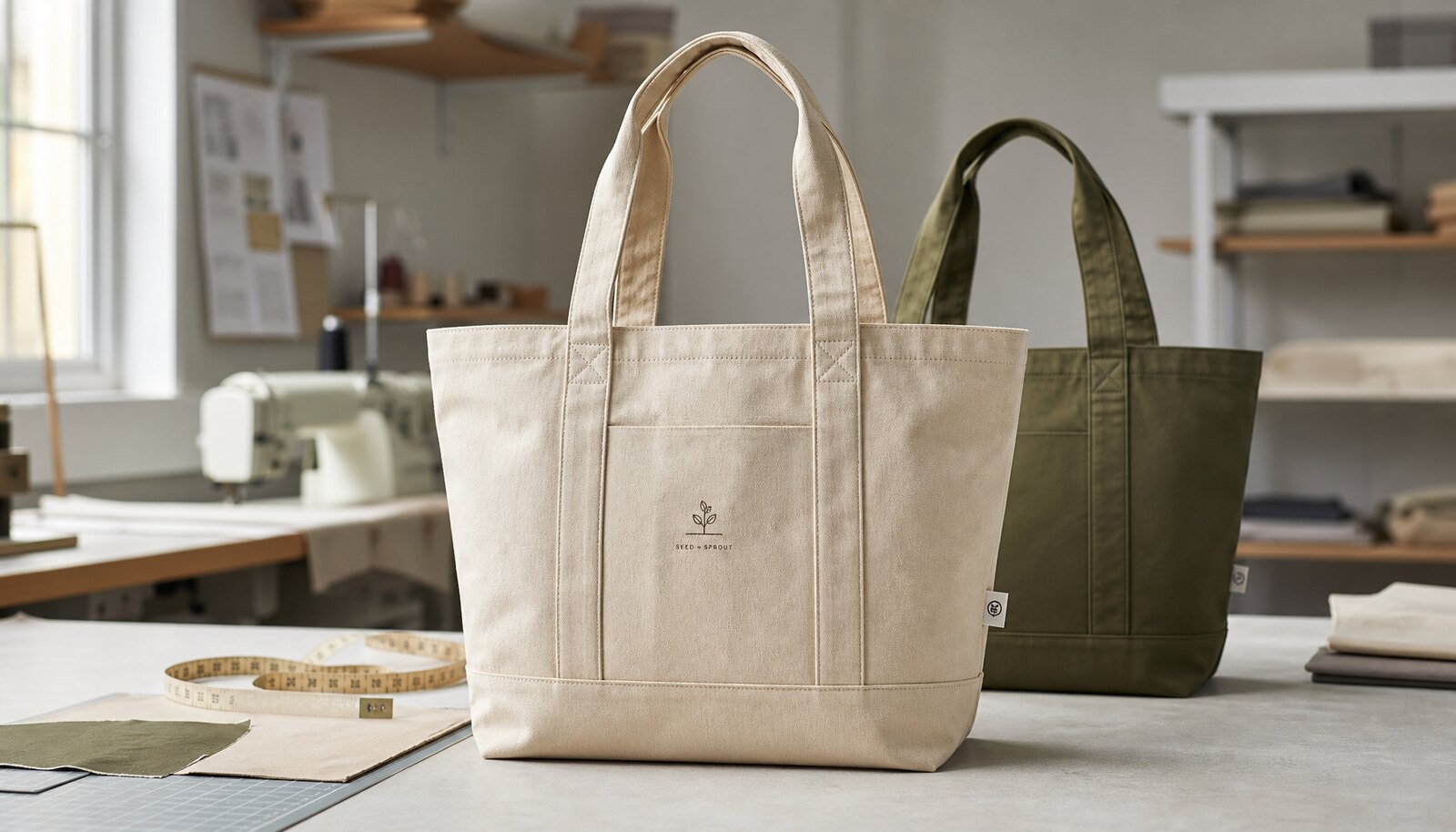
1) Why retail chain tote launches need a procurement spec, not a basic product brief
A recycled canvas tote for a retail chain is not the same purchase as a one-off event bag. The item has to survive repeat handling, fit a distribution center process, and look consistent across multiple stores and replenishment cycles. That means procurement needs a written spec that covers product, decoration, packing, and quality control. A loose brief such as 'eco tote with logo' leaves too much room for price drift and quality disputes later.
The most common launch failure is not a catastrophic defect; it is inconsistency. The first sample looks good, but the bulk order arrives with lighter canvas, a different handle drop, a shifted logo, or cartons packed in a way the DC does not want. For chain programs, that kind of drift creates rework, delayed store delivery, and avoidable complaints from merchandising teams.
A better approach is to write the tote as a retail SKU. Specify the use case, the exact fabric basis, the print area, the packing unit, and the approval path. That lets procurement compare vendors on the same basis instead of comparing a polished sample against a vague quote. It also gives the factory a clear production target and reduces back-and-forth during the launch window.
- Treat the tote like a sell-through item, not a giveaway.
- Write the brief for procurement, warehouse, and compliance teams together.
- Use the same spec version for RFQ, sample approval, PO, and inspection report.
2) Start with the use case, then choose fabric weight, structure, and finishing
For recycled canvas totes used in retail chains, the right fabric weight depends on the shopping basket and the presentation standard. A 12 oz recycled canvas is often a sensible baseline for standard shopping and gift use. It generally gives enough body for a clean retail look without pushing sewing cost too high. A 14 oz option is usually the safer choice if the tote must hold heavier goods, keep its shape on shelf, or better resist distortion during packing and customer use.
The procurement team should also decide whether the tote needs to feel soft and foldable or more structured and premium. Recycled canvas varies by source, weave tightness, and finishing. Two bags with the same stated weight can feel different if one fabric is tighter woven or more heavily calendared. Ask the supplier to quote the actual weight, weave style, and finish, not just a marketing description.
Structure matters as much as fabric. An unlined tote with reinforced handles and a clean top hem is usually easier to source consistently than a lined bag with pockets and multiple trims. Every added feature adds inspection points, additional labor, and more chances for a launch delay. If the brand only needs a strong retail-ready bag, keep the construction simple and use the print, label, and trim choices to create brand distinction.
When artwork is being planned, remember that recycled canvas can affect print clarity. A coarse surface may make fine lines less crisp than on smooth cotton. The product spec should therefore include any minimum print line thickness, acceptable logo size, and whether the logo needs to sit a minimum distance from seams or edges.
- Set the body size, fabric weight, handle drop, and print area before asking for price.
- Use measured oz or GSM and a finished-size tolerance; avoid descriptive-only language.
- Keep the first launch simple unless the bag must justify a premium price point.
3) Verify recycled-content claims before you compare prices
For procurement buyers, recycled canvas is not only a design choice; it is also a claim that may need to be defended internally. The term 'recycled' can mean recycled cotton, recycled fiber blended into new yarn, or a fabric built from pre-consumer or post-consumer waste. Those are not interchangeable from a documentation standpoint. If your retail chain wants to communicate sustainability on-product or online, you need the supplier to define what is actually being claimed.
Ask the factory or trading partner for written support before the order moves forward. At minimum, request the composition statement, the recycled fiber percentage, and the basis for that claim. If your compliance or brand team needs supporting evidence, ask whether the supplier can provide a certificate number, test report, declaration letter, or origin proof that links the recycled material to the finished fabric. Do not assume an 'eco' label on a quote is enough.
This matters because the claim may appear not only on the tote itself but also on hangtags, carton labels, shipping documents, or product pages. If the claim language on the bag and the wording used by the supplier do not match, the launch becomes harder to approve. Procurement should confirm the exact approved wording before artwork is finalized. That avoids last-minute changes after cartons have already been printed.
A good RFQ should also ask what part of the supply chain owns the documentation. If the factory cannot issue support documents directly, but the trader says it can, then the buyer needs to know who will actually respond if an audit or internal review is triggered later. For a chain launch, clarity here is worth more than a small price difference.
- Define what 'recycled' means in your program: fiber, yarn, or fabric level.
- Request documentation for the claim, not just a verbal assurance.
- Align bag artwork, carton labels, and product-page wording before production.
4) Compare supplier routes with a procurement-grade matrix, not a single factory quote
Retail buyers often receive two broad types of offer: direct factory and trading-layer quotes. Both can work, but they create different risks. Direct factory sourcing usually gives better visibility into sewing capacity, fabric booking, and packing discipline. It is usually the stronger choice for replenishable chain programs because the same operation that quotes the tote is also managing production. That helps when you need a repeat order with minimal variation.
Trading support can still be useful, especially when the launch brief is evolving or the buyer wants one point of contact across several accessories. The risk is that the quote can hide the actual factory, obscure who owns QC, or blur whether the pack format can truly be repeated. If the buyer uses a trader, the quotation should still name the factory, define sample ownership, and identify who signs off on inspection results.
A procurement-grade comparison should not ask only, 'Who is cheapest?' It should ask, 'Who can hold the same spec across two or three seasons, issue the required proof, and pack to our DC rules without surprises?' In practice, the supplier that wins is often the one with the cleanest documentation, not the one with the lowest headline ex-factory price.
The matrix below expands the decision beyond a simple factory-versus-trader view and helps buyers compare the routes that matter for retail chain launches.
- Name the actual production site if a trading partner is involved.
- Compare who owns QC, packing, and corrective actions, not only who sends the quote.
- Use the same spec and same sample gate for every supplier route.
5) Supplier-route comparison matrix: what to compare beyond the unit price
The table below is intended for procurement review. It helps buyers compare the most common sourcing routes against decision criteria that matter in chain launches: documentation, repeatability, packing control, and flexibility. The right route depends on how much internal support your team needs and how tightly the launch date is fixed.
When in doubt, favor the route that gives the clearest proof trail. For a retail chain, a slightly higher unit cost can still be the lower-risk option if it reduces rework, inspection disputes, or launch delays.
- Ask every supplier to quote against the same artwork version and carton spec.
- Require sample photos and a physical retained sample for the final approved version.
- Compare landed cost, not only ex-factory price.
6) Build the quote around real cost drivers: MOQ, print setup, packing, and overrun rules
A tote quote becomes useful only when it separates recurring cost from one-time cost. For recycled canvas totes, the line items that distort comparison most are print setup, label setup, sample freight, carton printing, and any packaging changes requested by the retail DC. If those are rolled into one line, the cheapest price may just be the least transparent price.
Procurement should also ask how MOQ is calculated. Some suppliers set MOQ by fabric color, others by print screen count, others by label type. One bag body with one artwork and one pack format is always easier to launch than a matrix of five colors and three labels. If a test order is unavoidable, keep the first launch as simple as possible and avoid splitting the minimum across too many variants.
Overrun and underrun policy is another item that should be written down. Retail buyers need to know whether the supplier may ship plus or minus a certain percentage, how invoices are handled, and whether the supplier can fill short counts with a later shipment. If the launch is tied to store opens or flyer dates, the buyer should decide in advance whether a short shipment is acceptable or whether the lot must be complete before the ship date.
Packing also belongs in the quote, because packing changes freight, warehouse labor, and shelf condition. Ask for bag count per carton, carton dimensions, gross weight, and whether the bags are flat packed, folded, or individually polybagged. The carton data should be compared line by line across suppliers, because a low unit price with a bulky carton can cost more once shipping is added.
- Split one-time setup costs from recurring unit pricing.
- Ask for overrun/underrun policy in writing.
- Use carton dimensions and gross weight to compare freight impact.
7) Print method and artwork rules: where brand logos often fail on recycled canvas
For most retail chain launches, screen print remains the default choice because it is predictable, scalable, and usually cost-efficient for one or two color logos. It performs best on bold artwork and larger print areas. If the brand graphic has fine lines, tight text, or gradients, the print method and fabric surface need to be checked together before approval. Recycled canvas can be slightly uneven or textured, and that affects how clearly small details land.
Heat transfer can work for shorter runs or more detailed art, but the buyer should not assume it is the better premium option. On a tote that will be folded, stocked, and handled repeatedly, transfer durability and edge appearance need to be tested, especially if the bag is a paid retail item rather than a giveaway. Embroidery can lift the perceived value, but it also changes stitch load, risks panel distortion, and can make unit price and lead time less predictable.
The RFQ should contain artwork rules that the supplier can actually quote against. Include the final artwork file type, Pantone or reference color, minimum stroke width, and the permitted print boundary relative to seams and hems. If the logo sits near a side seam or on a gusset, say so explicitly. Buyers should also ask for a strike-off and sign off on the print position, because visual approval alone does not guarantee correct placement at scale.
For chain launches, a practical rule is to limit the first order to a single front print position unless the second side is truly needed. Every added print position increases setup complexity and inspection time.
- Use screen print for simple, scalable retail programs.
- Test fine text and thin lines before approving detailed graphics.
- Write minimum line thickness and print boundary rules into the spec.
8) Sample approval should test size, stitching, packing, and presentation—not just appearance
A good tote sample should prove more than whether the logo looks nice. It should confirm the real bag size, handle length, top hem, stitch consistency, fold pattern, and how the bag behaves when packed into the proposed carton count. If a sample only gets a visual thumbs-up, the bulk lot can still fail on dimensions, packing density, or handle strength.
For procurement purposes, the strongest sample process is a two-step approval. First, review a pre-production sample made from the final fabric, final print method, and final trim components. Second, keep one sealed golden sample with the PO so that purchasing, QC, and the factory all reference the same approved standard. If the supplier cannot duplicate the same sample twice, that is a warning sign that the bulk order may drift.
When reviewing the sample, use a measuring tape and a simple inspection sheet. Check body width, height, gusset depth, handle drop, logo placement from centerline, seam straightness, and carton-fit behavior. Pull the handles by hand and inspect the bar-tacks or cross-stitches for symmetry and thread opening. If the tote is a paid retail item, also check surface presentation under retail lighting for lint, loose threads, and print edge quality.
If your product team wants to approve the bag for e-commerce or shelf photography, confirm whether the sample still looks good after light packing. Recycled canvas can compress and show creases, so a bag that photographs well flat may look different when packed for the DC.
- Approve final fabric, print method, and packing format together.
- Retain one sealed golden sample in the PO file.
- Use a measurement sheet, not only a visual review.
9) Packing, carton specs, and receiving rules for retail distribution centers
Packing is one of the easiest parts of tote sourcing to under-specify and one of the fastest ways to create receiving problems. Retail distribution centers want predictable counts, legible carton markings, and cartons that can be stored and handled without collapse. If the tote is packed too tightly, the bag may crease and the print can distort; if it is too loose, freight cost rises and cartons can deform in transit.
The quote should state exactly how the bags are packed: individually polybagged or not, folded or flat, carton count, carton size, gross weight, and whether cartons are palletized. Ask for carton labels that include the SKU, color code, quantity, country of origin, and any barcode required by your DC. If the retailer has a specific receiving format, that should be shared before the factory prints the first carton label.
Carton quality itself matters. A weak carton may pass on a short factory move but fail after stacking and cross-docking. Depending on the lane, buyers may want the supplier to confirm carton board strength or at least to use a carton spec that holds shape under the expected stack. If your warehouse team has a maximum carton weight or a preferred pallet pattern, do not leave that to the factory’s default.
This is also the point where many programs get tripped up by mismatched pack data. The packing list, carton mark, and purchase order must all show the same SKU and count. A bag count mismatch can delay receiving even if the tote itself is good.
- Define pack count, carton dimensions, gross weight, and pallet pattern before approval.
- Align carton marks with PO SKU codes and DC receiving rules.
- Check carton strength if the lane includes stacking, long transit, or multiple handoffs.
10) QC checklist, inspection method, and closeout questions before PO release
A retail launch should not move to bulk production until the buyer has written quality checkpoints. For recycled canvas totes, the inspection plan should define major, minor, and critical defects. It should also state what the factory will inspect in-line and what the final shipment inspection will cover. An informal 'good quality' promise is not enough for a chain program that may reorder the same SKU later.
Use a normal AQL-based inspection plan if your internal policy allows it, and tie it to the actual tote defects that matter: incorrect fabric weight, off-center print, crooked seams, loose handles, missing labels, wrong carton count, or mislabeled cartons. If the order includes a recycled-content claim, make sure the label and carton wording is checked during final inspection so the shipment does not leave with a documentation mismatch.
The best QC questions are the ones that force the supplier to show its control points. Ask how the factory measures fabric weight, how it checks print registration, what it does if the handle stitch fails, and which documents it can provide before shipment. If the supplier cannot describe its inspection flow clearly, it will be difficult to manage an issue later.
Before releasing the PO, procurement should also ask about replacement terms. If the bulk order misses size, print position, carton count, or agreed workmanship standards, what happens? Who pays for rework, reshipment, or replacement units? A retail launch is not protected until those terms are documented.
- Write defect definitions into the PO or QC appendix.
- Use AQL or another formal inspection standard, not a vague visual check.
- Confirm replacement terms before bulk sewing starts.
Specification comparison for buyers
| Spec decision | Recommended option | When it fits | Buyer risk to check |
|---|---|---|---|
| Fabric weight | 12 oz recycled canvas for standard retail launches; 14 oz if the tote must hold heavier goods, stand up on shelf, or better resist distortion during packing | Apparel, gift, home, bookstore, and grocery-adjacent chains that want a reusable tote with visible body and repeatable presentation | Ask for measured oz or GSM with a tolerance band. Too-light fabric can look limp after packing; too-heavy fabric raises cost and sewing load, so confirm seam strength, handle stitch count, and whether the fabric is pre-shrunk or finished to size |
| Recycled-content claim | Prefer documented recycled-content wording tied to supplier certificates, fiber composition, and carton labels | Any retail chain that needs proof for internal sustainability claims, product pages, or supplier audits | Do not accept a generic 'eco canvas' claim. Request material specification, recycled fiber percentage, origin proof for the yarn or fabric, and any third-party testing or certification documentation the factory actually holds |
| Print method | 1-2 color screen print for most chain launches; heat transfer only for short runs or highly detailed artwork; embroidery only when premium appearance justifies added cost and distortion risk | Private label launches with stable artwork and a need to control unit cost across multiple stores | Fine lines, gradients, and small text can break down on coarse recycled canvas; require strike-offs, line-width limits, and registration tolerance before approval |
| Supplier route | Direct factory with tote experience and packing control, or a verified trading partner with named factory and QC ownership | Programs needing repeat orders, tighter cost control, and consistent carton packing across replenishment cycles | Trading-only quotes can hide fabric origin, finishing loss, inspection scope, or packing changes; compare true factory capacity, sample ownership, and whether the supplier can issue test and inspection documents on request |
| MOQ structure | Start with one body style, one artwork location, one handle color, and one label format per SKU | Retail chains testing a new tote program across a few regions or banners | MOQ may be calculated separately for fabric, print setup, woven label, and colorway. Confirm whether each variation creates a new minimum and whether overrun/underrun is allowed |
| Lining and trim | Unlined body with reinforced top edge and cross-stitch handles unless the retail concept specifically needs an interior pocket or zip closure | Retail launches focused on value, speed, and a clean natural-canvas look | Lining, zippers, and pockets add cost, lead time, and inspection points. If added, define seam allowance, pocket placement, zipper gauge, and stitch density clearly |
| Handle length and reinforcement | Short hand-carry plus optional longer shoulder drop if the tote is meant for shoppers carrying multiple items | Chain stores with mixed purchase baskets and staff who need to demo the bag in-store | A handle that is too short can limit use; a handle that is too long can twist on the shelf. Require bar-tacks or cross-stitches with a defined size and symmetry tolerance |
| Packing route | Flat packed in polybag with master carton count matched to replenishment units, or fold-pack without polybag if the DC prefers reduced plastic | Retail distribution that needs easy counting at DC and low carton damage risk | Overpacked cartons crush fabric and distort logos; underfilled cartons raise freight cost and carton deformation risk. Ask for carton dimensions, gross weight, and pack count before approving the PO |
| Sample approval path | Pre-production sample plus one sealed gold sample for QC reference, with a signed dimensional and print-position sheet | First orders, artwork-sensitive programs, or supplier changes | Without a sealed reference, changes in print shade, panel size, stitch density, or label position are hard to dispute during production |
Buyer checklist before sampling
- Define the end use: shelf giveaway, paid retail item, gift-with-purchase, checkout impulse item, or promotional bundle insert. Load requirement, finishing level, and acceptable defect rate depend on use.
- Lock one body size first, then approve fabric weight, handle length, handle drop, and print location before requesting pricing.
- Choose the recycled canvas specification and ask for the recycled-content claim wording in writing, including what appears on the bag, carton, hangtag, or shipping label.
- Request origin proof for recycled fiber, yarn, or fabric if your compliance team needs it, and confirm whether the supplier can provide invoices, declarations, or certificate numbers that support the claim.
- Send final artwork in vector format with Pantone or lab reference values, minimum line thickness, and a seam-safe print boundary for the chosen decoration method.
- Request a pre-production sample, a washed or rubbed test if durability matters, and one sealed golden sample for the PO file.
- Confirm carton count, inner polybag plan, carton markings, carton label format, and whether barcode labels are applied at bag level or carton level.
- Separate prototype cost, sample freight, production unit price, overrun/underrun policy, and any one-time plate, cylinder, or setup fees in the quote.
- Ask for carton dimensions, gross weight, and pallet pattern so the warehouse team can check receiving and storage fit before launch.
- Build time for print approval, bulk fabric booking, bulk inspection, and outbound shipping into the launch calendar before store marketing dates are fixed.
Factory quote questions to send
- What exact fabric construction are you quoting: oz or GSM, weave type, recycled fiber percentage, whether the canvas is natural, dyed, or bleached, and what tolerance do you hold on weight and finished size?
- What documents can you provide to support the recycled-content claim: fiber or fabric specification, declaration letter, certificate numbers, test report, and origin proof for the recycled material?
- Which print method is included in the unit price, how many colors are covered, what is the minimum line thickness you recommend, and what is the charge for extra print positions or larger print areas?
- What is your MOQ per colorway, per artwork, per label, and per handle color, and does a different woven label, zipper, pocket, or trim style create a separate MOQ?
- Do you allow overrun and underrun, and if so, what percentage range applies, how is invoicing handled, and what happens if the final output falls outside the agreed range?
- Can you quote the bag, sample, carton pack, export packing, and any testing fee separately so we can compare landed cost rather than only ex-factory price?
- What sample stages do you supply before bulk production, and can you issue a sealed pre-production sample and a retained golden sample for approval?
- What load test or seam strength test do you use for this tote, and what is the pass/fail criterion for handles, side seams, and top hem?
- What are the carton dimensions, gross weight, units per carton, and pallet pattern, and can you adjust packing to our DC receiving rules?
- What is the realistic lead time after artwork approval and deposit, which step usually becomes the bottleneck on your line, and what approvals must happen before sewing starts?
Quality-control points to confirm
- Define finished fabric weight in oz or GSM and require a tolerance band on the purchase order. For launch work, avoid vague wording like 'heavy canvas' or 'premium canvas' without a measured specification.
- Define finished size tolerance for body width, height, and gusset depth. If the bag is intended to fit a retail fixture or gifting set, even a small drift can cause packing or merchandising issues.
- Set print position tolerance against seam, top edge, and centerline. Small logos and text should not be allowed to drift into the stitch line or sit unevenly across the front panel.
- Specify print registration tolerance, ink coverage expectations, and color match method. If the artwork is brand-critical, require strike-off approval under daylight-equivalent lighting and a retained approval sample.
- Require handle attachment symmetry and stitch density checks. Bar-tacks or cross-stitches should be even on both sides, with no skipped stitches, loose threads, broken needles, or thread snags.
- Check seam allowance consistency on side seams, top hem, and gusset corners. A curled or twisted hem often points to uneven pressing or inconsistent sewing guides.
- If recycled fabric has visible slub or mixed fiber texture, define what is acceptable. Good recycled canvas can look natural, but buyers should still reject excessive pilling, heavy lint, oil marks, or contamination.
- Request lot traceability for fabric rolls, print batches, and carton labels. A production lot code on the carton helps isolate issues if one batch fails inspection.
- Inspection should use an agreed AQL standard rather than informal 'good quality' wording. For promotional and retail tote launches, many buyers use a normal inspection plan with clear major, minor, and critical defect definitions tied to the PO.
- Check carton build quality: flute type, bursting strength or edge crush rating if required by your DC, carton tape seal, and whether cartons maintain shape when stacked. Ask for carton drop or compression handling requirements if the lane is rough.