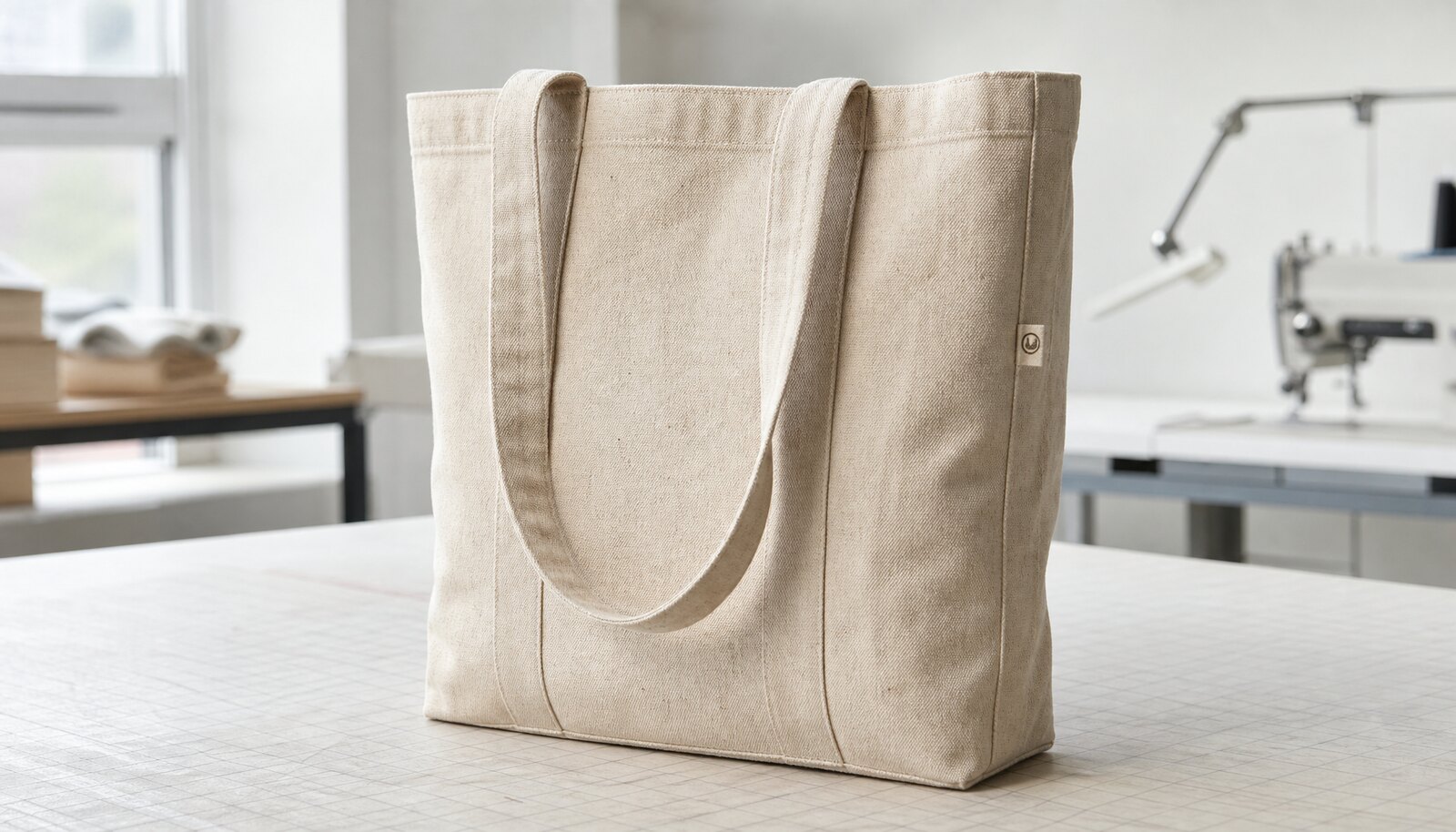
Start With the Event Job, Not the Bag
For retail chain giveaways, the tote is only useful if it matches the job it will actually perform. A recycled canvas tote can be a simple handout, a carrier for product samples, a reusable store bag, or a premium gift insert. Those jobs do not require the same fabric weight, handle construction, or packing method. If the bag only has to hold a brochure and a small sample, a lighter build may be enough. If the bag will be reused after the event and judged on first impression in a store, the tote needs more structure, stronger stitching, and a print method that still looks sharp after handling and refolding.
Procurement teams often lose time by writing the brief around the design instead of the use case. A supplier can quote almost any tote if the request only says 'recycled canvas tote with logo.' The quote becomes more meaningful when it states what goes inside, how long the bag must last, which stores will receive it, and whether the event has a fixed launch date. Those details determine the real procurement shape of the order: the base material, whether the handles need reinforcement, whether cartons must be store-sorted, and whether the shipment can tolerate sea freight or needs a faster transit plan.
Before you send an RFQ, document the operational details that affect cost. List the fill weight, whether the tote is distributed loose or inside a kit, whether it must fit into a display carton or another branded pack, and whether each store receives the same quantity or a regional split. Also note any sensitivity around brand appearance. A chain that wants a premium in-store perception may need a cleaner weave, tighter stitching, and tighter shade control than a chain using the tote for a single-day event handout. These are not cosmetic preferences; they change production method and supplier selection.
It also helps to define the event failure modes in plain language. Is the main risk missing the event date? Is it receiving bags with print defects? Is it a warehouse that needs 500 units per carton cluster? When the buyer understands the failure point, the RFQ becomes sharper and the supplier response becomes easier to compare. The best tote buy is not the cheapest bag. It is the one that arrives ready for the planned use with the least internal handling and the least post-arrival correction.
Useful buyer inputs for this stage are simple but specific: tote use case, fill contents, final delivery window, distribution geography, and any store-level handling constraints. That is enough to move the discussion from generic 'recycled tote' talk to an actual sourcing plan.
- Define the tote use case before specifying artwork or color.
- Document fill weight, distribution method, and store receiving method.
- Separate a one-day event handout from a reusable retail tote requirement.
- Write down the main failure risk: late arrival, poor print, weak build, or bad packing.
Choose the Recycled Canvas Spec That Matches Use
For most retail chain giveaway programs, 380 to 450 GSM recycled canvas is the most practical middle band. It gives the bag enough body to hold a printed panel cleanly, enough structure to feel like a real retail tote, and enough flexibility to pack efficiently in cartons. Below that range, the bag can feel too soft or flimsy for customer-facing use, especially if the event is trying to project quality. Above that range, cost and pack-out weight rise quickly, and the tote may become unnecessarily bulky for a mass giveaway.
Lighter options in the 300 to 340 GSM range are still valid when the bag only needs to carry a small insert pack or a sample set. They can also be useful when event staff will hand out very high volumes and packing efficiency matters more than reuse. Heavier 500 GSM or above should be reserved for programs where the tote itself is the item of value, where the chain wants a more premium hand feel, or where the bag needs to survive repeated use and heavier loads. In procurement terms, the right GSM is not a brand preference. It is a decision about cost, handling, and the expected life of the tote.
The material spec should also cover recycled-content proof and surface appearance. Recycled canvas often includes natural flecks, slubs, and slight shade movement. Those traits are normal, but they need a buyer decision. If the chain wants a cleaner premium look, then the spec should state whether visible flecks are acceptable, whether prewashing is required, and whether a soft finish or enzyme treatment is part of the approved appearance. Without that written standard, a supplier can deliver a technically acceptable bag that still looks too rough for the campaign.
Construction detail matters as much as fabric weight. A medium tote commonly uses a body size around 38 x 42 cm with an 8 to 10 cm gusset, but that only works if the inserts fit and the bag can still be folded to the intended carton size. Handle webbing or self-fabric handles should be wide enough to sit comfortably on the shoulder, often around 2.5 to 3 cm for a medium tote. Reinforcement at the handle points should use bar-tacks or another defined stress-point finish. If the tote is meant to hold more than a brochure pack, request a stronger base construction or a double-row stitch at the load points.
This is where procurement should stop relying on vague terms like 'heavy duty' or 'premium.' Ask for a measurable spec sheet: finished dimensions, fabric GSM, handle width, handle drop, handle reinforcement, and acceptable variation in color and natural fiber marks. The more specific the material and construction standard, the easier it is to separate a real production quote from a sales estimate.
- Use 300-340 GSM only for light event contents or short-life handouts.
- Use 380-450 GSM for most chain giveaway programs that need a retail-grade feel.
- Use 500 GSM or above only when the tote itself is the gift value.
- Write acceptance rules for flecks, slubs, shade movement, and any finishing treatment.
Decide the Print Method Before Art Approval
Decoration choice should be made before the artwork is finalized, not after the sample arrives. On textured recycled canvas, a logo that looks clean in a design file can lose detail if the lines are too fine, the font is too small, or the negative space is too tight. The supplier may be able to print the file, but the result may not be readable after folding, shipping, and repeated handling. That is why the print method and the artwork need to be treated as one procurement decision.
Screen printing remains the default method for most retail chain giveaway totes because it is durable, repeatable, and cost-efficient at medium volumes. One-color or two-color art usually produces the best result because it limits alignment risk and keeps the print panel clean. Water-based inks can give a softer hand feel, while plastisol can provide stronger opacity on natural canvas. The right choice depends on how the bag will be viewed, how often it will be handled, and whether the brand wants a softer or sharper finish.
Alternative methods can work, but each adds its own tradeoff. Heat transfer and DTF can support detailed artwork or smaller runs, but they can be vulnerable to cracking on fold lines if the tote is packed tightly and reopened often. Embroidery gives a premium feel, yet it can distort lighter canvas and slow production if the design is large. Woven patches can look strong but add sewing steps and may complicate lead time. For a chain giveaway, simple usually wins, especially when the order needs consistency across multiple stores or regions.
The practical buyer rule is to simplify art before production, not during factory sampling. Keep logos away from side seams, gussets, zipper areas, and dense stitch intersections. Avoid ultra-thin legal copy or reversed text unless the supplier has confirmed it can be reproduced clearly on the selected fabric. If the campaign truly needs complex artwork, ask the supplier to give a print-size recommendation and a safe line-width minimum before you approve the file. That reduces sample churn and keeps the approval cycle short.
Procurement should also confirm whether the ink coverage and print area match the actual display requirement. A tote that looks fine on a desk may not be legible from a retail counter. In buyer terms, the question is not simply whether the art can be printed. It is whether the printed bag will still look intentional after shipping, folding, and first use.
- Choose the print method before artwork is finalized.
- Use screen printing for repeatability and better control at medium volumes.
- Avoid ultra-thin lines, tiny text, and busy reversed details on textured canvas.
- Ask the supplier for safe print-size guidance when artwork is complex.
Build the MOQ Around Setup and Packing, Not Guesswork
MOQ on recycled canvas totes is usually driven by several different factors at once: fabric sourcing, cutting efficiency, printing setup, sewing labor, and final packing labor. A supplier may be willing to quote a low quantity for a blank tote, then push the real minimum much higher once custom dimensions, multi-color printing, sewn labels, or store-specific packing are added. That is why a useful RFQ should separate the bag body MOQ from the print MOQ and the packing MOQ. If the supplier cannot explain which step is creating the minimum, the buyer cannot compare quotes intelligently.
The most useful quote data is specific and repeatable. Ask for price breaks at 500, 1,000, 3,000, and 5,000 pieces, or at whatever quantities reflect your chain rollout. Also ask whether the supplier is quoting the same build at every quantity or silently changing materials, print method, or carton count to hit the price. A low MOQ can be misleading if the supplier achieves it by switching to a different blank, reducing handle reinforcement, or using a different packing format. The buyer should compare like with like.
For chain buyers, MOQ should be judged against the expected program life, not the first event alone. If the tote may be repeated for seasonal activations or reorders, a slightly higher first run can still be efficient if the same spec can be reordered later without requalification. If the tote is a one-off campaign item with no repeat, the buyer may prefer a smaller MOQ even if the unit price is higher. That is a planning decision, not just a cost decision.
It is also worth asking how the supplier handles shortages and overruns. Some factories allow a normal production variance, but that policy needs to be explicit in the PO so the receiving team knows what to expect. If the campaign is store-allocated, a small shortage can cause operational problems, while a large overrun can create idle stock and storage cost. The MOQ conversation should therefore include not just the lowest order quantity but also the acceptable final delivery tolerance.
A helpful procurement pattern is to separate 'commercial MOQ' from 'production minimum.' Commercial MOQ is what the supplier wants to book the job. Production minimum is what the actual line can run efficiently. When those numbers are different, ask why. Often the answer reveals whether the quote is realistic or whether the supplier is padding the minimum to reduce price pressure.
- Ask for separate MOQ lines for fabric, printing, and final packing.
- Request price breaks at meaningful chain quantities, not only at one round number.
- Confirm whether any low MOQ quote is being achieved by changing material or build detail.
- Require a written overrun and shortage policy in the quote or PO.
Compare Sourcing Routes Before You Send the Brief
The sourcing route changes the economics of the order as much as the tote spec does. A direct cut-and-sew factory usually offers the best control over fabric, dimensions, stitching, and packing. That makes it the strongest option when the tote has to meet a fixed standard across a retail chain, especially if the same tote will be repeated across multiple events. A direct factory can also align pattern making, print placement, and carton packing in one production flow, which reduces the number of handoffs and the chance of specification drift.
Trading companies are useful when the brief is still moving or when the buyer needs several sourcing options quickly. They can often respond faster to a first RFQ and can aggregate quotes from different factories. The tradeoff is that the buyer may not know which factory will actually receive the order until later, and sample control can become less transparent. If the chain needs stable long-term replenishment, the buyer should ask for factory identity, production address, and sample ownership before releasing bulk.
Stock distributors with overprint are the fastest route when lead time is the primary constraint. They work well for simple logos and smaller programs, but the buyer gives up some control over exact fabric, recycled-content proof, and consistency across replenishment. That route can still be valid for short-run event giveaways, but it should not be mistaken for the same quality control you get from a custom production line. Regional printers using imported blanks sit between those two models: they can shorten the final delivery window, but the buyer must still check blank quality, blank inventory continuity, and whether the print process suits the canvas texture.
The route should match the risk level of the event. If missing the launch date would harm the campaign, the buyer may accept a higher price for a closer supplier or a stock-based route. If the tote is a recurring chain asset, direct production often delivers better total value because the spec can be locked and reused. For either path, the same rule applies: do not compare route types on unit price alone. Compare them on total landed cost, consistency, and ability to repeat the same result on a future order.
A useful procurement document at this stage is a simple supplier comparison matrix listing factory identity, product route, MOQ, sample approach, lead time, packing capability, and claim-verification documents. That forces the conversation out of general promises and into operational differences the buyer can actually use.
- Use direct factories when the spec is stable and the event date is firm.
- Use trading companies when you need speed in the sourcing phase or multiple quote options.
- Use stock distributors only when time matters more than custom control.
- Require supplier identity, sample ownership, and packing evidence before bulk release.
Use Sample Approval to Lock the Real Standard
A sample is not just a visual sign-off. It is the reference standard for the bulk order. The sample should use the same fabric weight, the same trim, the same print method, and the same stitching structure that will appear in production. If the sample is cleaner, heavier, or better finished than the bulk, the supplier can still claim compliance while the chain receives a downgraded result. That is why sample approval should be tied to the production route, not only to the artwork.
The buyer should measure the sample the same way the factory will measure bulk. Record body width, body height, gusset depth, handle length, handle drop, seam density, and the final folded size if packing is constrained. Check print registration and coverage under consistent light, not just on a phone photo. If the bag is intended to carry a defined load, test it under the actual use case. For a chain giveaway tote, the question is usually not whether the bag can survive an extreme lab test, but whether it can handle normal event use without seam pullout, handle tearing, or obvious distortion.
Sample approval is also the time to resolve recycled-content documentation. Ask the supplier to identify the mill, yarn source, or recycled-fiber document that corresponds to the approved sample. If the production lot will differ from the sample lot, ask how the supplier will keep the approved appearance and weight within range. Buyers should not approve a sample and then discover that the bulk was made from a different blank, a different fabric lot, or a different decoration setup. The sample should be tied to the same chain of custody as much as possible.
For a practical approval, it helps to define pass/fail in writing. Pass may mean the tote is within dimensional tolerance, prints cleanly, folds correctly, and holds the agreed load without seam failure. Fail may mean visible print misalignment, weak handle anchoring, off-spec GSM, or carton-pack incompatibility. The cleaner the sample approval note, the easier the buyer can defend the release decision later if the goods arrive and there is a dispute about standard.
If the tote will be repeated or re-ordered, save the approved sample reference, the measured dimensions, the print file version, and any notes on fabric variation. That record becomes the base standard for the next order instead of forcing a new approval cycle from scratch.
- Use the same fabric, trim, and print route in sample and bulk whenever possible.
- Measure the sample against a documented tolerance sheet, not an informal impression.
- Tie recycled-content proof to the approved sample and bulk lot.
- Write a clear pass/fail note before bulk release.
Put Real QC Controls on Fabric, Stitching, Print, and Load
QC for tote bags needs more than a checklist. It needs a practical inspection plan that tells the buyer what to sample, what to measure, and what counts as a defect. At minimum, the order should define the inspection level or sample plan, the critical defects, the major defects, and the minor defects. If the PO does not include that structure, factory QC reports often become too generic to help the receiving team. For a retail chain program, a documented inspection method is especially important because the order may ship to a distribution center that cannot sort issues at the store level.
Fabric inspection should verify the fabric weight against the approved GSM range and check for obvious lot variation in shade or texture. This does not require overcomplicated lab language, but it does require a repeatable method. Buyers can ask the supplier to weigh sample swatches, check visual shade under standard light, and compare the bulk lot against the approved sample. Any lot that feels visibly lighter, looser woven, or too different in appearance should be held before packing. If the recycled canvas is supposed to include natural flecking, the buyer should define how much variation is acceptable and when the variation becomes a rejectable visual defect.
Stitching inspection should focus on stress points. The handles should have consistent attachment height, the bar-tacks should be even, and the seams should not show skipped stitches, open ends, or loose tails that could fray in handling. A bag may look fine when empty and still fail once loaded if the handle anchors are weak. That is why the QC plan should require a load test based on the intended use. For example, a tote used for event giveaways with inserts can be tested under the planned carry weight for a defined hold period. If the bag shows seam pullout, handle stretch beyond acceptable range, or base distortion that affects use, it fails.
Print QC should check registration, coverage, edge sharpness, and durability after folding. On canvas, thin letters, small logos, and reversed detail can blur or break down if the print deposit is not correct. The buyer should require a signed sample or approved swatch that shows what acceptable print quality looks like. For high-visibility campaigns, a simple rub or fold check can expose poor ink adhesion before the tote ships. Any printed area that smears, cracks prematurely, or loses legibility in ordinary handling should be treated as a defect, not as a cosmetic issue.
Carton and pack-out inspection is just as important as the tote itself. The team should verify carton count, SKU label, store code, and pallet pattern. A shipment can pass product QC and still fail on receiving if the cartons are miscounted, mixed, or mislabeled. For chain buyers, QC should therefore cover both unit quality and logistics accuracy. If the order is store-sorted, each carton should be checked against the allocation list so the distribution center is not forced to rework the shipment.
- Set an inspection plan with defined major, minor, and critical defects.
- Check fabric weight and shade against the approved sample, not just a general description.
- Inspect handle anchors, bar-tacks, and seam integrity under load, not only when the bag is empty.
- Treat carton labels, SKU data, and store allocation as QC items, not just logistics paperwork.
Pack for Stores, Not Just for Shipping
Many tote orders run into trouble not because the bag is wrong, but because packing was treated as a secondary task. A retail chain usually needs case packs that fit the receiving process, labels that can be scanned or sorted quickly, and cartons that tell the warehouse exactly where the goods should go. If the tote arrives in an inconvenient fold or with the print panel crushed, the first store employee to open the carton may think the order is defective even if the tote itself meets spec. Packing is part of product performance because it affects first impression and warehouse handling.
The buyer should define the fold method, the final packed size, and whether each tote ships loose or in individual polybags. Loose packing reduces material use and can be efficient when the print is robust and the distribution route is simple. Polybagging protects the print and keeps tote sets neat, but it adds labor, material, and waste. There is no universal answer; the right choice depends on print durability, chain presentation standards, and the amount of handling expected before the tote reaches the end customer.
Case-pack design matters too. A carton count of 50, 100, or another fixed number should be chosen to suit store receiving, palletization, and the physical size of the bag when folded. If each store needs a different quantity, ask whether the supplier can cluster-pack by location or label cartons by store code. For multi-region programs, request a packing matrix that shows how many units go to each carton, how cartons are grouped on the pallet, and whether mixed-SKU cartons are permitted. Without that data, the DC often ends up repacking goods and the cost moves downstream to your team.
Good packing specs also reduce freight waste. If the tote is bulky, small changes in fold method or carton dimensions can affect container cube and shipping cost. Buyers who include the packed dimensions in the RFQ often get a more accurate freight estimate than buyers who only describe the bag itself. That is especially true for large chain rollouts where a small packing inefficiency can create avoidable transportation cost across many cartons.
The buyer brief should therefore state pack format, carton count, outer carton label content, pallet pattern if needed, and any store-specific sort logic. That is the level of detail a supplier needs to avoid generic shipping assumptions and deliver a tote that is actually ready for distribution.
- Set fold direction, packed size, and loose vs polybagged format before production starts.
- Choose carton counts to fit receiving and pallet handling.
- Specify carton labels, SKU data, and store codes in the RFQ.
- Ask for a packing matrix when the order is split across stores or regions.
Compare Landed Cost, Not Just Factory Price
A low factory quote can be misleading if it excludes packing, testing, inland transport, export paperwork, duty, destination handling, or repacking. For retail chain buyers, the question is not what the tote costs at the factory gate. It is what each usable tote costs when it lands at the right location, on time, in the right carton format, and with no hidden handling burden. That is why quotes should be compared on the same commercial basis and with the same packing definition.
If one supplier quotes a loose blank tote and another quotes a store-packed, labeled, polybagged unit, the unit prices are not directly comparable. The buyer must normalize the offer by converting everything into landed cost per usable tote. That means including freight, duty, warehouse receiving, repacking, and any replacement reserve for defects or short shipment. If the program will ship to a distribution center before store allocation, the buyer should also include the labor cost of opening, sorting, and reworking cartons that do not match the store plan.
This is also where landed cost intersects with risk. A slightly higher quote can be lower total cost if the supplier has better chain-pack discipline, better on-time performance, or better documentation. A cheaper offer that generates inspection holds, label errors, or count discrepancies can consume more internal labor than the savings it created. For that reason, procurement should compare not only price but also the probability of rework. If a supplier cannot explain how they will control carton counts, store codes, or export documentation, the program cost is not fully known.
The cleanest comparison method is to ask every supplier to quote the same Incoterm, same case pack, same artwork, same inspection expectation, and same destination assumption. Then add destination-side charges in your own model. This removes the false advantage created by missing line items. It also helps the buyer identify whether the quote gap is real manufacturing cost or just incomplete pricing. A useful RFQ response should let the buyer see total cost drivers without requiring a second round of assumptions.
For procurement teams, landed cost is the better decision tool because it shows whether the tote is affordable in the context of the actual campaign. The cheapest quote is not the best if it fails the receiving plan or creates avoidable store labor.
- Compare all quotes using the same Incoterm and packing spec.
- Add inland freight, duty, receiving, and repacking to the cost model.
- Use cost per usable tote, not just cost per shipped unit.
- Treat missing line items as a risk signal, not a savings opportunity.
Demand Recycled-Content Proof You Can Actually Verify
Sustainability language is easy to write and harder to verify. If recycled content matters to the brand, the buyer needs evidence that is specific enough to tie to the actual production lot. Generic statements such as 'eco-friendly material' or 'recycled fabric' are not enough for procurement approval if legal, ESG, or brand teams want traceability. Ask for the document type the supplier can provide, the lot or batch reference, and whether the proof relates to the yarn, fabric, or finished tote.
Useful documents may include mill certificates, recycled-fiber declarations, batch traceability records, or other supplier-held material documentation that links the approved sample to the bulk lot. The exact document will depend on the sourcing route and the factory's supply chain, but the principle is the same: the paper trail should support the actual tote you are buying. If a supplier is quoting recycled canvas but cannot say which mill or batch the fabric comes from, the buyer should treat that as a risk. The objective is not to collect paperwork for its own sake. It is to confirm that the claim attached to the product can survive internal review.
The approval process should also check consistency between the document and the physical sample. If the sample feels heavier or cleaner than the proposed bulk lot, ask whether the production run will use the same blank, the same finishing, and the same decoration process. Recycled canvas can vary in texture and shade, so the buyer needs to know which variation is inherent and which variation signals a different material source. When the brand plans to mention recycled content in packaging or campaign assets, the evidence standard should be tighter, not looser.
A practical verification step is to ask for the document name, issue date, lot number, and the supplier contact who can confirm it. If the tote program is large or repeated, keep those records with the approved spec sheet. That way, if the next order is placed six months later, the buyer can reopen the same evidence trail instead of starting over. Strong procurement control here reduces the risk of sustainability claims being unsupported or inconsistent from one batch to the next.
The buyer should avoid overcomplicating the RFQ, but it should not be vague either. One line in the brief can say exactly what is needed: recycled-content proof tied to the bulk lot, acceptable document type, and a sample-to-bulk traceability check. That is enough to keep the sustainability claim useful without turning the sourcing process into a compliance project.
- Ask for batch-level or lot-level proof, not a generic sustainability statement.
- Record document name, issue date, and lot reference with the approved sample.
- Confirm whether the proof relates to yarn, fabric, or finished bag.
- Treat sample-to-bulk traceability as part of approval, not an afterthought.
Specification comparison for buyers
| Sourcing route | Typical price position | Typical MOQ | Typical turnaround | Main advantages |
|---|---|---|---|---|
| Direct cut-and-sew factory | Best unit economics for medium to larger runs | 500 to 3,000+ pieces, often higher for custom fabric | 3 to 6 weeks after sample approval, plus transit | Best control over GSM, dimensions, stitching, and packing; easiest route for repeat programs |
| Trading company with factory network | Usually 5% to 15% above direct factory pricing, sometimes more for rush coordination | 300 to 2,000 pieces depending on supplier network | 3 to 7 weeks, depending on factory assignment and artwork complexity | Useful for quote benchmarking, backup sourcing, and fast RFQ response |
| Stock distributor with overprint | Lowest setup friction, but often not lowest total landed cost | 50 to 1,000 pieces depending on blank inventory | 5 to 15 business days if blanks are on hand | Fastest option for simple logos and short lead times |
| Regional printer using imported blanks | Mid-range pricing; can be economical when freight is the main constraint | 100 to 2,000 pieces, tied to blank availability | 2 to 5 weeks after blank arrival and artwork sign-off | Helpful when local delivery timing is tighter than overseas freight windows |
| Factory with recycled-content documentation | Often modestly higher than undocumented alternatives | Usually 500+ pieces for batch-specific documentation | 4 to 7 weeks depending on documentation and testing needs | Best when brand, legal, or sustainability teams require material proof tied to the bulk lot |
| Full-service promotional supplier | Higher than factory-direct but can reduce coordination cost | 100 to 5,000 pieces depending on configuration | 2 to 6 weeks, depending on kitting and destination setup | Strong when the tote is one part of a wider giveaway bundle or multi-item event pack |
| Nearshore cut-and-sew supplier | Often higher labor cost but lower transit uncertainty | 200 to 2,000 pieces | 2 to 5 weeks, often with shorter transit | Can reduce shipping time and simplify communication on smaller runs or replenishment orders |
| Dual-source program with one backup supplier | Primary pricing depends on chosen source; backup may add qualification cost | Best for recurring programs with 500+ annual units | Primary and backup should both be able to meet the same release calendar | Reduces risk of missed event dates and helps when chain calendars change |
Buyer checklist before sampling
- Define the tote job: handout only, sample carrier, VIP gift, or reusable retail bag.
- Lock finished size, gusset depth, handle length, handle drop, and target GSM before requesting quotes.
- Choose decoration method before art approval so the file is built for the correct process and line thickness.
- Specify recycled-content proof, acceptable natural fiber variation, and whether prewashed or soft-finish fabric is required.
- State the event date, store count, region split, and delivery window in the RFQ so lead time can be compared on one basis.
- Require a pre-production sample made with the same fabric, trim, print method, and packing method as bulk.
- Set measurable acceptance criteria for dimensions, stitch quality, print alignment, load performance, and carton counts.
- Confirm quote basis using the same Incoterm across suppliers, then add inland freight, duty, and warehouse handling before choosing.
- Define case pack, inner pack, barcode label, palletization, and store-sorted allocation method early.
- Keep a single approved spec sheet and artwork version for reorders so future buys do not restart from zero.
Factory quote questions to send
- What recycled canvas GSM range are you quoting, and what tolerance will you hold in bulk production?
- Is the MOQ driven by fabric sourcing, print setup, sewing efficiency, or packing labor?
- Can you separate pricing for blank tote, printed tote, and store-packed tote if each has a different minimum?
- What price breaks do you offer at 500, 1,000, 3,000, and 5,000 pieces, and what changes at each tier?
- Which print method do you recommend for this artwork, and what line width, font size, or reverse detail is unsafe?
- Will the pre-production sample use the same fabric lot, trim, ink, and sewing method as the bulk order?
- What are the exact finished-size tolerances for body width, height, gusset depth, handle length, and handle drop?
- How are the totes folded and packed inside the carton, and can you support store-sorted or cluster-sorted packing?
- What is your overrun and shortage policy, and how do you handle replacements for defective units found at receiving?
- Can you provide mill documentation, recycled-content proof, or batch traceability tied to the approved bulk lot?
Quality-control points to confirm
- Fabric GSM is verified against the approved range using a calibrated fabric weight check on random production pulls; any lot that falls outside the agreed range is held for review.
- Finished dimensions are checked against tolerance, typically within plus or minus 1 cm for body width, body height, and gusset depth unless the PO says otherwise.
- Handle length and handle drop are measured on a sample set from each lot; both handles must match each other and meet the approved tolerance, typically within plus or minus 0.5 cm to 1 cm depending on construction.
- Stitching is inspected for skipped stitches, open seams, loose thread tails, off-set seam joins, and bar-tack placement; no broken seam at the handle base is acceptable.
- Print quality is checked for registration, opacity, edge sharpness, and ink coverage; the artwork must remain legible after normal folding and carton compression.
- A load test is run on a defined sample size; for example, a tote intended for event giveaway use can be tested with the planned carry weight for a hold period and carry cycle, with pass/fail based on no seam pullout, no handle tear, and no base failure.
- Color and shade are compared against the approved reference sample under consistent light; natural canvas flecking is acceptable only within the agreed visual limit.
- Carton counts are verified by opening cartons from multiple points in the shipment; carton labels, SKU data, and store allocation must match the packing list with zero mixed SKUs unless mixed packs were approved.
- Packing format is checked for fold direction, polybag use or loose pack, and whether the print panel is protected from crushing or abrasion during transit.
- AQL or equivalent inspection should be set in advance in the PO or QC annex; for higher-risk programs, buyers should specify a sample plan for major, minor, and critical defects rather than relying on a blanket approval statement.