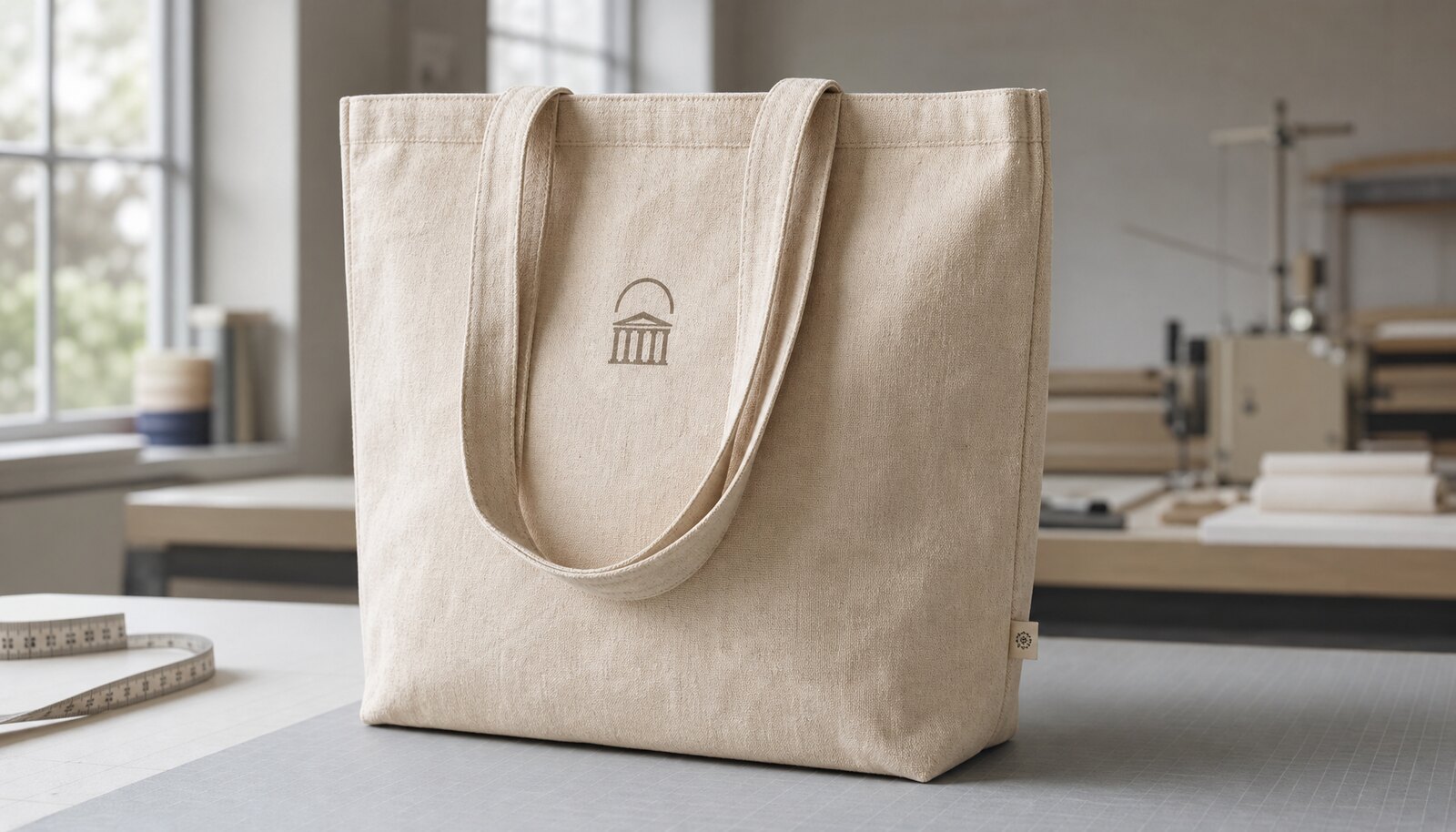
Why museum buyers source recycled canvas totes differently
Museums do not buy recycled canvas totes the same way a promo buyer does. The tote has to carry a brand message, survive retail handling, and still make sense on the shelf next to books, prints, and memberships. That changes the sourcing brief. A museum bag is usually judged by hand feel, print clarity, and whether it looks intentional enough to sell at a higher retail price point.
For procurement teams, the main problem is not finding a factory that can make a tote. It is choosing the right sourcing route for the commercial goal. A tote for a donor gift, a retail shop, and a visitor giveaway can use the same recycled canvas category but need very different fabric weights, decoration methods, and packing standards.
- Resale programs need better body structure and cleaner finishing than giveaway programs.
- Exhibit launches often need short runs with tight artwork control.
- Museum stores care about shelf presentation, fold size, and barcode placement.
- Sustainability claims must be supported by material description, not vague wording.
Choose the right recycled canvas spec before requesting quotes
Recycled canvas is not one universal cloth. In buyer terms, the useful question is whether the fabric is light enough for economical carry but heavy enough to hold shape after repeated use. For museums, the most workable range is usually 12 oz to 16 oz, or about 340 to 450 GSM, when the tote will be sold in a retail shop. If the bag is only for a visitor handout, a lighter 280 to 340 GSM spec can work, but the bag will feel less premium.
The weave matters as much as the weight. A coarse recycled canvas can create a rugged look, but it also makes fine line logos harder to print. If the artwork includes small text, thin strokes, or a detailed museum mark, the fabric should be tested with the actual print method before the order is locked.
- 12 oz / 340 GSM: good balance of cost, structure, and printability.
- 14 oz / 400 GSM: stronger retail feel and better body recovery after folding.
- 16 oz / 450 GSM: best for premium shop programs, heavier books, and repeated use.
- If the tote must stand upright on a shelf, request a firmer finish or tighter weave.
Sustainable packaging comparison: direct factory, trader, or converter
The quote you receive will depend heavily on the sourcing route. A direct factory quote can be the best value if you have enough volume and can define the spec clearly. A trader or converter may be easier for small orders or mixed products, but the factory data behind the quote can be weaker and the re-order consistency can suffer if the bag is built from bought-in components.
For museums, the commercial tradeoff is simple: more control usually means more responsibility. If the tote must match a seasonal exhibit, the direct factory route is usually better. If the goal is a quick retail test with low volume, a converter may reduce process friction, but the buyer should expect less transparency on fabric source, trim origin, and tolerance control.
- Direct factory: best for repeat programs and tighter custom control.
- Trader/converter: useful for lower MOQs and fast quoting, but verify who actually cuts and sews.
- Stock-program supplier: lower setup cost, but less brand distinction and less control over exact fabric tone.
- For sustainability reporting, ask for the material path, not only the final bag specification.
Where the price moves: fabric, decoration, and sewing labor
The ex-factory price is usually driven by three items: fabric weight, print complexity, and sewing time. Heavier recycled canvas increases fabric cost and slows cutting and sewing. A one-color logo is relatively efficient; a two-color print, large coverage print, or special ink treatment adds setup and waste risk. Handles and reinforcements are small details, but they add labor very quickly across a large run.
A useful quote should separate these pieces. When suppliers bundle everything into one unit price, procurement loses leverage. If the museum later asks for a larger print area or a different handle length, the hidden cost change becomes hard to manage. Ask for price steps by volume and by decoration complexity so the team can see what really affects the landed cost.
- Fabric weight increase usually hits both material and labor cost.
- Larger print area can raise ink cost and reduce sewing throughput.
- Cotton webbing handles usually cost more than self-fabric handles.
- Individual packing adds labor and packaging material, even if the tote itself stays unchanged.
Comparison table for museum sourcing routes
Use the table below to compare the common sourcing routes before sending an RFQ. The right option depends on whether the museum is buying for retail resale, event distribution, or a mixed program with both. The buyer should not treat all recycled canvas totes as interchangeable, because pricing and QC expectations change materially by route.
The goal is not to find the cheapest quote. It is to choose the route that gives the museum predictable quality, acceptable lead time, and a manageable reorder pattern without creating avoidable packaging or print problems.
- Write decisions in measurable language, not only descriptive wording.
- Ask for sample photos plus one physical approval sample for important orders.
- Keep quotation, sample approval, and inspection notes tied to the same spec version.
Sample approval should test the real artwork and the real fold
A sample that only proves the bag exists is not enough. Museums usually care about logo readability, shelf appearance, and the way the tote feels in hand. The pre-production sample should use the final fabric weight, actual print method, final handle length, and the final packing format. If the sample is unprinted or printed on a different cloth, the approval is weak and the production risk stays high.
The sample also needs a practical folding check. Some totes look fine open on a table but become awkward in carton packing or retail display when folded. If the museum wants the tote to sit flat with a hangtag or barcode, the sample should show that exact finish. Keep one sealed golden sample on file so the factory has a clear reference for reorder comparison.
- Approve artwork on actual fabric, not just a paper proof.
- Check print coverage at the tote corners and near the side seams.
- Measure handle drop after stitching, not only before assembly.
- Verify that the tote folds cleanly to the agreed retail footprint.
QC thresholds that prevent the most common tote complaints
Most tote complaints are simple: the bag is smaller than expected, the logo is off-center, the handles are uncomfortable, or the stitch quality looks careless. These are not abstract quality issues; they are acceptance criteria that can be written into the order. A buyer should set a tolerance sheet before production, especially when multiple departments are involved in the approval process.
For recycled canvas, the fabric itself needs a practical visual standard. Small slubs and minor shade variation are normal, but oil stains, broken yarn clusters, and uneven dye patches are not. Stitching should be checked at handle joins, side seams, and top edges because those are the points where tote failure usually starts.
- Size tolerance: typically ±1 cm or ±0.5 in depending on bag size.
- Print tolerance: centered within an agreed visual window, not just mathematically centered.
- Stitching: no skipped stitches, loose loops, or open reinforcement boxes.
- Defect control: agree on AQL or a clear visual rejection list for retail-grade units.
Packing choices affect both sustainability claims and store readiness
Packing is often treated as an afterthought, but for museum buyers it affects labor, appearance, and even sustainability messaging. Bulk packing in master cartons is usually the most efficient option for storage and inbound handling. If the tote is meant to sell as a gift shop item, individual polybagging, tissue, or barcode stickers may be needed, but each addition raises material use and packing labor.
The best approach is to define the packaging by sales channel, not by habit. A museum with a retail shop may want a clean flat pack with a barcode label and no unnecessary plastic. A special event bag may need simple bulk packing to reduce cost and storage volume. If the supplier does not understand the channel, the result is often packaging that looks fine on paper but works poorly in the store.
- Bulk pack is usually best for inbound efficiency and lower material use.
- Retail-ready packing is better only when the tote is sold individually on shelf.
- Carton count should match the tote thickness after folding, not the raw fabric weight alone.
- Request carton dimensions early if the bags ship with inserts or hangtags.
Lead time risk comes from fabric availability, not just sewing capacity
Factories often quote a lead time that sounds safe but does not reflect the real production chain. With recycled canvas totes, the timing risk is usually in fabric readiness, print queue capacity, and sample approval delay. If the fabric is stock-ready, the order can move quickly. If the supplier still needs to weave, dye, or source recycled yarn, the schedule becomes much less predictable.
For museum procurement, this matters because exhibit dates and shop launches are fixed. A small delay in sample approval can push the entire order into a busy production window. The RFQ should require the factory to state whether the lead time is based on stock fabric, booked print capacity, and confirmed trim availability, not a general estimate.
- Separate sample time from mass production time in the schedule.
- Identify whether artwork approval is on the critical path.
- Ask if the factory can hold fabric before final PO release.
- Build buffer time for carton labeling, export booking, and inbound inspection.
Landed-cost comparison for museum programs
The cheapest ex-factory quote is not always the best landed cost. For museum buyers, landed cost should include product price, sample freight, carton packing, print setup, testing if required, ocean or air freight, duty, and a small allowance for rework or replacement. A quote that looks low can become expensive if the packing is weak or the print quality forces rework before shipping.
Compare supplier offers on a like-for-like basis. If one supplier quotes flat bulk packing and another includes retail polybagging, those are not the same offer. The same is true for print methods: a one-color screen print and a full-coverage transfer are not interchangeable just because the unit price is close. Put the route, packaging, and decoration method into the cost model before choosing the supplier.
- Use a landed-cost sheet, not a unit-price-only comparison.
- Include freight by carton count and carton dimension, not an average guess.
- Treat sample freight and replacement allowance as part of total cost.
- Compare the cost of reorder stability, not only the first shipment.
Specification comparison for buyers
| Spec decision | Recommended option | When it fits | Buyer risk to check |
|---|---|---|---|
| Fabric weight / GSM | 12 oz to 16 oz recycled canvas; 340–450 GSM for gift shop resale, 280–340 GSM for event giveaways | Museum retail programs need structure, better print clarity, and a tote that feels worth paying for | Too-light fabric can look thin after washing; too-heavy fabric increases cost and slows sewing throughput |
| Source route | Direct factory with recycled yarn or recycled canvas source control | Best when the museum wants custom sizing, controlled trims, and repeat replenishment | Need evidence of fabric origin and shade consistency across reorders; otherwise color drift is common |
| Print method | 1–2 color screen print or water-based print on natural canvas | Best for logos, exhibit branding, and low- to mid-volume runs | Fine text can fill in on coarse recycled canvas; artwork needs line-thickness control |
| Decoration alternative | Woven label or sewn side label for small logos and donor-shop programs | Best when the tote should feel understated, premium, and durable after many washes | Label position can interfere with folding and carton packing if not placed early in spec development |
| MOQ approach | 1,000–3,000 pcs for custom recycled canvas with print; 300–500 pcs only if fabric is stock and decoration is simple | Best for seasonal museum stores, exhibit launches, and multi-site rollouts | Low MOQ often means higher unit cost, limited color options, and weaker tolerance on repeat orders |
| Handle construction | Self-fabric handles or cotton webbing handles stitched with box-X reinforcement | Best for heavier catalog books, exhibition catalogs, and retail carry use | If handle length is wrong, the tote becomes awkward for shoulder carry and resale complaints rise |
| Packing method | Flat packed with tissue insert and bulk master cartons; retail polybag only when shelf presentation requires it | Best when museums need store-ready presentation and efficient inbound handling | Polybag adds plastic volume and cost; bulk pack can crease the body if carton count is too high |
| Factory compliance evidence | BSCI/SEDEX-style social audit plus material traceability documents where available | Best for institutional procurement and ESG reporting | Audit papers do not replace product QC; buyers still need stitch, print, and dimension approvals |
| Sampling route | Pre-production sample with actual artwork, then sealed golden sample | Best when the tote has multiple variables: fabric, print, label, and packing | Skipping a printed sample leads to avoidable color mismatch, logo placement issues, and handle-length mistakes |
Buyer checklist before sampling
- Confirm finished size, seam allowance, and flat fold size for shelf, gift shop, or mailer use.
- Specify recycled canvas GSM, yarn composition, and acceptable fabric slub range before pricing.
- Define print area, artwork format, and minimum line thickness for the chosen decoration method.
- Set handle length, drop length, and reinforcement stitching standard in the RFQ.
- Decide whether the tote is resale-grade, giveaway-grade, or membership-gift grade; do not mix requirements.
- Request a pre-production sample with actual fabric, actual print, and final packing format.
- Agree on carton pack count, carton dimensions, and whether inner polybags are allowed.
- Ask for a tolerance sheet covering size, color, stitch count, and logo position.
- Match lead time to fabric availability, print capacity, and peak museum event dates.
- Build a landed-cost view that includes freight, duty, testing, and rework allowance, not only ex-factory price.
Factory quote questions to send
- What is the exact recycled canvas composition, fabric weight in GSM, and finished fabric width used for this quote?
- Is the quoted fabric stock-ready, or does it require weaving/dyeing before cutting and sewing?
- Which print method is included, how many colors are priced, and what is the minimum line thickness you can reliably reproduce?
- What is the MOQ by size, color, and logo version, and how does the unit price change at 500, 1,000, and 3,000 pcs?
- What handle construction is included, and what seam reinforcement standard will you use at the stress points?
- Will you provide a pre-production sample with actual materials, and what sample fee or freight applies?
- What packing format is included in the quote: bulk pack, individual polybag, tissue, barcode sticker, or insert card?
- What dimensional and stitching tolerances do you accept, and how do you handle out-of-spec pieces before shipment?
- What is the realistic production lead time after sample approval, and what causes delays in your current schedule?
- What documents can you provide for material traceability, carton data, and export shipment preparation?
Quality-control points to confirm
- Finished size within agreed tolerance, typically ±0.5 in or ±1 cm for tote body dimensions
- Fabric weight within an agreed GSM band, not just a verbal description like 'heavy canvas'
- Logo position within tolerance, with no off-center print or washed-out ink on textured fabric
- Stitching straightness, no skipped stitches, and box-X reinforcement fully closed at handle joins
- Handle length and drop length matched on both sides, with no visible twist
- Seam allowance consistent and internal thread tails trimmed so the tote feels clean in retail handling
- No broken yarns, oil stains, loose threads, or visible needle damage at the face of the bag
- Carton count, labeling, and carton dimensions matching the approved packing list
- Golden sample retained for reference before mass production begins