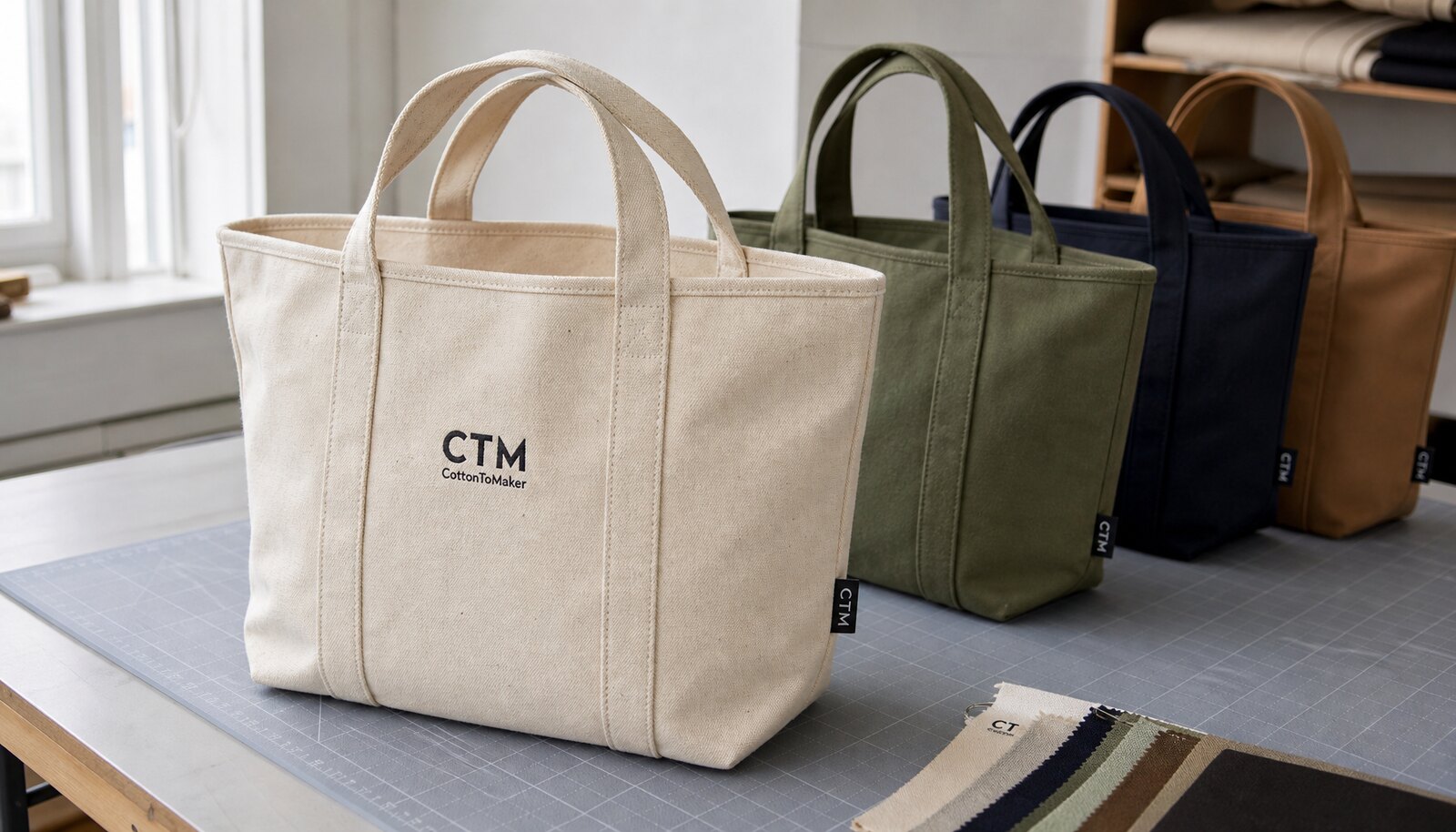
Why museum buyers need a tighter spec than a normal tote order
Museum tote programs usually sit between retail product and promotional item. That means the bag has to look good on a shop shelf, survive repeated visitor use, and still fit a controlled buying budget. If you write the RFQ like a generic giveaway, you will usually get a mix of quotes that cannot be compared on equal terms.
For recycled canvas totes for museums custom logo order guide planning, the main issue is not just decoration. It is how the bag performs with catalogs, postcards, children’s activity kits, membership materials, and small retail purchases. A museum buyer should define the carry load, target retail tier, and expected refill cycle before asking for pricing.
- Museum shop bags usually need a cleaner finish than event totes.
- A more recycled look is acceptable if the print remains sharp and the seams are tidy.
- The right spec depends on whether the bag is sold, gifted, or used as an in-store carrier.
Start with fabric weight, because recycled canvas hides more variation than buyers expect
The most common starting point is 10–12 oz recycled canvas, roughly 340–420 GSM. That range usually balances structure, printability, and price. Below that, the tote starts to feel soft and can twist under book weight. Above that, the bag becomes more expensive and may feel too stiff for some retail programs.
Buyers often focus on the printed front panel and overlook weave quality. Recycled yarns can create a slightly uneven surface, which is acceptable if you specify the acceptable appearance clearly. For museum work, the better question is not whether the surface is perfectly uniform. It is whether the bag still reads premium enough when displayed beside books, notebooks, and gift items.
- 10 oz works for lighter retail items and lower-cost gift programs.
- 12 oz is the safer choice for books, catalogs, and repeat use.
- If the tote will carry heavier merchandise, ask for reinforcement at the handle points and top seam.
Choose the logo method based on artwork, not habit
Most museum logos are best handled by screen print when the artwork is simple and the color count is low. One-color or two-color print usually gives the most stable result on recycled canvas, especially when the order needs repeatability across multiple deliveries. Screen print also stays cost-effective once the design is approved and the factory has a reliable plate or mesh setup.
If your logo uses small text, fine lines, gradients, or a detailed exhibit illustration, it may need a different route. A woven side label can be useful for branding without risking a messy front panel. Embroidery can look premium, but on medium-weight recycled canvas it may distort the panel unless the design is kept compact and the backing is controlled.
- Use screen print for bold museum marks and simple typographic logos.
- Use a woven label when the front panel must stay clean.
- Avoid complex halftones unless the factory shows a real sample on the same fabric.
Use MOQ logic to stop unit price from misleading the buying team
The lowest quoted unit price is not always the lowest real cost. On recycled canvas totes, setup charges, plate costs, color change fees, label costs, and packing changes can shift the economics fast. A 1,000-piece quote may look attractive until you compare it against a 3,000-piece run with lower setup amortization and cleaner carton packing.
For museum programs, MOQ should be tied to replenishment logic. If the tote sells steadily year-round, a larger first run may reduce the second-order price and protect stock continuity. If the order is tied to a seasonal exhibition, smaller MOQ may be safer even if the unit price is slightly higher. The important part is to ask for prices at multiple tiers so the team can model the real breakpoints.
- Ask for pricing at 1,000, 3,000, and 5,000 pieces if the program may repeat.
- Separate pricing by color and by print version.
- Make sure the quote shows setup fees distinctly from piece price.
Compare supplier routes before you commit to one quote
A museum buyer often has three sourcing routes: a direct factory, a trading company, or a local decorator that subcontracts production. Each route can work, but each one hides different risks. Direct factories usually give better control over fabric, sewing, and packing, while trading companies can simplify communication if your team lacks technical bandwidth. Local decorators can be fast for small runs, but they often lose control on recycled fabric consistency and landed cost.
The right route depends on whether your concern is artwork accuracy, speed, cost, or repeatability. If you need a branded program that repeats across exhibitions or store cycles, direct factory sourcing is usually the better long-term structure. If your order is a one-time event or a fast retail activation, a local route may be enough, but only if the sample matches the final production standard.
- Compare the same spec across routes, not each supplier’s preferred version.
- Ask who controls fabric purchase, print, sewing, and carton packing.
- Look for evidence of size tolerance and logo placement control, not just a price sheet.
Comparison table: sourcing routes for recycled canvas museum totes
Use this table to compare the way suppliers behave, not only the bag spec. The best quote is the one that fits your control needs and your inventory plan.
Define the measurable checks around fabric weight, size tolerance, handle pull, seam strength, logo rub, stains, loose threads, and carton count verification. Add tolerance ranges only where the buyer truly cares, and ask for photos that show the measurement point, not just a finished product overview.
- Write decisions in measurable language, not only descriptive wording.
- Ask for sample photos plus one physical approval sample for important orders.
- Keep quotation, sample approval, and inspection notes tied to the same spec version.
Sample approval is where most order mistakes get locked in
A museum tote sample should not be approved on appearance alone. The sample needs to show the actual fabric weight, seam construction, print registration, and final feel in hand. If the sample is stitched in a softer or lighter fabric than the planned bulk order, you may approve a version that cannot hold the real merchandise load.
Treat the pre-production sample as a functional benchmark. Confirm the bag flat size, depth if gusseted, handle drop, print opacity, and the position of any woven label. If the design includes a recycled-fiber look, decide ahead of time what level of visual variation is acceptable so the factory does not guess for you.
- Measure finished width, height, and handle drop against the approved tech pack.
- Rub the print lightly to see whether the ink transfers or cracks.
- Check seam alignment at the top edge and handle joints under tension.
- Approve color under daylight and indoor light if the bag will be sold retail.
Packing and carton specs matter more when the totes are sold in a museum shop
Packing is easy to ignore until the bags reach the warehouse. If the tote is sold folded on shelf, the folding style has to be consistent. If the tote is shipped in bulk to a distribution center, carton count and inner pack count should be built around picking speed, not only factory convenience. Loose or inconsistent folding creates messy retail presentation and slows receiving.
For import orders, ask for carton dimensions, gross weight, and carton marks before production starts. That lets the logistics team estimate volumetric cost and avoid a bad freight surprise. If the tote includes a print or label that can scuff, a thin polybag or tissue insert may be worth the extra cost, but it should be priced separately so the team can see the tradeoff.
- Use inner packs if stores replenish from back room to shelf.
- Specify folding direction if the logo must face forward in retail presentation.
- Request carton marks that include SKU, color, quantity, and pack method.
Lead time risk usually starts with artwork, not sewing
Most buyers think sewing time is the bottleneck, but the delay often comes from artwork approvals, fabric sourcing, and sample revisions. If your museum wants a specific recycled tone, a custom woven label, or a new print version for an exhibition, the factory may need extra time before cutting starts. This is especially true if the order uses multiple colors or mixed packing formats.
A realistic lead time should be broken into stages: sample development, sample approval, bulk material booking, production, and packing. If the factory gives one single number without stage detail, it is harder to see where delays will happen. For a repeat program, ask whether raw materials are pre-available or must be purchased after order confirmation.
- Artwork approval can take longer than sewing if the design is not production-ready.
- Confirm whether the factory holds recycled canvas in stock or buys it to order.
- If the tote includes custom label work, allow extra time for label approval and stitching setup.
Build a quote sheet that lets procurement compare apples to apples
A useful quote should break the tote into fabric, decoration, trim, sewing, packing, and carton costs. That structure helps the team compare alternative methods without rewriting the entire RFQ. It also exposes where a low quote is being subsidized by a weaker spec, such as lighter fabric, looser stitching, or simplified packing.
The landed-cost view is especially important for museums that buy through distributors or import directly. A quote that looks efficient ex-factory may rise once carton size, freight weight, and packing labor are added. If the tote is sold in multiple museum stores, small dimension changes can have a real impact on carton density and inbound handling.
- Ask for separate pricing on fabric, print, label, packing, and carton.
- Request carton size and weight with each quote tier.
- Compare total landed cost, not only the ex-factory unit price.
Specification comparison for buyers
| Spec decision | Recommended option | When it fits | Buyer risk to check |
|---|---|---|---|
| Fabric weight | 10–12 oz recycled canvas, or about 340–420 GSM | Retail museum shops, membership gifts, visitor carry bags with daily handling | Too light and the bag sags or distorts under brochures, catalogs, or catalogs plus gifts |
| Handle construction | Self-fabric handles with reinforced X-box or bar tack | Mid-weight totes carrying books, catalogs, and small retail purchases | Single-seam handles fail early if stitch density and thread strength are not specified |
| Print method | 1–2 color screen print for logos and exhibit marks | Most museum branding with simple art, clean lines, and repeat orders | Fine details and gradients may break up on coarse recycled canvas |
| Decoration placement | Centered front panel or lower corner with side woven label | When the museum wants a clean retail look without crowding the artwork | Logo can shift if the factory does not provide a placement template with tolerances |
| Lining | Unlined unless the tote will carry small merchandise or dark fabrics need a cleaner interior | General admissions, gift shop, and event distribution orders | Unlined bags can shed lint or show recycled fiber flecks; lined bags raise cost and lead time |
| Closure | Open top for faster filling, zipper only when theft control or premium retail is required | Point-of-sale use, visitor giveaways, and museum store carrying bags | Zippers add cost, sewing steps, and failure points if puller and tape quality are weak |
| Supplier route | Direct factory with artwork, size, and packing control | Known annual volumes, repeat museum programs, and custom brand standards | Factories may quote low on sample stage but change packing or trim specs later unless the RFQ is detailed |
| MOQ strategy | Price breaks at 1,000 / 3,000 / 5,000 pcs depending on color and print count | When you need a test run before moving to seasonal replenishment | Small runs can hide expensive setup costs and make unit price look higher than it is |
| Packing format | Bulk polybag by inner pack, then carton with clear carton marks | Importer and distributor shipments where warehouse receiving matters | Loose packing increases scuffing, while over-packed cartons raise crush risk and inbound damage claims |
Buyer checklist before sampling
- Final artwork in vector format with one-color and two-color versions approved for screen print
- Finished bag size with usable internal dimensions, not only flat cut size
- Target fabric weight in oz and GSM, plus acceptable tolerance range
- Handle length, handle width, reinforcement method, and stitch count requirement
- Printing method, print size, Pantone targets, and acceptable alignment tolerance
- Sample approval standard for shade, sewing, logo placement, and hand feel
- Packing spec: inner pack count, carton count, carton marks, and barcode label needs
- Target MOQ by color and print variant, plus replenishment logic for repeat orders
- Required lead time, shipping mode, and whether pre-production sample approval gates mass production
Factory quote questions to send
- What is your exact recycled canvas construction, including yarn content, fabric weight in GSM, weave density, and finished shrinkage allowance?
- Which print method are you pricing, and what changes in cost if we move from 1 color to 2 colors or add a side label?
- What is the MOQ by color, by artwork version, and by packaging format?
- What sample fees apply, and are they refundable against bulk production if the order converts?
- What is included in your unit price: fabric, print, sewing, woven label, polybag, carton, and outer shipping marks?
- What lead time applies after sample approval, and what steps could extend it?
- How do you control logo placement tolerance, stitch reinforcement, and panel symmetry during production?
- Can you share carton size, gross weight, and palletization assumptions for freight planning?
Quality-control points to confirm
- Fabric GSM should match the agreed spec within a practical tolerance, with no weak weave areas or obvious thin panels.
- Color shade should be consistent across front, back, handles, and side label parts, with recycled fiber variation within an agreed range.
- Print should be fully cured, rub-resistant, and aligned within the approved placement template.
- Handle attachments should pass a pull test suitable for the intended carry load, especially if the tote will hold books or merchandise.
- Stitching should be even, with no skipped stitches, broken thread, loose ends, or needle damage near the top seam.
- Finished size should stay within agreed tolerance for width, height, and gusset if the bag has one.
- Cartons should be dry, clean, and correctly marked, with no crush damage and no mixed color packs unless approved.
- Pre-production sample should match bulk intent for fabric feel, print density, label position, and overall silhouette.