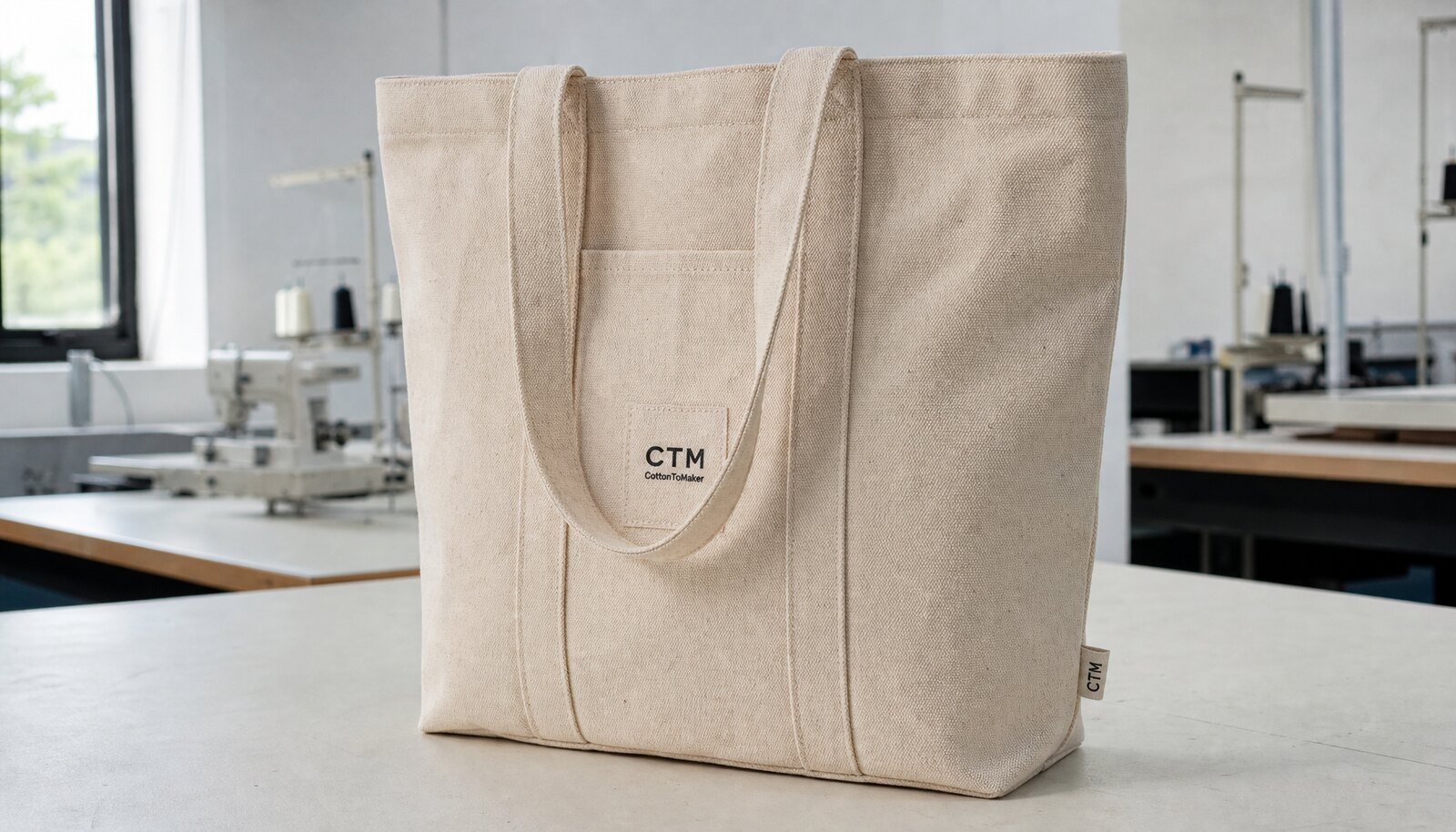
Why museum giveaway totes fail when the brief stays too broad
Museum event planning often begins with a sentence that sounds harmless: we need recycled canvas totes for the giveaway. Procurement teams know that this is where problems start. A tote is a simple product only when the spec is already clear. Once the brief reaches a factory, every vague phrase becomes a guess, and the guess may be wrong on fabric weight, print method, handle strength, or packing. The bag may still arrive on time, but not in a form that supports the event.
For museums, the tote has to carry more than leaflets. It is part of the visitor experience, a visible sign of brand standards, and sometimes the only item guests keep after the event. That means the procurement team should evaluate the bag like a durable branded product, not a disposable promo item. The differences between 'good enough' and 'fit for the event' show up in the details: whether the bag stands up on a registration table, whether the print stays sharp after folding, and whether the seams look deliberate rather than rushed.
The most common procurement failure is not choosing the wrong supplier. It is failing to define the decision points that actually drive the quote. A factory can make a recycled canvas tote in many ways, and a low quote may simply reflect a thinner cloth, shorter handles, looser stitching, or less careful packing. Once those compromises are written into the production run, the museum has limited leverage. A useful brief gives the supplier measurable targets and gives procurement a way to compare bids on equal terms.
- Treat the tote as a branded operational product, not just a promotional giveaway.
- Write the brief with measurable specifications: size, GSM, handle length, print method, and packing.
- Build the tote around the actual event contents, not around a generic tote photo.
Recycled canvas sourcing: what buyers should verify before they compare prices
The word 'recycled' can describe very different materials. In tote procurement, recycled canvas may mean recycled cotton yarn woven into canvas, a recycled cotton blend, or a recycled cotton-polyester blend. It may also be a marketing phrase that tells you little about where the fiber came from. Procurement buyers should ask the supplier to state exactly what is recycled, at what stage the recycling occurred, and what evidence supports the claim. That matters because recycled-content language affects brand reporting, sustainability communications, and internal approval from museum stakeholders.
A useful document set should go beyond a sales statement. Ask whether the recycled claim applies to the fiber, yarn, or finished fabric, and whether the supplier can trace the material back to a mill, converter, or certified source. If the supplier uses a third-party certification, ask for the certificate number, scope, and the specific product line covered. If no certificate is available, request a declaration that names the material content, supplier name, and lot or batch reference so the claim can be tied to the order. The more precise the documentation, the easier it is to defend the purchase during internal review.
Because recycled canvas is often made from mixed recovered input, lot-to-lot appearance can vary. That is not automatically a defect, but it is a procurement issue because the museum may care about color consistency across a multi-event campaign. Buyers should ask for a reference swatch or a pre-production lot sample and make sure the supplier agrees in writing to the acceptable variation range. If the tote will be used in a public-facing event, the museum should also confirm whether the recycled fabric has any surface irregularities, slubs, or color flecking that may affect print clarity. Those are not reasons to reject the material, but they do change the print and artwork rules.
- Ask what exactly is recycled: cotton, blended yarn, woven fabric, or finished cloth.
- Request traceability documents tied to the actual order lot or batch whenever possible.
- Do not rely on 'eco' or 'sustainable' language without material evidence and scope detail.
How to choose the right tote structure for the event content
Museum giveaways are rarely one-size-fits-all. A tote for family day handouts is not the same as a tote for donor evening gift packs or exhibition catalog distribution. The right structure depends on what goes inside, how the guest carries it, and how the museum wants the bag to feel in hand. For a simple handout program, a flat tote with a clean open top may be enough. For heavier material, a gusseted tote or boxed-bottom construction provides more usable volume and a more stable shape.
Flat totes are easier to produce and usually cost less. They work well when the contents are flat, such as brochures, maps, postcards, or a thin program booklet. Gusseted totes help when the museum expects catalog thickness, small merchandise, or uneven contents. A boxed bottom can make the tote stand up more cleanly on a table, but it uses more fabric and labor. Buyers should decide whether the extra volume is truly needed before approving it, because a larger shape can increase cost, carton size, and freight weight without improving usability.
Handle length also changes the user experience. A short handle may be fine for hand carry across a lobby, but it will frustrate visitors who need shoulder carry after an event. A longer handle is usually more versatile, yet too much length can make the tote swing awkwardly and look less polished. The museum should decide in advance whether the bag is meant to sit in a visitor’s hand, over the shoulder, or both. That single decision affects not just dimensions, but also reinforcement, stitch pattern, and where the handle attaches to the body.
- Match bag structure to contents: flat for brochures, gusseted for mixed packs, boxed bottom for more stable presentation.
- Choose handle length according to actual carry behavior, not just aesthetic preference.
- Use a sample load to confirm the bag stands, carries, and folds the way the event needs.
Fabric weight, hand feel, and why GSM matters more than the catalog photo
Fabric weight is one of the few spec items that directly affects both perceived quality and production cost. For recycled canvas totes for museums event giveaway planning, 10–12 oz canvas, roughly 340–410 GSM, is usually the most practical band. Inside that range, the tote has enough body to look deliberate, yet it still remains economical enough for event-scale ordering. When the bag is too light, the fabric wrinkles sharply, the print can look less premium, and the seams may show more stress after filling. When the bag is too heavy, freight and unit cost rise quickly, and the tote may feel overbuilt for a simple handout program.
That said, GSM alone is not enough. Buyers should ask whether the quoted weight includes finishing, coating, or post-wash treatment, because that can change how the fabric behaves in production. One mill’s 10 oz canvas may feel firmer than another mill’s 10 oz because of weave density or yarn twist. The procurement lesson is simple: compare not only the number, but the fabric sample and the factory’s cut-and-sew result. The goal is a bag that feels consistent enough for the event and stable enough for repeated use, not merely a number that looks right on paper.
If the museum plans to hand out a premium package or a bag that may be reused for shopping after the event, it is usually worth leaning toward the higher end of the weight range. That gives more structure for the handle base and reduces the chance of the bag collapsing when set down. For lower-budget education programs or mass visitor distribution, a lighter spec may still work if the contents are not heavy and the print is simple. Procurement should decide based on the load, the audience, and the expected lifespan of the bag, not only on unit cost.
- 10 oz recycled canvas suits lighter handouts and lower-budget events.
- 12 oz recycled canvas is better for catalogs, donor kits, and visitor bags that should feel substantial.
- Ask whether finishing, wash treatment, or coating changes the effective hand feel and print behavior.
Print methods that fit museum branding without creating avoidable rejects
Museum branding usually favors restraint. That makes print selection important because the best method is not always the most decorative one. For most recycled canvas tote programs, one- or two-color screen print is the strongest commercial option. It gives good opacity, clean edges, and predictable cost when the artwork is simple. The challenge is that recycled canvas is not a smooth retail cotton surface, so a design that looks sharp in a PDF can lose detail once ink meets the weave. Thin strokes, fine type, and delicate line art need a strike-off on real fabric before procurement signs off.
Heat transfer can work when the artwork is more complex, the order is smaller, or the event needs a quick turnaround. It is especially useful when the museum wants gradient-like art, multiple colors, or a more photographic feel. However, buyers should ask how the transfer performs after folding, rubbing, and repeated use, because some transfers can show edge lift or abrasion sooner than screen print. Embroidery and woven labels are best reserved for premium membership kits, gift shop programs, or situations where the bag is expected to look more like a retail accessory than a handout.
The key procurement question is not 'which print method is best?' but 'which print method best matches the tote’s purpose, artwork complexity, and quantity?' A strong factory will explain the tradeoff instead of pushing one process for every project. Ask the supplier to show a real fabric sample with the same print method, ink type, and curing approach before approving mass production.
- Screen print is usually the best value for simple museum logos and short color counts.
- Heat transfer can be useful for smaller runs or more complex artwork, but must be tested for rub and fold performance.
- Use embroidery or woven labels only when the added cost matches the program’s premium positioning.
Comparison table: supplier routes and what they change commercially
A tote quote is not just a price; it is the result of a sourcing route. A direct factory, a trading company, and a local stockholder may all sell what looks like the same recycled canvas tote, but the commercial controls differ sharply. This matters because museums often need a clear answer on lead time, sample authority, and quality accountability. The table below is more useful than a generic spec chart because it helps buyers see where the risk sits.
If the museum has a recurring event calendar, the safest path is usually a direct factory relationship once the spec is stable. If the order is one-off, urgent, or part of a multi-item bundle, a trading company or local stock route may be acceptable. Procurement should choose the route that best matches the event timing and internal approval burden, not simply the lowest advertised unit price.
Choose the sourcing route that matches order size, speed, and control
Direct factory sourcing gives the museum the best chance to lock the real production details. You can ask who cuts the fabric, who prints the logo, who checks the seam lines, and who signs off on the pre-production sample. That level of control is valuable when the tote needs to be repeated for more than one event or when the museum wants a consistent look across programs. The tradeoff is that direct sourcing requires more disciplined spec writing and more follow-up from procurement.
Trading companies can be helpful when the museum wants consolidation across different giveaway items. They may also be more flexible on low quantity because they aggregate fabric and manufacturing runs across several clients. The risk is that the actual factory may be harder to verify, and sample approval can become slower if the trading layer is not technically strong. For museum buyers, that means compliance documents and sample ownership must be spelled out from the beginning. If a problem appears later, the buyer needs to know who is responsible for correction.
Local stockholders or domestic printers can make sense when the event calendar is compressed and shipping time is the priority. In those cases, procurement often pays a higher unit price in exchange for quicker response and easier communication. That can be the right business decision if the event cannot move. The buyer should still ask for the same essentials: fabric spec, print method, packing, and inspection standard. Speed is not an excuse for a weak spec.
- Direct factory: best for repeatable programs and tighter spec control.
- Trading company: useful for bundled orders or lower quantity, but verify factory identity and sample authority.
- Local stock route: fast and practical, but usually higher cost and less control over material variation.
MOQ, setup cost, and why low quantities can become expensive fast
Minimum order quantity is not just a gate number; it is where the factory’s process becomes economical. Screen making, pattern cutting, reinforcement sewing, and final inspection all have setup costs that get spread over the batch. For a simple museum logo on stock recycled canvas, 500 to 1,000 pcs per design is often a realistic commercial range. Below that, the quoted piece price usually climbs because the factory still has to prepare screens, arrange sewing lines, and inspect the run with the same care.
The problem for procurement is that a low MOQ quote can look attractive if the setup fees are buried or if the supplier quietly reduces another spec element. A lower price may be achieved by simplifying the handle reinforcement, using thinner fabric, shrinking the print size, or packing more loosely. That is why buyers should compare the total landed cost, not just the headline unit price. The real question is: how much does one tote cost after setup, samples, packing, freight assumptions, and any event-specific labeling are included?
There is one more commercial issue: if the museum wants the same tote across several programs, it may be better to order a little more than needed and hold controlled stock. That approach only works if the print is evergreen and the bag is not date-specific. A hold-stock model can reduce unit cost and protect against re-order delays, but only when the museum is confident the branding will remain usable across future events.
- Ask whether MOQ applies per size, per color, per artwork, or per material source.
- Separate setup cost from unit price before comparing quotes.
- If the design is evergreen, consider a controlled stock program to reduce future reorder risk.
What a procurement-grade quote should include before the museum signs anything
A quote for recycled canvas totes should be detailed enough that another supplier could reproduce it without guessing. If the line item only says 'canvas tote with logo,' the buyer does not have a real commercial offer; they have an invitation to negotiation after the fact. A procurement-grade quote should state the recycled material type, GSM, tote dimensions, handle length, print process, color count, reinforcement detail, packing format, and shipping terms. If the supplier can only provide a casual sales estimate, the quote is not ready for event planning.
Quote structure also matters. Buyers should be able to see which costs are included and which are separate: sampling, artwork conversion, screens or plates, carton labeling, export documents, and freight. A small difference in the piece price can disappear once those extras are added, so the cleanest comparison is a line-by-line quote from every bidder. Museum procurement teams often need to explain the choice internally, so the quote should be transparent enough to defend the decision in front of marketing, events, finance, or sustainability stakeholders.
One more point: the buyer should ask whether the supplier is quoting from a production-ready blank spec or only a reference sample. If the factory is copying an existing tote, ask what changes are needed to make it compliant for your order—logo placement, recycled-content documentation, stitch reinforcement, or carton labeling. That avoids a common misunderstanding where the buyer thinks the quote is for an exact match but the factory is actually budgeting for a lighter imitation.
- Require every supplier to quote on the same spec sheet.
- Ask for all setup, sampling, packing, and document fees in writing.
- Make sure the quote is based on a production-ready spec, not an informal reference bag.
Sampling and approval: the stage where most avoidable tote mistakes are caught
Museum programs should treat sampling as a formal approval gate, not as a courtesy step. The right sample is a pre-production sample made from the exact recycled canvas, using the final print method, final handle length, and final reinforcement pattern. A digital proof is not enough because it cannot reveal how the design behaves on textured fabric, how the tote folds, or whether the bag stands properly once filled. If the event has a fixed date, sample delays are one of the most expensive reasons the order slips.
A good sample review should cover the front, back, side, inside, seam, label, and folded state. Buyers should also load the bag with the same type of material it will carry at the event, such as brochures, catalog pages, or a small retail pack. That reveals whether the handles dig into the seam, whether the tote twists when lifted, or whether the gusset collapses under realistic weight. If the sample fails in hand, the factory should correct it before bulk production starts. That is far cheaper than correcting 1,000 finished totes.
Keep the approval trail organized. Save the sample photo set, mark the version number, and write down any accepted deviation, no matter how small. If the museum accepts a slight difference in shade, handle length, or print position, that acceptance should be documented in the same file as the quote. Otherwise the dispute gets replayed later as a memory contest between buyer and factory.
- Approve a physical sample on real recycled canvas with final print and final sewing.
- Test the tote under realistic event load, not only as an empty bag.
- Document every accepted deviation so future inspection has a reference point.
Specification comparison for buyers
| Supplier / product route | Best use case | Commercial advantages | Tradeoffs / buyer risk |
|---|---|---|---|
| Direct factory, stock recycled canvas + one-color screen print | Recurring museum event giveaways with stable artwork and repeat ordering | Best control over GSM, stitching, print placement, and lead time; usually the strongest value when specs are frozen | Requires tighter buyer spec writing and more hands-on sample approval; less helpful if you need many SKUs or very low quantity |
| Direct factory, custom size / custom handle / one- or two-color print | Opening events, donor programs, exhibition launches, and programs where the tote must look intentional in photos | Lets procurement define exact usable size, reinforcement, and brand presentation instead of adapting to an off-the-shelf shape | Higher setup burden; MOQ and lead time usually increase because cutting, printing, and QC are less standardized |
| Trading company / multi-item consolidator | One-off campaigns where the tote is part of a larger gift pack or shipment bundle | Can combine bags with notebooks, pins, lanyards, or packaging in one order and one export process | Factory identity may be hidden; sample ownership, compliance documents, and QC follow-up can be slower or less transparent |
| Domestic stockholder / local printer using imported blank totes | Short deadlines, emergency replenishment, or local distribution where freight time matters more than unit cost | Fast turnaround and simpler communication; convenient for small event adjustments after artwork lock | Higher piece price and less fabric control; stock may vary between lots, and recycled-content claims may be thin or undocumented |
| Retail-oriented premium tote with woven label or embroidery | Membership gifts, patron events, shop promotions, or long-life visitor bags | Stronger perceived value, better shelf presence, and often improved brand recall after the event | Cost rises quickly with embroidery, woven labels, and higher finishing expectations; may not be justified for simple handout programs |
| Low-cost large-volume giveaway tote with bulk packing | Conferences, family days, education programs, and high-volume visitor distributions | Lowest landed cost per bag when artwork and structure are simple and order quantity is high | Needs careful QC on seams, print rub, and carton packing because the unit cost leaves less room for rework |
Buyer checklist before sampling
- Define the event use case first: visitor handout, donor gift, membership campaign, education program, conference collateral, or shop giveaway.
- Lock a measurable fabric spec: recycled content target, GSM/oz range, weave type, width, and acceptable lot variation.
- Ask the supplier for recycled-material evidence: recycled-content declaration, traceability to yarn or fabric source, and any third-party certificates they can actually provide.
- Confirm whether the tote is made from recycled cotton canvas, recycled blended canvas, or recycled polyester-cotton canvas; do not accept a vague 'eco canvas' description.
- Provide final artwork in vector format and specify colors by Pantone, CMYK, or a signed visual reference so print approvals are traceable.
- Set tote dimensions based on the actual items going inside, including brochure width, catalog thickness, or boxed merchandise footprint.
- Specify handle length, handle reinforcement, seam style, and whether the bag must support shoulder carry or only hand carry.
- Request a pre-production sample on the exact fabric and print method, not a generic blank bag or digital proof.
- Ask for a production control plan: stitch inspection, seam allowance target, in-line print checks, final inspection, carton packing standard, and what AQL or acceptance approach the factory uses.
- Define whether individual polybags are needed, whether tissue or paper wrap is acceptable, and how cartons must be labeled for event distribution.
Factory quote questions to send
- What is the exact material composition of the recycled canvas, and what recycled-content evidence can you share for this lot or fabric source?
- Is the quote based on stock fabric or custom-woven/custom-dyed fabric, and how does that choice affect MOQ, lead time, and price stability?
- What GSM, yarn count, weave type, and fabric width are included in the quoted price?
- Which print method is included, how many colors are covered, and what are the separate charges for screens, plates, setup, or artwork conversion?
- Do the handles, side seams, and stress points include reinforcement stitch patterns such as bar-tacks, cross-stitch, or double stitching?
- What exact sample is included before production, what is the sample fee, how long does sampling take, and is the fee refundable against the order?
- Will you provide compliance or verification documents if requested, such as recycled-content declarations, factory audit information, or material traceability records?
- What inspection standard do you use for bulk production, what AQL or acceptance level do you work to, and can you share the final inspection checklist?
- What are the accepted dimensional tolerances for bag size, handle length, stitch count, and print placement?
- How do you handle a dispute if the bulk goods differ from the approved sample—replacement, rework, credit, or claim procedure?
Quality-control points to confirm
- Use a fabric verification check at receiving or pre-production: confirm GSM/oz, fabric width, weave consistency, and whether recycled fibers are visibly blended as expected across the lot.
- Inspect the recycled-content claim against documentation. If the factory says recycled, ask whether the claim applies to the yarn, the woven fabric, or only a portion of the blend; request traceability paperwork tied to the order lot whenever possible.
- Check seam construction with a ruler and eye test: seam allowance should be consistent, side seams should run straight, and stitching should not wander enough to distort the tote shape.
- Set a stitch-density target and inspect representative samples for skipped stitches, loose ends, needle holes, and weak corners. Dense reinforcement at handle bases should be visible on both sides.
- Require a load test using the actual event use case, not an empty bag test. Fill the tote with brochures, a catalog, or a weighted load close to real use and observe handle stretch, seam stress, and deformation.
- Ask the supplier to define the load test method in writing: static hang test, repeated lift test, or filled-carry simulation. Record the weight used, duration, and failure criteria.
- Review print quality under normal and oblique light. Check for registration, edge sharpness, ghosting, smudging, dye migration, and whether the print remains legible on the textured recycled canvas surface.
- Perform a simple rub or abrasion check on the print face and handles after curing. For screen print, confirm the ink is set well enough that rubbing does not create visible transfer or feathering.
- Inspect carton packing for abrasion risk. Bags should be folded consistently, print faces protected from rubbing, and carton stack height should not crush gussets or create bending damage at corners.
- Agree an inspection approach before mass production, such as AQL-based final inspection or a defined sample count from each lot. Keep the check tied to the same approved spec version.