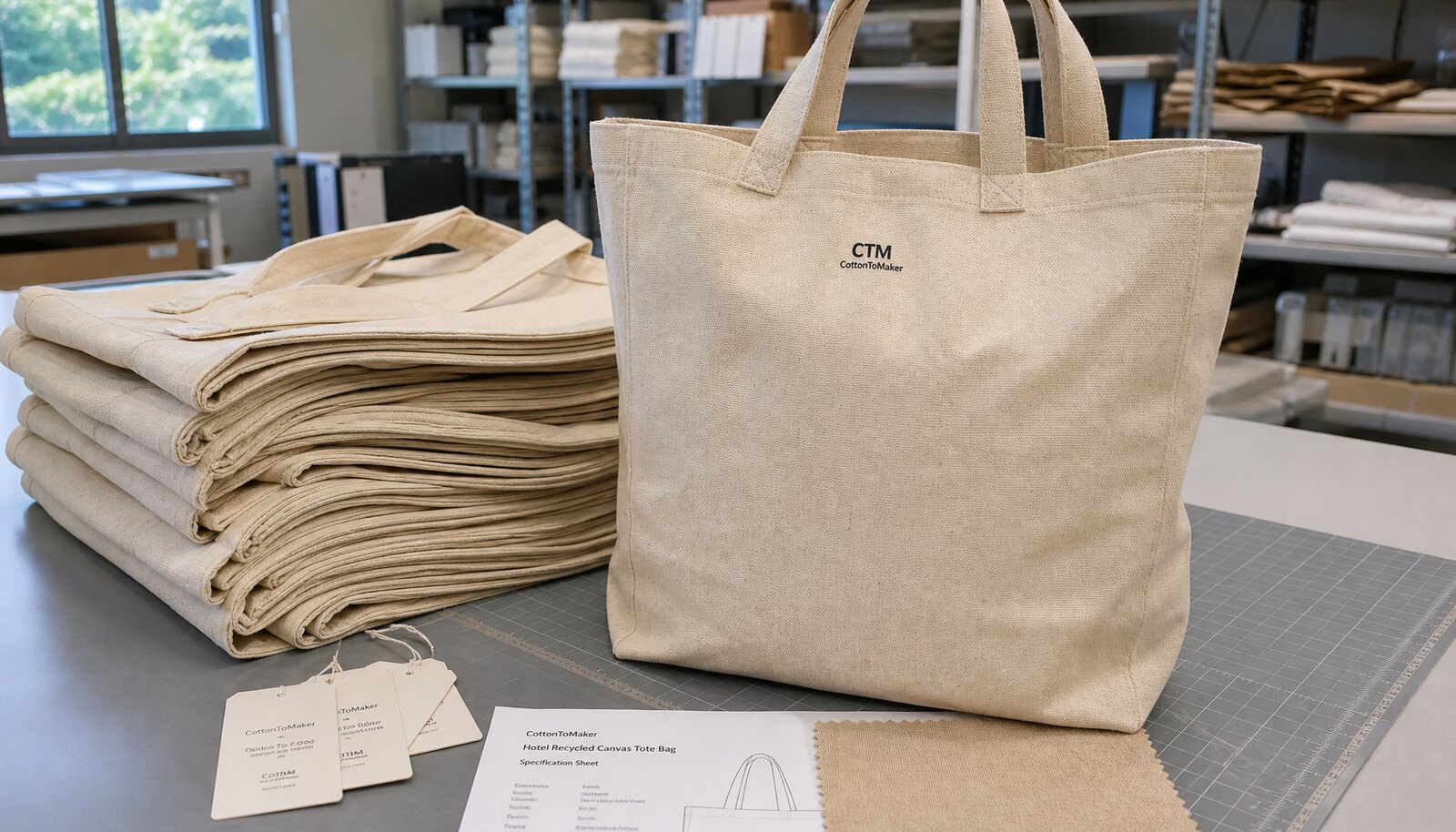
Why hotel tote reorders fail even when the first order looked fine
A recycled canvas tote reorder for hotels usually breaks down for one of three practical reasons: the original spec was not detailed enough, the factory substituted material without a clear approval trail, or the buying team judged the bag only by appearance instead of repeatability. The first shipment often looks acceptable because the team is focused on launch timing and the bag is judged in a clean sample-room setting. The second or third order is where the weak points show up: handle length shifts, print edges blur, the fabric arrives lighter than expected, or the bag no longer matches the approved retail display sample.
For hotel programs, the tote is rarely just a tote. It may be a guest welcome item, a retail item in the gift shop, a laundry or spa carry bag, or a conference giveaway tied to brand standards and guest experience. That means the reorder memo has to protect both brand consistency and operational efficiency. Procurement should treat this as a controlled repeat production, not a fresh creative project. The job is to reproduce the approved bag at the same functional level, on the same timeline, with the fewest surprises possible.
- Keep the approved sample, spec sheet, and artwork file tied together under one SKU or program code.
- Record the exact material source if the first order performed well, especially if the fabric had a distinctive texture, wash, or recycled-content blend.
- Separate retail-facing bags from back-of-house bags; the quality expectation, inspection method, and packing format are not the same.
- Treat any unapproved change in fabric, print, handle, or size as a new deviation request, not as a routine reorder.
Define the use case first: guest amenity, retail, conference, or operations
Before anyone asks for pricing, the hotel team should define what the tote is actually for. A guest amenity bag that stays in-room can use a simpler finish and may tolerate a lighter or softer canvas. A retail gift-shop tote needs a cleaner face, stronger print durability, and better presentation because the guest inspects it before purchase. Conference giveaways are usually judged by perceived value and branded visibility. Spa, housekeeping, or laundry totes may need more load support and a different internal finish than a retail bag.
The use case also controls how many units should be stocked and how fast they should turn. A hotel that gives a tote as part of a premium package may order in tighter alignment with arrivals or seasonal campaigns. A retail bag in a multi-property shop may need a deeper stock position because sell-through is less predictable. If procurement does not separate these use cases, the quote comparison becomes muddy and the reorder trigger will be wrong. The same looking tote can be unacceptable if it is judged by the wrong performance standard.
- Write the primary use case on the PO or spec sheet, not just in internal notes.
- Set a different acceptance standard for retail display bags versus in-room amenity bags.
- Ask properties to report whether the bag is a consumable, a retail SKU, or a reusable operational item.
Choose the recycled canvas spec before you price the reorder
The phrase recycled canvas tote can mean several things in factory quoting. Buyers need to pin down whether the fabric is recycled cotton canvas, a recycled cotton-poly blend, or another recycled fiber construction. For hotel use, the most common practical range is 10–12 oz, or roughly 320–400 GSM, but that should be treated as a starting range, not a universal rule. The right fabric weight depends on bag size, intended load, hand feel, and the level of finish the hotel expects. A smaller giveaway tote can work lower in the range; a retail bag carrying bottles, brochures, or layered merchandise may need more body.
It helps to think in exceptions. A lightweight conference tote may be fine if it only carries papers and a brochure, especially when unit cost and shipping cube matter more than structure. A spa or resort bag may need a heavier canvas and reinforced handles because the guest is likely to load it with wet items, towels, or multiple retail purchases. If the tote is meant to be reused often, a tighter weave, more stable seam construction, and better top-edge finish matter as much as the base fabric weight. Procurement should avoid quoting on appearance alone, because recycled canvas can look substantial while still behaving differently in sewing and in use.
- Define the fiber composition in writing; do not rely on the term recycled canvas by itself.
- Use 10–12 oz / 320–400 GSM as a common hotel starting point, then adjust for load, use case, and finish.
- Heavier is not automatically better: too much stiffness can increase sewing difficulty, raise cost, and reduce folding efficiency.
- Request a fabric swatch or loom-state reference if shade and texture matter to the hotel brand.
Build a buyer-ready spec sheet that the factory can actually repeat
A reorder should never rely on memory alone. The spec sheet needs enough detail that a different merchandiser or factory technician can reproduce the bag without guesswork. At minimum, define material composition, GSM or oz, finished size, handle width and drop, print area, seam type, reinforcement points, closure style, and packing format. If the original order used a wash, dye, or special finish, that also needs to be written down. Recycled canvas shades can vary more than many hotel buyers expect, and the finished look can change if fabric lots are mixed casually.
Dimension clarity matters more than many teams realize. A bag that is one or two centimeters narrower can alter the visual balance of the logo and the usable capacity of the tote. If the bag sits on a retail hook, handle drop changes how it hangs and how the logo reads from the aisle. That is why the spec should include both nominal size and acceptable tolerance. It is also worth marking which measurement is critical and which can flex slightly without affecting function. Without that hierarchy, a factory may optimize for the wrong detail.
- Material: exact composition, recycled-content statement, and any prohibited substitutions.
- Fabric weight: oz or GSM with acceptable tolerance and test basis if available.
- Construction: side seams, bottom gusset, top hem, handle attachment, and reinforcement style.
- Branding: print method, color count, artwork file type, and approved placement with a measurement reference.
- Packaging: fold direction, carton quantity, barcode labeling, and any insert card or swing tag requirements.
Compare sourcing routes like a procurement buyer, not just a shopper
The lowest headline quote is not always the best route for a hotel reorder. A direct factory quote, a trading company quote, and a stockist route can all look similar on paper, but the landed result can be very different. The key issue is whether the supplier can reproduce the same recycled canvas construction, print position, and packing without hidden substitutions. For repeat programs, a direct factory with a stable sample room often gives the best control if your team can manage spec discipline. The advantage is not just price; it is traceability. You can ask who sews, who prints, which fabric lot is used, and what inspection record exists before shipment.
A trading company can be helpful when the buying team needs one point of contact across multiple products or needs an urgent fill for a small number of units. The tradeoff is that you may lose visibility into the actual sewing site, the fabric source, and the QC method unless you push for documentation. A stock item with logo added can be useful for temporary programs, but it limits size, material, and branding control. The buyer should match the sourcing route to the risk level. If the tote is part of a stable hotel brand program across several properties, paying for repeatability is usually easier to justify than saving a little on a single PO.
- Factory-direct: best for spec control, repeat orders, and custom packing.
- Trading route: acceptable for small urgent fills only if the actual factory is identified and approved.
- Stock route: fast, but limited control over recycled content, size, and branding consistency.
- Fully custom redevelopment: treat as a new project with a new approval timeline and new QC checkpoints.
Use sourcing red-flag checks before you accept a quote
Procurement can save time by screening suppliers before the quote is even compared. Ask whether the supplier can name the actual factory, provide the approved sample history, and show how they manage incoming fabric inspection. If a supplier cannot explain where the recycled canvas comes from, how shade is controlled, or how a repeat order is matched to the prior approved sample, the quote should be treated cautiously. A low price is not useful if the production process cannot be audited at a basic level.
Documentation matters. Ask for business registration details, recent product photos that are clearly tied to the quoted construction, and a sample confirmation trail that shows who approved what and when. If the supplier claims to be factory-direct but answers only with generic marketing language, that is a red flag. So is a quote that changes fabric weight, size, or print method without making the change obvious. For hotel buyers, the main risk is not just poor quality; it is a quiet spec drift that shows up after the goods are already in transit.
- Ask for the actual factory name and location, not only a sales office name.
- Reject quotes that avoid naming fabric weight, print method, or seam construction.
- Ask how the supplier handles substitutions if the planned fabric lot is unavailable.
- Request proof that the sample you approved is the one being referenced on the reorder.
Print method selection for a hotel program
For most recycled canvas tote reorders in hotels, one-color screen print is the default choice because it is cost-effective, visually clear, and repeatable when the artwork is stable. If the logo is small, detailed, or intended to feel premium without a large ink area, a woven label, embroidered patch, or sewn-on side label can be better than printing a fine logo directly onto textured canvas. Heat transfer can work for limited runs, but it is more sensitive to surface texture, pressure, and long-term wear. It should be used with caution when the tote will be handled often or expected to last through repeat guest use.
The right method also depends on how the bag will be viewed. A retail tote seen by guests in a hotel shop needs a cleaner face and tighter registration than a back-of-house utility bag. If the hotel brand uses a limited-color identity, keep the print simple and make the logo placement repeatable. Avoid artwork that depends on soft gradients, tiny reverse text, or very thin strokes. Canvas texture and mesh count can break those elements up. In buyer terms, the question is not whether the art looks good in a PDF; it is whether the chosen print method can reproduce it twice, cleanly, on the same fabric.
- Best default: 1-color screen print for stable branding and reorder efficiency.
- Best premium alternative: woven or sewn label if the logo is small and detailed.
- Avoid overcomplicated artwork that cannot survive the canvas texture and print mesh.
- If color is brand-critical, ask for an actual printed strike-off, not a digital mockup only.
Artwork file checklist before the PO is released
Artwork mistakes create unnecessary rework, and they often show up only after the factory starts printing. Before a hotel reorder is released, the buyer should confirm the final artwork file format, the exact logo version, and the intended print size on the actual bag. If the brand uses Pantone or another controlled color standard, the quote should state whether the supplier is matching to ink formula, fabric print standard, or visual reference. The hotel should also confirm whether the logo should be centered, offset, or aligned to a seam or pocket line. Those small placement choices matter when the tote is displayed in a retail environment.
A practical artwork checklist is simple but exact. Remove unused layers, convert fonts to outlines, and specify any minimum line thickness that the print method can handle. If the logo contains small words or fine lines, ask the supplier to confirm the smallest printable detail on that fabric. For multi-property hotel programs, the artwork file should be locked so that one property cannot accidentally use a slightly different logo version on the same SKU. This is one of the easiest ways to prevent visual inconsistency across sites.
- Provide final vector artwork, not only a JPEG or a presentation mockup.
- Confirm the exact print size in millimeters or centimeters on the tote panel.
- State the target color reference and acceptable visual tolerance if the brand is color-sensitive.
- Check minimum line thickness and smallest text size against the chosen print method.
- Keep one master artwork file under version control so properties do not drift onto different logo files.
Set MOQ and pricing expectations with real cost drivers
MOQ should be discussed as a function of raw material setup, print setup, and sewing line efficiency. A true reorder with the same fabric and same artwork can sometimes be filled at a lower MOQ than the first custom run, but only if the factory can use leftover fabric or the same production settings. If the fabric shade changes, the print count changes, or the bag structure changes, the factory may reset the MOQ because the setup effort is no longer the same. That is normal and should be planned for instead of argued after the quote arrives.
When comparing quotes, ask for the price break at the quantity you actually expect to order in the next 6–12 months. That is more useful than a low quote for a volume you will never hit. Separate one-time charges from unit cost. Screen setup, plate making, sample courier fees, and extra packing elements can distort the apparent price, especially on smaller hotel programs. Also ask which assumptions are built into the quote: whether the fabric is single-lot or mixed-lot, whether the bags are packed flat or stuffed, and whether the cartons include internal protection. Those details affect both unit cost and damage risk.
- Quote should separate fabric cost, sewing labor, print setup, packing, and carton cost.
- Lower MOQ is more realistic when the spec is unchanged and the factory has prior tooling.
- A new colorway, wash, closure, or structure often resets both MOQ and lead time.
- Ask for the cost difference between a pure reorder and a reorder with any requested change.
Inventory and reorder planning for multi-property hotel programs
This is where many teams are underprepared. Recycled canvas totes for hotels reorder planning memo decisions should be driven by stock coverage, not just the next PO date. Start by grouping demand into three buckets: forecasted guest or retail demand by property, safety stock for replacements or seasonal spikes, and transit stock already in the pipeline. A simple planning rule is to protect at least one lead time of demand plus a buffer, rather than waiting until the shelves are nearly empty. For fast-moving property programs, a 6–8 week stock cover can be a useful starting point; for slower, seasonal, or highly customized programs, longer coverage may be needed because the bag is not easily substituted.
Seasonality matters. Resorts, beach properties, holiday periods, conference seasons, and regional tourism peaks can create demand swings that look small on an annual spreadsheet but large at the property level. If the tote is sold rather than given away, track sell-through by month and property. If the tote is an amenity, track usage by occupancy and guest-program adoption. Reorder trigger points should be tied to realistic consumption math, not a gut feeling. A practical trigger is to reorder when on-hand plus in-transit stock falls to roughly one lead time of forecasted demand plus a safety buffer that reflects your worst-case property spike. For hotel groups with several sites, one property running short should not force a rushed emergency order if the network can rebalance stock internally.
- Keep demand by property, not only by hotel group total.
- Use lead-time coverage plus a safety buffer as the main reorder trigger.
- Track seasonal spikes separately for resorts, conference hotels, and gift-shop programs.
- Maintain a small inter-property transfer policy before placing an emergency PO.
- Review stock coverage weekly when a reorder is within one lead time of depletion.
Specification comparison for buyers
| Sourcing option | Best use case | Pricing / setup tradeoff | Lead time / QC tradeoff | Buyer red flags |
|---|---|---|---|---|
| Factory-direct repeat run | Approved hotel tote with unchanged fabric, print, and packing | Usually best unit cost at scale; setup charges may be low if tooling and screens are reusable | Often shortest path to a consistent repeat order if the factory owns the sample room and can book the same fabric | No written spec, reluctance to name fabric source, vague answers on GSM tolerance or inspection method |
| Trading company / middleman | Small urgent replenishment or consolidated buying across several SKUs | Convenient quoting, but price can include margin layers and less visibility into fabric or labor cost | Lead time can be acceptable, but control depends on the actual factory behind the quote | Cannot identify the actual production site, no pre-production sample trail, sample differs from bulk |
| Stock item with logo added | Fast fill for temporary promotions or low-complexity amenity use | Lower setup effort, but less control over shade, size, and handle details | Fastest if the base tote already exists, but branding limits are tighter | Print area too small, stock body not matching the previous approved bag, inconsistent carton counts |
| Fully custom redevelopment | New hotel concept, new size, new closure, or new sustainability requirement | Higher unit cost and new setup charges are expected because the spec is changing | Longer development cycle, more samples, more approvals, and a higher risk of schedule slip | Trying to treat a redesign as a reorder, or comparing it to the old bag as if nothing changed |
| Material | 8-12 oz cotton canvas, 120-220 gsm cotton, recycled cotton, or blended fabric selected by use case and target price | Before price comparison | Different cloth weights, backing, or certification claims make quotes hard to compare | |
| Construction | bag size, gusset, handle drop, seam allowance, stitch density, reinforcement patch, and loading expectation | Before sampling | Weak stress points create returns and failed inspections | |
| Decoration | screen print, heat transfer, embroidery, woven label, or hangtag matched to fabric texture and brand durability needs | Before artwork approval | The wrong method can crack, bleed, pucker, or fail on the chosen fabric | |
| MOQ | Base MOQ plus change drivers | During quote review | Custom colors, trims, and packing can change minimums |
Buyer checklist before sampling
- Match the previous approved sample to a current production spec sheet: fabric weight, yarn type, dimensions, handle length, print area, closure, seam construction, and packing format.
- Lock the reorder quantity by property and by use case: guest amenity, retail gift shop, conference giveaway, spa, or housekeeping/laundry use.
- Confirm the exact recycled material definition in writing: recycled cotton canvas, recycled blend, or post-consumer content, and ask for any fiber-content documentation the supplier can provide.
- Approve artwork in the exact print method planned for production, not only as a PDF proof; verify logo line thickness, clear space, and Pantone or ink target if color matters.
- Set packing rules for fold direction, carton quantity, barcode labels, inner polybag use, insert cards, master carton marks, and whether the bags must arrive retail-ready or bulk-packed.
- Define size tolerances, print-registration tolerance, acceptable shade variation, stitch visibility, and functional load requirement before bulk production starts.
- Ask for pre-shipment photos, carton-count confirmation, and a written final inspection summary before balance payment.
- Keep one retained reference sample at procurement and one with the property team so future reorders are checked against the same benchmark.
Factory quote questions to send
- What exact recycled canvas composition are you quoting, and can you state the fabric weight in GSM or oz with a tolerance range rather than a single nominal value?
- Is the quote based on the same construction as the approved sample, including handle width, handle drop, seam allowance, gusset depth, top hem, and reinforcement stitching?
- Which print method is included, what is the setup charge, what is the ink coverage or color count, and do you expect any extra charge for small text or fine lines?
- What is the MOQ for a true reorder with no fabric change, and what changes would trigger a new MOQ, new tooling, or a new lead time?
- Can you identify the actual factory that will sew the order, and what documents can you share: company name, inspection process, QC photos, and carton marks?
- What packing format is included: flat pack, individual polybag, carton quantity, desiccant, barcode sticker, or master carton marking?
- What pre-shipment QC records will you share: size check, print placement check, load test result, AQL or sampling basis, carton count, and shipping mark photos?
- If we need shade matching across several hotel properties, how do you control one lot of fabric and one lot of ink across the whole program?
Quality-control points to confirm
- Fabric weight should stay within the agreed range, with no visible thin spots, uneven weave, oil marks, or stain contamination on finished bags.
- Finished size should be checked against the approved sample with a defined tolerance. As a practical buyer target, keep critical dimensions such as opening width, height, and gusset depth within ±0.5 cm to ±1.0 cm unless the program is unusually large or the bag is intentionally relaxed-fit.
- Handle length, handle drop, and symmetry should be measured on the same bag. A handle mismatch of more than about 0.5 cm side-to-side is worth flagging on a premium hotel program.
- Print placement should stay within a defined registration window, commonly around ±0.3 cm to ±0.5 cm for logo position on a standard tote, with no ghosting, smearing, pinholes, or misaligned layers.
- For one-color screen print, judge whether the edge stays crisp enough at normal viewing distance. For very fine logos, require a proof on the actual fabric rather than on paper only.
- Stitching should be even, with no skipped stitches, loose thread tails, or seam puckering. A simple practical screen for hotel totes is at least 7–9 stitches per inch on visible seams, unless the approved sample uses a different standard.
- Reinforcement at handle stress points should be consistent: bar-tacks, cross-stitches, or folded reinforcement should appear on both sides and not wander off center.
- Load testing should be defined before production. A useful procurement check is a 5 kg to 8 kg carry test for 30 seconds with no handle tear, seam split, or visible deformation; higher-capacity retail bags may need a heavier test based on actual use.
- Shade variance should be controlled by lot. If the hotel program requires property-to-property consistency, ask the supplier to keep the same fabric batch or to confirm how they will manage lot-to-lot color drift.
- Cartons should arrive with the correct count, dry condition, clean labeling, and no crushing that could distort the bags or damage print. Open random cartons and compare contents to the retained sample before signing off the shipment.