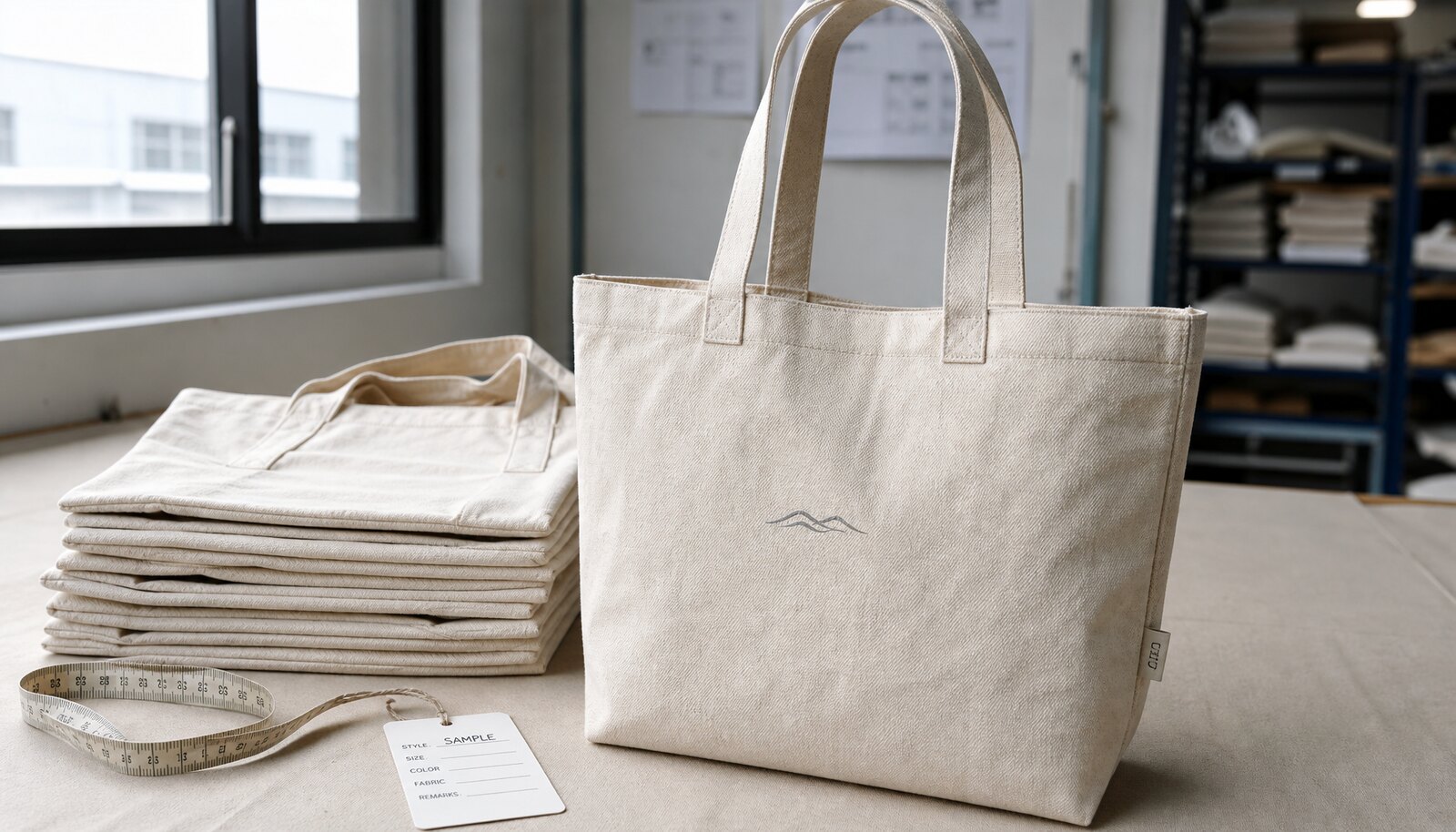
Why hotel totes need a stricter checklist than promo bags
Recycled canvas totes for hotels sit in a different buying category from standard promotional giveaways. They are often handled as guest-facing retail items, welcome-pack components, spa accessories, or conference carry bags. That means the tote has to look intentional, hold weight without distortion, and arrive with consistent presentation across cartons and properties. A bag can still fail even if the mockup looks clean, because the weaknesses only appear once the bag is loaded, folded, packed, and handled in service.
That is why a hotel buyer should start with use case, not artwork. A tote destined for a gift shop needs better shape retention and finish quality than a tote used once for a conference handout. A tote meant for bottles or amenity kits needs stronger handle transfer and bottom stability. If those requirements are not written into the order, the supplier will fill in the gaps with whatever is cheapest or easiest to produce.
The procurement risk is simple: the sample room version looks fine, but bulk production does not hold the same seam quality, size consistency, or print registration. A stricter checklist is not about over-specifying a basic bag. It is about making sure the lowest-risk factory choices line up with the hotel's actual use environment, brand standard, and receiving process.
- Start with the tote's end use: retail, welcome, amenity, conference, or gift-pack.
- Review the bag empty, folded, and loaded before approval.
- Compare bulk production against one physical golden sample, not just photos.
Translate the use case into measurable specs
The first control point is the spec sheet. A hotel tote should not be bought as a generic canvas bag with a logo added later. The buyer should specify the fabric type, recycled-content basis, GSM target, finished dimensions, handle drop, gusset depth, and seam allowance. Those are the numbers the factory can actually build to, and they are the numbers that show up later in inspection disputes if they were never defined.
Fabric weight should be matched to contents, not to a catalog description. A structured retail tote or a bag that carries bottles and brochures can justify a heavier canvas. A lighter welcome-pack tote can work at a lower GSM, but only if the bag is still stable enough to hold shape after folding and transport. The useful question is not whether the fabric feels premium in a photo. The useful question is whether the tote still performs after the hotel distributes it at scale.
The same logic applies to dimensions. A tote that is 1 cm shorter than expected may not matter for a promo giveaway, but it can matter if the bag must fit a specific in-room amenity set or shelf display. Put the tolerance in writing. If the bag is meant to be sold or reused, also define handle length and handle drop so the carry profile is consistent between lots and between properties.
- Write the construction, not just the style name.
- Set GSM, dimensions, handle drop, and gusset depth in the PO.
- Match the spec to the actual contents the guest or warehouse will use.
Compare construction options side by side
The comparison should be based on measurable differences, not general supplier descriptions. Two bags that both say 'recycled canvas' can behave very differently if one is 260 GSM with a simple handle seam and the other is 350 GSM with boxed reinforcement and a tighter weave. For procurement, the key is to compare load behavior, print stability, and packing consistency as part of the buying decision, not as a post-award surprise.
Construction details affect both presentation and failure mode. A flat tote can look neat but lose shape when packed with heavy items. A gusseted tote can carry more volume, but only if the side and bottom seams are clean and the reinforcement is adequate. Likewise, a premium logo can be improved or undermined by how the handle is attached and whether the print crosses a seam or fold line.
For hotel programs, the right construction is usually the one that makes receiving and reorder control easiest. That means the bag should be simple enough to reproduce consistently, but detailed enough to survive the intended use. If the factory cannot explain how the chosen construction will be controlled from one lot to the next, the design is not procurement-ready.
- Use GSM and reinforcement as the first comparison points, not only price.
- Check whether the tote must stand upright, carry bottles, or fold flat for distribution.
- Treat decoration and packing as part of construction, because they change failure risk.
Treat recycled-content proof as a sourcing control, not a marketing line
The phrase recycled canvas can hide a lot of variation. It may refer to recycled cotton canvas, a recycled blend, or a reclaimed-fiber construction that only resembles canvas in appearance. For a buyer, the risk is not just semantic. If the sustainability requirement matters to the hotel brand or the property owner, the file has to show what was used, where it came from, and whether the proof matches the exact product quoted.
Request documentation that is tied to the actual fabric and factory, not a generic brochure. At minimum, ask for a material specification sheet, a recycled-content declaration, and any certificate or transaction evidence that supports the claim. If a certification is referenced, check the scope carefully. The certificate should cover the material and the entity involved in the order, not an unrelated site or product family.
A practical rule is to treat unsupported sustainability language as a rejectable risk item. If the supplier cannot connect the claimed recycled content to the fabric used in your tote, the claim should not be used in the hotel's procurement file or guest-facing materials. This is one of the few areas where being strict is easier than cleaning up the record later.
- Ask for proof tied to the actual fabric lot or certificate scope.
- Check that the named factory, mill, and product on the evidence match the PO.
- Do not accept recycled-content language without support that survives audit review.
Choose decoration based on durability and fold behavior
Decoration should be selected for how the tote will be handled, not only for how it looks in the sample room. Screen printing is often the cleanest option for one- or two-color hotel logos because it gives predictable placement and repeatability. Embroidery and woven labels can create a more refined appearance, but they add thickness, hand feel, and sometimes more distortion when the canvas is folded or sewn around the logo area.
The detail that often gets missed is what happens after packing. A logo that looks centered on a flat sample may shift slightly once the tote is folded and carton-packed. If the print is near a seam, gusset, or handle attachment, insist on approving a sewn sample rather than only a flat artwork proof. That is the only way to see whether the logo lands where it should after construction is complete.
Durability checks need to be part of decoration approval. Ask the supplier how the print is cured, what rub-fastness result they can document, and whether the artwork has been checked after folding and unpacking. For premium hotel programs, embroidery should also be checked for backing, thread density, and whether the stitch pattern distorts the canvas. The best decoration method is the one that survives the tote's actual use, not the one that just photographs well.
- Screen print is usually the simplest repeat-order option for hotel logos.
- Approve the logo on a sewn sample when the artwork sits near a seam or fold.
- Verify cure, rub-fastness, and folded-sample behavior before bulk release.
Make the quote comparable before you talk about price
A weak RFQ produces weak offers. If the supplier is quoting only a unit price with no detail on fabric, reinforcement, decoration, or packing, the quote is not really comparable. For recycled canvas totes for hotels, the largest cost drivers are fabric weight, handle construction, decoration method, color count, pack-out style, and whether the supplier needs fresh artwork setup or a new cutting template. Each of those choices affects both cost and risk.
The cleanest way to compare offers is to break the order into separate line items or at least separate assumptions. Body cost, decoration cost, packing cost, and freight assumption should be visible. That lets a buyer see whether one supplier is simply hiding setup fees or using a lighter fabric that will not hold up in use. It also makes it easier to compare a direct factory quote with one from a trading company or local decorator.
For multi-property programs, MOQ should be discussed at the program level and at the property level. A supplier may promise a low total MOQ but still require separate setup for each logo, property name, or colorway. If that is your buying pattern, ask the supplier to show how they would consolidate common components and only change the decoration where needed. Without that detail, the lowest quote can become the most expensive route to repeat ordering.
- Break the quote into body, decoration, packing, and freight assumptions.
- Ask whether MOQ is driven by fabric color, logo design, or total order volume.
- Request any setup fees separately so repeat ordering can be judged accurately.
Use QC thresholds that are operational, not symbolic
Quality thresholds are useful only when the factory and the inspector can apply them the same way. A simple starting point is ISO 2859-1 sampling with AQL 2.5 for major defects, AQL 4.0 for minor defects, and zero tolerance for critical defects. That gives the procurement team a repeatable language for acceptance, but it is only useful if the defect classes themselves are written clearly into the order.
Critical defects should cover anything that makes the tote unusable or legally risky: open seams, missing handle attachment, severe contamination, mixed product in the carton, wrong SKU, or a recycled-content claim that does not match the evidence. Major defects should capture functional or brand-impacting issues such as seam weakness, logo misplacement beyond tolerance, wrong dimensions, or reinforcement that is visibly incomplete. Minor defects should be limited to cosmetic issues that do not break function, such as loose threads or small print haze.
The inspection plan should also include the actual tests used for the tote. For fabric weight, use a named method such as ISO 3801 or ASTM D3776. For printed areas, use a documented rub-fastness method such as ISO 105-X12 or AATCC 8. For wash-related claims, use ISO 6330 or the supplier's agreed protocol, but keep the acceptance criteria written in the PO. If the test method is not named, the threshold is too vague to enforce.
A good rule is to approve one golden sample, one strike-off or lab dip, and one packed reference carton before production. Then hold the factory to those references during bulk. If the factory changes the weight, the print alignment, or the pack-out format without approval, the lot should be treated as out of spec even if the bag still looks acceptable at a glance.
- Name the sampling plan and the defect classes in the PO.
- Use a method reference for GSM, rub-fastness, and shrinkage tests.
- Treat any unapproved change to fabric, print, or packing as a nonconformance.
Inspect packing and warehouse fit before shipment
Packing is where a lot of otherwise acceptable tote orders go wrong. A hotel buyer may need a retail-ready presentation for guest-facing stock, or a simple flat-packed carton for central warehouse distribution. Those are different pack-out routes, and they should not be treated as interchangeable. A retail shelf program may need tissue, fold direction, and a clean carton opening experience, while a distribution program may care more about count accuracy and pallet efficiency.
The packing spec should include fold method, inner count, master carton dimensions, gross weight target, carton mark format, and barcode or SKU label placement. If the hotel uses a warehouse receiving system, the supplier should be able to show a sample label before the bulk run starts. If the cartons are going to sit in transit or in storage, the supplier should also confirm protection against moisture, crushing, and dirt transfer.
Receiving teams benefit from clear carton logic. If one carton contains multiple property codes or mixed sizes, the risk of receiving error rises quickly. The more standard the pack-out, the easier it is to audit. For that reason, packing should be approved with the same care as the tote itself. It is part of the product, not a shipping afterthought.
- Approve fold direction, inner count, carton size, and label placement before bulk production.
- Match carton marks and barcodes to the hotel's receiving system.
- Require a pack-out sample if the program is shelf-facing or property-specific.
Build a reorder file so the next batch matches the first one
The best hotel programs are not just well made once. They are repeatable. To make that happen, keep a reorder file that contains the signed spec sheet, approved sample photos, test reports, packing reference, and the exact defect standard used on the first order. That file should sit at the program level so it can be reused across properties and future purchase orders without rebuilding the requirement from scratch.
Repeatability matters because tote programs often drift during reorders. A supplier may switch thread, alter handle length, substitute a slightly different canvas, or change the fold method to improve throughput. Those changes can be reasonable if the buyer approves them, but they should never happen silently. Change control is the guardrail that keeps a re-order from becoming a new product with the same SKU.
A serious supplier will make the reorder file easier to maintain, not harder. They should be able to identify which factory line handled the bag, which inspection standard was used, and how shade, size, and packing were controlled. If the factory cannot support that level of traceability, the first order may still be acceptable, but the second and third orders will be harder to trust.
For procurement teams, the practical goal is consistency, not perfection. A tote that is slightly imperfect but repeatable is easier to manage than a sample-perfect bag that cannot be reproduced. If the supplier can hold the spec across lots, the order becomes a program. If they cannot, every reorder becomes a new sourcing project.
- Store the spec, sample, test report, and pack-out reference together.
- Require written approval for any fabric, print, size, or packing change.
- Review repeat-order consistency as part of supplier performance, not just first-article approval.
Watch for common failure modes before they hit receiving
Most tote failures are boring and preventable. The common ones are weak handle attachment, size drift, print misalignment, and inconsistent packing. These are not design mysteries. They are usually caused by vague specs, insufficient sample approval, or a factory that changed one process step to save time. The buyer's job is to make the failure visible before it ships.
Handle attachment is the first place to look because it is the most obvious functional risk. If the reinforcement is incomplete or the stitch line is too close to the edge, the bag may pass visual approval and still fail under load. The second place is print placement, especially if the artwork crosses a seam or fold. The third is packing, where mixed counts or wrong labels can create receiving delays even when the bag itself is fine.
The easiest way to avoid these problems is to inspect the tote from the user backward. Ask what the guest will carry, how the bag will be folded, where the logo must sit, and how the warehouse will receive it. If the spec answers those questions clearly, the tote is much more likely to perform. If the spec is still generic, the bag is still underdefined.
- Inspect handle reinforcement, print position, size, and carton labels first.
- Reject hidden substitutions in fabric, thread, or pack-out method.
- Use the real guest workflow as the basis for inspection, not the product photo.
Specification comparison for buyers
| Decision area | What to specify | Measurable difference | Buyer risk to check |
|---|---|---|---|
| Supplier route | Direct factory with in-house cutting, sewing, printing, and final inspection | One accountable source for fabric, stitching, decoration, and packing; easier lot-to-lot control | Verify the factory actually runs the production steps, not just the quotation |
| Supplier route | Trading company with a named and audited partner factory | Useful when you need multiple constructions or faster market comparison | Confirm who signs off fabric shade, print approval, and carton packing |
| Supplier route | Local decorator using imported blank totes | Can work for short runs, launch kits, or temporary promotions | Check blank tote traceability, recycled-content proof, and size drift after decoration |
| Fabric weight | 320-450 GSM recycled canvas | More body, better shelf presence, and less sag under retail or amenity load | Ask whether GSM is measured before or after finishing, and require tolerance |
| Fabric weight | 260-300 GSM recycled canvas | Lighter hand feel for welcome packs or cost-sensitive programs | Watch for handle stretch, show-through on light colors, and soft bottom collapse |
| Handle build | Double-fold handle with box-X or bar-tack reinforcement | Better load transfer and lower risk of handle pull-out | Reject a straight seam only, especially for bottle sets or retail carry |
| Decoration method | 1-2 color screen print with controlled cure | Best for repeat hotel logos and consistent reorders | Check cure, rub resistance, and logo distortion after folding |
| Decoration method | Embroidery or woven label | Good for premium positioning and understated branding | Confirm stitch density, backing, and whether the logo distorts on soft canvas |
| Packing route | Flat-packed with defined fold, count, and carton label spec | Simplifies central warehouse receiving and multi-property distribution | Check moisture control, carton count accuracy, and barcode/SKU match |
Buyer checklist before sampling
- Define the hotel use case first: retail gift shop, welcome kit, spa retail, conference pack, or in-room amenity bag.
- Write the fabric construction in full: recycled cotton canvas, recycled-blend canvas, or reclaimed-fiber canvas, not just 'recycled canvas.'
- Lock the GSM target and tolerance before sampling; for example, 320 GSM +/- 5% for a structured retail tote.
- Set the finished dimensions, gusset depth, handle length, handle drop, and seam allowance against the actual contents the bag will carry.
- Approve a sewn pre-production sample, a retained golden sample, and a packed carton reference sample before bulk production starts.
- Use a named sampling plan in the PO, preferably ISO 2859-1 normal inspection with General Level II unless your risk policy is stricter.
- Define defect classes in advance: critical defects such as open seams or wrong recycled-content claim, major defects such as wrong size or failed reinforcement, and minor defects such as loose threads or small print shift.
- Test at least one loaded sample for handle stretch, seam opening, and bottom deformation under realistic weight before approval.
- Require a color approval method before production, such as Pantone target, approved strike-off, or lab dip under controlled light.
- Ask for recycled-content proof, current factory audit evidence if required, and the test report that matches the exact fabric and decoration method being quoted.
Factory quote questions to send
- What exact recycled canvas construction are you quoting, and how do you document the recycled content claim for the specific fabric lot?
- What GSM range do you hold in bulk production, and is that GSM measured before finishing or after finishing?
- Is the decoration screen print, digital print, embroidery, woven label, or heat transfer, and what setup cost is included in the quote?
- What MOQ applies by color, by design, and by hotel property if we need multiple locations in one program?
- What finished size tolerance, handle tolerance, and seam allowance will you hold during production?
- What stitch density do you plan for the load-bearing seams, and what reinforcement do you use at the handle attachment point?
- What packing method is included: flat pack, folded with tissue, individual polybag, or bulk carton only?
- What is the sample lead time, bulk lead time, and the approval gate before production starts?
- Which inspection standard do you use for defects, what AQL level do you apply, and do you use tightened inspection after a failed lot?
- Can you provide recycled-content proof, fabric or finished-bag test reports, and factory audit evidence before we issue the PO?
Quality-control points to confirm
- Use ISO 2859-1 for lot inspection, typically normal inspection at General Level II, and record the sample size, accept number, and reject number on the inspection report. If a previous lot failed, move to tightened inspection rather than reusing the same sample plan.
- Set critical defects to zero acceptance. Critical examples for hotel totes include open seams, missing handle attachment, wrong size that makes the tote unusable, severe contamination, mixed SKU cartons, or a recycled-content claim that cannot be supported by the document set.
- Define major defects as issues that affect function or brand perception: broken stitches in load-bearing seams, handle pull-out risk, logo misplacement beyond tolerance, incorrect fabric weight, or carton damage that exposes the product. A lot fails if the sample count exceeds the AQL limit for major defects.
- Define minor defects as issues that do not break function but still reduce presentation quality: loose thread ends, small surface yarn irregularities, slight print haze, or tiny label skew. Minor defects should be tracked separately from functional failures so reorders do not normalize cosmetic drift.
- Measure fabric GSM on a representative set of at least 5 swatches from bulk panels using ISO 3801 or ASTM D3776, depending on the factory's test lab. Accept only if the average falls within the agreed tolerance and no individual swatch falls outside the hard limit written in the PO.
- Check finished dimensions on a representative sample of bags, not just on one approved piece. A practical control is to hold width, height, gusset, and handle length within the PO tolerance, often +/- 5 mm on smaller totes and a slightly wider band on larger formats. Any unit outside the critical dimension should be treated as a major defect.
- Inspect stitch quality with a stitch gauge on the load-bearing seams. A useful target is 7-9 stitches per inch, or the factory's documented equivalent in stitches per centimeter, with no skipped stitches, seam puckering, or visible needle damage at the handle attachment.
- Require reinforced handle attachments with a named construction such as box-X or bar-tack. The reinforcement must be centered, fully formed, and consistent on both handles. A handle that relies on a single straight seam should be rejected for hotel programs that carry bottles, catalogs, or amenity sets.
- Run a static load test on at least 3 samples from the sampled lot. A practical acceptance rule is no seam opening greater than 3 mm, no handle elongation greater than 5%, and no bottom seam deformation when the tote holds the agreed test load, often 10 kg for 60 seconds for standard hotel use. Heavier retail programs should write a higher target.
- If the bag includes printed branding, verify logo placement and print quality against the approved strike-off or golden sample. Keep placement within 3 mm on critical placement points, and require no bleed, cracking, or visible ghosting after the bag is folded and unpacked.