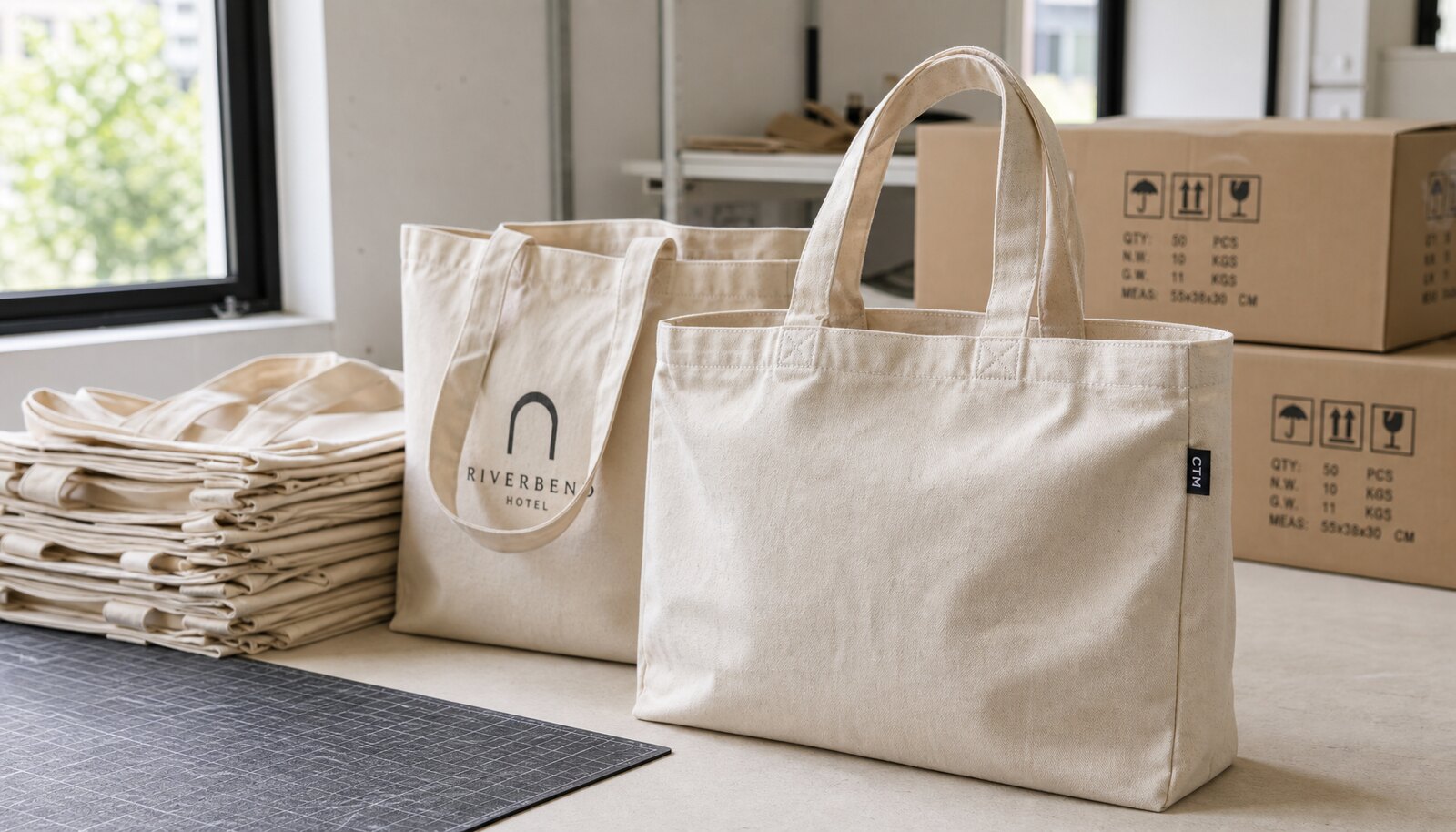
Why hotel buyers need a packaging spec, not just a tote spec
Hotel programs often fail in ways that are easy to miss on a sample table. The tote itself may look fine, but the shipment arrives folded differently than expected, the logo sits too low for front-of-house presentation, the cartons are marked inconsistently, or the bags are packed in a way that slows receiving at property level. For recycled canvas totes for hotels, the packaging specification is not a minor logistics note. It is the document that turns a generic canvas bag into a repeatable procurement item.
This matters because hotels rarely buy totes as standalone accessories. The bags are usually part of a wider guest experience: welcome kits, conference packs, spa bundles, retail merchandise, or amenity delivery. Once that is the use case, the buyer needs a spec that covers the fabric, the finish, the branding method, the fold, cartonization, and the receiving instructions. Without that detail, different suppliers will quote different interpretations and the comparison becomes unreliable.
A serious packaging spec should answer four questions before the first sample is approved: what is the bag made of, what does it need to carry, how should it look when opened, and how should it arrive at the warehouse or property. If those answers are not written down, the buyer ends up managing the program by email after production has already started. That is where avoidable costs, change orders, and quality disputes come from.
- Define the use case first: guest welcome pack, amenity delivery, retail sale, event pack, or housekeeping insert.
- Treat the packaging format as part of the product, not as a warehouse afterthought.
- Compare quotes only after the bag size, decoration, fold, and carton pack are all locked.
Start with the end use: what the tote actually needs to do in a hotel setting
A recycled canvas tote for a boutique gift shop has different requirements from a tote that carries bottled amenities to guest rooms. If the bag is for a branded retail shelf, the print needs to look polished, the fabric should hold shape on display, and the packing may need a cleaner presentation, such as a belly band or individual polybag. If it is a back-of-house delivery tote, the priorities shift toward load strength, repeatable folding, and efficient carton density.
For procurement teams, the easiest way to avoid spec drift is to define the tote’s job in practical terms. What weight will it carry? Will it be reused by guests or discarded after one use? Will it sit upright on a reception counter? Does it need to travel through laundry or housekeeping? These questions affect fabric weight, handle drop, closure choice, and even the print method. A tote that is meant to feel premium in a suite will not be specified the same way as one meant for conference registration desks.
It is also worth mapping the internal owner of the tote program. Front office teams often care about appearance and guest touchpoints. Housekeeping may care about fold consistency and cart fit. Procurement cares about landed cost and reorder stability. The spec should reconcile those priorities instead of assuming the factory will infer them from a logo file.
- Record the bag’s primary use and the secondary use, if any.
- If the tote will be reused, prioritize seam strength, handle comfort, and print durability.
- If the tote is for retail or shelf display, add presentation requirements to the spec early.
Fabric specification: recycled content, weave, weight, and finish all matter
The phrase recycled canvas sounds simple, but the details behind it can change the bag’s performance and the quote you receive. Ask the supplier to state the recycled fiber content clearly, along with whether the content comes from pre-consumer or post-consumer sources, where applicable. Do not rely on a generic “eco canvas” description. Procurement teams should request a written material declaration that identifies the main fiber composition, the recycled-content claim, and the finished GSM or ounce weight after any finishing process.
For hotel programs, 10 oz to 14 oz is usually the useful range. Around 12 oz is the most practical baseline for general guest use because it balances structure, hand feel, and freight efficiency. Move to 14 oz if the tote will carry heavier amenity items, multiple bottles, or a premium gift set. But do not stop at weight alone. Two bags with the same GSM can behave differently if one has a tight weave and one has a looser, more open weave. The tighter weave generally prints more cleanly and resists seam distortion better.
Finish is another area where quotes can hide variation. Some recycled canvases are softened, washed, calendered, or lightly brushed. That can improve feel, but it can also change shrinkage, surface ink behavior, and dimensional stability. If the tote will be folded and stored in cartons, ask how the finish affects crease memory and whether the supplier has tested the final packed appearance after compression. For hotel buyers, those details are not cosmetic; they affect how the product looks when the receiving team opens the case.
- Ask for composition, recycled-content claim, and finished GSM in writing.
- Use 12 oz as a starting point, then adjust for load weight and display requirements.
- Request evidence of finish-related shrinkage or dimensional changes if the fabric has been washed or softened.
Weave, shrinkage, color, and wash performance: the hidden variables that decide whether the bag feels premium or cheap
Recycled canvas does not fail only because it is too thin. It can also fail because the weave is inconsistent, the shrinkage is not controlled, or the color tolerance is too loose for a hotel brand. A coarse weave may be appropriate for a casual resort or a rustic property, but it can make fine logo lines look ragged and may allow small print details to disappear into the texture. A denser weave gives a cleaner appearance and usually improves structural stability, though it can raise cost.
Shrinkage should be defined in the spec if the tote may be washed, steamed, pressed, or stored in a humid environment. A hotel buyer should ask the factory what shrinkage they expect after whatever finishing process they use, and whether that figure applies to the unwashed, finished, or packed bag. If the product is likely to be reused by guests, it is worth asking for a simple wash or steam test on the approved sample. Even a modest change in size can affect the way the bag stacks, folds, and presents at the front desk.
Color tolerance is equally important. Recycled fibers can create natural shade variation, and different dye lots can appear noticeably different under warm lobby lighting versus daylight. Specify the acceptable range rather than saying “match the sample.” If the hotel needs a natural recycled look, say so. If the brand needs a controlled neutral or a strict Pantone match, say that too. A good supplier should be able to explain the limits of shade control before production begins, not after the cartons land.
- Define acceptable color variation and ask where recycled-fiber shading may naturally appear.
- If washability matters, test the finished sample for shrinkage, seam stability, and print appearance after washing or steam exposure.
- Use weave density to control logo clarity and bag structure, not just fabric weight.
Decoration choices: print, woven labels, side labels, and what each one means for quality risk
Most hotel tote programs do not need complicated decoration. A clean one-color screen print is still the workhorse option because it is cost-effective, durable enough for repeated handling, and easy for a factory to control at scale. It also keeps the artwork legible on recycled canvas, where a more complex decoration can get lost in the texture. If the logo has fine details or small text, ask the supplier to confirm the minimum line width they can reliably print on the chosen fabric.
Woven labels and sewn side labels are useful when the hotel wants a more premium presentation or wants branding to remain subtle. A label can elevate the look without requiring multiple print colors, but it adds sewing steps and another quality checkpoint. That means a higher chance of crooked placement or inconsistent positioning if the factory is not disciplined. Embroidery can be attractive on some programs, but it usually adds cost and may not be the best choice if the tote will be folded tightly or packed in volume.
Full-coverage prints, multicolor gradients, and oversized art should be treated as exceptions, not defaults. They can look strong in a presentation deck and still create issues in production: heavier ink laydown, slower curing, more rejection for print shift, and a stiffer hand feel on the bag. For procurement buyers, the question is not whether the decoration looks attractive on screen. The question is whether the decoration can be repeated at scale with acceptable defect risk and a manageable reorder path.
- Use 1-color screen print as the default unless the brand story needs something different.
- Choose a woven or side label when premium presentation matters more than lowest cost.
- Ask the supplier for minimum line thickness, print register limits, and expected ink coverage on recycled canvas.
Hotel-specific construction details: handles, gussets, reinforcement, and closure options
A tote used in a hotel environment needs more than a logo and a body panel. The handle construction is one of the first places quality issues show up. Self-fabric handles are common because they match the bag and keep material sourcing simpler, but they need secure reinforcement where the handles meet the body. Cross-stitching or bar-tack reinforcement is usually preferable to a light, decorative seam because it reduces the risk of tearing under point load. The handle drop should also be long enough for comfortable carrying, but not so long that the bag drags or looks sloppy when displayed.
The gusset decision affects both utility and carton efficiency. A gusseted tote stands better and gives the bag more usable volume, which is helpful for amenity kits or welcome packs. However, a wider gusset increases carton cube and can complicate folding if the receiving team expects a compact pack. That is why the gusset should be specified alongside the actual contents the tote needs to carry, not in isolation.
Closures should be added only when they solve a real hotel problem. An open-top tote is easier to pack and distribute, and it is usually the right choice for room delivery or event kits. Zippers and snaps make sense when the bag is intended to be reused as a retail item or when the contents need additional protection. But closures add material cost, sewing time, and inspection points. If there is no operational reason for them, leave them out.
- Specify handle drop in relation to real use, not just a drawing.
- Use reinforcement at stress points and inspect for stitch density and loose ends.
- Add closures only when they improve function or presentation enough to justify the cost.
Packaging specification: fold standard, carton dimensions, pack count, and receiving instructions
This is the part many tote programs under-specify. If the buyer only defines the bag and ignores the package, the factory will choose a folding method, carton size, and count arrangement that may be logical to them but inconvenient for the hotel. A packaging specification should say how the tote is folded, how many pieces go in each inner and master carton, whether the handles must sit flat or tucked, and whether labels or barcodes must face the carton opening. Those details affect receiving speed and the first impression when the warehouse opens the box.
For bulk hotel distribution, a standard folded pack is usually the best option. It keeps unit cost down and simplifies box loading. If the tote is being sold in a lobby shop or given as a premium welcome item, the spec may call for individual polybagging, a belly band, tissue wrap, or a hangtag. Each of those adds labor and cube, so the buyer should separate presentation packing from transport packing when comparing quotes. It is often smart to ask the factory to quote both options side by side.
Carton dimensions matter because they drive freight density and receiving efficiency. A carton should be sized to protect the tote from crushing while still loading efficiently on a pallet or in a van. Ask the supplier to propose carton dimensions, gross weight, and pack count together. Then check whether those cartons fit your warehouse receiving process or property storage layout. The carton label hierarchy should be clear: PO number, SKU, size, color, quantity, destination property, and any handling mark such as “do not crush” if that is actually justified by the contents.
- Write the fold method into the spec and approve it with a physical sample.
- Request carton dimensions, gross weight, pack count, and label hierarchy in the quote.
- Use individual polybags only when dust protection, retail presentation, or brand control requires them.
How to compare suppliers without comparing mismatched quotes
Procurement teams often receive quotes that look similar but are not directly comparable. One supplier may include a woven label, another may omit it. One may quote bulk pack, another may assume polybags. One may use a direct factory with one printing line, while another is a trading company adding its own margin and an unstated handling step. If the RFQ is loose, the lowest price is usually just the least complete quote.
The fix is to standardize the RFQ scope before you ask for prices. Send one approved size, one target fabric weight, one decoration method, one pack method, and one delivery destination. Ask suppliers to price the same line items separately: blank tote, decoration, packing, cartons, and optional extras. That makes it possible to identify the true cost drivers and spot where a supplier is hiding risk. It also helps procurement decide which elements should remain fixed for reorders and which can be changed without disrupting the whole program.
Supplier route also matters. Direct factories usually give the best control over stitching, print, and packing because the buyer can talk to the people who actually make the goods. Trading companies can be helpful if the hotel is combining totes with other welcome items and wants one consolidation point, but the buyer should still ask where the product will be made and who performs QC. If the supplier cannot clearly explain the production path, the quote is not ready for award.
- Use one spec sheet and one artwork file for every supplier.
- Require separate price lines for base bag, decoration, packing, and cartons.
- Choose the sourcing route based on control, communication, and reorder stability, not only unit price.
MOQ, reorder planning, and how to standardize across multiple hotel properties
MOQ is rarely just about the tote itself. It is usually tied to fabric color, decoration setup, label type, and carton configuration. When hotel groups split an order into too many property-specific versions, the MOQ pressure rises fast. The factory may need separate cutting, printing, packing, and labeling runs for each property, which increases cost and raises the chance of shade inconsistency. A better strategy is to keep the bag body identical and vary only the secondary branding element, such as a small insert card, barcode sticker, or woven side label.
That approach is especially useful for multi-property groups. A neutral recycled canvas tote can serve several hotels if the shape and main decoration stay fixed. The property-specific detail can be handled with a small, lower-cost component that is easy to change on reorder. This gives procurement more flexibility and usually improves stock management because the same tote can be allocated where demand is strongest. It also reduces the risk of ending up with obsolete property-specific bags when a brand refresh or seasonal campaign ends.
For reorders, ask the supplier whether the original fabric lot can be matched or whether a new dye lot will be needed. That is important for color consistency. It is also useful to know whether the factory keeps cutting patterns, print screens, or label tooling on file. If they do not, a reorder may not be a true repeat order at all. Build your internal buying record to include approved sample photos, carton photos, and the exact packing method so the next purchase order starts from the same reference point.
- Standardize the bag body, then customize the secondary branding layer.
- Keep property-level variations limited to items that can change without reengineering the bag.
- Store the approved sample, artwork, carton photos, and packing notes in the procurement file for reorders.
Quality control: define defects, AQL logic, and what the receiving team should actually inspect
A useful QC plan does more than say “check quality before shipment.” It defines what good looks like, what defects are unacceptable, and how the shipment will be sampled. For hotel tote programs, the inspection should cover size, stitching, print quality, color consistency, fold accuracy, carton packing, and label placement. If the tote is printed, check the first-off sample on the line before the run continues. If the tote is label-constructed, inspect placement against a measurement guide, not against the operator’s eye.
An AQL-based approach is common for bulk goods, but the important part is to define which defects count as major and which are minor. A broken seam, missing print, wrong size, or incorrect carton count should be treated as major because it affects usability or distribution. Minor issues may include small thread tails or slight fold variation, depending on the hotel’s tolerance. The point is to decide this before shipment. If the supplier does not know what will be accepted, they will likely inspect against their own standard, not yours.
The receiving team also needs a practical checklist. Ask them to verify carton marks, quantity count, pack condition, and visible damage before inventory is booked in. For property-level deliveries, they should also check that the tote can be opened and used without re-folding or ironing. A good tote is not only sewn correctly; it is packable, receivable, and presentable at the destination.
- Set acceptance criteria for size, stitching, print, shade, fold, and carton count before production starts.
- Classify defects as major or minor in the PO or quality agreement.
- Inspect the first-off sample, a carton sample, and a quantity count before release.
Specification comparison for buyers
| Spec decision | Recommended option | When it fits | Buyer risk to check | Cost / procurement impact |
|---|---|---|---|---|
| Fabric weight | 12 oz recycled canvas for standard guest use; 14 oz for amenity kits, retail sets, or heavier contents | Best for welcome packs, boutique retail, spa kits, and reusable tote programs where shape and hand feel matter | Too-light fabric can sag and show print distortion; too-heavy fabric can increase freight and slow packing | 12 oz is usually the best balance of look and landed cost; 14 oz often raises unit price, carton weight, and shipping cube |
| Recycled fiber content | Specify a documented recycled cotton canvas blend with finish-state GSM and declared recycled content range | When the hotel wants an eco-positioned bag and needs a defensible supplier declaration | Unverified claims, inconsistent recycled input, and shade variation between lots | Request the supplier’s recycled-content evidence before award; lower-risk sourcing can cost more upfront but reduces compliance disputes |
| Weave / construction | Stable plain weave or dense canvas weave with visible but even texture | When the bag needs a clean print surface and repeatable sewing performance | Loose weave can cause print bleed, seam puckering, and poor dimensional stability | Tighter weave often costs more, but it usually reduces reject risk and improves logo clarity |
| Print route | 1-color screen print for most hotel branding; woven label or side label for premium programs | Good for repeatable branding with fewer defects and lower setup complexity | Large solid areas may crack or look heavy; thin lines may fill in on coarse weave | Screen print is usually the lowest-cost branded option; labels raise unit cost but can improve perceived quality |
| Handle construction | Self-fabric handles with cross-stitch or bar-tack reinforcement at stress points | Suitable for repeated guest handling and heavier amenity loads | Short reinforcement zones or weak seam allowance can fail under point loading | Reinforced handles add sewing time but are cheaper than failures, replacements, or guest complaints |
| Closure | Open top for easy room delivery; zipper or snap only when the tote is reused as a retail or amenity bag | Fits most hotel distribution programs where speed matters | Closures add extra material, extra inspection points, and more warranty risk | Choose closures only when they are functionally required; otherwise they increase unit cost and lead time |
| Packing format | Bulk folded with carton pack plan; individual polybag only for dust-sensitive or retail-facing programs | Best when bags are inserted into kits or shipped to property warehouses | Overpacking increases cube and freight; underpacking can cause dusting and crease marks | Bulk fold usually delivers the lowest landed cost; polybagging adds labor, plastic, and carton volume |
| Supplier route | Direct factory for spec control; trading company only if they add genuine project management or mixed-category consolidation | Works best for repeat programs and multi-property hotel groups that need consistency | If the supplier cannot explain their production flow, the quote may be generic and hard to audit | Direct factory pricing can be clearer on cost drivers; trading companies may be convenient but less transparent |
| MOQ logic | Standardize the bag body first, customize inserts, labels, or barcode stickers second | Good for hotel groups with multiple properties or phased openings | SKU fragmentation can multiply MOQ and make shade control harder | One standardized bag with secondary property identifiers usually lowers total program cost and stock risk |
Buyer checklist before sampling
- Confirm final bag size, gusset depth, handle drop, and intended load weight.
- Specify recycled fiber content, finished GSM or oz, weave density, and acceptable shrinkage after washing or steam exposure.
- Define color target, Pantone reference if applicable, and the acceptable shade tolerance range.
- Send vector artwork and lock print size, print position, and label placement before sampling.
- Request a material swatch, a pre-production sample, and a golden sample if the order is large or property-critical.
- Approve the fold standard, carton pack count, carton dimensions, labeling hierarchy, and receiving marks before production.
- Ask for inspection photos or a line QC report covering stitching, print alignment, stains, and count accuracy.
- Confirm whether the totes will ship bulk packed, polybagged, belly-banded, or retail finished.
- Compare landed cost, not just ex-factory price, including cartons, packing labor, freight, and defect allowance.
- Record what happens if the fabric shade, print position, or carton count falls outside spec.
Factory quote questions to send
- What recycled cotton construction are you quoting, and can you state the recycled fiber content, weave type, and finished GSM after finishing?
- Please separate the price for blank bag, print, woven label, hangtag, polybag, belly band, and carton packing so we can see each cost driver.
- What are the MOQ and price break points by size, color, print color, and label type?
- Can you confirm your shrinkage target, color tolerance, and dimensional tolerance after production and after steam or wash testing?
- Which samples are included in your process: material swatch, pre-production sample, and golden sample?
- What packing format will you use, how many pieces per inner and master carton, and what are the carton dimensions and gross weight?
- What inspection standard do you use at in-line, pre-shipment, and carton count stages?
- What is the production lead time after sample approval, and which step usually creates the critical path?
- Can you provide recycled-content documentation, dye or print process information, and any required compliance declarations for our market?
- If we split this order by hotel property, how will MOQ, carton labeling, and packing change?
Quality-control points to confirm
- Finished size should stay within the agreed tolerance band, commonly +/- 1 cm for small totes and +/- 1.5 cm for larger formats; verify with a calibrated tape measure on a sample set, not a single bag.
- Handle attachment should show consistent stitch density and reinforcement; check for skipped stitches, loose thread ends, and weak bar-tack ends under visual inspection and a light pull test.
- Seams should lie flat without puckering or twisting; inspect corner stress points and side seams after loading the bag with test weight.
- Print should be centered, clean, and repeatable; confirm the first-off print sample against the approved artwork for alignment, opacity, and edge sharpness.
- Fabric should be free from oil stains, dye spots, hard slubs, loose weave damage, and cutting fray at visible edges.
- Color should match the approved lab dip or strike-off within the agreed tolerance, and all cartons in the same PO should be consistent unless a split-lot plan is approved.
- Shrinkage should be verified if the tote will be washed, steam-pressed, or stored in humid conditions; confirm the spec on a washed sample if that matters to use.
- Carton pack should match the approved fold method, with no overstuffing, broken corners, or compression marks on the tote surface.
- Labeling should be legible and placed according to the approved hierarchy: SKU, size, color, PO number, hotel property, pack count, and carton mark.
- Set an AQL or acceptance method in the PO or quality agreement before shipment, and define which defects are major versus minor so the factory knows what will be rejected.