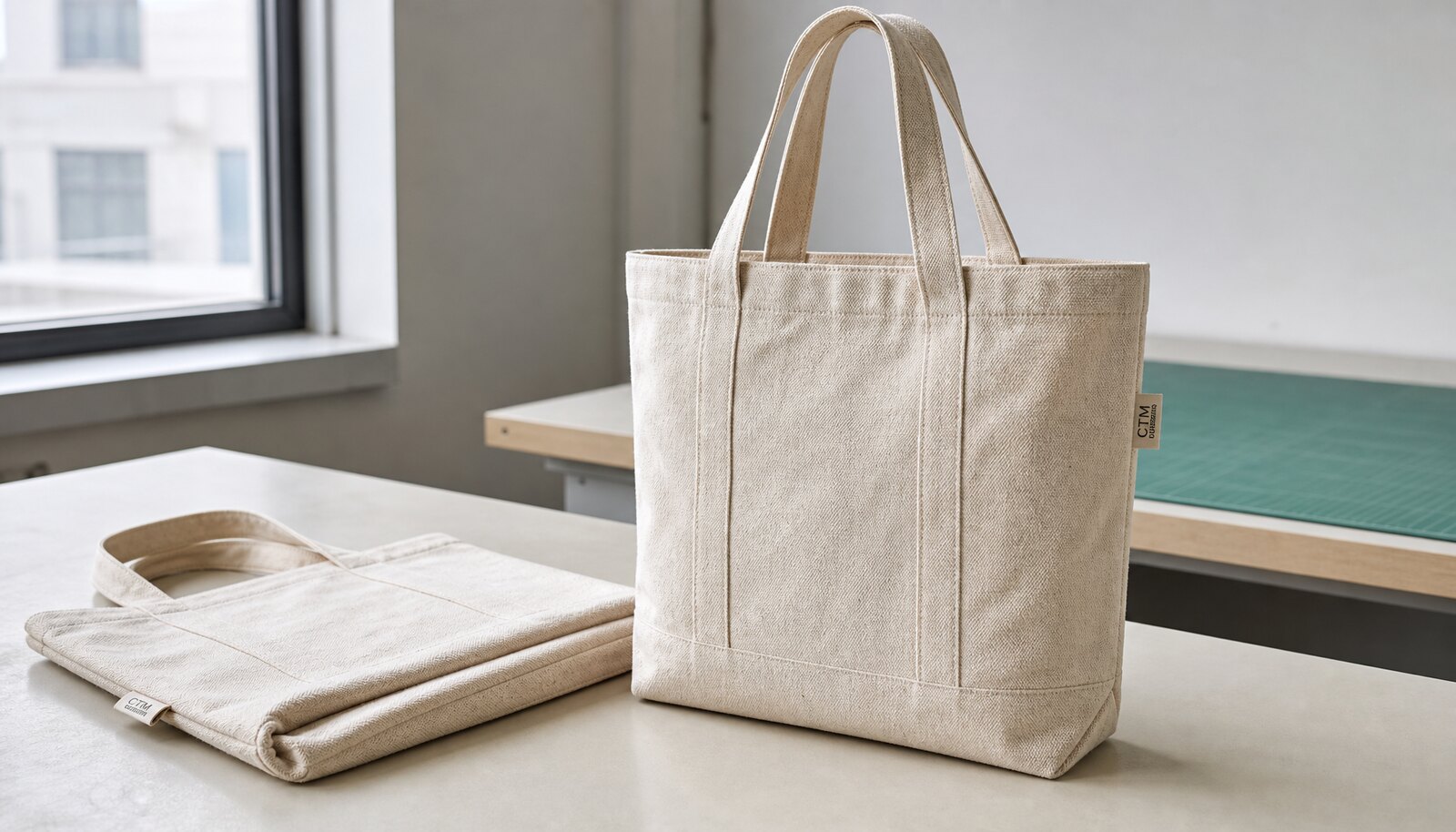
1. Start With the Hotel Use Case, Not the Tote Itself
Recycled canvas totes for hotels are not one generic procurement item. The same bag construction can serve very different programs: a welcome amenity at check-in, a gift-shop retail item, a conference giveaway, a spa accessory, a laundry drop bag, or a seasonal campaign piece. Each program changes the bag’s load requirement, visual standard, and reorder pattern. A tote that works for a short-stay welcome kit may fail in a retail environment if it looks too thin or prints poorly. A tote that feels premium in a gift shop may be oversized and expensive for a conference pack.
The first sourcing mistake is asking a supplier for a tote before the use case is clear. The second mistake is using the same brief for every hotel location. A city-center business hotel may need a smaller, more polished tote with subtle branding and fast replenishment. A resort may prefer a larger bag with stronger handles, a softer recycled canvas hand feel, and more room for tourist purchases. A convention property may care more about packing efficiency and carton count than about a premium stitched finish.
If you want reliable quotes, define the bag as an operational product, not a merch idea. State where it will sit in the guest journey, who will touch it first, how much it should carry, whether it must survive repeated use, and whether it will be sold or given away. That is the difference between a decorative tote and a usable hotel supply item.
For shortlisting suppliers, ask one practical question early: can this factory quote the same tote for three hotel scenarios without changing the construction? If the answer is no, the supplier may still be acceptable, but only for a narrow use case. If the supplier can quote a light amenity version, a standard retail version, and a heavier premium version from the same base platform, you will usually get a more useful comparison.
- Define the use case before the size.
- Decide whether the bag is sold, gifted, or used internally.
- Specify the expected load in kilograms or pounds.
- State the guest-facing finish level: basic, standard, or premium.
2. Specify the Bag So Every Supplier Quotes the Same Item
A useful RFQ does more than ask for a recycled canvas tote. It defines the finished dimensions, handle length, handle drop, fabric weight, side seams, bottom construction, print area, and packing method. Without those details, one supplier will quote a flat promotional bag, another will quote a structured shopper tote, and a third will include reinforcement that changes the whole cost picture. That is why many buyer comparisons look cheap on paper and expensive in operation.
For hotel sourcing, the most useful spec structure is simple: finished size, material, reinforcement, branding, packing, and documentation. Under material, specify recycled canvas weight and whether you want a plain weave, duck canvas, or twill look. Under reinforcement, define what should happen at the handle anchors and the bottom corners. Under branding, identify one method only if possible. Under packing, state whether the bags should be folded, banded, polybagged, or carton-packed in fixed counts. Under documentation, ask for recycled-content evidence and any test reports you need.
If the supplier asks you to “just share an image,” push back. An image is helpful, but it does not prevent quote drift. Suppliers can interpret proportions differently unless you also provide a dimensioned sketch or a sample reference. For a hotel program, a dimensioned brief saves more time than a long email chain because it reduces back-and-forth after the first quote.
One practical tip: include a “do not change without approval” list. This should cover fabric weight, handle length, print method, recycled-content wording, and carton count. These are the items that most often change between sample and bulk if the RFQ is vague.
- Write finished size, not cut size.
- State handle length and handle drop.
- Define reinforcement at load points.
- Include a no-change list for bulk production.
3. Recycled Canvas Weight, Weave, and Finish: What Hotel Buyers Should Actually Compare
Recycled canvas is often sold by ounce weight or GSM, but the number alone is not enough. Two totes that both say 10 oz can still feel different if one uses a looser weave, a different yarn blend, or a heavier finish. For hotel procurement, the useful comparison is not only weight; it is also structure, print surface, shrinkage behavior, and how the fabric looks after handling. That matters because hotel buyers are often choosing between a presentable retail look and a practical carry bag.
As a starting point, 8 oz / 240 gsm works for light carry and lower-budget guest use, but it should be treated as the low end rather than a universal standard. 10 oz / 340 gsm is usually the most balanced choice for hotel retail, conference, and amenity programs because it gives a sturdier body without pushing sewing time and freight weight too high. 12 oz / 410 gsm and heavier suits premium retail or repeated use, but the buyer should expect higher cost, slightly slower production, and more attention to seam reinforcement. There is no single “lowest practical weight” for every hotel; the right minimum depends on load, presentation, and whether the bag will be reused.
Buyers should also ask how the recycled content is created. Some fabrics use recycled cotton or post-industrial reclaimed fiber blended into a new yarn. Others use recycled polyester or a mixed fiber approach. The claim matters because the end-use story, documentation, and feel can differ. If your hotel wants a sustainability statement on the packaging or in a guest-facing tent card, the claim language has to match the supplier’s actual document trail.
The other overlooked variable is finishing. Prewashed fabric can reduce surprises in shrinkage and drape, while unwashed fabric may feel stiffer at first but change after first use or laundering. If the tote will be a retail item, ask the factory to explain whether the texture and color will be stable across reorders. If the tote is for internal hotel operations, prioritize consistency and clean packing over a fashionable hand feel.
- Compare GSM and weave together, not separately.
- Ask whether the fabric is prewashed or raw-finish.
- Request the recycled-content story in the exact wording needed for your program.
- Treat 10 oz / 340 gsm as a common hotel baseline, not a universal rule.
4. MOQ Is a Set of Constraints, Not a Single Number
Procurement teams often ask for “the MOQ” and get one answer back. For recycled canvas totes, that answer is incomplete. MOQ can change by fabric availability, bag size, decoration method, label type, carton pack, and even by whether the factory has a production slot open during your target month. A supplier may be able to make 1,000 pcs of a stock-style tote, but 3,000 pcs if the bag has custom dimensions and a woven label, and 5,000 pcs if you also want custom-dyed canvas or complex packaging.
The cleanest way to review MOQ is to break it into three layers. First is fabric MOQ: does the mill or converter need a minimum order to reserve the canvas? Second is process MOQ: does screen printing, embroidery, or woven labeling require a minimum setup quantity to keep the unit cost reasonable? Third is packing MOQ: can the factory pack in your requested unit count without wasting labor or outer-carton space? When those are separated, the buyer can see where the order becomes economical and where it becomes forced.
This is especially important for hotel programs because the first order is often a pilot and the second order is a replenishment. A property opening may only need a smaller launch quantity, but if the bag sells well, the reorders can be larger and more regular. Ask suppliers to quote both launch MOQ and reorder MOQ. The factory that can support a lower repeat MOQ is often more valuable to a hotel chain than the one with the lowest first-run unit price.
If the supplier refuses to split MOQ by feature, treat that as a signal. It may mean the factory is not used to custom programs, or it may mean they are bundling many assumptions into one number. Either way, it makes planning harder. Good procurement practice is to know what is driving the minimum before you approve the minimum.
- Separate fabric MOQ, process MOQ, and packing MOQ.
- Ask for launch MOQ and reorder MOQ.
- Treat custom size, woven labels, and custom dye as separate cost drivers.
- A single MOQ number without context is not enough for approval.
5. Quote Structure: Sample Cost vs Bulk Cost, and Why That Gap Matters
A hotel buyer should never review only the bulk unit price. For recycled canvas totes, sample cost and setup cost can be material, especially when the order uses custom artwork or a non-stock label. A sample may cost more than the per-piece bulk price because the factory is paying for one-off cutting, print setup, label fabrication, and manual handling. That is normal. The problem is when the quote hides those costs in a vague lump sum, making comparison impossible.
Use a three-part pricing review. First, ask for the sample quote: what is the charge for one pre-production sample and whether that charge is refundable against bulk. Second, ask for setup costs: screen charges, plate charges, label charges, pattern charges, or wash charges. Third, ask for the bulk tier pricing: unit price at the launch quantity, the reorder quantity, and the next step-down or step-up if available. Once you have all three, you can see whether a low sample fee is offset by a higher bulk price or whether a higher setup fee buys you a better run rate.
For buyers managing hotel openings, sample cost matters because approval delays can affect launch dates. A supplier that can turn a reliable sample quickly may save more project risk than a slightly cheaper factory with a slower approval loop. That does not mean the fastest supplier is always the right supplier. It means the sample should be evaluated as a project control item, not only as a cost item.
When comparing quote lines, look for the hidden variables: folding method, inner packing, barcode label, insertion card, polybag, carton mark, export master carton, and whether the supplier included a freight-ready pack. These items can change landed cost and receiving labor. A quote that is $0.18 lower may cost more overall if it requires extra labor at the hotel or at the consolidation warehouse.
- Request sample cost, setup cost, and bulk price separately.
- Ask if the sample charge is refundable or deductible.
- Compare price tiers at the exact quantities you expect to order.
- Check whether packing and labeling are included in the unit price.
6. Supplier Shortlisting: Which Route Fits Which Hotel Scenario?
The right supplier route depends on the hotel’s timeline, internal sourcing capacity, and appetite for custom control. Factory-direct sourcing usually gives the buyer the best leverage on recycled fabric source, seam quality, and private-label details. It is the preferred route when the hotel program will repeat, when the tote will be sold in retail channels, or when brand control matters across multiple properties. The tradeoff is that you need better spec discipline and usually a higher MOQ.
A trading company or sourcing agent can be useful when the hotel group wants one contact for multiple products, multiple destinations, or mixed quantities across properties. This route often reduces administrative effort and can help with coordination, but it may also add margin layers and reduce visibility into the actual fabric source. If recycled-content documentation matters for ESG reporting or guest-facing claims, insist on document clarity and change control.
A stock-blank-plus-local-print route is often the best answer for urgent openings, promotional events, or pilot tests. It is quick, simple, and usually less risky from a schedule perspective. But the buyer should accept the limits: fewer size choices, limited seam build control, and weaker traceability if the recycled-content claim must be documented tightly. Nearshore decorators can make sense when lead time is the deciding factor and the bag is not highly customized.
A practical shortlist should be built on use-case fit, not on whoever responded first. Ask each supplier to answer the same scenario questions: Can you repeat this bag with the same fabric next quarter? Can you keep the label placement stable? Can you quote a reorder without retooling? Can you support hotel receiving with carton labels and pack counts? The suppliers who answer those questions directly are usually easier to manage later.
- Use factory-direct for repeat custom programs and stronger control.
- Use a trading company when coordination and consolidation matter more than deep factory visibility.
- Use stock-plus-local-print for urgent launches or low-risk pilots.
- Ask every supplier the same reorder and change-control questions.
7. Lead Time Review: What Actually Extends the Schedule
Lead time for recycled canvas totes is usually driven by four things: fabric readiness, artwork approval, sewing capacity, and packing or export timing. If the fabric is in stock and the print is simple, the schedule can be reasonably short. If the fabric needs to be reserved, woven, dyed, washed, or inspected first, the timeline changes immediately. That is why a vague promise such as “two to three weeks” is not enough. Buyers should ask what is included in that number and what happens if any spec changes after sample approval.
A better way to review lead time is to separate it into sample lead time and bulk lead time. Sample lead time covers making the first physical reference, usually after artwork and construction are confirmed. Bulk lead time starts only after sample approval and material booking. For hotel openings, the risk is often not the sewing time itself but the approval gap: internal review, brand sign-off, packaging review, and then a last-minute change request that resets the clock.
Also ask about seasonality and factory congestion. Tote bags may look simple, but the line that sews them is often shared with other soft goods. Holiday seasons, trade-show peaks, and shipping disruptions can change scheduling. If the hotel launch is fixed, build buffer time into the plan and ask the factory to identify the longest pole in the process. Is it fabric sourcing, printing, or sewing? A supplier that can explain the bottleneck is more useful than one that only quotes the shortest possible calendar.
For procurement planning, work backward from the opening date. Leave time for sample review, art correction, bulk production, final inspection, and transit. If a hotel chain needs the bags at multiple properties, also include distribution time after arrival. One central delivery does not equal on-time availability at the property level.
- Separate sample lead time from bulk lead time.
- Ask what happens if artwork or packing changes after approval.
- Check whether fabric must be reserved before production starts.
- Plan backward from the hotel opening, not forward from the PO date.
8. Packing, Cartons, and Reorder Planning for Hotel Operations
Packing has an outsized effect on how the tote is received and used at the hotel. A well-packed bag arrives ready for shelf placement, amenity distribution, or front-desk handoff. A poorly packed bag forces hotel staff to refold, sort, or relabel the product, which adds hidden labor. That labor is easy to ignore in a quote review, but it shows up on the receiving dock.
Ask the supplier to quote the pack format in operational terms. How many pieces per carton? Are they same-facing? Folded to the same size? Bundled by color or size? Is there a barcode sticker on each carton? If the tote is going to a retail shop, is there a hangtag or insert card? If the tote is for internal distribution, can the factory pack in a way that reduces hotel labor rather than maximizing carton fill?
For a hotel program, carton count and carton size matter as much as unit price because they affect freight efficiency and storage. A slightly larger tote may look economical at the piece level but create poor pallet density, increasing the cost to move and store the bags. Ask the supplier to provide carton dimensions, gross weight, and carton count so you can compare shipping options properly. If you are using a consolidation warehouse or importing into multiple regions, the carton spec should be part of the commercial review.
Reorder planning is also important. Hotel programs often fail when the first order is treated as a one-time event. A better plan is to define launch quantity, forecast replenishment quantity, and a safety-stock level. Then ask the supplier whether the reorder can reuse the same pattern, screen, and carton spec. If the answer is yes, your second order should be materially easier. If not, the first order may have created avoidable future friction.
- Specify pieces per carton and whether units must be same-facing.
- Ask for carton dimensions, gross weight, and pallet efficiency.
- Align pack format with the hotel receiving workflow.
- Define launch, replenishment, and safety-stock quantities before ordering.
9. QC Checklist: Acceptance Criteria That Buyers Can Actually Use
QC for recycled canvas totes should be measurable. Generic phrases like “good stitching” are not enough for a procurement team or a hotel distributor. Set acceptance criteria before production starts so the supplier knows what will be inspected and what will be rejected. The criteria should cover size, stitching, print, color, recycled-content paperwork, packing, and transit resistance. If you do not define those items, you will argue about them after shipment.
Start with dimensions. The finished size should be measured after sewing, not on cut fabric. Decide the tolerance band in advance; many tote programs use around plus or minus 1 cm for standard dimensions, but the exact limit should fit the hotel’s presentation standards. Then look at seam quality: no skipped stitches, no open seams, no loose thread tails beyond the limit you set, and reinforced handle anchors with bar tacks or an equivalent load-bearing stitch pattern. The buyer should also check that the bag sits flat and does not twist when filled.
For print quality, require a physical approval sample or a signed color proof. Define acceptable color tolerance and registration tolerance. If the bag uses one-color print, the edges should be clean and the ink should not crack or smear under normal handling. If the logo is placed on both sides, the supplier should confirm placement symmetry. If the hotel brand uses a subtle, low-contrast logo, test visibility under actual retail lighting or guest-room lighting before full release.
Color and fabric consistency matter more than buyers sometimes expect. Recycled canvas can have natural variation, but that variation should be within a band the hotel approves. Ask the supplier to show what counts as acceptable slub, shade variation, or texture variation. Also review odor and contamination. A tote intended for guests should not arrive with oil marks, mold smell, or visible fiber contamination. For bulk runs, request carton drop or transit checks to make sure cartons survive normal handling without crushing the bags inside.
Finally, ask for document control. If the hotel needs to reference recycled content in a sustainability report or a guest-facing note, the invoice wording, supplier declaration, and product claim should align. If those documents do not match, the bag may be acceptable physically but unusable commercially. Good QC includes paperwork, not only product appearance.
- Set a measured size tolerance before bulk starts.
- Define seam, handle, and stitch acceptance criteria.
- Use an approved physical sample for color and print review.
- Require recycled-content documents that match the commercial claim.
- Check carton integrity and pack consistency before shipment.
10. RFQ, Supplier Comparison, and Quote Questions That Reduce Risk
The easiest way to short-list suppliers is to compare their answers to the same set of commercial questions. Use a one-page RFQ summary and ask each vendor to respond line by line. That keeps the focus on the tote itself rather than on sales language. For hotels, the most useful comparison is usually not just price but also sample cost, lead time, documentation strength, and whether the supplier can support reorders without reengineering the bag.
When you receive quotes, do a clause-by-clause review. Look for differences in fabric weight, size tolerance, handle construction, print method, recycled-content language, packing format, sample charge, setup fee, bulk MOQ, and payment terms. A quote that seems cheaper may be excluding one of those items. The buyer should mark each line as included, excluded, or unclear. If something is unclear, ask for it in writing before comparing against another supplier.
It helps to compare suppliers by scenario rather than by rank. For example, a factory-direct supplier may be the strongest choice for a long-term private-label hotel retail program, while a regional decorator may be better for urgent replenishment. A trading company may be the easiest to manage for a multi-property rollout if the buyer needs one contact and consolidated paperwork. That is a more useful decision than saying one supplier is simply “better.”
A strong short-list also includes one question about changes. Ask: if I reorder in six months, what will change in price, lead time, and proofing? A supplier that can explain the reorder path is usually easier to work with than one that treats every order like a new prototype. That matters in hotels because replenishment is a normal part of the program, not an exception.
- Review every quote line as included, excluded, or unclear.
- Compare suppliers by scenario, not by a single rank.
- Ask what changes on a reorder six months later.
- Keep the RFQ to one page plus a dimensioned spec sheet when possible.
Specification comparison for buyers
| Supplier route or spec choice | Best fit | Main advantage | Tradeoff or buyer risk |
|---|---|---|---|
| Factory-direct cut-and-sew | Private-label hotel programs, repeat replenishment, custom dimensions | Best control over fabric source, seam build, label placement, and packing rules | Usually higher MOQ, longer approval cycle, and more detailed artwork/spec control needed |
| Trading company or sourcing agent | Multi-property rollout, mixed product programs, buyers with limited internal sourcing time | Can consolidate orders across factories and manage communication or documentation | Less direct visibility into mill source, process changes, and factory-level QC behavior |
| Stock blank tote plus local print | Urgent openings, event kits, pilot orders, simple logo needs | Fastest route when calendar matters more than exact custom build | Limited recycled-content traceability, fewer size options, and weaker structure control |
| Regional decorator or nearshore convertor | Short lead-time replenishment, lower-volume programs, destination-market delivery | Reduced transit time and easier follow-up on samples or corrections | Higher unit cost and fewer build options for size, fabric, or reinforcement |
| 8 oz / 240 gsm recycled canvas | Light retail carry, simple welcome gifts, low-load merchandising | Lower fabric cost and lighter carton weight | May feel too soft for premium retail, and load performance should be checked carefully |
| 10 oz / 340 gsm recycled canvas | Most hotel retail, conference, and guest-use programs | Balanced hand feel, structure, and print performance | Must still confirm finished GSM, shrinkage, and actual carry performance |
| 12 oz / 410 gsm recycled canvas | Premium resale, heavier shopping, repeated guest use | Stronger body and more upscale feel | Higher material and sewing cost, often slower output and sometimes higher MOQ |
| Single-color screen print | Clear logo presentation at moderate or higher volumes | Lowest setup cost for clean, repeatable branding | Need to check registration tolerance, cure quality, and color consistency |
| Woven side label plus no body print | Minimalist branding and subtle sustainability positioning | Cleaner look and lower clutter, useful when print MOQ is tight | Brand may not read clearly from a distance, especially in retail displays |
Buyer checklist before sampling
- Confirm the hotel use case before you ask for quotes: amenity bag, retail bag, conference tote, spa carry bag, laundry bag, or gift-shop merch bag.
- Write the finished size, handle length, handle drop, and expected load in the RFQ so suppliers quote the same construction.
- Specify fabric weight in GSM or ounces, plus weave type if you care about print sharpness or drape.
- Ask the supplier to state whether the recycled content is in the yarn, in the fabric, or only in a fabric blend; then request the supporting document set.
- Choose one primary decoration method and one fallback method in case MOQ or timing is tight.
- Request a pre-production sample made from the same bulk fabric lot or approved equivalent, not a hand-picked showroom sample.
- Lock the packing spec: polybag yes or no, unit fold direction, carton count, carton marks, barcode placement, and whether inserts are needed.
- Ask for quote tiers at three quantities so you can see the MOQ break and the real unit-price curve.
- Request sample cost, setup cost, and bulk unit price separately so you can compare supplier economics cleanly.
- Build at least one reorder plan: pilot quantity, replenishment quantity, and a safety-stock quantity for hotel operations.
Factory quote questions to send
- What is the MOQ by fabric weight, bag size, decoration method, and packing format?
- Is the recycled canvas fabric already in stock, or does it need to be reserved, woven, dyed, or finished first?
- What finished GSM do you guarantee after cutting and sewing, and what tolerance do you allow?
- Can you quote sample cost, setup cost, unit price, inner packing, export carton, and any special insert or barcode work separately?
- What is the exact lead time for sample production, sample approval, and bulk production after artwork sign-off?
- Which decoration method is most stable at my quantity: screen print, woven label, embroidery, heat transfer, or a combination?
- What seam reinforcement do you use at the handle ends, top edge, and bottom corners?
- Can you share the carton size, carton count, gross weight, and estimated packing efficiency per carton?
- What recycled-content document can you provide, and what is the exact wording you will place on the invoice or packing list?
- What changes will trigger a revised lead time or a revised price after I approve the sample?
Quality-control points to confirm
- Measure the finished bag size after sewing and hold it to the agreed tolerance; for many tote programs, a practical target is around plus or minus 1 cm on width and height, but the buyer should set the final allowance in the spec.
- Check handle length and handle symmetry so the tote wears evenly in hand and the carry drop matches the hotel’s intended use.
- Verify fabric weight against the approved spec; do not accept a batch that is materially lighter than the agreed GSM without written approval.
- Review seam build at the side seams, bottom seam, and handle anchors; require reinforced stitching such as bar tacks or X-box reinforcement at load points.
- Define a thread quality standard: no skipped stitches, no broken seams, no loose thread tails longer than an agreed limit, and no loose knots on the inside.
- Check logo placement against the signed artwork proof and require a clear tolerance for print position, color shift, and registration between colors.
- Set a visible color acceptance rule using an approved physical sample or Pantone reference; define the acceptable shade variation before production starts.
- Require odor, contamination, oil spot, and stain checks on bulk fabric and finished bags, especially if the tote is going into retail or guest-facing areas.
- Ask for a wash or rub test if the tote may be laundered, wiped down, or handled repeatedly; define what fading, shrinkage, or print transfer is acceptable.
- Run a load test at the expected hotel use level and inspect for handle stretch, seam opening, base distortion, or print cracking after the load period.