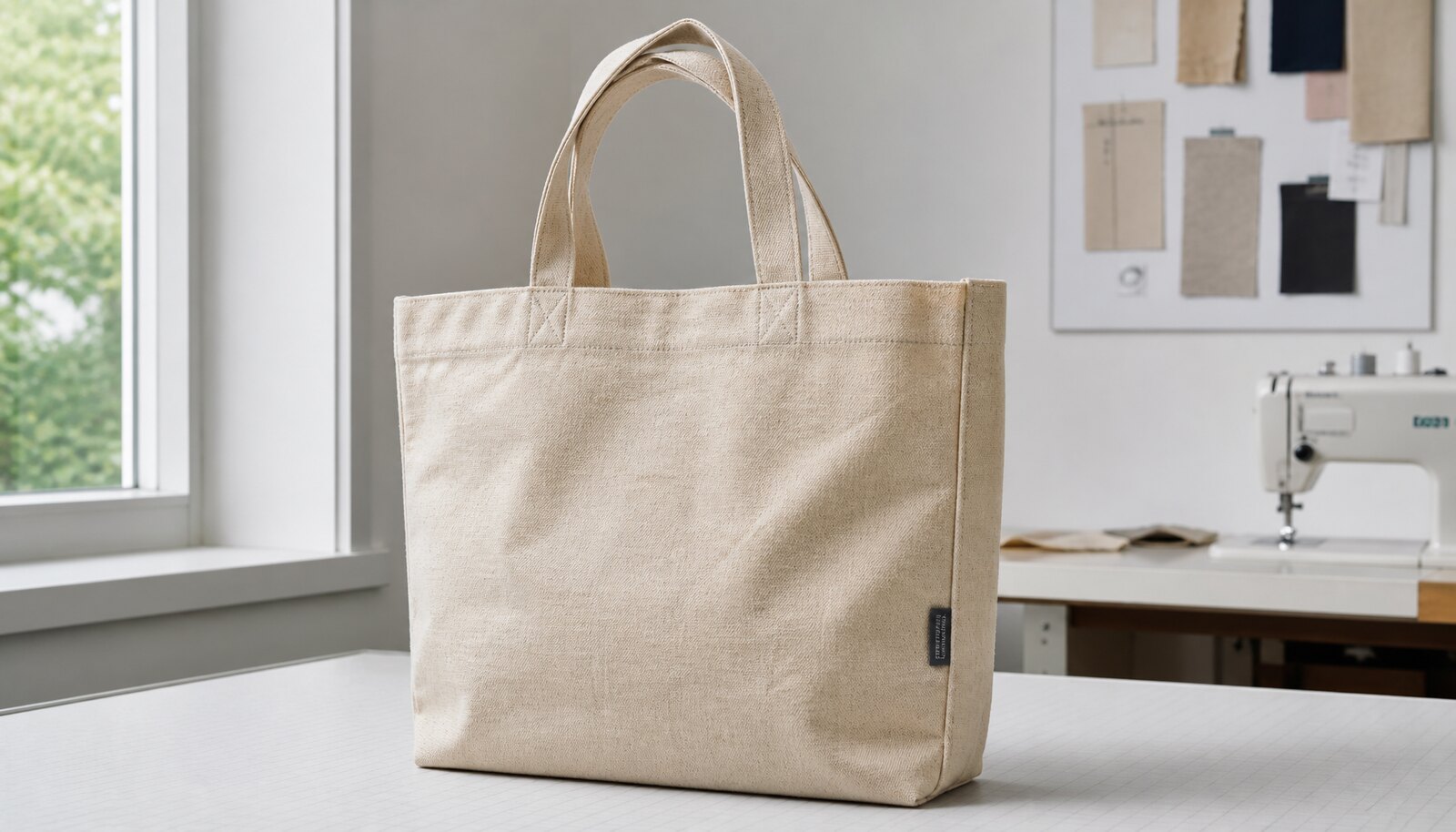
Start with the hotel job, not the tote
Recycled canvas for hotels is not a single material choice. It is a sourcing decision tied to how the bag will be used, handled, and judged by guests or staff. A room welcome tote that sits beside a stationery kit has a different requirement from a retail bag in a lobby shop, and both differ from a laundry or spa return bag. If the use case is not defined first, the supplier will fill the gap with a generic spec that may look fine on paper and fail in operation.
The fastest way to sharpen the brief is to write the bag's job in one sentence, then attach a real content list. For example: welcome kit with brochure, water bottle, and folded amenity items; retail bag for resale with premium shelf presentation; utility bag for repeat back-of-house carry. That single sentence drives size, fabric weight, handle build, decoration, and packing. It also stops the quote from drifting into vague sustainability language that does not help procurement compare offers.
- Write the primary use case before you talk about artwork.
- List the contents the tote must carry, even if the list is short.
- Separate guest-facing retail bags from utility bags if the requirements differ.
- Decide whether the tote needs to present well flat, stand upright, or both.
Treat the fabric spec like a measurable buying decision
For recycled canvas totes, GSM matters, but it is only one part of the fabric spec. Buyers also need the exact fiber breakdown, weave behavior, finishing method, and a realistic expectation of how the cloth will age. A recycled cotton canvas can feel softer and more variable than a conventional virgin cotton canvas, which is useful for a natural look but risky if the hotel expects perfectly uniform shade and hand feel across every carton.
A practical procurement target for most hotel programs is 10 oz to 12 oz, or roughly 340 to 400 GSM. That range usually balances structure, print performance, and cost. If you need a lighter bag for a small welcome pack, 8 oz to 9 oz can work, but only if the hotel accepts a softer body and lower shape retention. If the bag is meant to feel premium in retail or sit upright in a room, a heavier 12 oz build is easier to present and less likely to collapse in transit.
Ask for the fabric using measurable terms. The supplier should state the measured GSM method, finished width, weave type, fiber composition, and whether the fabric is raw, washed, or pre-shrunk. A reasonable buyer-side acceptance target is less than or equal to 3 percent dimensional change after the agreed conditioning or wash cycle, measured from the same reference points before and after. That gives you a number to evaluate instead of a subjective statement like low shrinkage.
- Require a written GSM tolerance, not only a nominal value.
- Ask whether the bulk will be a single lot or mixed lots across production.
- Use washed or pre-shrunk fabric when size stability matters after handling.
- Ask for shade consistency expectations if recycled fiber variation is visible.
Construction choices determine failure points
Most tote failures do not start in the center panel. They start at the handle roots, the top edge, and the bottom corners where the load changes direction. That is why the quote should specify seam allowance, reinforcement pattern, and handle attachment method instead of only listing dimensions. A simple tote can be built with self-fabric handles or cotton webbing handles, but the choice changes both price and durability. Self-fabric handles can be perfectly adequate if the load is modest and the sewing is well controlled. Webbing handles are better when the bag will carry heavier or more frequent loads.
For hotel procurement, box-X stitching or bar-tack reinforcement should be written into the spec at every high-stress point. If the supplier uses a decorative stitch but cannot describe the reinforcement underneath, the bag may look good in a photo and still fail under repeated use. Handle width and handle drop also matter because they shape the carry experience. A handle that is too narrow cuts into the hand, while a drop that is too short makes the tote awkward to wear over the shoulder. These are small details, but they are the details guests notice first.
The gusset should be sized around the contents, not the logo layout. A shallow gusset works for flat welcome materials, while a deeper gusset is more appropriate for retail or amenity kits that include bottles, soft goods, or boxed items. If the tote must stand up in a room or shop display, ask the factory to confirm how the bottom is finished and whether the bag holds shape when empty. Shape retention is not a cosmetic issue; it affects how the product is perceived before the guest even touches it.
- Specify reinforcement at every handle root and bottom corner.
- Define handle width and drop so the bag carries correctly in use.
- Use gusset depth as an operational choice, not a design afterthought.
- Request a measured stitched sample if the bag must hold a heavier load.
Choose branding that survives fabric texture and guest handling
Screen print is usually the most reliable decoration method for recycled canvas totes in hotel programs because it is repeatable, cost controlled, and readable on textured cloth. It works well for one or two color logos, which covers most hospitality branding. If the artwork is complex, the first question should not be which printer can force it onto canvas. The question should be whether the artwork can be simplified without losing the brand identity. Thin serif fonts, small taglines, gradients, and detailed line art often blur or fill in when they hit a woven surface.
Woven side labels, sewn patches, and embroidery can all work, but they should be chosen for the right reason. A woven label adds a premium cue and can support a retail position or a higher perceived value. Embroidery can look strong on heavier canvas, but it adds labor and may distort the panel if the design is dense. Heat transfer can be acceptable in short runs, yet it is generally less durable under abrasion than a well-executed screen print. For a hotel tote that will be handled often, the decoration method needs to be judged by use, not by convenience at the factory.
The approval process should include a strike-off on the real fabric, not only a digital proof. That strike-off should be checked for registration, edge sharpness, ink coverage, and any visible bleed into the weave. If the bag is sold in a gift shop, inspect how the logo sits when the tote is folded or displayed flat. A good print does not only look clear in isolation; it remains legible from a distance, after folding, and after a few days of handling.
- Use screen print for simple hotel logos and repeatable bulk runs.
- Use woven labels or patches when the tote is a premium retail item.
- Avoid artwork that depends on thin strokes or tiny text.
- Approve a strike-off on the actual fabric lot whenever possible.
Require verification for recycled-content claims and hotel compliance
If a tote is sold or specified as recycled, the buyer should decide what evidence is acceptable before the order is placed. A generic supplier statement is not enough if the hotel group needs a defensible procurement file. At minimum, request a recycled-content declaration, lot traceability, and a mill or supplier certificate that identifies the fabric source. If the hotel or brand requires a certified chain of custody, ask for the relevant transaction certificate or equivalent documentation rather than assuming a certificate exists somewhere in the supply chain.
Hospitality buyers should also check restricted substance and finish requirements. The right documents depend on the market, but the core question is simple: what in the fabric, ink, dye, or packaging could create a compliance issue once the tote reaches a guest room or retail shelf? For many buyers that means asking for azo-free dye confirmation, restricted substance compliance for the destination market, and any test reports relevant to formaldehyde, odor, or packaging materials. If the tote is entering a country with specific consumer safety rules, build those requirements into the RFQ instead of adding them after the sample looks good.
Documentation matters because recycled content claims can be easy to state and harder to prove. Keep the claim language aligned across the PO, product spec, carton labels, and any customer-facing description. If your hotel group plans to promote the bag as recycled, make sure the supplier's paperwork supports that wording. That prevents a situation where the product is technically acceptable to receive but not supportable for branding or reporting.
- Ask for lot-level recycled-content evidence, not just a one-time statement.
- Match the claim language in the PO, artwork, and product description.
- Check restricted substance requirements for ink, dye, and packaging.
- Request the documentation before sample approval so the quote stays comparable.
Build the RFQ so suppliers quote the same bag
A useful RFQ removes interpretation. It should force every supplier to quote the same size, same fabric, same handle, same decoration, same packing, and same shipping term. If the tote is only described as recycled canvas bag with logo, the suppliers will fill in different assumptions and the quotes will not compare. That is the most common reason procurement gets a spreadsheet full of numbers that look precise and are not actually equivalent.
The RFQ should break the tote into separate commercial pieces: fabric, cutting and sewing, print or label, inner packing, master carton packing, and logistics term. That structure reveals where the price is moving and makes it easier to see what can be standardized on a reorder. It also helps the buyer ask the right questions when a quote seems unusually low. A low total can be real, but it can also mean the supplier has quietly downgraded fabric weight, hidden print setup charges, or assumed loose packing instead of the requested retail format.
Use a simple comparison rule: if the fabric, finishing, or packing differs, the quote is not a like-for-like answer. Ask the supplier to confirm the exact sample reference, fabric lot, and artwork version they are pricing. If they cannot point to those three items, the offer is not procurement-ready yet.
- Quote the same size, fabric, handle, logo, and packing across all suppliers.
- Split the offer into fabric, sewing, decoration, packing, and freight terms.
- Ask which sample and artwork version the quote is based on.
- Treat any unstated assumption as a cost and risk item.
Use sample approval and QC thresholds that are actually inspectable
Sample approval should be a controlled gate, not a visual courtesy. Start with a pre-production sample or strike-off that matches the intended fabric, construction, and print process. Measure the finished tote, check handle symmetry, inspect seam starts and ends, and verify print placement relative to the edge and seam lines. If the bag is for guest rooms or retail, fold it the way the property will use it and see whether the presentation still feels clean. A bag that photographs well but cannot fold neatly is a weak retail item.
A good hotel tote inspection plan should include a defined defect policy. Many buyers use their house AQL or a similar standard with separate major and minor defect thresholds, such as AQL 2.5 for major defects and AQL 4.0 for minor defects. Whatever standard you use, write it into the PO or inspection appendix so the factory knows what is acceptable before production begins. Major issues usually include holes, failed stitches, wrong size, print misplacement, wrong packing, or contamination. Minor issues include loose threads, slight shade variation within the accepted range, or small packing imperfections that do not affect function.
The first units off the line matter more than the last carton. Inspect the initial output for stitch consistency, print cure, odor, and seam quality before the full run proceeds. If you find a recurring defect early, stopping the line is cheaper than sorting a full lot. For hotel programs, this is especially important because the bag often carries the hotel's own brand. The defect then becomes a brand problem, not only a vendor problem.
- Approve a physical golden sample and retain it at both buyer and factory sides.
- Use a defined AQL or equivalent inspection standard in the PO.
- Inspect the first pieces from the line, not only finished cartons.
- Reject any sample that relies on hidden shaping, steaming, or hand-fixing to look right.
Packing and warehouse handling affect the final guest experience
Packing decisions should follow the hotel's operating model. If the totes are going straight to housekeeping or room stock, bulk packing may be the most efficient choice. If they will be sold in a shop, given in a welcome kit, or inserted into a branded package, individual polybagging, tissue wrap, or an insert card may be necessary. Each of those choices affects labor, cubic volume, and carton count, so the factory quote should state the packing method clearly rather than treating it as a small add-on.
Carton labels must be useful to the receiving team. At minimum, they should show style, color, quantity, purchase order, carton number, and destination instructions if the hotel uses a central warehouse. If the property relies on barcode scanning or item codes, those codes need to match the warehouse master data exactly. A mismatch between the carton mark and the receiving system can create more operational pain than a small unit-price difference ever saves.
Because canvas can absorb odor and moisture, the packing spec should also address storage conditions. Ask for clean cartons, dry packing, and a carton build that can survive normal freight stacking without crushing the contents. If the route is sea freight, the buyer should think about humidity, compression, and transit time at the same time. A neat bag can arrive with a stale smell or deformed fold if the packing method is sloppy.
- Choose bulk packing for back-of-house use and retail packing for guest-facing resale.
- Align carton marks with the hotel's warehouse system before the goods ship.
- Specify dry packing and clean cartons to reduce odor and moisture risk.
- Ask for carton dimensions and gross weight before booking freight.
Compare landed cost with a simple model, not a vague unit price
A tote that looks inexpensive at the factory gate can become the most expensive option once sampling, setup, packing, freight, and receiving costs are added. The simplest landed-cost model is: unit price plus print setup amortized across quantity, plus packing, plus freight, plus duty or clearance charges, plus any expected correction cost. If the tote is purchased in a small run, setup charges matter more. If the tote is being repeated across multiple hotels, consistency and low reject risk become more valuable than chasing the lowest ex-works number.
Use a worked example before you pick a route. Suppose you need 1,000 bags. One direct factory quotes $2.05 per bag, plus a one-time $180 print setup and $0.15 per bag for retail packing. Amortized over 1,000 units, the setup adds $0.18 each, so the pre-freight subtotal is $2.38. If freight, duty, and destination handling add another $0.62 per bag, the landed cost becomes $3.00. A trading route might quote a higher base price but include more complete packing, or a local decorator might cost more per unit but save on freight and shorten lead time. The point is not which route is always cheapest. The point is to make the hidden costs visible before you approve the order.
For comparison, do not let one supplier quote ex-works while another quotes delivered. Normalize the incoterm, destination, and packing scope first. Then compare the total cost and the risk of rework. A slightly higher quote that includes cleaner QC, clearer documentation, and stable packing can produce a lower total cost if it prevents rejects or relabeling after arrival.
- Amortize setup charges across the ordered quantity before comparing quotes.
- Add freight, duty, and handling to every route so the numbers stay like-for-like.
- Treat quality risk and rework as part of landed cost, not as an afterthought.
- Compare the same incoterm and the same packing scope across all suppliers.
Lock the spec before reorder so the second run is cheaper
Once the first production run is approved, preserve the spec in a way that a different buyer or hotel team can use later without guessing. Keep the approved sample, the measured spec sheet, the artwork file, the recycled-content documents, and the packing instructions together as a single record. If the hotel group operates multiple properties, this file should include the order history, color references, and any changes made after the first release. That keeps the next quote from starting over.
Change control matters because tote programs often drift through small improvements that create commercial noise. A new logo placement, a different label, or a changed bag fold can seem minor but can reset the printing setup, packaging, or even the MOQ. Before approving a change, ask whether it affects fabric yield, sewing time, packing labor, or compliance paperwork. If it does, the buyer should expect a price or lead-time impact rather than assuming the supplier will absorb it.
The best reorder process is boring on purpose. Keep one version of the tote for the standard program, one version for special events if needed, and one documented exception only when a business case justifies it. That discipline lowers variation, makes warehouse receiving easier, and gives the hotel a more consistent guest experience across seasons and properties.
- Store the spec sheet, golden sample, and artwork file as one controlled record.
- Track every change that affects fabric, print, packing, or compliance.
- Use a stable standard version for reorders whenever possible.
- Treat exceptions as exceptions, not as the new default.
Specification comparison for buyers
| Spec decision | Recommended option | When it fits | Buyer risk to check |
|---|---|---|---|
| Fiber content | 100% recycled cotton canvas or cotton-rich recycled blend with lot-level declaration | Best for guest-facing hotel retail, welcome gifts, and brand programs that want a natural textile story | Ask for the exact blend, the source declaration, and whether the bulk lot will match the approved sample |
| Fabric weight | 10 oz to 12 oz, roughly 340 to 400 GSM | Works for most hotel tote programs that need a balance of body, cost, and carry strength | Confirm the measured GSM method and a written tolerance, not just a nominal number |
| Weave and finish | Plain weave with pre-shrunk or washed finish and low-lint surface | Useful when bags will be folded, reused, or packed in room sets and retail displays | Unfinished fabric can shrink, skew, or shed lint after the first handling cycle |
| Construction | Self-fabric handles with box-X reinforcement or cotton webbing with bar-tacks | Suitable for welcome packs, shop merchandise, and light repeat carry | The weak point is usually the handle join, so require the exact reinforcement method in writing |
| Decoration | 1 to 2 color screen print or woven side label for premium positioning | Best when the hotel logo must stay crisp on textured canvas | Fine text, gradients, and thin strokes often fail on strike-off and need redesign |
| Compliance evidence | Supplier declaration, mill certificate, and recycled-content traceability; transaction certificate if a certified chain is required | Needed for procurement files and sustainability claims made by the hotel or brand group | Do not rely on a marketing statement alone if the tote is being sold or reported as recycled |
| MOQ route | Direct factory with stocked fabric and standard sizes | Good for 300 to 1000 pieces per style with one logo version | Extra colors, labels, or custom packing can push MOQ and cost up quickly |
| Sourcing route | Direct tote factory rather than a trading chain for stable repeat orders | Best when the hotel group wants control over fabric, sewing, and print approval | A middleman can add convenience, but it can hide the real factory and weaken accountability |
Buyer checklist before sampling
- Define the hotel use case first: guest welcome gift, spa retail item, minibar accessory, laundry return bag, or gift shop merchandise
- Write the intended load in the spec, even if it is only an internal target such as brochure pack, folded apparel, or light daily carry
- Lock the target GSM and ask for the measured method plus a written tolerance range
- Specify the fiber declaration and recycled-content evidence required before sample approval
- Choose a bag size that fits the actual contents, shelf display space, and packing format
- Set handle width, handle drop, seam allowance, and reinforcement type before pricing
- State the decoration method, maximum color count, and any minimum line thickness for artwork
- Request a strike-off or pre-production sample on the same fabric lot or a clearly identified equivalent
- Ask for finished-size, shrinkage, and print-position acceptance criteria in writing
- Confirm packing method, carton count, carton marks, and whether the goods ship palletized or loose
Factory quote questions to send
- What is the exact fiber composition, recycled-content declaration, and lot traceability for the fabric you are quoting?
- Which standard or method do you use to measure GSM, and what tolerance do you guarantee?
- Is the fabric raw, washed, or pre-shrunk, and what dimensional change should we expect after first use or cleaning?
- What seam construction do you use on the handles, side seams, and bottom corners?
- What is the exact reinforcement method at the handle roots and stress points?
- Which print method are you proposing, how many colors are included, and what changes the price?
- Can you supply a strike-off on the actual fabric before bulk approval?
- What is the MOQ by size, color, print version, and label type?
- What are the sample fee, setup fee, screen fee, and whether any are credited against bulk?
- What packing spec is quoted, including polybag, tissue, insert card, carton count, and carton dimensions?
Quality-control points to confirm
- Verify the fabric composition, recycled-content statement, and GSM against the approved swatch and written spec
- Measure finished size, gusset depth, handle length, and print placement before bulk release
- Check that the first pieces off the line match the golden sample in shade, hand feel, and texture
- Inspect seam density, stitch path, bar-tack length, and corner reinforcement on the first output pieces
- Confirm the print registration, color density, and cure quality on the approved fabric, not on paper
- Perform a rub check on the print and packaging wrap to catch uncured ink or transfer
- Look for loose threads, needle damage, oil stains, broken yarns, and odor before packing approval
- Test the bag under the intended carry weight and verify that handles and stress points hold without seam pop
- Open cartons from the middle of the lot, not only the top layer, and compare random units against the spec
- Check carton count, carton marks, PO number, and item codes against the packing list and warehouse instructions